- Free Consultation: (217) 544-4057 Tap Here To Call Us













Illinois FAIR Act: What the New State Public Defender Law Means for Criminal Defendants in Sangamon County


By: W. Scott Hanken | Former Sangamon County Prosecutor | Springfield Criminal Defense & DUI Attorney |
Voted “Best Attorney” — Illinois Times Best of Springfield & State Journal-Register Reader’s Choice | Springfield, IL • Sangamon County • (217) 544-4057 • hankenlaw.com
Public Act 104-0300 (HB3363) is the most significant reform to Illinois public defense in nearly 80 years. Here is what changed, what stays the same, and what it means for you
DIRECT ANSWER
Illinois Public Act 104-0300 — known as the FAIR Act (Funded Advocacy and Independent Representation Act) — creates a statewide Office of State Public Defender and an independent oversight commission for the first time in Illinois history. The State Public Defender Commission became active on July 1, 2026. The Office of State Public Defender itself opens on January 1, 2027. Your constitutional right to appointed counsel if you face possible jail time and cannot afford a lawyer is unchanged — but the system providing that counsel is about to be rebuilt from the ground up.
What Is the FAIR Act and Why Did Illinois Pass It?
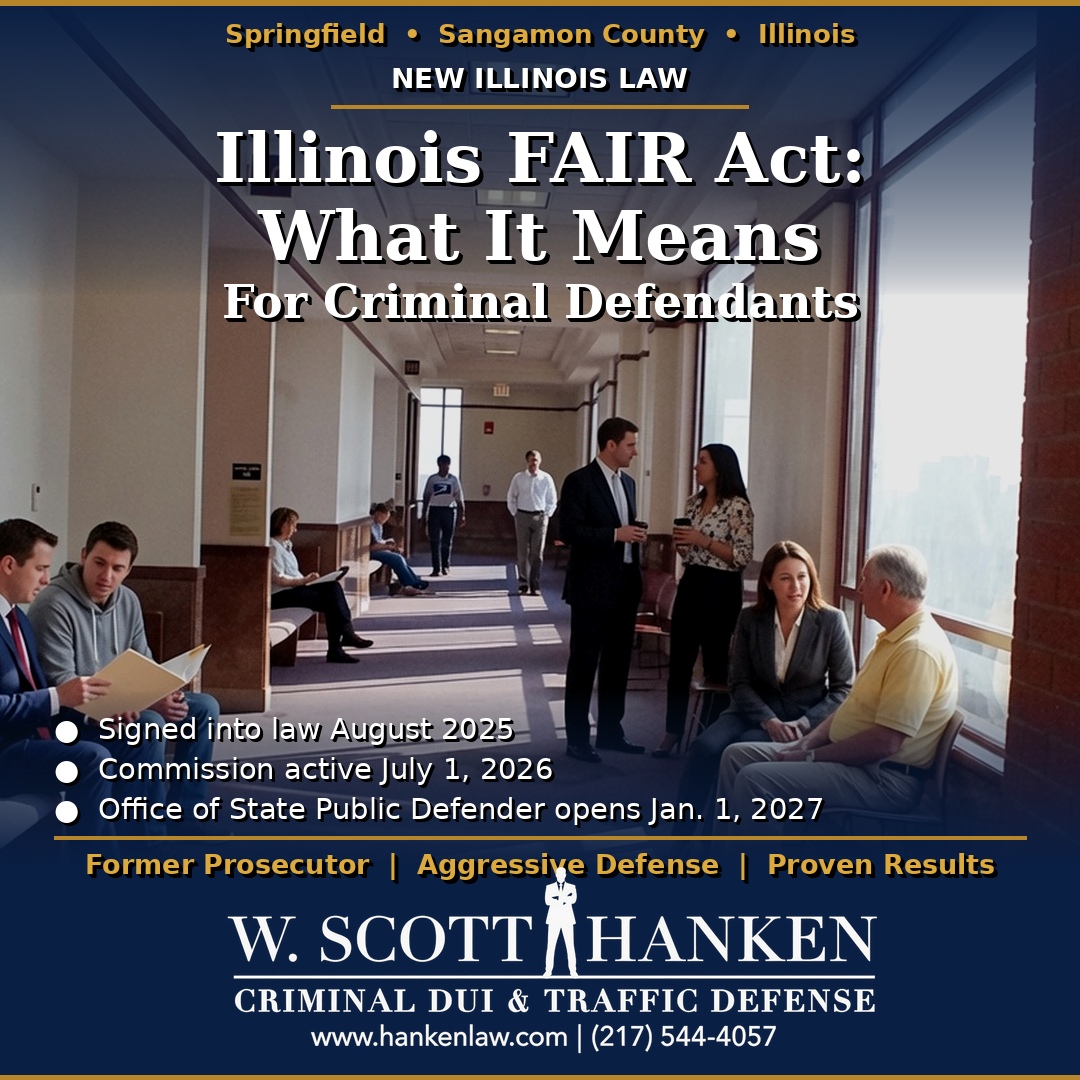
The Funded Advocacy and Independent Representation Act — HB3363, now Public Act 104-0300 — was signed into law by Governor JB Pritzker on August 15, 2025. It is the first major structural overhaul of Illinois’ public defense system since 1949, predating the U.S. Supreme Court’s landmark Gideon v. Wainwright decision that established the right to court-appointed counsel in 1963.
The bill did not emerge from thin air. In 2021, the Sixth Amendment Center — a national nonprofit that evaluates state public defense systems — released a comprehensive report on Illinois. Its findings were stark: the county-by-county public defense structure was failing its constitutional obligations. The report identified three core failures: overwhelming caseloads that made genuine individual representation impossible, insufficient and inconsistent funding across the state’s 102 counties, and the complete absence of statewide oversight or independence for public defender offices.
Illinois’ situation was not unique, but it was severe. Research cited during the legislative process estimated the state needs at least 2,000 public defenders to meet demand — and it falls well short of that number. In many counties, individual public defenders carry caseloads that would be appropriate for an entire team of full-time attorneys. The FAIR Act is the legislature’s direct answer to those documented failures.
WHY THIS REFORM MATTERS
A 2021 Sixth Amendment Center report concluded that Illinois’ county-based public defense system fails its constitutional obligations due to overwhelming caseloads, insufficient funding, and no statewide oversight. The FAIR Act is the legislature’s direct response — the first major reform to Illinois public defense in nearly 80 years.
What Does the FAIR Act Actually Create?
At its core, the FAIR Act builds two new institutional pillars for public defense in Illinois: the State Public Defender Commission and the Office of State Public Defender.
The State Public Defender Commission (Active July 1, 2026)
The Commission is the governing and oversight body created first. It is composed of 11 members appointed across three branches of government: three members appointed by the Illinois Supreme Court, four members appointed by the Governor, and four members appointed by the Legislature. This multi-branch structure is by design — it is intended to insulate the Commission from the kind of political pressure that has historically compromised public defender independence at the county level.
The Commission’s first statutory duty is to identify the operational costs and funding sources for establishing the Office of State Public Defender. It will also develop performance metrics to assess the provision of indigent defense services statewide — measured against both the standards set by the Act itself and national benchmarks tied to Sixth Amendment compliance.
The Office of State Public Defender (Opens January 1, 2027)
The Office of State Public Defender is established as an independent agency within the judicial branch of state government. It will be headed by the State Public Defender, initially appointed for a two-year term by a majority vote of the Illinois Supreme Court. Going forward, vacancies will be filled through a nomination and appointment process run by the Commission.
The law sets minimum qualifications for the State Public Defender: the person must be a licensed Illinois attorney with at least five years of legal experience, demonstrated through active practice, must have administrative experience, and must be committed to the goal of providing high-quality representation for eligible persons. The statute is specific about that commitment — it is a qualification, not just aspirational language.
The Office will have the authority to ensure access to digital discovery storage systems, case management software, and legal research subscriptions for county public defender offices across the state — resources that many counties currently lack. It will also conduct a statewide survey within its first year to catalog exactly how many people are providing public defense services in Illinois and what kinds of cases they are handling. That data has never existed at a statewide level.
How Does the FAIR Act Change County Public Defender Offices?
One of the most significant structural changes involves how public defenders are appointed and removed at the county level. Under the prior system, county public defenders could be removed by the president of the county board — creating an inherent tension between the independence a defense attorney needs and the political accountability of local elected officials.
Under the FAIR Act, a public defender may be removed only for good cause or dereliction of duty, and only after notice and a hearing before the State Public Defender Commission. That change removes county boards from the removal process entirely and vests that authority in the independent Commission instead.
The Act also changes how vacancies are filled. When a county public defender position becomes open, the State Public Defender nominates a candidate and the State Public Defender Commission appoints — replacing the prior county-level appointment process that varied widely from county to county.
Additionally, the Act allows two or more counties within the same judicial circuit to create a shared public defender office — extending that option beyond the previous requirement that the counties be geographically adjoining. This matters for smaller counties in central Illinois that have long struggled to sustain a fully staffed, independent public defender office on their own.
What Is the Implementation Timeline?
| Date | What Happens |
|---|---|
| Aug. 15, 2025 | Governor Pritzker signs HB3363; Public Act 104-0300 enacted |
| July 1, 2026 | State Public Defender Commission becomes active; Commission begins identifying funding and operational costs for the Office |
| Jan. 1, 2027 | Office of State Public Defender officially established as a state agency within the judicial branch |
| Year 1 of Office | State Public Defender conducts statewide survey of public defense staffing and caseloads |
| Ongoing | Phased statewide rollout; performance metrics implemented; county systems integrated over time |
It is worth being direct about what “phased in” means in practice: the FAIR Act creates the architecture for reform, but the actual improvements to public defense services across Illinois’ 102 counties will take years to materialize fully. The Commission, the State Public Defender, and the legislature will need to work through funding, staffing, and structural integration over an extended period.
Does This Law Affect My Rights as a Criminal Defendant in Illinois?
Your core constitutional rights are not changed by the FAIR Act. Under both the Sixth Amendment to the U.S. Constitution and Illinois law, you retain the right to remain silent when questioned by police, the right to ask for a lawyer as soon as you are arrested or taken into custody, and the right to have a lawyer appointed to you if you face possible jail time and cannot afford one. Those rights continue to apply in all criminal cases — including traffic cases where jail is a possible penalty.
What changes is the infrastructure behind those rights: how public defenders are selected, how they are funded, how their caseloads are monitored, and how the system is held accountable at a statewide level. That is meaningful institutional reform — but it does not alter your rights in the courtroom today.
Facing charges in Sangamon County? Your constitutional rights are intact — but the choices you make in the first hours after an arrest can shape the rest of your case. Call W. Scott Hanken for a direct consultation with a 37-year veteran of Sangamon County courts: (217) 544-4057.
What Does This Mean for Criminal Defendants in Springfield and Sangamon County?
If you are facing criminal charges in Sangamon County — whether a felony, misdemeanor, DUI, or drug offense — the FAIR Act’s long-term significance is real, but its immediate practical effect on your case is limited. The Commission just became active on July 1, 2026. The Office does not open until January 1, 2027. County public defender offices in Sangamon County operate as they did before this law was signed, and will continue to do so through the transition period.
What the FAIR Act does signal, clearly, is that the Illinois legislature has formally acknowledged what defense attorneys in this state have known for decades: the existing system was not delivering on the constitutional promise of the right to counsel. That acknowledgment matters — not just as a policy matter, but as a reflection of how seriously Illinois now intends to treat the quality of legal representation across the board.
As a private criminal defense attorney who has practiced in Sangamon County courts for 37 years — and who served as an Assistant State’s Attorney in this county before transitioning to the defense side — I have seen firsthand what happens when defendants are not adequately represented. The FAIR Act is a step in the right direction for the system. But systemic reform takes time, and your case is happening now.
If you can hire private counsel, there are meaningful differences between private representation and a public defender office — not in the dedication of the attorneys, but in the structural realities of caseload, time, and resources. A private criminal defense attorney can commit focused, individualized attention to your case from the moment you call.
Frequently Asked Questions (FAQs)
The FAIR Act — Funded Advocacy and Independent Representation Act — is Public Act 104-0300, signed into law August 15, 2025. It creates the Office of State Public Defender and the State Public Defender Commission, establishing for the first time a statewide oversight and funding structure for indigent defense in Illinois.
No. Your Sixth Amendment right to appointed counsel if you face possible jail time and cannot afford an attorney is unchanged by the FAIR Act. The law reforms how that system is structured and funded — not your underlying constitutional rights.
The State Public Defender Commission provisions took effect July 1, 2026. The Office of State Public Defender becomes fully operational on January 1, 2027. Full implementation across the state will be phased in over time after that date.
The initial State Public Defender is appointed for a two-year term by a majority vote of the Illinois Supreme Court. Subsequent appointments will be made through the State Public Defender Commission’s nomination and appointment process.
A 2021 Sixth Amendment Center report found the county-based system unconstitutionally deficient: crushing caseloads, inconsistent funding across 102 counties, no statewide standards, and no meaningful independence from local political pressure. The FAIR Act is the legislature’s direct legislative response to those findings.
Public defenders are committed lawyers, but they typically carry heavy caseloads. A private criminal defense attorney can give your case individualized attention from day one. If you have been charged with a crime in Sangamon County or anywhere in central Illinois, call W. Scott Hanken at (217) 544-4057 for a direct consultation before making any decisions.
Yes. The FAIR Act governs the statewide public defense system broadly, including cases where defendants face potential jail time — which includes DUI charges in Illinois. Any criminal defendant who cannot afford an attorney and faces possible incarceration is entitled to appointed counsel, and the FAIR Act is designed to improve the quality of that representation statewide.
BOTTOM LINE
The FAIR Act is the most significant reform to Illinois public defense in nearly 80 years. It creates real institutional infrastructure — an independent Commission and a statewide Office of State Public Defender — to address decades of documented failure. Implementation is underway now and the Office opens January 1, 2027. Your Sixth Amendment rights are unchanged. But your case is happening today, and the difference between adequate representation and exceptional representation is not something you want to leave to chance.
Last Reviewed: July 14, 2026 | Reviewed By: W. Scott Hanken, Attorney at Law | Statute Verified Against: ILGA.gov, Public Act 104-0300
Ready to Fight Your Criminal Charge in Springfield?
Call W. Scott Hanken at (217) 544-4057 or contact us online for a free consultation. We serve clients throughout Springfield, Sangamon County, and Central Illinois.
About the Author: W. Scott Hanken, Attorney at Law
Scott Hanken is a Springfield, Illinois criminal defense attorney with over 37 years of experience, including service as a former Sangamon County prosecutor. He has been voted Best Attorney by the Illinois Times and State Journal-Register, holds an Avvo 10.0 “Superb” rating, and has earned over 270 five-star Google reviews. His firm handles DUI defense, drug crimes, traffic violations, violent crimes, and weapons offenses throughout Sangamon County and Central Illinois.
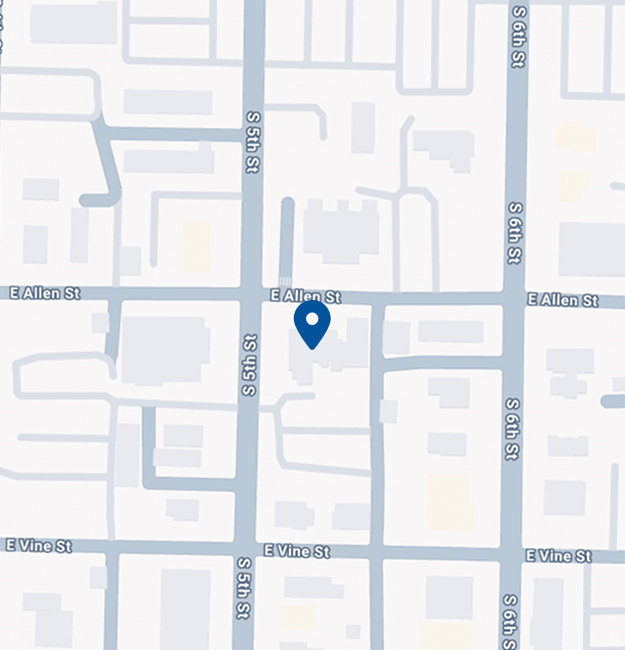
📍 1100 S 5th St, Springfield, IL 62703 | ☎ (217) 544-4057 | 🌐 hankenlaw.com
This article is for general educational purposes only and does not constitute legal advice. Every case is unique — contact an experienced Springfield criminal defense attorney for guidance on your specific situation.
Address
Our offices are located at the corner of South Fifth Street and Vine, in the historic Mary Bryant Home for the Blind.