- Free Consultation: (217) 544-4057 Tap Here To Call Us








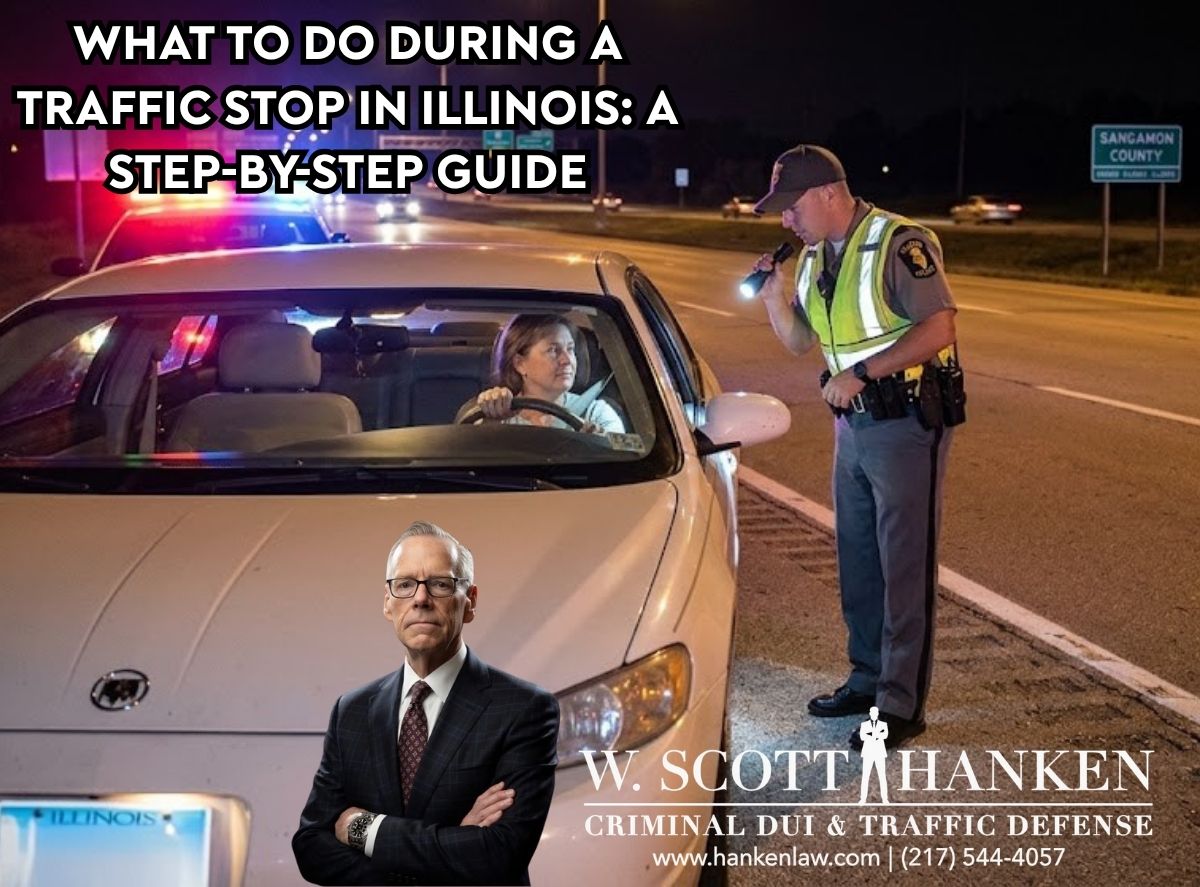
What to Do During a Traffic Stop in Illinois: A Step-by-Step Guide


By: W. Scott Hanken Former Sangamon County Prosecutor | Springfield Criminal Defense & DUI Attorney Voted “Best Attorney” — Illinois Times Best of Springfield & State Journal-Register Reader’s Choice Springfield, IL • Sangamon County • (217) 544-4057 • hankenlaw.com
Getting pulled over in Illinois is stressful — even when you haven’t done anything seriously wrong. The decisions you make in those first few minutes, from the moment you see the lights in your mirror to the moment the officer walks away, can shape everything that comes after. As a former Sangamon County prosecutor with more than 37 years of experience, I’ve seen how a single remark, a panicked movement, or a misunderstood “yes” to the wrong question can turn a routine traffic stop into a DUI arrest — or a DUI arrest into a much harder case to defend.
This guide walks you through exactly what to do, step by step.
The Moment You See the Lights
Pull over promptly and safely. Activate your turn signal, reduce your speed gradually, and move to the right shoulder or the nearest well-lit area where both you and the officer have room to operate without risk. Don’t brake hard or dart across lanes — those movements are themselves observable and record-able.
Once stopped, turn off the engine and the radio. Keep the interior calm and quiet. If it’s dark, turn on your dome light. Avoid reaching into the back seat, the center console, or the glove box before the officer reaches your window — any sudden movement before contact can raise the officer’s guard unnecessarily.
Place your hands on the steering wheel where they’re easy to see. Officers approach every vehicle not knowing who or what they’re walking toward. Visible hands communicate that you’re not a threat, and that matters.
When the Officer Reaches Your Window
Roll your window all the way down. Be polite and stay calm. Officers interact with dozens of drivers each week, and their gut reaction to your demeanor will influence how the stop unfolds. Courtesy is not weakness — it’s strategy.
Wait to be asked before you reach for your license, registration, or insurance card. If those documents are in the glove box, tell the officer where they are before you open it. A simple “My insurance card is in the glove box — may I get it?” keeps everything transparent and avoids any confusion about what you’re doing.
What to Say — and What Not to Say
The most common mistake drivers make during a traffic stop is volunteering information. Many patrol vehicles record both video and audio. What you say at the window is evidence, and it doesn’t disappear because you later regret saying it.
If the officer asks why you think you were stopped, you don’t have to guess or admit anything. A simple, honest answer like “I’m not sure, officer” is appropriate. That’s not evasiveness — it’s an accurate statement of your uncertainty, and it protects you.
Do not offer explanations or excuses. Saying you were running late, that you didn’t see the sign, or that you’ve had a long day rarely influences the outcome — but it can be interpreted as an acknowledgment that you did something wrong.
If no ticket has been issued yet and the officer indicates you’ve violated a traffic law, it’s entirely appropriate — without admitting fault — to respectfully ask whether a warning is possible. Officers have discretion, and a calm, respectful request sometimes works.
If the Officer Asks Whether You’ve Been Drinking
This question deserves careful thought. Everything you say at this point is likely being recorded.
- If you haven’t been drinking, say so clearly and simply.
- If you had a small amount earlier and feel confident you are not impaired, being straightforward about that may actually work in your favor later — but be measured. Don’t elaborate beyond what’s accurate.
- If you have serious concerns about your level of impairment, you have the right to politely decline to answer questions and to state that you’d prefer to speak with your attorney before responding. This is not illegal. It may prompt escalation, but it also prevents you from creating evidence that could be used against you.
The key principle: don’t lie. Fabricating a story or denying something the officer already has evidence of creates a much bigger problem down the road — in court and in terms of your credibility.
Field Sobriety Tests and Breath Tests: Know the Difference
These are two entirely separate categories, and the rules are different for each.
Field Sobriety Tests (FSTs) — the walk-and-turn, one-leg stand, and similar physical exercises — are not legally required in Illinois. You can decline to perform them without an automatic legal penalty. Because these evaluations depend heavily on subjective officer observation, physical conditions, footwear, road surface, lighting, and nervousness, they often produce misleading results even for sober drivers. Politely declining is a legitimate choice.
Breath tests are a different matter entirely. Illinois’s implied consent law means that by driving on a public road, you have already agreed to submit to chemical testing if you’re lawfully arrested on suspicion of DUI. Refusing a breath test after a lawful arrest typically results in an automatic statutory summary suspension of your driving privileges — up to one year for a first refusal — and the refusal itself can be introduced as evidence in court.
The general framework:
- If you believe you are sober: submit to the breath test, and if you’re offered a choice, a blood test tends to be more accurate and provides a sample that can be independently verified.
- If you have serious doubt about your sobriety: understanding the consequences of refusal versus the potential consequences of a high reading is a judgment call that depends on your specific situation.
Testing over the legal limit is not an automatic conviction. The accuracy of the equipment, the training of the officer who administered the test, the timing of the test relative to when you were driving, and the procedure followed all matter — and all can be challenged by an experienced defense attorney.
Always request that any blood or urine sample be independently preserved and tested. If the officer cannot preserve a breath sample (which is common), request an alternative test that can be retained.
Vehicle Searches: Your Rights Matter
An officer who asks your permission to search your vehicle is telling you something important: they don’t already have the legal authority to do it. Consent is a valid — and frequently used — workaround to the warrant requirement.
You are not required to consent to a vehicle search. Politely declining is legal, it is not an admission of guilt, and it preserves your ability to challenge the search in court if one occurs anyway. Do not hand over your keys, unlock doors, or open compartments for the officer, as those actions can be interpreted as implied consent.
If the officer mentions calling for a drug-detection dog or obtaining a search warrant, stand firm. Those statements are often a pressure tactic. Consenting at that point doesn’t improve your position — if they have grounds for a warrant, they’ll get one regardless. If they don’t, your refusal protects you.
The same logic applies to searches of your person. Illinois law permits officers to conduct a limited pat-down for weapons based on reasonable suspicion — you cannot legally prevent that. But you can make clear you don’t consent to anything beyond what the law requires. Don’t open your jacket or empty your pockets voluntarily.
If You Are Arrested
Stay calm. Do not resist, argue, or pull away. Remain cooperative with the physical aspects of the arrest while asserting your legal rights verbally and clearly.
Once you are in custody:
- Stop talking. This applies to everyone — officers, other detainees, staff, and anyone else who might be nearby. Jails and squad cars often have recording equipment, and casual conversation has a way of becoming courtroom evidence.
- Do not discuss your case with family or friends over the phone from a jail line. Those calls are typically recorded.
- Request your attorney as soon as possible, directly or through a trusted contact. Until you have spoken with counsel, the answer to virtually every question should be: “I’d like to speak with my attorney before answering.”
Regarding Miranda rights: not being read your rights at the time of arrest doesn’t automatically mean your charges are dismissed. It may mean that statements you made in custody become inadmissible — which can still be significant, but is a separate issue from the underlying charges. The rules around Miranda are nuanced, which is another reason to say as little as possible until you have legal counsel.
Driving Habits That Reduce Your Risk of Being Stopped
A traffic stop that never happens is always the best outcome. Several patterns make drivers more likely to attract officer attention:
Driving significantly slower than surrounding traffic is as conspicuous as speeding. Troopers are trained to look for vehicles that stand out from the normal flow, in either direction.
Weaving or lane drift is one of the most common observable indicators of impaired driving. Stay within your lane consistently, especially late at night or near bar closing times — those hours see higher enforcement activity.
Vehicle maintenance matters more than most drivers realize. A broken taillight, a cracked windshield, expired plates, or any equipment violation gives officers a legal basis for a stop entirely separate from your driving behavior. Keep up with basic maintenance and registration.
Speed limit changes on local roads are a frequent source of citations. The moment you pass a new speed limit sign, the new limit applies — not after you’ve had a chance to slow down, but immediately.
High-enforcement periods include weekend nights, holiday weekends, and evenings following major sporting events or concerts. Officers are specifically deployed for impaired driving detection during these windows. That doesn’t mean you shouldn’t drive — it means you should be especially deliberate about your speed, lane discipline, and equipment during those times.
The Bottom Line
A traffic stop in Illinois can go in many directions. Your behavior in those first few minutes has real consequences — for whether you get a ticket, for whether that ticket becomes something more serious, and for how defensible your situation is if it does. Know your rights, stay composed, and if things escalate beyond a routine stop, get an attorney involved as quickly as possible.
If you’re facing DUI charges, a traffic violation, or any related criminal matter in Springfield or Sangamon County, I’m here to help.
Frequently Asked Questions (FAQ): Illinois Traffic Stops & DUI
A: You are required to provide your license, registration, and proof of insurance when asked. Beyond that, you have a Fifth Amendment right to remain silent. You don’t have to answer questions about where you’ve been, where you’re going, or whether you’ve been drinking. A polite “I’d prefer not to answer questions without my attorney present” is both legal and appropriate.
A: Yes. Field sobriety tests — the walk-and-turn, one-leg stand, and horizontal gaze nystagmus — are voluntary in Illinois. There is no automatic legal penalty for declining. Because these tests are highly subjective and affected by factors like footwear, road surface, and nerves, refusing them is often a reasonable choice for any driver, not just those who’ve been drinking.
A: Illinois’s implied consent law means refusing a chemical test after a lawful DUI arrest carries serious consequences. A first refusal typically triggers a one-year statutory summary suspension of your driving privileges — longer than the six-month suspension that follows a failed test. The refusal can also be introduced as evidence against you in court. This is not a simple decision, and the right answer can depend on the specifics of your situation.
A: Yes. If an officer asks for your permission to search, that means they don’t already have the legal right to do it. You can politely decline. Doing so is not an admission of guilt, and it preserves your ability to challenge any subsequent search in court. Don’t hand over your keys, unlock compartments, or open the trunk voluntarily.
Stay calm and cooperate physically — do not resist. Then stop talking. Don’t discuss your case with anyone at the scene, in the squad car, or over a jail phone. Request your attorney immediately. Until you’ve spoken with counsel, the answer to virtually every question is: “I’d like to speak with my attorney before answering.”
A: Not automatically. Failure to give Miranda warnings typically means that statements you made in custody may be suppressed — they can’t be used against you in court. But the underlying charges don’t disappear. The distinction matters, and it’s one of many reasons why saying as little as possible until you have legal representation is always the right move.
A: A statutory summary suspension is an administrative suspension of your driver’s license that takes effect 46 days after a DUI arrest — separate from any criminal penalties. It applies if you failed a breath test (registering .08 or above) or refused one. For a first offense, a failed test typically results in a six-month suspension; a refusal results in a one-year suspension. You have the right to request a hearing to contest the suspension, and an attorney can help you pursue that and apply for a Monitored Device Driving Permit (MDDP) so you can continue driving during the suspension period.
A: Yes — a failed breath test or an officer’s observations are not automatic convictions. The accuracy of the testing equipment, whether the officer followed proper procedure, the timing of the test relative to when you were actually driving, and whether the stop itself was legally valid are all factors that can be challenged. An experienced DUI defense attorney will examine every aspect of your case for viable defenses.
A: For a simple traffic citation, you may choose to handle it yourself — though even minor tickets can affect your driving record and insurance rates. For anything involving DUI, license suspension, or criminal charges, retaining an experienced defense attorney is strongly advisable. The decisions made in the earliest stages of a case — including what you say and whether you challenge the statutory summary suspension — can have lasting consequences.
Ready to Fight Your Traffic Case in Springfield? Call W. Scott Hanken at (217) 544-4057 or contact us online for a free consultation. We serve clients throughout Springfield, Sangamon County, and Central Illinois.
About the Author: W. Scott Hanken, Attorney at Law Scott Hanken is a Springfield, Illinois criminal defense attorney with over 37 years of experience, including service as a former Sangamon County prosecutor. He has been voted Best Attorney by the Illinois Times and State Journal-Register, holds an Avvo 10.0 “Superb” rating, and has earned over 190 five-star Google reviews. His firm handles DUI defense, drug crimes, traffic violations, violent crimes, and weapons offenses throughout Sangamon County and Central Illinois.
📍 1100 S 5th St, Springfield, IL 62703 | ☎ (217) 544-4057 | 🌐 hankenlaw.com
This article is for general educational purposes only and does not constitute legal advice. Every case is unique — contact an experienced Springfield criminal defense attorney for guidance on your specific situation.

Address
Our offices are located at the corner of South Fifth Street and Vine, in the historic Mary Bryant Home for the Blind.