- Free Consultation: (217) 544-4057 Tap Here To Call Us















Illinois Scott’s Law — The Move Over Law: What Every Driver Needs to Know Before It Costs Them Thousands


By: W. Scott Hanken | Former Sangamon County Prosecutor | Springfield Criminal Defense & DUI Attorney |
Voted “Best Attorney” — Illinois Times Best of Springfield & State Journal-Register Reader’s Choice | Springfield, IL • Sangamon County • (217) 544-4057 • hankenlaw.com
The short answer:
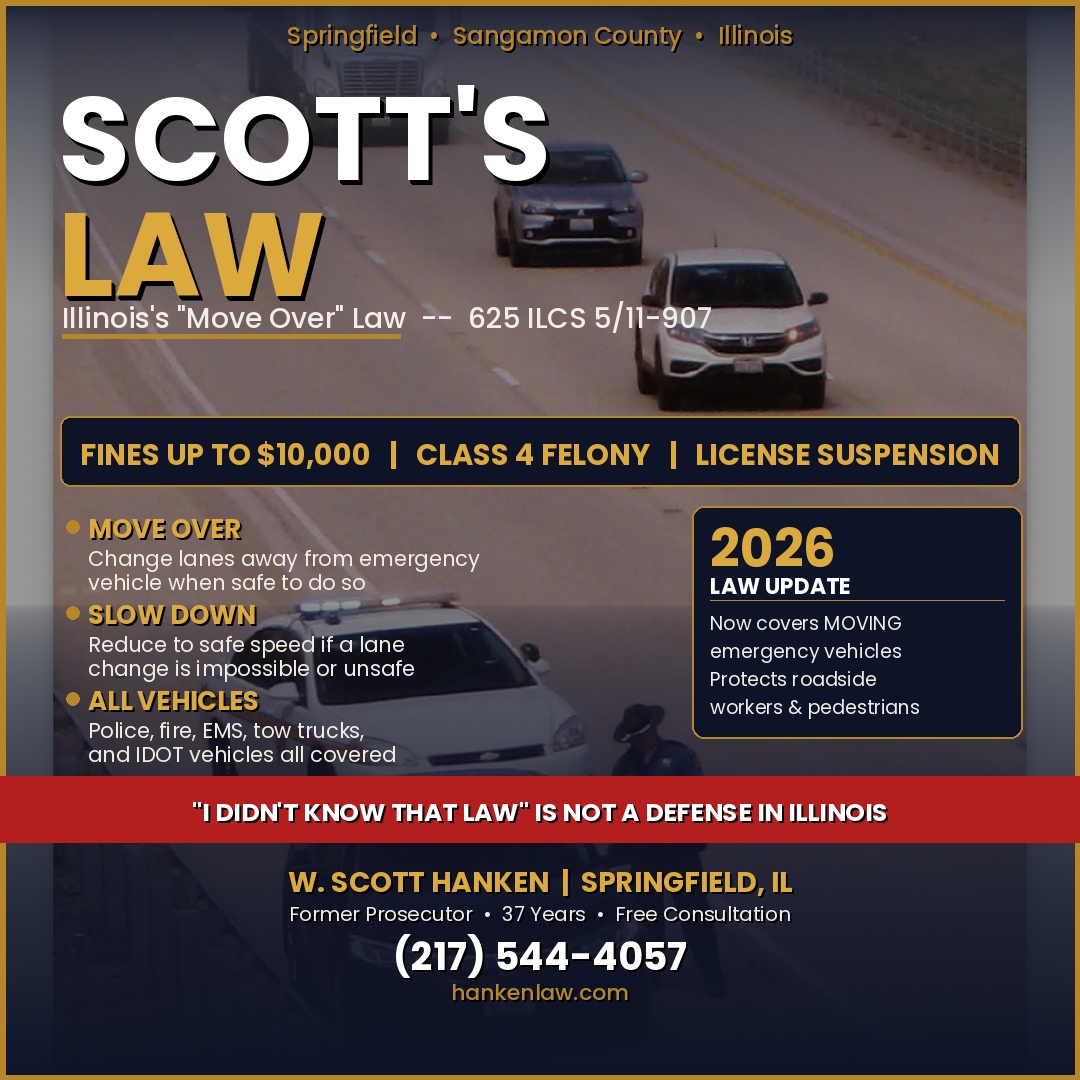
Illinois Scott’s Law (officially 625 ILCS 5/11-907(c), with 2026 expansions in (c-5) and (c-10)) requires every driver to move over or slow down for any authorized emergency vehicle displaying flashing lights — whether the vehicle is stationary or moving and engaged in work on the highway. It also requires yielding to emergency workers and pedestrians directly involved in an emergency scene.
Violating it can cost $250 to $10,000+ (plus a mandatory $250 Scott’s Law Fund assessment and court costs), trigger license suspension, and — if an accident occurs — result in misdemeanor or felony charges. “I didn’t know that law existed” is not a defense in Illinois.
If you received a Scott’s Law citation in Sangamon County or while driving through Central Illinois (I-55 or I-72), contact a local traffic defense attorney immediately. Out-of-state drivers: an attorney can often appear on your behalf.
What Is Scott’s Law?
Illinois named this statute in memory of Lieutenant Scott Gillen of the Chicago Fire Department. On December 23, 2000, Lt. Gillen was struck and killed on the Dan Ryan Expressway by an intoxicated driver while assisting at an accident scene. The legislature responded with what became known as Scott’s Law, effective January 1, 2002.
The law has been strengthened repeatedly. The most recent major expansion — Public Act 104-400, effective June 1, 2026 — added coverage for:
- Authorized emergency vehicles obviously and actually engaged in work on a highway (stationary or moving) when displaying flashing lights (new subsection (c-5)).
- Emergency workers and pedestrians directly involved in an emergency scene on a highway (new subsection (c-10)).
Scott’s Law questions now appear on the Illinois driver’s license written exam.
What Does Scott’s Law Actually Require? (625 ILCS 5/11-907(c))
The statute imposes tiered duties when approaching a stationary authorized emergency vehicle (or emergency scene) with activated oscillating, rotating, or flashing lights. The flashing lights themselves provide legal notice of a hazardous condition — it does not matter whether you personally see the hazard.
On a highway with four or more lanes (at least two in your direction): You must move into a lane not adjacent to the emergency vehicle if it is safe and possible to do so. You must also reduce speed to what is reasonable and proper for conditions and maintain a safe distance until you have completely passed the scene.
On a two-lane road (or when a lane change is impossible or unsafe): You must still reduce to a reasonable and safe speed, proceed with due caution, and leave a safe distance until you are past the emergency vehicle or scene.
Which Vehicles Are Covered?
Any vehicle authorized by law to be equipped with oscillating, rotating, or flashing lights under Section 12-215 of the Illinois Vehicle Code while the owner or operator is engaged in official duties. This includes police cruisers, fire trucks, ambulances, tow trucks, IDOT vehicles, and emergency management vehicles.
What Changed on June 1, 2026?
Public Act 104-400 added subsections (c-5) and (c-10) to the statute. Drivers must now yield to:
- Authorized emergency vehicles obviously and actually engaged in work upon a highway — whether stationary or moving — when displaying flashing lights.
- Emergency workers and pedestrians directly involved in an emergency scene on a highway.
These changes significantly broaden protection beyond just stopped vehicles.
The Penalty Structure: This Is Not a Normal Traffic Ticket
Treating a Scott’s Law citation like a routine speeding ticket is a serious mistake that can destroy a driving record — or worse.
| Violation | Fine | Additional Assessment |
|---|---|---|
| First violation (no accident) | $250 – $10,000 | + $250 Scott’s Law Fund assessment + court costs |
| Second or subsequent violation | $750 – $10,000 | + $250 Scott’s Law Fund assessment + court costs |
If Your Violation Caused an Accident:
| Outcome | Charge |
|---|---|
| Property damage to another vehicle | Class A misdemeanor — up to one year in jail |
| Personal injury to another person | Class 4 felony — one to three years in prison |
| Death of another person | Class 4 felony, with additional civil and criminal exposure |
License Suspension (Mandatory, Triggered by the Secretary of State):
| Result | Suspension Length |
|---|---|
| Property damage only | 90 days to one year |
| Personal injury | 180 days to two years |
| Death | Two years |
Suspensions can be extended or stacked if an existing suspension is already in place. The Secretary of State’s office in Springfield processes these.
Aggravating Factors — DUI, Texting & Phone Use
The statute specifically identifies driving under the influence (625 ILCS 5/11-501), texting while driving (12-610.1), and handheld cell phone use (12-610.2) as factors in aggravation. As a former prosecutor, I can tell you that aggravating factors change how a case is charged and how aggressively it is pursued. Courts may also order community service in addition to any other penalty (added by a 2021 amendment).
A Special Warning for Out-of-State Drivers
I-55 and I-72 run straight through Springfield and Sangamon County. Drivers from Missouri, Indiana, Wisconsin, Iowa, and across the country pass through here every single day. And every single year, out-of-state drivers receive Scott’s Law citations in Illinois.
The most common thing I hear from those clients: “I’ve never heard of Scott’s Law. We don’t call it that back home.”
That may be true. All fifty states have some version of a move-over law, but they differ in scope, vehicles covered, and penalty structure. A driver from Missouri or Indiana who has been following that state’s move-over rules their entire life may not realize that Illinois’s law is broader, its fines are higher, and that a conviction here can follow them home under the Driver License Compact.
Here is the hard reality: Every state enacted some version of this law by 2012. Illinois’s version — Scott’s Law — has been on the books since 2002 and has been strengthened repeatedly since. The Illinois Secretary of State publishes it. It appears in the Rules of the Road handbook. It is tested on the Illinois driver’s license exam. Courts in Sangamon County and across Illinois will not accept “I was from out of state and didn’t know” as a legal defense.
“I Didn’t Know That Was a Law” — Why That Argument Fails in Court
Illinois, like every state in the country, operates under the legal doctrine of ignorantia juris non excusat — ignorance of the law is no excuse.
This doctrine has deep roots in both common law and Illinois jurisprudence. The Illinois Supreme Court has affirmed it repeatedly. The rationale is straightforward: if personal ignorance of a law were a valid defense, no law could be enforced uniformly. Every defendant would simply claim they had never heard of it.
The Secretary of State publishes the law. The Illinois State Police actively campaign on Scott’s Law compliance. The Rules of the Road handbook covers it explicitly. A dedicated Secretary of State publication — “Move Over; It’s the Law” — exists specifically to inform drivers. Courts do not accept ignorance as a defense to a Scott’s Law citation, a speeding ticket, or any other traffic offense.
Does this mean out-of-state drivers are without options? Absolutely not. What it means is that ignorance alone is not the right argument to lead with. There are factual defenses — whether the emergency lights were actually activated and visible, whether a lane change was truly possible, whether road conditions made a full lane shift unsafe. These are the arguments that matter, and they require a lawyer who knows how to develop them.
A Client Scenario
A client from Missouri was traveling north on I-55 through Sangamon County when Illinois State Police made a traffic stop on a vehicle in the right shoulder. The client moved slightly left but did not execute a full lane change. She said she believed she had slowed enough. The trooper cited her for a Scott’s Law violation.
Her first call was to my office. Her first instinct had been to just pay the fine online. I told her what that would mean: an admission of guilt on her record, mandatory court costs on top of the fine, and a formal conviction that her home state of Missouri might treat as a moving violation under the Driver License Compact.
We evaluated the factual record. Traffic was heavy. A full lane change may not have been safely possible at the time. That argument — not “I didn’t know the law existed” — is what gives a defense traction.
What Defenses Actually Work?
As a former prosecutor, I know what the State needs to prove. That knowledge works in my clients’ favor now.
One of the first things I do in any Scott’s Law case is request dashcam footage — from the officer’s squad car, any Illinois State Police in-car cameras, and any available trooper body cameras. I do not rely on the officer’s recollection alone. Neither should you.
That footage often tells a different story than the citation. On multiple occasions, I have reviewed dashcam video in Scott’s Law cases where the footage clearly showed other vehicles — including large tractor-trailer trucks — making complete lane changes in the same stretch of road, under the same conditions, at or near the same time. That footage became a centerpiece of the defense.
Why does that matter? Because the statute itself contains a carve-out. If changing lanes would be impossible or unsafe given traffic conditions, the law does not require it — it requires you to slow down and proceed with due caution instead. The question then becomes whether a full lane change was actually feasible at that moment on that road.
When dashcam video shows that semi-trucks and other large vehicles were successfully completing lane changes in the same location, that undercuts the argument that conditions made a lane change impossible or unsafe. Conversely, when the video shows genuine congestion, a blocked lane, or hazardous conditions that prevented a safe move, that footage supports the defense.
We have raised this argument on multiple occasions. It has resulted in dismissals and findings of not guilty.
Viable defenses in Scott’s Law cases can include:
- Camera evidence contradicting the officer’s account. Officer recollection and the actual video record do not always match. Dashcam footage can establish lane conditions, traffic density, the behavior of surrounding vehicles, and the precise moment the citation was issued — all of which matter.
- Lane change was genuinely impossible or unsafe. The statute acknowledges this explicitly. Surrounding traffic, road construction, adjacent vehicles — including large commercial trucks — and pavement conditions can all bear on whether a full lane change was reasonably achievable. This is not an excuse. It is a statutory defense.
- Lights not clearly activated or visible. If the emergency vehicle’s lights were not functioning properly, or were obscured by a curve, overpass, large vehicle, or weather, the visual trigger under the statute may be challenged.
- Factual dispute about driver conduct. Speed estimates, lane positions, and timing are all challengeable — and the video often resolves those disputes faster than cross-examination alone.
- Improper stop or citation. Like any traffic enforcement, the circumstances of the stop must comport with the law.
What does not work as a defense: not knowing the law existed, assuming it only applied to police vehicles and not tow trucks, or believing you slowed down enough because that is what your home state requires.
What Happens If You Are Charged in Sangamon County
Scott’s Law cases in Sangamon County are handled at the Sangamon County Courts Complex, located at 200 S. 9th Street, Springfield, Illinois 62701. Traffic matters are typically heard in the traffic courtroom 1A. Fines and court costs are addressed here. If your license is suspended, the Secretary of State’s Office — headquartered right here in Springfield — processes the suspension.
For out-of-state drivers, that creates a logistical problem. You cannot simply mail in a fine for a Scott’s Law violation without understanding what you are admitting. In most cases, I can appear on your behalf, which means you do not need to make a return trip to Central Illinois.
For Illinois residents, the stakes are just as high. A license suspension in Sangamon County affects every aspect of daily life here — your commute on Route 66, your ability to get to work on the south side of Springfield, your family’s transportation. These consequences compound fast.
How This Connects to the Broader Traffic Defense Picture
Scott’s Law citations often arrive alongside other charges. An out-of-state driver ticketed for failing to move over might also receive a speeding citation. A driver who was intoxicated at the time of the violation now faces a DUI investigation on top of a Scott’s Law charge — with mandatory aggravation language built right into the statute.
If you are dealing with a combination of charges, our related posts and resources at hankenlaw.com cover what to do during a traffic stop in Illinois, how a traffic ticket outside Illinois impacts your Illinois driving record, and the full guide to DUI defense in Sangamon County.
- Traffic Stop Rights Guide
- Out-of-State Ticket Impact on Illinois Driving Record
- Traffic Ticket Defense Overview
- DUI Defense Overview
- DUI FAQs
Frequently Asked Questions (FAQs)
Yes. Any vehicle authorized by law to be equipped with oscillating, rotating, or flashing lights under Section 12-215 of the Illinois Vehicle Code is covered. Tow trucks, IDOT service vehicles, emergency management vehicles, and ambulances are all included. “I thought it only applied to police” is not a defense.
Paying the fine is an admission of guilt. Depending on your home state and its membership in the Driver License Compact, that conviction may transfer to your home state driving record. Before you pay anything, consult with an Illinois traffic defense attorney who can tell you what a conviction actually means for your particular situation.
The minimum fine is $250, plus a mandatory $250 Scott’s Law Fund assessment, plus court costs. Total financial exposure on a base first offense typically runs well north of $500 when all mandatory fees are factored in. The maximum fine is $10,000.
Yes. If a violation of 625 ILCS 5/11-907(c) results in the injury or death of another person, it is charged as a Class 4 felony — punishable by one to three years in prison. If your violation caused damage to another vehicle (without injury), it is a Class A misdemeanor punishable by up to one year in jail.
As of June 1, 2026, yes. Public Act 104-400 added coverage for emergency vehicles obviously and actually engaged in work upon a highway — whether stationary or not — when displaying flashing lights. Prior to this amendment, the law applied primarily to stationary vehicles.
It does — and it is written directly into the statute. If changing lanes would be impossible or unsafe, the law requires you to reduce to a safe speed and proceed with due caution. Whether the facts of your specific situation actually support that argument is something a lawyer needs to evaluate. The officer’s account and any available dashcam footage will be part of that analysis.
Yes. A conviction is reported to the Secretary of State. License suspension is mandatory if property damage, injury, or death resulted. Even without an accident, the conviction itself goes on your record and can affect insurance rates and future driving privilege decisions.
Scott’s Law and traffic matters in Sangamon County are handled at the Sangamon County Courts Complex, 200 S. 9th Street, Springfield, Illinois 62701. Out-of-state drivers should know that in most cases, an attorney can appear on their behalf without requiring a return trip to Springfield.
Ready to Fight Your Traffic Case in Springfield?
Call W. Scott Hanken at (217) 544-4057 or contact us online for a free consultation. We serve clients throughout Springfield, Sangamon County, and Central Illinois.
About the Author: W. Scott Hanken, Attorney at Law
Scott Hanken is a Springfield, Illinois criminal defense attorney with over 37 years of experience, including service as a former Sangamon County prosecutor. He has been voted Best Attorney by the Illinois Times and State Journal-Register, holds an Avvo 10.0 “Superb” rating, and has earned over 270 five-star Google reviews. His firm handles DUI defense, drug crimes, traffic violations, violent crimes, and weapons offenses throughout Sangamon County and Central Illinois.
📍 1100 S 5th St, Springfield, IL 62703 | ☎ (217) 544-4057 | 🌐 hankenlaw.com
This article is for general educational purposes only and does not constitute legal advice. Every case is unique — contact an experienced Springfield criminal defense attorney for guidance on your specific situation.

Address
Our offices are located at the corner of South Fifth Street and Vine, in the historic Mary Bryant Home for the Blind.