- Free Consultation: (217) 544-4057 Tap Here To Call Us




Why AI Can’t Replace a Criminal Defense Lawyer in Illinois


Last Reviewed & Updated: July 27, 2026
By: W. Scott Hanken | Former Sangamon County Prosecutor | Springfield Criminal Defense & DUI Attorney |
Voted “Best Attorney” — Illinois Times Best of Springfield & State Journal-Register Reader’s Choice | Springfield, IL • Sangamon County • (217) 544-4057 • hankenlaw.com
Direct Answer
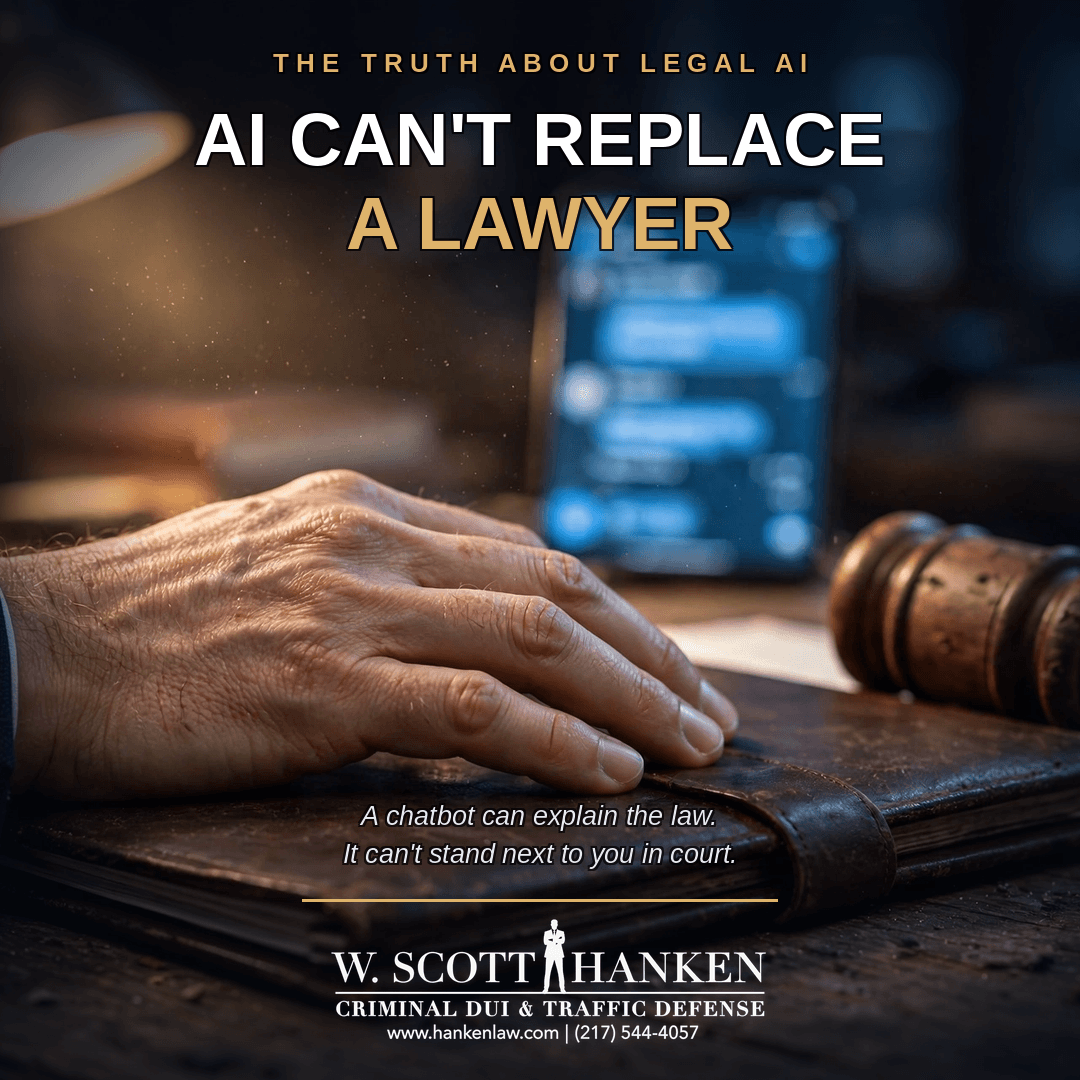
An AI chatbot can summarize what a statute says, but it cannot appear in Sangamon County Circuit Court, cross-examine a police officer, or negotiate directly with the prosecutor assigned to your case. Illinois law limits the practice of law to licensed attorneys under the Attorney Act, 705 ILCS 205/1, and courts across the country have already sanctioned lawyers for filing briefs built on AI-invented case law. If you’re facing a DUI, traffic, or criminal charge in Springfield, an AI tool can help you understand the words. It cannot represent you where the outcome is actually decided.
Bottom Line
Use AI to get familiar with terms and general procedure if that helps you feel less lost. Do not use it as a substitute for calling a licensed Springfield attorney about your specific arrest, your specific police report, or your specific court date. The gap between “general information” and “your case” is exactly where convictions happen.
Can an AI Chatbot Give Me Legal Advice for a DUI or Criminal Charge in Illinois?
It can give you general information. It cannot give you legal advice about your case, because it doesn’t know your case. AI tools are trained on the text of statutes and old court opinions, not on the police report sitting in your file, the video from the squad car, or the specific judge you’ll stand in front of at the Sangamon County Circuit Court. When someone asks a chatbot what happens if they get a DUI in Illinois, it can accurately describe the range of penalties. It cannot tell you whether the stop that led to your arrest was constitutional, because it has never seen the stop.
In 37 years of practicing criminal defense in Springfield, I’ve watched cases turn entirely on details a generic answer would never surface: the exact wording an officer used when asking for consent, whether a squad car’s dash camera was running, whether a breath test machine had a current calibration certificate. None of that lives in a statute. All of it lives in your file.
Is It Illegal for an AI Tool to “Practice Law” in Illinois?
STATUTE: Attorney Act, 705 ILCS 205/1 (P.A. 100-872, eff. 8-14-18)
No person may practice as an attorney, receive compensation for legal services, or hold themselves out as providing legal services in Illinois without a law license issued by the Illinois Supreme Court. Violations are treated as contempt of court, with a civil penalty of up to $5,000 payable to the Illinois Equal Justice Foundation.
Whether that statute reaches an AI company producing general legal information, as opposed to a person practicing law without a license, is a live legal question that courts and legislatures around the country are still working through. What isn’t in question: no AI product holds an Illinois law license, none can be held in contempt of court, and none can be disciplined by the Attorney Registration and Disciplinary Commission if its answer turns out to be wrong. That accountability gap is worth sitting with before you rely on one for something as serious as a criminal charge.
Why Do Courts Keep Sanctioning Lawyers for Using AI?
Since a New York federal court first sanctioned attorneys in Mata v. Avianca, Inc., 678 F. Supp. 3d 443 (S.D.N.Y. 2023), for filing a brief full of ChatGPT-invented cases, the problem hasn’t gone away. It’s grown. A research database maintained by a legal-research fellow at HEC Paris had documented more than 1,800 instances worldwide of fabricated AI citations submitted to courts as of July 2026, up from roughly 200 in mid-2025, with new cases surfacing at a rate of five to eight per day. In Whiting v. City of Athens, Nos. 24-5918/5919, 25-5424, 2026 WL 710568 (6th Cir. Mar. 13, 2026), the Sixth Circuit sanctioned two attorneys after finding over two dozen fake citations in their briefs, fining them and ordering them to cover the opposing side’s fees. The court stopped short of blaming AI specifically, but the pattern of confident, well-formatted, nonexistent case law is the same one showing up across nearly every one of these incidents.
Here’s why that matters for you, not just for lawyers: these are trained professionals with law licenses on the line, and AI still fed them confident, well-formatted, completely fake case law. If a licensed attorney can be misled into filing invented precedent, a defendant researching their own DUI charge at midnight is at even greater risk of treating a fluent, wrong answer as settled law.
What Can AI Actually Help With in a Criminal or DUI Case?
To be fair to the technology: AI is genuinely useful for a narrow slice of this. It can help you understand what a Class A misdemeanor is in plain English, walk you through general terminology like “implied consent” or “statutory summary suspension,” and help you prepare questions before you call an attorney. Used that way, it can make your first phone call more productive.
What it cannot do is anything that requires judgment, advocacy, or accountability: appear in court, negotiate with a specific prosecutor, argue a motion, or take responsibility if the strategy it suggested backfires. Those aren’t technology limitations that will disappear with the next model update. They’re structural. A chatbot has no bar license to lose and no client relationship to be liable for.
What Can Only a Local Defense Attorney Do in Sangamon County?
The clearest way to see the difference is in the moments that actually decide a case. The Sixth Amendment right to counsel isn’t just about having someone next to you at trial. In Missouri v. Frye, 566 U.S. 134 (2012), the U.S. Supreme Court held that the right to effective assistance of counsel extends to plea negotiations, because that stage is a “critical” part of a criminal case, not a formality after the real decisions are made. Frye’s underlying charge, notably, was driving with a revoked license, elevated to a felony because of his prior record for the same offense: an ordinary case, not a headline-grabbing one, and the Court still treated the plea-negotiation stage as constitutionally significant.
And in Strickland v. Washington, 466 U.S. 668 (1984), the Supreme Court set the standard for effective counsel as “reasonably effective assistance, considering all the circumstances.” That phrase, “considering all the circumstances,” is the whole argument for local experience. An AI model can tell you Illinois offers court supervision for many first-offense DUI cases. It cannot tell you which specific prosecutors in the Sangamon County State’s Attorney’s Office are realistically willing to agree to it given a particular BAC result, or how a specific judge on the Sangamon County bench tends to handle a first-time offender with no prior record. I know that because I spent years on the other side of that table as a prosecutor, and I’ve spent 37 years since standing in that same courtroom.
| What’s Needed | AI Chatbot | Local Defense Attorney |
|---|---|---|
| Explain what a statute generally says | Yes | Yes |
| Confirm the statute is still in effect and current | Often outdated or wrong | Verified against ILGA.gov |
| Appear in Sangamon County Circuit Court | No | Yes |
| Cross-examine the arresting officer | No | Yes |
| Negotiate with the specific prosecutor on your case | No | Yes |
| Argue a motion to suppress evidence | No | Yes |
| Know how a specific judge treats first offenders | No | Yes |
| Be disciplined or held liable for bad advice | No license to lose | Bound by Illinois Rules of Professional Conduct |
What If I Already Asked ChatGPT About My DUI Charge Before Calling a Lawyer?
Using AI to understand your charge doesn’t hurt your case by itself. Treating its general answer as a deadline calculator can.
STATUTE: 625 ILCS 5/11-501.1(g) (P.A. 104-260, eff. 8-15-25)
A statutory summary suspension of your driver’s license takes effect on the 46th day after notice is given, and the window to petition to rescind it runs alongside that clock.
I’ve had clients arrive with printouts that explained implied consent reasonably well in general terms, but missed that their own 46-day window was almost gone because they spent two or three weeks reading summaries instead of picking up the phone.
What If the AI’s Answer Sounds Right But Misses a Local Wrinkle?
General AI models are trained on the text of the law, not on how the Sangamon County State’s Attorney’s Office and the judges who sit in Springfield actually apply it day to day. That gap is exactly what Strickland’s “considering all the circumstances” standard is getting at, and it’s why Frye ties effective counsel to the negotiation itself, not just the trial. A chatbot can describe Illinois court supervision in the abstract. It has no way of knowing which prosecutors in this county will actually agree to it for your BAC level, your record, or the way your stop was documented.
What If I Can’t Afford a Lawyer, Isn’t Free AI Better Than Nothing?
Free general information beats no information, but it isn’t the same thing as representation, and it’s worth remembering that under Illinois’ Attorney Act, only a licensed attorney may actually practice law in this state. The good news is you don’t have to choose between free AI and an expensive lawyer. A consultation with W. Scott Hanken, Attorney at Law, is free, and flat-fee options are available for many first-offense cases. Call before you assume you can’t afford the conversation.
How I’ve Seen This Play Out in Sangamon County
Here’s an illustrative example, a composite drawn from patterns I’ve seen over 37 years rather than one specific client: someone gets pulled over on MacArthur Boulevard, blows over the limit, and spends the next two weeks reading everything they can find online, including AI summaries, about Illinois DUI law. By the time they call, they understand the vocabulary well. They also nearly missed the window to challenge the license suspension, because nothing they read told them that clock had already started the day they were arrested. A five-minute phone call in week one would have preserved options that two weeks of self-research quietly closed off.
That’s the real risk. It’s rarely that AI gets the law completely wrong. It’s that general information creates a false sense of having it handled, while deadlines that are specific to your arrest keep running in the background.
If an AI chatbot raised more questions than it answered, call (217) 544-4057 to talk to someone who has stood in front of the Sangamon County bench for 37 years.
Frequently Asked Questions (FAQs)
Yes, general research is fine, and it can help you ask better questions when you call. Just don’t treat an AI’s answer as a substitute for advice about your specific arrest, and don’t let it delay your call once a deadline like the 46-day suspension window is running.
The Attorney Act, 705 ILCS 205/1, says no person may practice law or receive compensation for legal services in Illinois without a license from the Illinois Supreme Court. Whether that reaches AI-generated general information is still being sorted out in courts and legislatures nationwide, but no AI product holds an Illinois law license or can appear in court for you.
No. Plea negotiation requires a licensed attorney who can speak directly with the Sangamon County State’s Attorney’s Office, and the U.S. Supreme Court has held that the right to effective counsel specifically applies to that stage, in Missouri v. Frye, 566 U.S. 134 (2012).
Courts nationwide have sanctioned attorneys, sometimes tens of thousands of dollars at once, for filing briefs containing case citations that AI tools invented outright. A tracking database out of HEC Paris had logged over 1,800 of these incidents worldwide as of July 2026. It’s a clear warning about trusting AI output without a licensed professional checking it.
Not by itself. What can hurt you is delay. Spending two or three weeks reading general explanations instead of contacting a Springfield attorney can cost you the window to challenge a license suspension or preserve evidence like dash-camera footage.
A consultation with W. Scott Hanken, Attorney at Law, is free. Call (217) 544-4057 to discuss your specific charge, and flat-fee options are available for many first-offense cases.
Ready to Fight Your Criminal Charge in Springfield?
Call W. Scott Hanken at (217) 544-4057 or contact us online for a free consultation. We serve clients throughout Springfield, Sangamon County, and Central Illinois.
About the Author: W. Scott Hanken, Attorney at Law
Scott Hanken is a Springfield, Illinois criminal defense attorney with over 37 years of experience, including service as a former Sangamon County prosecutor. He has been voted Best Attorney by the Illinois Times and State Journal-Register, holds an Avvo 10.0 “Superb” rating, and has earned over 270 five-star Google reviews. His firm handles DUI defense, drug crimes, traffic violations, violent crimes, and weapons offenses throughout Sangamon County and Central Illinois.
📍 1100 S 5th St, Springfield, IL 62703 | ☎ (217) 544-4057 | 🌐 hankenlaw.com
This article is for general educational purposes only and does not constitute legal advice. Every case is unique — contact an experienced Springfield criminal defense attorney for guidance on your specific situation.

Address
Our offices are located at the corner of South Fifth Street and Vine, in the historic Mary Bryant Home for the Blind.