- Free Consultation: (217) 544-4057 Tap Here To Call Us













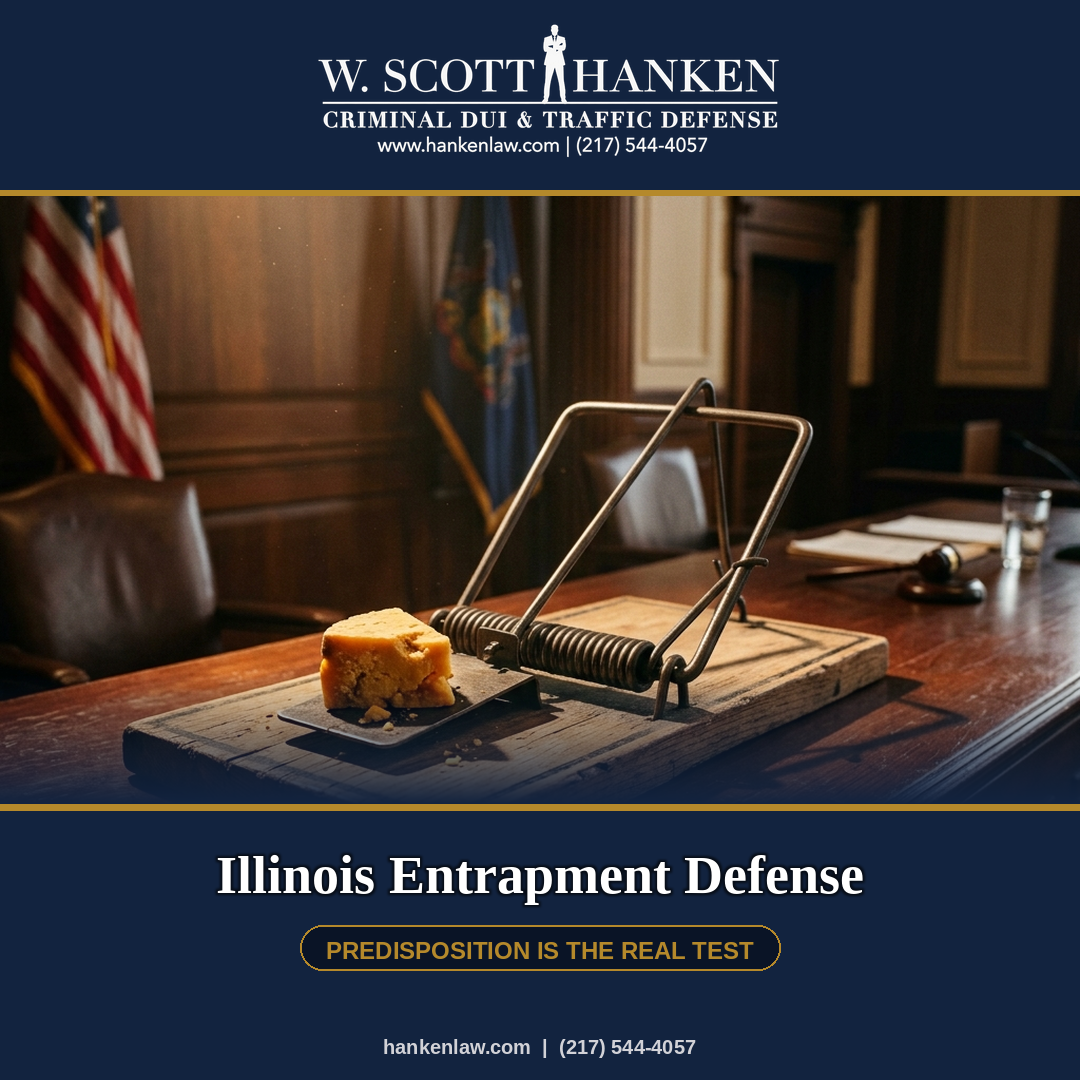
Entrapment Defense in Illinois: What Actually Works


Last Reviewed & Updated: August 5, 2026
By: W. Scott Hanken | Former Sangamon County Prosecutor | Springfield Criminal Defense & DUI Attorney |
Voted “Best Attorney” — Illinois Times Best of Springfield & State Journal-Register Reader’s Choice | Springfield, IL • Sangamon County • (217) 544-4057 • hankenlaw.com
In Illinois, entrapment is an affirmative defense under 720 ILCS 5/7-12: you are not guilty of an offense if a police officer, or someone working for one, induced you to commit it and you were not already predisposed to do so. The defense collapses the moment the State shows you were ready and willing before law enforcement ever got involved. Being handed an opportunity to break the law is not the same as being talked into breaking it.
Bottom Line
Police are allowed to use deception, undercover buys, decoys, and informants to catch people who are already inclined to commit a crime. What they cannot do is manufacture criminal intent in someone who had none. Whether your case lands on one side of that line or the other almost always comes down to facts about your background, your reluctance (or lack of it), and how hard the government had to push before you acted.
What Is the Entrapment Defense Under Illinois Law?
The Illinois entrapment statute reads:
720 ILCS 5/7-12, Entrapment
“A person is not guilty of an offense if his or her conduct is incited or induced by a public officer or employee, or agent of either, for the purpose of obtaining evidence for the prosecution of that person. However, this Section is inapplicable if the person was pre-disposed to commit the offense and the public officer or employee, or agent of either, merely affords to that person the opportunity or facility for committing an offense.”
That second sentence does almost all the work. It means an undercover officer offering to buy drugs, pose as a sex worker, or run a fake online ad is not, by itself, entrapment. The government is allowed to “afford the opportunity.” The defense only kicks in when the government’s conduct crosses from offering an opportunity into creating the crime.
Illinois courts have applied this statute in drug buy-bust operations, prostitution and solicitation stings, gambling raids, and online sting operations for years. The legal test is the same regardless of the underlying charge; only the facts change.
What Are the Two Elements of an Illinois Entrapment Defense?
The Illinois Supreme Court laid out the modern framework in People v. Placek, 184 Ill. 2d 370 (1998). To raise entrapment, a defendant must present at least some evidence, however slight, of two things:
- Inducement — that a public officer or their agent incited or induced the offense.
- Lack of predisposition — that the defendant was not otherwise ready and willing to commit the crime.
Once a defendant clears that low bar, the burden shifts. The State must then prove, beyond a reasonable doubt, either that there was no improper inducement or that the defendant was in fact predisposed. This burden-shifting matters: in my 37 years defending clients in Sangamon County, I’ve seen prosecutors underestimate how much this shifts leverage once entrapment is properly raised. It is not a defense you casually mention at trial; it is one you build a record for from the first pretrial motion, because the jury instruction (Illinois Pattern Jury Instructions, Criminal, No. 24-25.04) puts the State’s burden front and center for the jury.
Government induces the offense → Defendant shows slight evidence of both elements → Burden shifts to the State → Predisposition factors are weighed
How Do Illinois Courts Decide Whether You Were “Predisposed”?
Predisposition is the real battleground in almost every entrapment case I have handled. Illinois courts look at a set of factors the Supreme Court identified in Placek, 184 Ill. 2d at 381, which the Second District applied directly in People v. Glenn, 363 Ill. App. 3d 170 (2d Dist. 2006). The Second District later expanded the list to nine factors in People v. Bonner, 385 Ill. App. 3d 141, 145 (2008), adding two more drawn from People v. Day, 279 Ill. App. 3d 606, 612 (1996), and People v. Poulos, 196 Ill. App. 3d 653, 661 (1990):
| Factor | What It Asks |
|---|---|
| Reluctance vs. willingness | Did you hesitate, refuse, or agree right away? |
| Familiarity | Did you already know how to get what was asked for? |
| Accommodation | Did you go out of your way to help, beyond what was asked? |
| Profit motive | Did you try to make money or gain something from it? |
| Prior/current conduct | Do you have a history involving this type of offense? |
| Participation in mechanics | Did you handle, cut, package, or arrange logistics yourself? |
| Ready access | Could you supply what was requested without government help? |
| Course of similar conduct | Were you already engaged in a pattern of this type of offense before police got involved? |
| Subsequent activities | Did your conduct after the offense show the same willingness, undercutting a claim of reluctance? |
No single factor decides a case. Courts weigh them together. In Glenn, the defendant argued an informant used his attraction to her to manipulate him into buying drugs for an undercover officer. The court found his own conduct, quick agreement, prior drug conviction, and willingness to arrange the deal, established predisposition despite the emotional manipulation. The trial court’s own assessment was blunt: wanting to impress someone is not the same as being entrapped.
What Are Examples That Would Likely Support an Entrapment Defense?
- Repeated solicitation after a genuine refusal. In People v. Bonner, 385 Ill. App. 3d 141 (2d Dist. 2008), an informant repeatedly asked the defendant to sell drugs, and when he refused, escalated the pressure until he relented. The appellate court found entrapment as a matter of law. A single “no” followed by days of badgering, guilt-tripping, or exploiting a personal relationship is the classic inducement pattern.
- No prior history and no independent means. People v. Criss, 307 Ill. App. 3d 888 (1st Dist. 1999), confirmed that a clean record is admissible evidence on predisposition. Someone with no criminal history, no access to contraband, and no established connections who only “succeeds” because police supplied the drugs, the money, or the buyer is a strong candidate for the defense.
- Exploiting addiction, desperation, or a treatment relationship. The U.S. Supreme Court’s Sherman v. United States, 356 U.S. 369 (1958), involved a government informant who met the defendant in a narcotics treatment program and wore him down with appeals to shared suffering. Illinois courts look at this same dynamic: using someone’s vulnerability, not their predisposition, to produce the crime.
- Months of escalating government contact with no prior interest shown. In Jacobson v. United States, 503 U.S. 540 (1992), the government spent over two years sending mailings before the defendant acted, with no independent evidence he would have done so otherwise. Sustained government effort aimed at someone who shows no initial interest cuts strongly toward entrapment.
What Are Examples Where an Entrapment Defense Would Likely Fail?
- You said yes immediately. If an undercover officer asks and you agree without hesitation, negotiate price, or set the meeting location yourself, courts treat that as strong evidence of predisposition regardless of who made first contact.
- You had the means before police showed up. Having product, contacts, or a supply chain already in place defeats the “opportunity or facility” defense built into the statute itself.
- You initiated the conversation. In online solicitation cases, whether prostitution-related or otherwise, who sent the first message and what it said matters enormously. If your own words show intent before any undercover exchange, predisposition is difficult to overcome.
- You have relevant prior convictions. A prior record involving the same type of conduct is admissible and often decisive, even though it isn’t automatically dispositive on its own.
- Emotional or romantic pressure, without more. As Glenn shows, an informant using attraction or friendship to get a “yes” is not entrapment if the defendant otherwise had the willingness and ability to commit the offense.
What if I Initially Said No but Later Agreed?
Illinois law does not treat a delayed “yes” as automatic entrapment, but it does not treat it as automatic predisposition either. The rule is that mere reluctance overcome by ordinary persuasion is not entrapment; reluctance overcome by repeated, escalating pressure after a genuine refusal can be. People v. Boalbey, 143 Ill. App. 3d 362 (3d Dist. 1986), frames this as the core inquiry: how much did the State have to do, and how much did you resist, before the offense occurred. In Sangamon County cases I have handled, the difference between a defendant who briefly hesitated and one who firmly refused multiple times before an informant escalated tactics is often the difference between a viable defense and a losing one.
What if the Crime Happened Entirely Online, Like a Chat or Messaging Sting?
Online sting operations, whether involving prostitution solicitation, drug sales arranged by text, or other offenses, raise the same predisposition analysis, but the evidence looks different. Courts examine who initiated contact, what was said in the defendant’s own messages before any explicit ask from the undercover account, and whether the defendant took independent steps, arranging payment, travel, or logistics, without prompting. Because these conversations are usually preserved in full, they tend to make predisposition easier to prove or disprove than in older, undocumented buy-bust cases. A defendant’s own words early in the exchange frequently decide the outcome before the case ever reaches a jury.
What if I Have No Prior Criminal Record?
A clean record helps, and Criss confirms it is legally relevant to predisposition, but it is not a guarantee. Courts still weigh your conduct during the offense itself, your familiarity with the activity, and how readily you participated. A first-time offender who negotiated terms, supplied their own resources, or showed obvious familiarity with the conduct can still be found predisposed despite having no prior convictions.
How Does an Entrapment Defense Actually Proceed in a Sangamon County Case?
Entrapment is an affirmative defense, which means it is typically developed well before trial, not improvised on the stand. In Sangamon County Circuit Court, that usually means reviewing the discovery for informant communications, body camera and audio recordings, and text or chat logs early, then deciding whether to raise the issue through pretrial motion practice or preserve it for the defense case at trial. Once a defendant presents even slight evidence supporting both inducement and lack of predisposition, the jury is instructed under IPI Criminal 24-25.04, and the burden shifts to the State to disprove the defense beyond a reasonable doubt. Getting that instruction in front of a Sangamon County jury, rather than losing the issue on a directed finding, is often the real fight in these cases.
Is Entrapment the Same as a Due Process or “Outrageous Government Conduct” Defense?
No, and this distinction matters. Entrapment under 720 ILCS 5/7-12 focuses on the defendant: were you induced, and were you predisposed. A separate, much narrower due process argument focuses on the government’s conduct itself, arguing it was so extreme that prosecution should be barred regardless of predisposition. Illinois courts rarely apply the due process theory, and it is not a substitute for a properly developed entrapment defense. Most Sangamon County cases live or die on the statutory predisposition analysis, not the due process theory.
Conduct That Is Not Entrapment vs. Conduct That May Support It
| Not Entrapment (Legal Police Tactics) | May Support Entrapment |
|---|---|
| Undercover officer offers to buy drugs, no pressure applied | Informant repeatedly solicits after a clear refusal |
| Posting a decoy ad and waiting for a response | Escalating guilt, sympathy, or romantic appeals over time |
| Using a confidential informant who is a stranger | Exploiting a known addiction or treatment relationship |
| Defendant negotiates price or logistics unprompted | Government supplies all means, product, and buyer with no independent access |
| Defendant has relevant prior convictions | Sustained government contact over months with no initial interest shown |
Frequently Asked Questions (FAQs)
Yes. Undercover deception, false identities, and misrepresenting the purpose of a conversation are standard investigative tools and are not, by themselves, entrapment. The question is whether that deception induced someone with no predisposition to commit a crime they otherwise would not have committed.
It can. An informant’s motive to fabricate or exaggerate their role is relevant to credibility, and it can support an argument that they pushed harder than they otherwise would have. It doesn’t automatically prove entrapment, but it is a detail worth developing in discovery.
Yes. An informant’s own legal exposure — pending charges, a bond reduction, a deal contingent on cooperation — is directly relevant to both inducement and credibility. In Bonner, the informant had two pending criminal cases and her bond had been lowered in exchange for helping police, a fact the defense used to show she had a strong incentive to manufacture business for the officer she was working with. Courts don’t require proof of a formal written deal; the informant’s circumstances at the time go to how much pressure they had reason to apply.
Yes. A prior conviction doesn’t automatically block the jury from hearing an entrapment instruction. The threshold to raise the defense is low — just some evidence, however slight, of inducement and lack of predisposition. In Bonner, the State introduced the defendant’s 2001 drug conviction to attack predisposition, and the entrapment defense still succeeded on appeal because the conviction was old and unconnected to the pattern of conduct the government had induced. A prior record is a factor the jury weighs, not an automatic bar to raising the defense.
It usually decides the case. When conversations are recorded — by body camera, a court-authorized eavesdrop order, or preserved text and chat logs — the analysis stops being a swearing contest between the defendant and the officer or informant. In Bonner, police obtained an eavesdrop order and recorded most of the calls between the informant, the officer, and the defendant; those recordings let the appellate court see exactly how much pressure was applied and how quickly the defendant gave in. Recorded evidence tends to sharpen predisposition analysis in both directions — it can prove reluctance and repeated refusal just as easily as it can prove eager, unprompted cooperation.
The jury simply decides guilt or innocence based on the remaining evidence, the same as any other case. Raising and losing an entrapment defense does not carry additional penalties on its own, though the underlying facts you had to admit to raise the defense, such as your own conduct during the offense, remain part of the record.
Generally, no. Entrapment concedes that you committed the act but argues you shouldn’t be held criminally responsible because of how the government induced it. Arguing both that you didn’t do it and that you were entrapped into doing it creates a direct contradiction that undermines both defenses.
Rarely. Entrapment requires an officer inducing you to commit a crime you weren’t otherwise going to commit. Driving after drinking is a decision made before any police contact, so the defense almost never fits DUI arrests. It applies far more often to buy-bust, vice, and undercover investigation cases.
Yes. Anything you say about your intent, prior involvement, or reluctance can become evidence on the predisposition factors discussed above. Statements made without counsel present routinely undercut entrapment defenses that could otherwise have succeeded.
Related Reading
Ready to Fight Your Criminal Charge in Springfield?
Call W. Scott Hanken at (217) 544-4057 or contact us online for a free consultation. We serve clients throughout Springfield, Sangamon County, and Central Illinois.
About the Author: W. Scott Hanken, Attorney at Law
Scott Hanken is a Springfield, Illinois criminal defense attorney with over 37 years of experience, including service as a former Sangamon County prosecutor. He has been voted Best Attorney by the Illinois Times and State Journal-Register, holds an Avvo 10.0 “Superb” rating, and has earned over 270 five-star Google reviews. His firm handles DUI defense, drug crimes, traffic violations, violent crimes, and weapons offenses throughout Sangamon County and Central Illinois.
📍 1100 S 5th St, Springfield, IL 62703 | ☎ (217) 544-4057 | 🌐 hankenlaw.com
This article is for general educational purposes only and does not constitute legal advice. Every case is unique — contact an experienced Springfield criminal defense attorney for guidance on your specific situation.

Address
Our offices are located at the corner of South Fifth Street and Vine, in the historic Mary Bryant Home for the Blind.