- Free Consultation: (217) 544-4057 Tap Here To Call Us




Illinois Hemp Act 2026: Is Delta-8 Now Illegal?


Last Reviewed & Updated: July 28, 2026
By: W. Scott Hanken | Former Sangamon County Prosecutor | Springfield Criminal Defense & DUI Attorney |
Voted “Best Attorney” — Illinois Times Best of Springfield & State Journal-Register Reader’s Choice | Springfield, IL • Sangamon County • (217) 544-4057 • hankenlaw.com
Direct Answer:
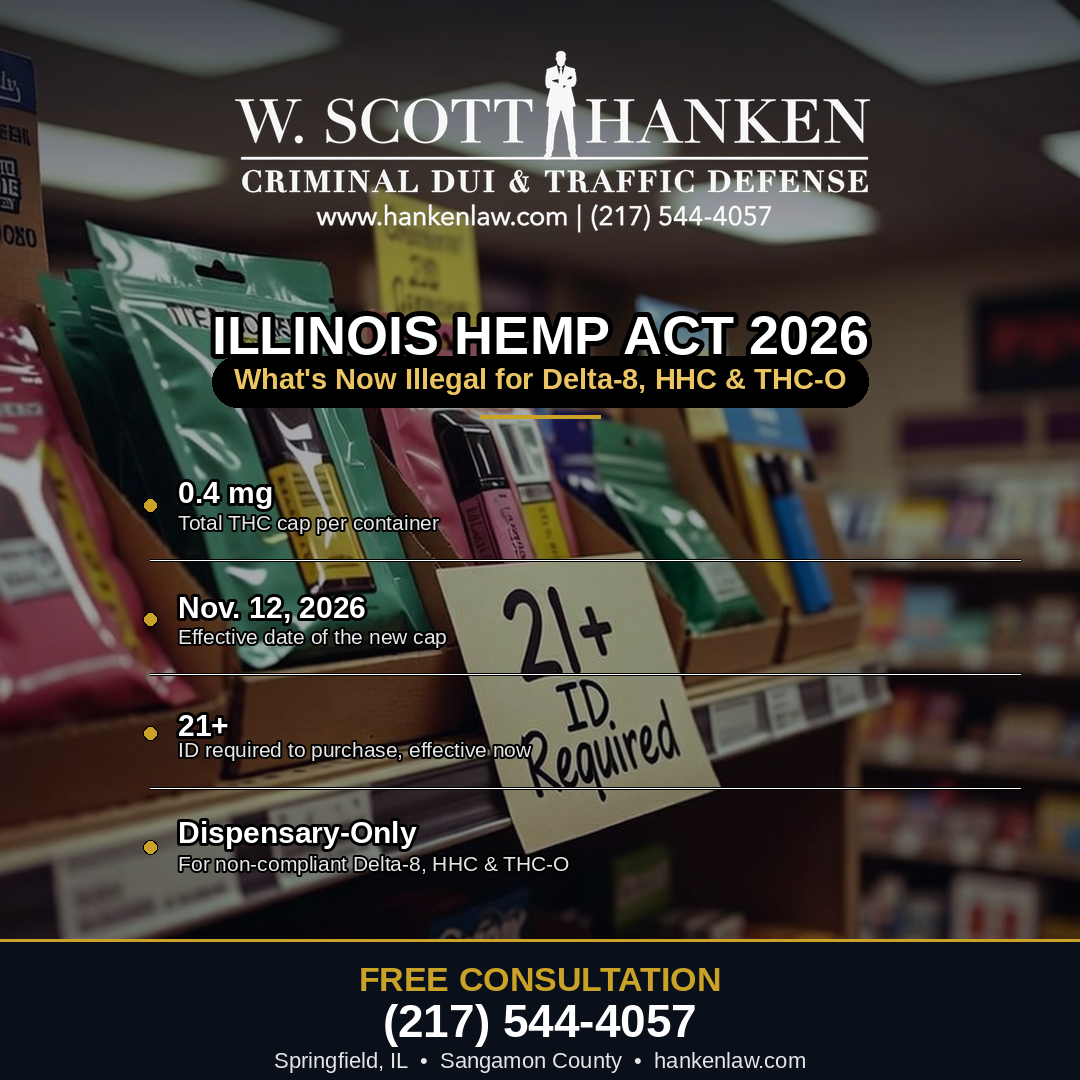
Under the Illinois Hemp Act (Public Act 104-0463, signed June 12, 2026), any Delta-8, Delta-10, HHC, THC-O, or other intoxicating hemp product that exceeds 0.4 milligrams of total THC per container becomes legally treated as cannabis on November 12, 2026, meaning it can only be sold at a state-licensed dispensary to buyers 21 and older. Selling any intoxicating hemp product to a person under 21 is already illegal right now, since that piece of the law took effect immediately when Governor Pritzker signed it.
Bottom Line:
If you buy, carry, or get pulled over with a gas-station Delta-8 vape, an HHC gummy, or a THC-O cartridge after November 12, 2026, Illinois law will treat it the same way it treats unlicensed cannabis, not a legal supplement. If you’re under 21, that exposure already exists today.
What Is the Illinois Hemp Act (SB 3222) and When Does It Take Effect?
The Illinois Hemp Act is Public Act 104-0463, the enrolled version of Senate Bill 3222. Governor JB Pritzker signed it into law on June 12, 2026, and it rewrites how the state treats hemp-derived cannabinoid products that had been sold for years in gas stations, vape shops, and smoke shops with almost no oversight. The Act repeals the old Industrial Hemp Act, effective November 12, 2026.
The effective dates matter, and they’re not all the same date. Most of the bill, including the ban on selling intoxicating hemp to anyone under 21, took effect immediately on June 12, 2026. The creation of the Illinois Hemp Act itself, along with the 0.4 milligram THC cap and the requirement that non-compliant products be sold only through licensed dispensaries, doesn’t take effect until November 12, 2026. Between now and then, Illinois is in a transition window: the under-21 sales ban is already enforceable, but the broader product cap and dispensary-only rule are not yet in force. You can review the full text of Public Act 104-0463 directly at ilga.gov.
What Hemp Products Will Still Be Legal to Buy Outside a Dispensary?
Starting November 12, 2026, a product only qualifies as a legal “final consumer hemp cannabinoid product” if it meets three conditions at once: it can’t contain any cannabinoid that a hemp plant is incapable of producing naturally, it can’t contain a naturally occurring cannabinoid that was synthesized or manufactured outside the plant, and it can’t exceed 0.4 milligrams of total THC per container. It also has to be lab-tested, properly labeled with cannabinoid content down to the milligram, and packaged in a child-resistant container.
That’s a narrow lane. Standard low-dose CBD products that genuinely stay under the 0.4 milligram cap can still be sold at ordinary retail outlets in Springfield. Most of what’s currently marketed as an intoxicating hemp product cannot, because it’s designed to produce an effect nowhere near that threshold.
What Happens to Delta-8, HHC, Delta-10, and THC-O Products?
The Act specifically lists Delta-8, Delta-10, HHC, HHC-P, THC-O, THC-P, THC-B, and similar compounds as cannabinoids that either aren’t naturally producible in meaningful amounts by a hemp plant or are chemically synthesized in a lab from CBD, and it separately classifies them as having THC-like effects. That double classification matters. Even a product containing a naturally-occurring trace of one of these cannabinoids still has to count it toward the 0.4 milligram cap, and if the compound was synthesized outside the plant, as most commercial Delta-8 and HHC products are, it fails the definition of a legal hemp product regardless of dose.
Practically, that means the vast majority of Delta-8 vapes, HHC gummies, and THC-O cartridges currently on Springfield shelves will not qualify as legal hemp products after November 12, 2026. Under Section 40 of the Act, a product that doesn’t meet the hemp definition is treated as cannabis under the Cannabis Regulation and Tax Act and the Cannabis Control Act, unless it’s sold through a licensed dispensary.
Is It Already Illegal to Sell Intoxicating Hemp to Anyone Under 21?
Yes, and this part is not waiting until November. Governor Pritzker’s June 12, 2026 signing confirmed that the ban on selling intoxicating hemp products to anyone under 21 took effect immediately, alongside a new requirement that retailers check identification before selling these products. If you’re under 21 and a Springfield retailer sold you a Delta-8 or HHC product this month, that sale was already unlawful on the retailer’s end, and the age restriction is fully enforceable right now, not in November.
Can Springfield or Sangamon County Pass Their Own, Looser Hemp Rules?
No. Section 70 of the Illinois Hemp Act contains a home-rule limitation: a home-rule unit of government, and Springfield is one, cannot regulate hemp any less restrictively than the state Act does. In my 37 years practicing in Sangamon County, I’ve watched home-rule authority get used to tighten local ordinances on everything from towing to firearms storage. This is the opposite situation. The state has set a floor, not a ceiling, so Springfield’s city council could theoretically pass stricter local rules on where intoxicating hemp is sold, but it cannot loosen the state’s 0.4 milligram cap, its age restrictions, or its dispensary-only requirement for non-compliant products. Anyone hoping a local ordinance might carve out an exception should assume it won’t hold up.
How Does This Change Criminal Exposure for an Ordinary Sangamon County Resident?
This is the part generic hemp-industry articles don’t cover, and it’s the part that actually matters if you’re the one holding the product. Because Section 40 reclassifies a non-compliant hemp product as cannabis rather than creating a new, separate hemp-specific offense, the product falls back under existing cannabis law once the Act takes effect. That means the same legal framework that already governs unlicensed cannabis possession, distribution, and sale in Illinois would apply to an out-of-compliance Delta-8 or HHC product obtained outside the licensed dispensary system.
This is a brand-new statute, and Sangamon County prosecutors, the State’s Attorney’s office, and local courts have not yet built an established charging pattern around it. Anyone telling you with total certainty how a specific fact pattern will be charged in November is guessing. What I can tell you with confidence, from three decades on both sides of drug prosecutions in this courthouse, is that law enforcement in Springfield tends to treat unfamiliar products conservatively once a new law creates ambiguity, and that ambiguity itself is where a defense gets built.
What If I Bought My Delta-8 or HHC Products Before November 12, 2026?
The general rule is that intoxicating hemp above 0.4 milligrams per container becomes cannabis-equivalent on November 12, 2026, when the Illinois Hemp Act’s core provisions take effect. The Act itself doesn’t grandfather in products purchased earlier, since it regulates the product’s characteristics and how it’s sold or possessed going forward, not the date of purchase. In Sangamon County, this comes up constantly with people who bought something perfectly legally at a smoke shop on Wabash Avenue in the spring and don’t realize the legal status of that same unopened product changes under their feet in November, with no new purchase required. If you’re still holding intoxicating hemp products after the effective date, treat them as you would any unlicensed cannabis product, not as a leftover legal purchase.
What If I’m Pulled Over in Sangamon County With an Intoxicating Hemp Vape in My Car?
The general DUI rule under 625 ILCS 5/11-501(a) already makes it illegal to drive with certain THC concentrations in your blood or other bodily substance, or while impaired by any drug, regardless of whether that drug was purchased legally. A Delta-8 or HHC vape doesn’t get special treatment just because it came from a hemp shop instead of a dispensary. After November 12, an officer who finds one of these products in your vehicle may treat it, and any related odor or field-sobriety indicators, exactly the way officers currently treat cannabis found during a traffic stop, layering a possible unlawful-possession issue on top of any drugged-driving investigation. I’ve handled hundreds of cannabis-related DUI stops in Sangamon County Circuit Court, and the products involved keep changing while the constitutional questions, reasonable suspicion, probable cause, and the reliability of field sobriety testing for anything other than alcohol, stay exactly the same.
What If I’m Under 21 and Was Caught With an Intoxicating Hemp Product Right Now?
The sales-side ban is already active, but the Act’s enforcement structure targets the person or retailer that sells the product, not primarily the underage buyer. That said, a minor found in possession of what turns out to be a non-compliant intoxicating hemp product could still face scrutiny under existing cannabis or drug paraphernalia laws depending on the specific product and circumstances, and a retailer who sold it to them is already exposed to Department of Agriculture enforcement. If your teenager was cited or questioned in connection with one of these products anywhere in Springfield or Sangamon County, get them legal advice before they or you talk to school administration, police, or anyone else about it.
What Are the Penalties for Selling Non-Compliant Hemp Products in Illinois?
Section 45 of the Act sets out administrative fines the Department of Agriculture can impose on a person or retailer who violates the Act: up to $500 for a first violation within a 24-month period, up to $750 for a second, and up to $1,000 for a third or subsequent violation in that same window. Separately, Section 50 authorizes the Director to issue cease-and-desist orders and mandatory recalls, and the Attorney General can pursue violations as unlawful practices under the Consumer Fraud and Deceptive Business Practices Act. These fines apply to the sale side of the transaction. A consumer simply possessing a non-compliant product faces a different kind of exposure, discussed above, through the product’s reclassification as cannabis.
Illinois Hemp Rules: Before and After November 12, 2026
| Feature | Now (through Nov. 11, 2026) | Starting Nov. 12, 2026 |
|---|---|---|
| Where sold | Gas stations, smoke shops, and general retail | Non-compliant products: dispensaries only |
| THC cap per container | Governed by old Industrial Hemp Act (0.3% dry-weight plant standard) | 0.4 mg total THC per container (Sec. 5) |
| Buyer age | Under-21 sales already banned | Under-21 sales banned; dispensary ID required |
| Delta-8, HHC, Delta-10, THC-O | Widely sold, largely unregulated | Illegal outside dispensaries unless naturally occurring and under the cap |
| Retailer penalties | Limited under old Industrial Hemp Act | $500–$1,000 fines, cease-and-desist, recalls (Sec. 45, 50) |
Frequently Asked Questions (FAQs)
Not yet, as of this writing in July 2026. Delta-8 remains available at many Springfield retailers today. That changes on November 12, 2026, when most Delta-8 products will exceed the Act’s 0.4 milligram cap and become legally treated as cannabis, sellable only through a licensed dispensary.
Only if the product genuinely contains 0.4 milligrams or less of total THC per container and meets the Act’s labeling and testing requirements. Most standard CBD isolate products can meet this bar. Anything marketed for a noticeable high almost never can.
The product would likely be treated as unlicensed cannabis rather than a legal hemp item, which can add possession exposure on top of any DUI investigation if impairment or a positive THC test is also involved. Don’t answer questions about it without talking to a lawyer first.
No. The DUI statute, 625 ILCS 5/11-501, is unchanged. What changes is which products can trigger a THC-related stop or charge, since intoxicating hemp products that used to sit in a legal gray area will now function like cannabis for these purposes.
It’s illegal for the retailer to sell it to them right now; that ban took effect June 12, 2026. Whether the buyer faces separate exposure depends on the specific product and facts, so get advice before assuming either way.
No. Section 70 of the Act bars home-rule units, including Springfield, from regulating hemp less restrictively than the state law does.
Ready to Fight Your Drug Charge in Springfield?
Call W. Scott Hanken at (217) 544-4057 or contact us online for a free consultation. We serve clients throughout Springfield, Sangamon County, and Central Illinois.
About the Author: W. Scott Hanken, Attorney at Law
Scott Hanken is a Springfield, Illinois criminal defense attorney with over 37 years of experience, including service as a former Sangamon County prosecutor. He has been voted Best Attorney by the Illinois Times and State Journal-Register, holds an Avvo 10.0 “Superb” rating, and has earned over 270 five-star Google reviews. His firm handles DUI defense, drug crimes, traffic violations, violent crimes, and weapons offenses throughout Sangamon County and Central Illinois.
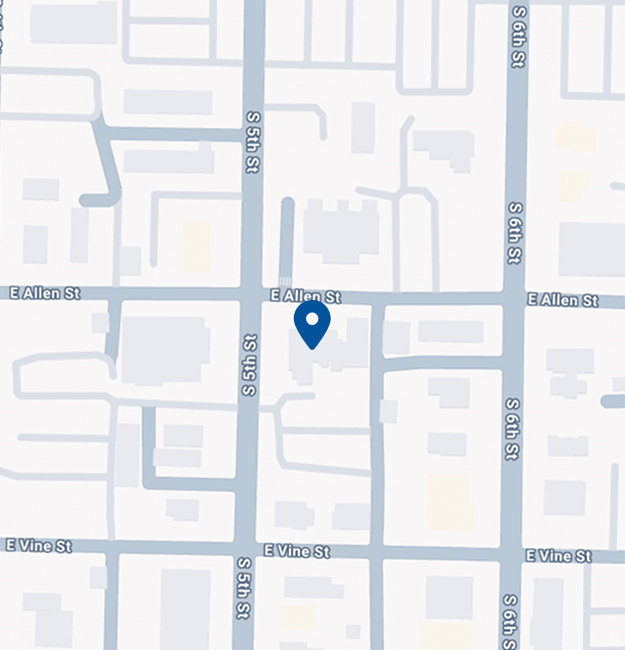
📍 1100 S 5th St, Springfield, IL 62703 | ☎ (217) 544-4057 | 🌐 hankenlaw.com
Address
Our offices are located at the corner of South Fifth Street and Vine, in the historic Mary Bryant Home for the Blind.