- Free Consultation: (217) 544-4057 Tap Here To Call Us















Illinois Orders of Protection & No Contact Orders: Not Just for Celebrities — This Happens Every Day to Ordinary People


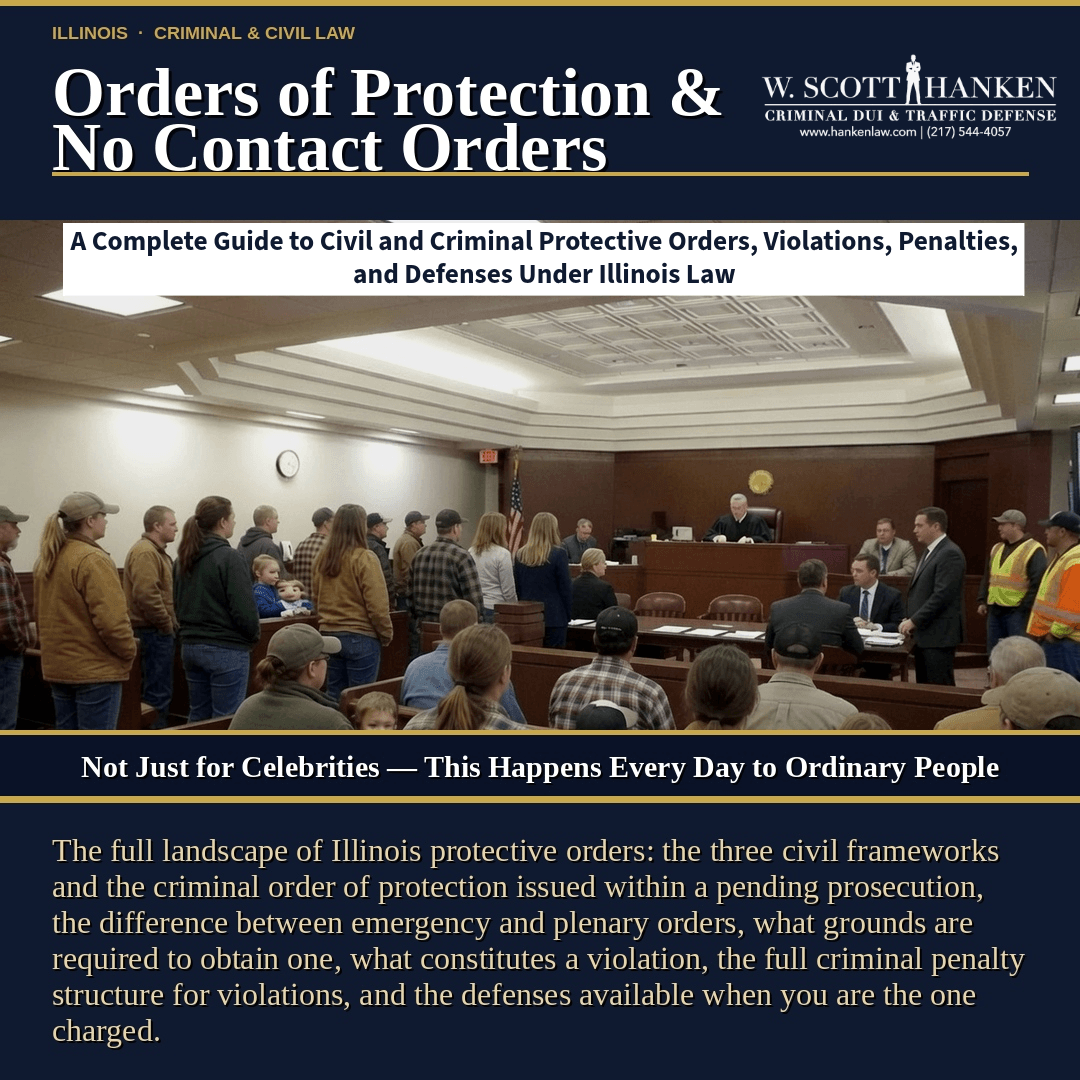
A Complete Guide to Civil and Criminal Protective Orders, Violations, Penalties, and Defenses Under Illinois Law
By: W. Scott Hanken | Former Sangamon County Prosecutor | Springfield Criminal Defense & DUI Attorney |
Voted “Best Attorney” — Illinois Times Best of Springfield & State Journal-Register Reader’s Choice | Springfield, IL • Sangamon County • (217) 544-4057 • hankenlaw.com
When most people hear the words “order of protection” or “stalking no contact order,” their minds go to headlines. WNBA superstar Caitlin Clark — her stalker, Michael Lewis of Texas, sent her over 800 threatening and sexually explicit messages on social media before traveling from Texas to Indianapolis, driving past her home three times a day, and buying tickets to games so he could sit behind the bench. He pleaded guilty in July 2025 to felony stalking and harassment and was sentenced to two and a half years in prison. Then, just days before this post was published — Indianapolis man Kevin Singh was charged with stalking, intimidation, and harassment of Clark’s Indiana Fever teammate Sophie Cunningham, accused of a months-long campaign of threatening and explicit messages that left Cunningham staying home more often and suffering nightmares. A no-contact order was entered at Singh’s initial hearing on Thursday, June 25, 2026.
Those cases make national news because the victims are famous. But these orders are not tools reserved for professional athletes and celebrities. They are everyday legal mechanisms used by ordinary people — your neighbors, coworkers, family members, and classmates — in situations that never make a single headline. The divorced spouse who cannot stop showing up. The ex-partner who texts sixty times a day. The coworker who follows someone to their car. These are the people who fill the dockets of courts across Illinois — including the Thursday morning order of protection call at the Sangamon County Courthouse in Springfield — week after week, year after year, in numbers that would alarm most people who have never set foot in that courtroom.
This post explains the full landscape of Illinois protective orders: the three civil frameworks and the criminal order of protection issued within a pending prosecution, the difference between emergency and plenary orders, what grounds are required to obtain one, what constitutes a violation, the full criminal penalty structure for violations, and the defenses available when you are the one charged.
Illinois Has Three Distinct Types of Protective Orders
Illinois law provides three separate civil protective order frameworks, each with its own statute, its own eligibility requirements, and its own criminal enforcement mechanism. Confusing them is a mistake — both for petitioners trying to obtain relief and for respondents trying to understand the charges they face.
| Order Type | Governing Statute | Who Can Petition | Relationship Required? | Criminal Violation Statute |
|---|---|---|---|---|
| Order of Protection (OP) | 750 ILCS 60 (Illinois Domestic Violence Act of 1986) | Victims of domestic abuse by a family or household member | Yes — domestic/family relationship required | 720 ILCS 5/12-3.4 |
| Stalking No Contact Order (SNCO) | 740 ILCS 21 (Stalking No Contact Order Act) | Any person who is a victim of stalking | No — any relationship, including strangers | 720 ILCS 5/12-3.9 |
| Civil No Contact Order (CNCO) | 740 ILCS 22 (Civil No Contact Order Act) | Victims of sexual assault, sexual abuse, or human trafficking | No — designed for non-domestic sexual offenses | 720 ILCS 5/12-3.8 |
The critical dividing line between an Order of Protection and the other two types is the nature of the relationship between the parties. Orders of Protection are for domestic situations. If there is no domestic relationship, the petitioner must use either the Stalking No Contact Order Act or the Civil No Contact Order Act, depending on the nature of the harm.
In the News — And In Courts Across Illinois Every Week
The mechanisms that protect famous athletes are the same mechanisms used daily by teachers, nurses, college students, retirees, and factory workers across central Illinois. The statute applies equally, and so do the consequences for violating it.
Orders of Protection Under the Illinois Domestic Violence Act (750 ILCS 60)
Who Is Protected
Under 750 ILCS 60/201, an Order of Protection may be sought by any person who has been abused by a family or household member. The statute broadly defines “family or household member” to include:
- Spouses, former spouses, parents, children, stepchildren, and other persons related by blood or by present or prior marriage
- Persons who share or formerly shared a common dwelling
- Persons who have or allegedly have a child in common
- Persons who share or allegedly share a blood relationship through a child
- Persons who have or have had a dating or engagement relationship
- Persons with disabilities and their personal assistants
- High-risk adults with disabilities who have been abused, neglected, or exploited
What Constitutes “Abuse” — The Grounds for an Order
The petitioner must establish that the respondent has committed abuse as that term is defined by the Act:
- Physical abuse — sexual abuse, bodily harm, physical confinement or restraint
- Harassment — knowing conduct that causes emotional distress, including repeated telephoning, following, surveillance, or threatening to abuse
- Intimidation of a dependent — causing a minor child or dependent adult to witness abuse
- Willful deprivation — denying a person required care, medication, or assistance to the extent that it endangers health or safety
- Interference with personal liberty — compelling, by force, threat, or intimidation, any conduct or restraint
- Stalking — as defined in 720 ILCS 5/12-7.3
No Physical Injury Required
Under 750 ILCS 60/214(a), a court shall not deny an order of protection because the petitioner shows no physical manifestations of abuse. Verbal threats, harassment, surveillance, and interference with personal liberty are sufficient grounds on their own.
Standard of Proof
The burden in an Order of Protection proceeding is preponderance of the evidence — more likely true than not. This is a civil standard, not the “beyond a reasonable doubt” standard required in criminal cases. Under 750 ILCS 60/205, this civil standard applies whether the proceeding is heard in criminal or civil court.
Remedies Available in an Order of Protection
Under 750 ILCS 60/214(b), a court may include any combination of the following remedies:
- Prohibition of abuse, harassment, intimidation, stalking, and interference with personal liberty
- Grant of exclusive possession of the shared residence — even if the respondent owns or leases it
- Stay-away orders and exclusion from specified places (school, workplace, etc.)
- Temporary allocation of parental responsibilities and parenting time
- Order to surrender firearms and Firearm Owner’s Identification Card (FOID)
- Order for payment of temporary support
- Order for payment of losses caused by the abuse (medical expenses, lost wages, property damage, attorney fees)
- Prohibition from removing or concealing a minor child from the State
- Exclusive care, custody, or control of pets
- Transfer of a shared wireless telephone number to the petitioner
Emergency Orders of Protection: Ex Parte and Immediate
An emergency order of protection is issued by the court without prior notice to the respondent — what lawyers call ex parte relief. Under 750 ILCS 60/217, the court will issue an emergency order when the petitioner establishes that the court has jurisdiction, the requirements of 750 ILCS 60/214 are satisfied, and there is good cause to grant relief without prior notice — typically because giving notice would likely cause further harm or allow the respondent to escalate the danger.
Emergency Order — Duration
Under 750 ILCS 60/220(a)(1): Emergency orders issued under Section 217 shall be effective for not less than 14 nor more than 21 days.
Emergency orders are available 24 hours a day, seven days a week. When the court is unavailable at the close of business, any available circuit judge or associate judge may issue a 21-day emergency order upon finding an immediate and present danger of abuse. The chief judge of each circuit must designate at least one judge to be available at all times for this purpose.
Plenary Orders of Protection: Full Hearings, Longer Duration
A plenary order of protection is the full-length order issued after the respondent has been properly served and given the opportunity to appear, contest the allegations, and present evidence. Under 750 ILCS 60/219, a plenary order shall issue when the petitioner establishes jurisdiction, abuse by a family or household member, proper service on the respondent, and that the respondent has answered or is in default.
Plenary Order — Duration
Under 750 ILCS 60/220(b): A plenary order of protection entered under this Act shall be valid for a fixed period of time, not to exceed two years. It may be extended one or more times, and upon good cause shown may be entered to remain in effect until vacated or modified.
There is no right to a jury trial in an Order of Protection proceeding under 750 ILCS 60/206. The proceeding is bench-tried. If the respondent fails to appear after being properly served, the court may enter the plenary order by default.
Stalking No Contact Orders (740 ILCS 21): No Domestic Relationship Required
The Stalking No Contact Order Act (740 ILCS 21) fills a critical gap in Illinois protective order law. Before its enactment, a person being stalked by a coworker, acquaintance, neighbor, or complete stranger had no civil protective order remedy. The Act fixes that.
What Is Stalking Under Illinois Law?
Stalking is defined in 720 ILCS 5/12-7.3 as knowingly engaging in a course of conduct directed at a specific person that the offender knows or should know would cause a reasonable person to fear for his or her safety or suffer other emotional distress. A “course of conduct” means two or more separate acts, including following the person, placing the person under surveillance, threatening, contacting, communicating with, or monitoring the person through any electronic means. Stalking does not require physical contact or threats of physical violence.
Emergency and Plenary Stalking No Contact Orders
An emergency stalking no contact order may be issued ex parte when the court finds an immediate and present danger of stalking. Under 740 ILCS 21/105(a), it is effective for not less than 14 nor more than 21 days. A plenary stalking no contact order issues after notice and a hearing and is effective for a fixed period not to exceed two years, with extensions available under 740 ILCS 21/105(b).
Civil No Contact Orders (740 ILCS 22): For Sexual Assault Victims
The Civil No Contact Order Act (740 ILCS 22) is designed specifically for victims of non-consensual sexual conduct, sexual assault, sexual abuse, or human trafficking where no domestic relationship exists between the parties. A Civil No Contact Order may prohibit the respondent from any contact or communication with the petitioner and require the respondent to stay away from the petitioner’s residence, school, workplace, and other locations. Emergency orders are effective 14 to 21 days; plenary orders up to two years.
Criminal Orders of Protection Under Article 112A: A Different Animal Entirely
Everything discussed so far involves civil protective orders. There is a separate and parallel universe of protective orders that most people never hear about until they are sitting in a criminal courtroom: criminal orders of protection issued under Article 112A of the Code of Criminal Procedure of 1963 (725 ILCS 5/112A).
How a Criminal Order of Protection Is Initiated
Under 725 ILCS 5/112A-5, a petition for a criminal order of protection must be filed in conjunction with a delinquency petition or a criminal prosecution — or in conjunction with a bond forfeiture warrant in an existing case — and the petition must name a victim of the alleged crime. The petition may allege: (1) abuse by the respondent who is a family or household member; (2) non-consensual sexual conduct or penetration, including a single incident; or (3) stalking by the respondent.
The Critical Terminology Difference: Ex Parte vs. Final
Civil orders use the terms “emergency,” “interim,” and “plenary.” Criminal Article 112A orders use different vocabulary: ex parte orders and final orders. The functional concepts are the same but the terminology is different enough to cause confusion when reading the statute or reviewing an order.
Duration — The Critical Difference From Civil Orders
Under 725 ILCS 5/112A-20, the duration of a final criminal order is tied to the criminal case and sentence:
- If entered during pre-trial release: until disposition, withdrawal, or dismissal of the underlying charge
- If in conjunction with a bond forfeiture warrant: until final disposition or an additional period not exceeding two years
- Until two years after the expiration of any supervision, conditional discharge, probation, parole, or mandatory supervised release
- Until two years after the date set for expiration of any sentence of imprisonment and subsequent parole or MSR
- Permanent for a stalking no contact order if a judgment of conviction for stalking is entered
- Permanent for a civil no contact order at the victim’s request upon conviction for criminal sexual assault, aggravated criminal sexual assault, criminal sexual abuse, or aggravated criminal sexual abuse
Certain domestic violence and civil no contact orders that run two years post-sentence may be extended one or more times upon proper motion under 725 ILCS 5/112A-20(e).
The Duration Trap
Under the civil framework, a plenary order lasts up to two years and must be actively extended. Under the criminal framework, an order tied to a felony sentence with mandatory supervised release can last years beyond release from prison — and in stalking or sex offense convictions, can be permanent. Many defendants discover this only after sentencing.
What Happens When the Criminal Case Is Dismissed?
A dismissal or not-guilty verdict in the underlying criminal case does not automatically vacate the order of protection. The order may be transferred to civil court and treated as an independent proceeding. Under 725 ILCS 5/112A-20(g), the statute is explicit that the practice of dismissing a criminal prosecution in exchange for issuing a protective order undermines the purposes of the Article and is not to be encouraged. Courts take that language seriously.
| Feature | Civil Order of Protection (750 ILCS 60) | Criminal Order of Protection (725 ILCS 5/112A) |
|---|---|---|
| Filed By | Petitioner/victim independently | Must be filed within a pending criminal prosecution; often driven by State’s Attorney |
| Court | Civil court | Criminal court — within the pending case |
| Short-Term Order | Emergency: 14–21 days (ex parte) | Ex parte order tied to case status |
| Long-Term Order | Plenary: up to 2 years, extendable | Final: 2 yrs post-sentence; potentially permanent on conviction |
| If Case Dismissed | Order unaffected; must be separately vacated | Order may survive; may transfer to civil court |
| Standard of Proof | Preponderance of evidence | Preponderance of evidence (same civil standard) |
| Victim’s Control | Petitioner controls filing and enforcement | State’s Attorney controls prosecution |
Inside Sangamon County’s Order of Protection Court: What You Will Not Read in the Statute
Statutes tell you the rules. Practice tells you what actually happens. After 37 years in Sangamon County courts — first as a prosecutor, then in private practice — I can tell you that order of protection practice in Springfield has a rhythm of its own that is not written in any statute.
Thursday Mornings at 8:30 a.m. — The Order of Protection Call
In Sangamon County, civil order of protection matters are typically calendared on Thursday mornings, beginning at 8:30 a.m., in the Sangamon County Courthouse at 200 S. Ninth Street in Springfield. The volume of matters set for that call routinely requires multiple judges. On any given Thursday, it is not unusual to see two, three, or even more courtrooms running simultaneously to handle the sheer number of hearings generated by pending order of protection petitions.
The Pre-Holiday Surge — A Pattern Every Practitioner Recognizes
The Thursday morning order of protection call gets dramatically busier in the days and weeks leading up to major holidays. Thanksgiving. Christmas. New Year’s. The Fourth of July. Labor Day. The filing rate spikes — sometimes dramatically — in the period just before these holidays arrive.
This pattern is worth naming directly. Yes, some of those filings represent genuine emergency situations — holiday gatherings that escalate into violence, the particular stress that comes when estranged families are forced into proximity. Those cases are real and deserve the court’s full attention. But the honest practitioner also recognizes that a significant portion of the pre-holiday surge represents something different: orders of protection being sought as a tactical or retaliatory tool. A spouse who wants to get the other party out of the house before the holiday. A partner who wants leverage in an impending divorce or custody dispute. An emergency order issues ex parte — without the respondent even knowing it is coming — and by the time the respondent finds out, they have been removed from their home, cut off from their children, and served with papers.
A Practitioner’s Observation
The observation that pre-holiday filing rates spike, and that some filings reflect retaliatory or tactical motivations, is a pattern observed over decades of practice in Sangamon County. It is not a comment on any particular case. Genuine victims deserve protection. Every case must be evaluated on its own facts. But the plenary hearing exists precisely to test whether the allegations hold up when both sides are present and have the opportunity to be heard.
What Constitutes “Contact” — Understanding What Can Trigger a Violation
Under Illinois protective order law, “contact” and “violation” are construed broadly. Whether you are subject to an Order of Protection, a Stalking No Contact Order, or a Civil No Contact Order, any of the following can constitute a violation — even if you think it seems minor or harmless.
Direct Contact
- Calling the protected person’s phone — even one time, even if they pick up
- Sending a text message, email, letter, or private message on any social media platform
- Appearing at the protected person’s home, even if invited by a third party who lives there
- Approaching or speaking to the protected person in a public place
- Giving or attempting to give any item to the protected person
Indirect Contact
- Sending messages through a mutual friend, family member, or third party
- Having someone else deliver a message, letter, gift, or communication on your behalf
- Using social media to post about the protected person or to communicate indirectly in a way they will see
- Following or monitoring the protected person through any electronic means
Location-Based Violations
- Entering the protected person’s residence, even if you previously lived there
- Appearing at a specified prohibited location — workplace, school, church, gym — when the order prohibits it
- Coming within a specified distance of the protected person, even in a public place
- Remaining at a location after becoming aware the protected person is present, when the order requires you to leave
Critical Point: “They Invited Me” Is Not a Legal Defense
The protected party does not have the legal authority to suspend an order of protection. Only a court can modify or lift the order. If you comply with an invitation from the protected party and show up at a prohibited location, you can and likely will be charged with a violation — regardless of who made the first move. If circumstances have genuinely changed — including reconciliation — the only safe and proper course is to immediately file a motion to modify or vacate the order with the court. Do not rely on a private agreement or an invitation from the protected party as a substitute for a court order.
Criminal Penalties for Violations — The Full Penalty Structure
Violation of an Order of Protection — 720 ILCS 5/12-3.4
A person commits this offense when they knowingly commit an act prohibited by the order, or knowingly fail to perform an act required by the order, after having been served with notice of the order’s contents. The conduct triggering criminal liability is tied to violations of the following remedies under 750 ILCS 60/214(b):
- Paragraph (1) — Prohibition of abuse, harassment, intimidation, stalking
- Paragraph (2) — Exclusive possession of the residence
- Paragraph (3) — Stay-away order and prohibition from specified places
- Paragraph (14) — Prohibition from entering while under the influence
- Paragraph (14.5) — Prohibition of firearm possession
- Any other remedy when the act constitutes a separate crime against the protected party
PENALTY STRUCTURE — 720 ILCS 5/12-3.4:
- First violation: Class A misdemeanor — up to 364 days in county jail, fine up to $2,500, probation or court supervision up to 24 months
- Class 4 felony (1–3 years prison) if defendant has any prior conviction for domestic battery (720 ILCS 5/12-3.2), violation of an order of protection, or aggravated domestic battery
- Class 4 felony if defendant has prior convictions for first degree murder, attempt murder, kidnapping, aggravated kidnapping, criminal sexual assault, aggravated criminal sexual assault, stalking, aggravated stalking, aggravated battery, unlawful restraint, or other enumerated violent offenses committed against a family or household member
- Mandatory minimum of 24 hours imprisonment for second or subsequent violations absent a court finding of manifest injustice
- Court may also order restitution to the victim under the Unified Code of Corrections
Violation of a Stalking No Contact Order — 720 ILCS 5/12-3.9
- First violation: Class A misdemeanor — up to 364 days in jail, $2,500 fine
- Second or subsequent violation: Class 4 felony — one to three years in prison
- As currently codified (P.A. 100-199, eff. 1-1-18), 720 ILCS 5/12-3.9 does not contain a mandatory-minimum imprisonment provision for second or subsequent violations
- Prosecution does not bar concurrent prosecution for any other crime committed at the time of violation
Violation of a Civil No Contact Order — 720 ILCS 5/12-3.8
- First violation: Class A misdemeanor — up to 364 days in jail, $2,500 fine
- Second or subsequent violation: Class 4 felony — one to three years in prison
- As currently codified (P.A. 100-199, eff. 1-1-18), 720 ILCS 5/12-3.8 does not contain a mandatory-minimum imprisonment provision for second or subsequent violations
Aggravated Stalking — 720 ILCS 5/12-7.4
If you are under a stalking no contact order or any order of protection and you also commit stalking, the charge is aggravated stalking — a Class 3 felony carrying two to five years in prison. A second or subsequent conviction is a Class 2 felony carrying three to seven years. The aggravating factor is the fact that you violated a protective order while engaging in the stalking conduct.
Contempt of Court and Federal Exposure
Every Order of Protection contains a statutory notice that any willful violation is contempt of court. Under 720 ILCS 5/12-3.4(b), the court’s inherent authority to enforce orders through civil or criminal contempt proceedings is expressly preserved — independent of and in addition to any criminal prosecution. Federal exposure also exists: Illinois Orders of Protection are enforceable in all 50 states, the District of Columbia, tribal lands, and U.S. territories under VAWA (18 U.S.C. 2265). Federal criminal penalties under 18 U.S.C. 2261–2262 may apply to interstate violations.
Defenses to Criminal Charges for Violating a Protective Order
Being charged with violating an order of protection, stalking no contact order, or civil no contact order is not a conviction. These cases are defensible. With 37 years of criminal defense experience in Sangamon County — and the perspective of a former Sangamon County Assistant State’s Attorney who has been on both sides of these cases — I know where the prosecution’s case can fail. Here are the primary defenses I evaluate in every case of this kind.
1. Lack of Proper Notice / Insufficient Service
Every criminal violation statute requires that the violation occur after the defendant has been served notice or has otherwise acquired actual knowledge of the order’s contents. If the order was not properly served and the defendant lacked actual knowledge, there is no criminal violation. Failure to provide reasonable notice and opportunity to be heard is specifically enumerated as an affirmative defense to charges of violating a foreign order of protection.
2. The Order Was Invalid, Void, or Issued Without Jurisdiction
The criminal charge under 720 ILCS 5/12-3.4 requires a “valid” order of protection. If the issuing court lacked jurisdiction over the subject matter or the parties, the order may be void and unenforceable. There is a presumption of validity when an order is certified and appears authentic on its face — but that presumption is rebuttable.
3. The Defendant’s Conduct Was Not “Knowing”
All three violation statutes require that the defendant knowingly commit the prohibited act. If the respondent ended up at the same location as the petitioner purely by accident — with no intent to contact or approach — the mens rea element of “knowingly” is not satisfied.
4. The Specific Conduct Is Not Covered by the Order’s Terms
Illinois orders of protection must describe each remedy in “reasonable detail” so the respondent can clearly understand what they must do or refrain from doing. Under 750 ILCS 60/221(a), the order may not incorporate another document by reference. If the conduct charged is not specifically prohibited by the order’s terms, the charge should not stand.
5. Contact Was Initiated and Invited by the Protected Party
While contact initiated by the protected party does not legally excuse the violation — only the court can modify or vacate the order — evidence that the protected party invited, encouraged, or initiated the contact can raise serious questions about whether a violation in the criminal sense actually occurred, and can be powerful mitigation at sentencing.
6. Constitutional Challenges to the Underlying Order
In some cases, the order of protection may have been issued in a way that violated the respondent’s constitutional rights — for example, a plenary order entered without adequate notice in violation of due process. Under 750 ILCS 60/224, respondents are expressly entitled to petition the court to reopen an emergency order upon showing lack of prior notice and a meritorious defense.
7. Mistaken Identity / False Accusation
Order of protection cases frequently arise in the context of fractured domestic relationships where accusations are contested and motivations are mixed. Establishing the defendant’s actual whereabouts at the time of the alleged violation — through phone records, credit card data, GPS data, or witness testimony — can be dispositive.
8. Third-Party Accountability
Under 720 ILCS 5/12-3.4(f), a defendant who directs a third party to commit acts that would violate the order is equally guilty. But if a third party acts independently and without the defendant’s direction or knowledge, accountability does not attach to the defendant.
Frequently Asked Questions (FAQs)
Yes. Under 750 ILCS 60/202(a)(3), a petition for an Order of Protection may be filed in conjunction with a criminal prosecution. If you are charged with domestic battery, aggravated domestic battery, or any other crime involving a family or household member, the circuit court may enter an Order of Protection in that same criminal case — often before the underlying criminal case is resolved.
Mutual orders of protection — a single order binding both parties simultaneously — are prohibited in Illinois under 750 ILCS 60/215. Correlative separate orders are allowed only if both parties have properly filed pleadings, proved past abuse, given proper notice, and met all other prerequisites.
The civil order itself is not a criminal conviction and does not appear on a criminal background check as a conviction. However, a criminal conviction for violating an order of protection or no contact order is a criminal conviction and does appear on your criminal record. Class 4 felony convictions carry lifelong FOID card revocation consequences under Illinois law.
Yes. That is the entire purpose of the ex parte emergency order. The court can act based solely on the petitioner’s verified petition and sworn testimony, without notice to you and without your presence. Under 750 ILCS 60/224, you have the right to petition the court to reopen the emergency order if you did not receive actual prior notice and can demonstrate a meritorious defense.
A civil order of protection under 750 ILCS 60 is filed independently in civil court by the petitioner and lasts up to two years unless extended. A criminal order of protection under 725 ILCS 5/112A is issued within an existing criminal prosecution, the State’s Attorney typically controls the process, and the order may last up to two years post-sentence — and potentially permanently upon conviction for stalking or certain sex offenses.
No. Under 725 ILCS 5/112A-20, a dismissal or not-guilty verdict does not automatically vacate the order. It may be transferred to civil court as an independent proceeding. You need a court order specifically vacating the protective order, which requires a separate motion and hearing.
Probably not. The Thursday morning order of protection docket in Sangamon County gets measurably more crowded in the weeks before major holidays. Some of those filings represent real emergencies. Some represent tactical filings timed to inflict maximum disruption. The fact that an order issued does not mean the allegations are proven. The plenary hearing exists for exactly this reason.
Civil order of protection matters in Sangamon County are typically calendared on Thursday mornings beginning at 8:30 a.m. at the Sangamon County Courthouse, 200 S. Ninth Street, Springfield. The volume routinely requires multiple judges sitting simultaneously. Do not appear on that docket without a lawyer.
Yes. The standard of proof for an order of protection is preponderance of the evidence — not beyond a reasonable doubt. An acquittal does not prevent a court from entering or maintaining an order of protection at the civil preponderance standard. These are two independent legal proceedings with two different burdens, and an acquittal in one does not dictate the outcome of the other.
If an Order of Protection includes the firearm prohibition remedy under 750 ILCS 60/214(b)(14.5), you are ordered to surrender all firearms and your FOID card to law enforcement within 24 hours of service. Retaining firearms while subject to such an order violates both state and federal law. At the conclusion of the order, you must petition for reinstatement through the Illinois State Police Firearm Owner’s Identification Card Office.
Yes. Under 740 ILCS 21/105(e), an emergency or plenary stalking no contact order may be extended one or more times as required. A plenary order may upon good cause shown remain in effect until vacated or modified by the court.
Ready to Fight Your Criminal Charge in Springfield?
Call W. Scott Hanken at (217) 544-4057 or contact us online for a free consultation. We serve clients throughout Springfield, Sangamon County, and Central Illinois.
About the Author: W. Scott Hanken, Attorney at Law
Scott Hanken is a Springfield, Illinois criminal defense attorney with over 37 years of experience, including service as a former Sangamon County prosecutor. He has been voted Best Attorney by the Illinois Times and State Journal-Register, holds an Avvo 10.0 “Superb” rating, and has earned over 270 five-star Google reviews. His firm handles DUI defense, drug crimes, traffic violations, violent crimes, and weapons offenses throughout Sangamon County and Central Illinois.
📍 1100 S 5th St, Springfield, IL 62703 | ☎ (217) 544-4057 | 🌐 hankenlaw.com
This article is for general educational purposes only and does not constitute legal advice. Every case is unique — contact an experienced Springfield criminal defense attorney for guidance on your specific situation.

Address
Our offices are located at the corner of South Fifth Street and Vine, in the historic Mary Bryant Home for the Blind.