- Free Consultation: (217) 544-4057 Tap Here To Call Us















Notice, Summons, or Warrant: How Illinois Courts Bring You Back for a Probation Violation


Last Reviewed & Updated: July 23, 2026
By: W. Scott Hanken | Former Sangamon County Prosecutor | Springfield Criminal Defense & DUI Attorney |
Voted “Best Attorney” — Illinois Times Best of Springfield & State Journal-Register Reader’s Choice | Springfield, IL • Sangamon County • (217) 544-4057 • hankenlaw.com
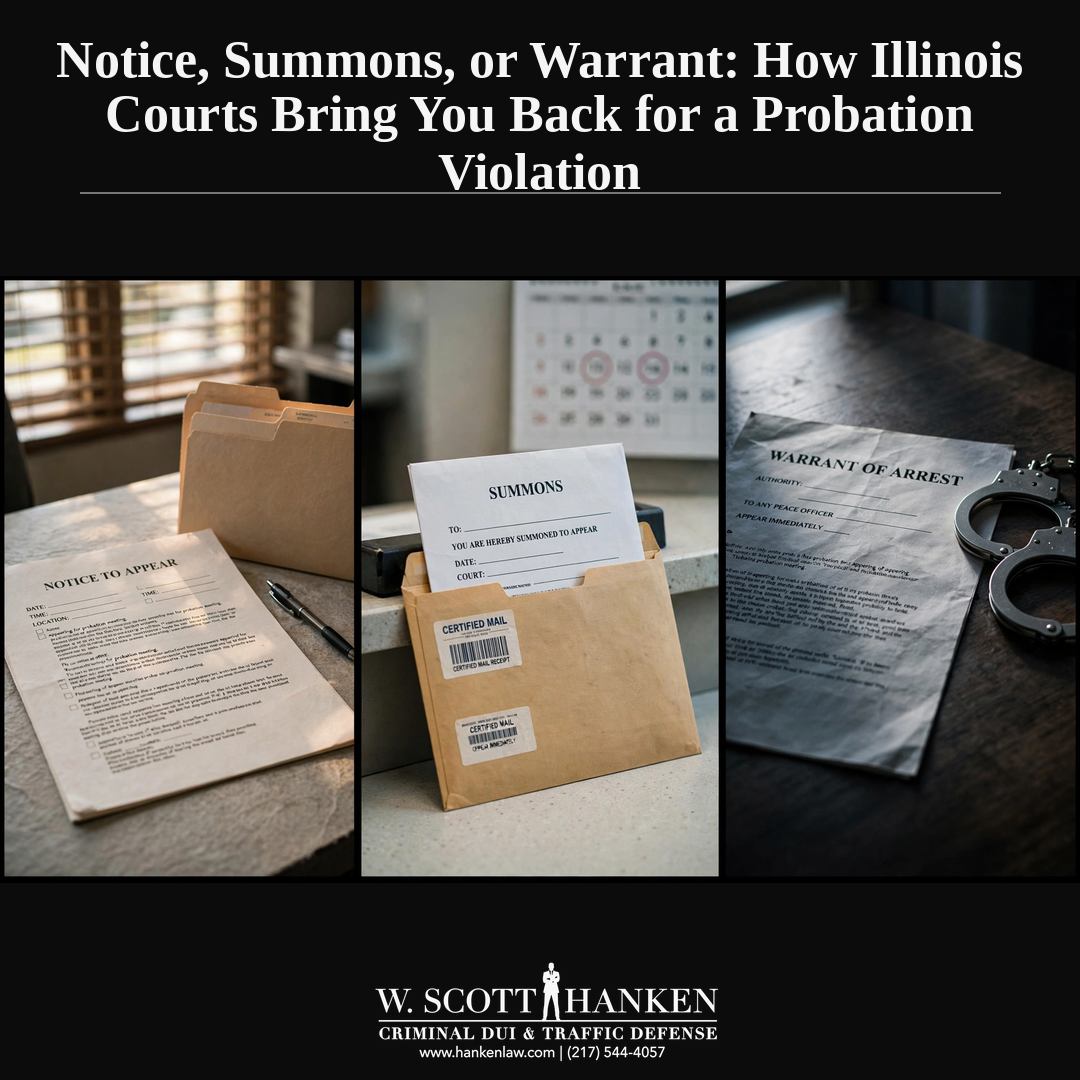
When a petition alleging a probation violation is filed in Illinois, the court doesn’t automatically send police to your door. Under 730 ILCS 5/5-6-4, a judge has three distinct tools available to bring you back before the court — and which one gets used often tells you a lot about how seriously your case is being treated.
Option 1: Notice Through the Probation Department
The least severe option is a notice issued through your probation officer, directing you to appear. This is typically used for minor, first-time, technical issues where the court has no reason to think you’re a flight risk or a danger to anyone.
Option 2: A Court Summons
A summons is a formal, written order requiring you to appear at a hearing on a specific date. It’s more serious than a notice but still doesn’t involve an arrest. Courts often use this option when the alleged violation is more significant, but there’s still no particular concern about you failing to show up.
Option 3: An Arrest Warrant
An arrest warrant is the most serious of the three, and Illinois law reserves it for specific circumstances:
- There’s a concern you might flee the jurisdiction
- There’s a concern about harm to others
- You already failed to respond to an earlier summons or notice
If a warrant has been issued, you may be taken into custody before ever having a chance to explain your side — which is exactly why time matters so much once you learn one exists.
What This Means for Your Case
The method the court chooses isn’t just procedural — it’s a signal. A notice suggests the court sees this as something manageable. A warrant suggests the court has real concerns about compliance or safety. Understanding which category your case falls into helps determine how urgently you need to respond and what kind of defense posture makes sense from the outset.
It’s also worth knowing that once a petition is filed and served — or once the warrant, summons, or notice is issued — your probation clock stops running until the matter is resolved. It doesn’t continue counting down while the violation is pending.
If You’ve Learned a Warrant Has Been Issued
Ignoring a warrant doesn’t make it go away, and it typically makes the underlying situation worse. An attorney can often help you address an outstanding warrant proactively — surrendering on your own terms rather than being picked up unexpectedly — and start building your defense before the hearing.
For the full picture of how a probation violation case unfolds from start to finish, visit our Probation Violation Defense page.
Frequently Asked Questions (FAQs)
A notice is issued through the probation department and is typically used for minor, technical violations. A summons is a formal written order to appear in court, used for more significant violations where the court isn’t worried about you failing to show up. A warrant is an arrest order, reserved for cases where there’s a flight risk, a safety concern, or a failure to respond to an earlier notice or summons.
Illinois law limits warrants to three specific circumstances: a concern you might flee the jurisdiction, a concern about harm to others, or a prior failure to respond to a summons or notice. Absent one of those factors, the court typically starts with the less severe options.
No. Once the petition is served — or once a notice, summons, or warrant is issued — your probation clock stops running. It doesn’t resume until the violation is fully resolved.
A warrant means you can be taken into custody without notice, unlike a notice or summons. That’s part of what makes a warrant more serious — you may not get the chance to explain your side before you’re picked up.
Ignoring it typically makes things worse. An attorney can often help you address it proactively — arranging to surrender on your own terms rather than being picked up unexpectedly — and start building your defense before the hearing.
No. Notice and summons are both non-custodial paths, and Illinois law also allows a probation officer to offer a Notice of Intermediate Sanctions — a set of consequences you can accept without a full revocation hearing — instead of filing a formal violation at all.
Ready to Fight Your Criminal Charge in Springfield?
Call W. Scott Hanken at (217) 544-4057 or contact us online for a free consultation. We serve clients throughout Springfield, Sangamon County, and Central Illinois.
About the Author: W. Scott Hanken, Attorney at Law
Scott Hanken is a Springfield, Illinois criminal defense attorney with over 37 years of experience, including service as a former Sangamon County prosecutor. He has been voted Best Attorney by the Illinois Times and State Journal-Register, holds an Avvo 10.0 “Superb” rating, and has earned over 270 five-star Google reviews. His firm handles DUI defense, drug crimes, traffic violations, violent crimes, and weapons offenses throughout Sangamon County and Central Illinois.
📍 1100 S 5th St, Springfield, IL 62703 | ☎ (217) 544-4057 | 🌐 hankenlaw.com
This article is for general educational purposes only and does not constitute legal advice. Every case is unique — contact an experienced Springfield criminal defense attorney for guidance on your specific situation.

Address
Our offices are located at the corner of South Fifth Street and Vine, in the historic Mary Bryant Home for the Blind.