- Free Consultation: (217) 544-4057 Tap Here To Call Us















Illinois Retail Theft Charges: Why the $300 Line Matters


Last Reviewed & Updated: July 30, 2026
By: W. Scott Hanken | Former Sangamon County Prosecutor | Springfield Criminal Defense & DUI Attorney |
Voted “Best Attorney” — Illinois Times Best of Springfield & State Journal-Register Reader’s Choice | Springfield, IL • Sangamon County • (217) 544-4057 • hankenlaw.com
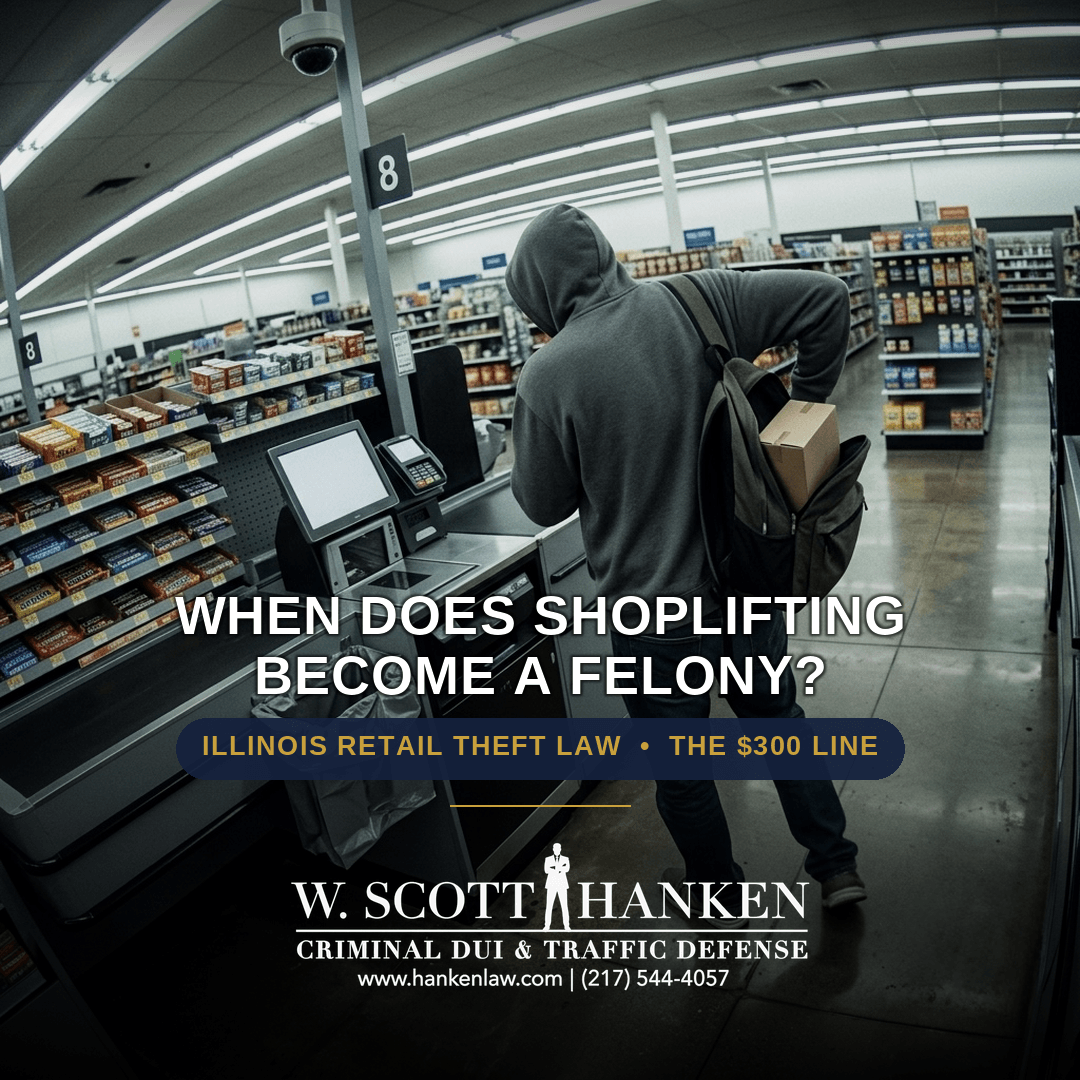
In Illinois, shoplifting merchandise worth more than $300 is retail theft under 720 ILCS 5/16-25 — a Class 3 felony, not a misdemeanor. The general theft statute caps its misdemeanor line at $500, but retail theft cuts that number in nearly half, and it comes with its own set of enhancements. A qualifying prior conviction, a repeat theft detection shielding device offense, or leaving through an emergency exit can each push a retail theft charge into felony territory regardless of the dollar amount involved.
Bottom Line:
If you were stopped by loss prevention or charged with retail theft in Sangamon County, the value the State assigns to what you allegedly took, combined with your prior record and exactly how the theft was carried out, determines whether you are facing a misdemeanor or a felony. Those numbers and facts are worth challenging before you assume the charge is set in stone.
What Counts as Retail Theft Under Illinois Law?
Illinois treats retail theft as its own offense under 720 ILCS 5/16-25, separate from the general theft statute that covers most other property crimes. Most people picture retail theft as walking out of a store with unpaid merchandise in a bag, and that is one way to commit it, but the statute reaches much further. A person commits retail theft by knowingly:
- Taking merchandise from a store without paying full value, intending to keep it or permanently deprive the merchant of it
- Switching, altering, or removing price tags or other markings to pay less than an item’s actual value
- Moving merchandise between containers to disguise its price
- “Under-ringing” an item at checkout
- Taking a shopping cart from the premises without the merchant’s consent
- Falsely claiming ownership of property to obtain money or merchandise credit from a merchant
- Using or possessing a theft detection shielding device (sometimes called a “booster bag”) or a theft detection device remover
- Failing to return leased personal property, or pay its full value, within 10 days of a proper written demand
How Is Retail Theft Different From General Theft in Illinois?
This is the detail most people miss walking into an initial consultation. Illinois’ general theft statute, 720 ILCS 5/16-1, sets its misdemeanor ceiling at property valued up to $500. Retail theft under 720 ILCS 5/16-25 cuts that ceiling to $300 for most merchandise, and to just $150 for motor fuel. Cross that line and a shoplifting case that would have stayed a misdemeanor under general theft law becomes a Class 3 felony under the retail theft statute instead.
| Circumstance | Retail Theft (720 ILCS 5/16-25) | General Theft (720 ILCS 5/16-1) |
|---|---|---|
| Value at/under threshold, no priors, no aggravators | Class A misdemeanor (≤$300 non-fuel / ≤$150 motor fuel) | Class A misdemeanor (≤$500) |
| Value exceeds threshold | Class 3 felony | Class 3 felony ($500–$10,000); escalates further above $10,000 |
| Qualifying prior conviction, value at/under threshold | Class 4 felony regardless of value | Class 4 felony regardless of value |
| Theft by emergency exit, value ≤$300 | Class 4 felony | No emergency-exit provision |
| Theft by emergency exit, value exceeds $300 | Class 2 felony | No emergency-exit provision |
| Theft by emergency exit + qualifying prior conviction, value ≤$300 | Class 3 felony | No emergency-exit provision |
| Theft detection shielding device (“booster bag”), 1st offense | Class A misdemeanor, regardless of merchandise value | Not applicable |
| Theft detection shielding device (“booster bag”), 2nd+ offense | Class 4 felony, regardless of merchandise value | Not applicable |
What Happens When a Retail Theft Charge Involves a Prior Conviction?
A prior conviction can turn a low-value retail theft charge into a felony even when the merchandise itself would never have crossed the $300 line on its own. Under 720 ILCS 5/16-25(f)(2), if you have a previous conviction for theft, robbery, armed robbery, burglary, residential burglary, possession of burglary tools, home invasion, unlawful use of a credit card, or forgery, a retail theft charge that would otherwise be a Class A misdemeanor becomes a Class 4 felony, no matter how little the merchandise was worth. If the theft also involved leaving through a designated emergency exit, that same prior conviction pushes the charge one level higher, to a Class 3 felony.
In 37 years defending theft cases in the Sangamon County Circuit Court, I’ve seen this enhancement charged off a certified copy of conviction that, on closer look, doesn’t actually match one of the nine qualifying offenses. That gap is worth having a defense attorney check before you assume a felony enhancement will hold up.
What Is “Theft by Emergency Exit” and Why Does It Carry Its Own Penalty?
Leaving a store through a designated emergency exit to facilitate a theft is its own aggravating category under 720 ILCS 5/16-25(b), and it carries a heavier sentence than an ordinary retail theft of the same value. At $300 or under, an ordinary retail theft is a Class A misdemeanor, but theft by emergency exit at that same value is a Class 4 felony instead — a felony charge attached to what would otherwise be misdemeanor-level merchandise. Above $300, theft by emergency exit is a Class 2 felony, one level higher than the Class 3 felony that would apply to an ordinary retail theft of the same amount. Combine an emergency-exit theft with a qualifying prior conviction and the charge becomes a Class 3 felony even at $300 or under.
Can a Booster Bag Turn a Misdemeanor Into a Felony?
Yes, and this is one of the more surprising enhancements in the statute. Using or possessing a theft detection shielding device — commonly called a booster bag — or a device designed to remove a store’s theft-detection tags, is its own offense under 720 ILCS 5/16-25(a)(7). A first offense is a Class A misdemeanor. A second or subsequent offense is a Class 4 felony. Notice what is missing from that sentence: a dollar figure. This enhancement runs entirely on the device itself and the defendant’s history with it, independent of what the merchandise inside the bag was worth. Merely possessing a booster bag also gives a merchant reasonable grounds to detain someone under the detention statute discussed below, even before any merchandise has been found.
Can a Store Legally Detain Me If They Think I Shoplifted?
Illinois’ merchant detention statute, 720 ILCS 5/16-26, allows store personnel who have reasonable grounds to believe a retail theft occurred to detain a person, on or off the premises, in a reasonable manner and for a reasonable length of time, to request identification, investigate ownership of merchandise, or turn the person over to police. Off-premises detention is only allowed if it happens during immediate pursuit of the person. Under the statute, mere possession of a theft detection shielding device or a device remover is, by itself, enough to establish reasonable grounds. How a stop was actually conducted — its length, what was said, whether force was used — can become relevant to a defense, even though an improper detention is not, on its own, a defense to the underlying charge.
What Does 37 Years of Sangamon County Retail Theft Cases Actually Look Like?
In my 37 years defending clients in the Sangamon County Circuit Court, the cases that turn into felonies rarely start out looking like felonies. A store’s loss prevention report will sometimes list a total retail value that includes items recovered before the person ever left the building, or it will aggregate several visits to the same chain over months to clear the $300 line under the continuing-course-of-conduct provision in 720 ILCS 5/16-25(f)(3). Both of those numbers are contestable. The State has to prove value as an element of the offense once a felony-level amount is charged, and a Springfield judge is not going to take a merchant’s number on faith if the defense puts the receipt, the price tag, or the inventory record in front of them.
What if I have an old theft conviction but the merchandise this time was under $300?
The dollar amount alone will not save you from a felony if a qualifying prior conviction applies. Under 720 ILCS 5/16-25(f)(2), a prior conviction for theft, robbery, armed robbery, burglary, residential burglary, possession of burglary tools, home invasion, unlawful use of a credit card, or forgery converts an otherwise Class A misdemeanor retail theft into a Class 4 felony regardless of value. In Sangamon County, I’ve seen this charged off convictions ten or fifteen years old, and off out-of-state convictions a prosecutor assumed, incorrectly, qualified under the Illinois list.
What if I left through an emergency exit but didn’t realize it was monitored?
The statute does not require you to know the exit triggers an alarm, only that you used it to facilitate the theft. 720 ILCS 5/16-25(b) defines theft by emergency exit without a knowledge element tied to the exit’s monitoring status, and it carries a Class 4 felony at $300 or under. Whether the exit was clearly marked and whether your use of it was actually connected to facilitating the theft, rather than simple proximity, is often where the real defense in these cases lives.
What if loss prevention held me for over an hour before police arrived?
The detention statute only protects a “reasonable” length and manner of detention, not any length a merchant chooses. 720 ILCS 5/16-26 permits detention for a reasonable time in a reasonable manner, and an unreasonable detention does not by itself defeat the underlying charge, but it can affect what evidence is admissible and how a case gets resolved. An hour-long hold with no police contact and no clear investigative purpose is the kind of fact pattern that belongs in a motion, not something to raise for the first time at trial.
Frequently Asked Questions (FAQs)
Value alone will not get you there. But a prior conviction for theft, robbery, armed robbery, burglary, residential burglary, possession of burglary tools, home invasion, unlawful use of a credit card, or forgery can push even a low-value retail theft charge up to a Class 4 felony regardless of the dollar amount, and up to a Class 3 felony if the theft also involved an emergency exit.
They are separate statutes with separate thresholds. Retail theft, 720 ILCS 5/16-25, applies to merchandise taken from a retail establishment and caps its misdemeanor line at $300 for most goods and $150 for motor fuel. General theft, 720 ILCS 5/16-1, covers a broader range of property and sets its misdemeanor ceiling at $500.
Illinois’ merchant detention statute, 720 ILCS 5/16-26, allows a reasonable detention on or off the premises to investigate suspected retail theft, but the length and manner of that detention have legal limits, and off-premises detention is only permitted during immediate pursuit. Whether a specific stop was handled reasonably is a fact-specific question worth having reviewed.
Not necessarily. A first-offense, low-value retail theft charge is typically a Class A misdemeanor carrying up to 364 days in the Sangamon County Jail, and actual outcomes vary based on the specific facts, your record, and how the case is handled.
Yes, on a second or subsequent offense. Using or possessing a theft detection shielding device or theft detection device remover is a Class A misdemeanor the first time and a Class 4 felony every time after that, regardless of what merchandise, if any, was involved.
If the State can show you used the exit to facilitate the theft, yes. Theft by emergency exit is a Class 4 felony at $300 or under and a Class 2 felony above $300 — one classification level higher than an ordinary retail theft of the same value.
Ready to Fight Your Theft Charge in Springfield?
Call W. Scott Hanken at (217) 544-4057 or contact us online for a free consultation. We serve clients throughout Springfield, Sangamon County, and Central Illinois.
About the Author: W. Scott Hanken, Attorney at Law
Scott Hanken is a Springfield, Illinois criminal defense attorney with over 37 years of experience, including service as a former Sangamon County prosecutor. He has been voted Best Attorney by the Illinois Times and State Journal-Register, holds an Avvo 10.0 “Superb” rating, and has earned over 270 five-star Google reviews. His firm handles DUI defense, drug crimes, traffic violations, violent crimes, and weapons offenses throughout Sangamon County and Central Illinois.
📍 1100 S 5th St, Springfield, IL 62703 | ☎ (217) 544-4057 | 🌐 hankenlaw.com

Address
Our offices are located at the corner of South Fifth Street and Vine, in the historic Mary Bryant Home for the Blind.