- Free Consultation: (217) 544-4057 Tap Here To Call Us














Police Drones and Surveillance in Springfield, Illinois: What Your Rights Are — and Why They Matter Right Now


By: W. Scott Hanken | Former Sangamon County Prosecutor | Springfield Criminal Defense & DUI Attorney |
Voted “Best Attorney” — Illinois Times Best of Springfield & State Journal-Register Reader’s Choice | Springfield, IL • Sangamon County • (217) 544-4057 • hankenlaw.com
Springfield, Illinois is watching. And the eyes doing the watching are now airborne.
If you attended the Springfield City Tournament at the BOS Center, walked in a downtown 5K, or wound up at a summer block party in Sangamon County, there is a real chance a police drone circled overhead. The Springfield Police Department owns eight drones — confirmed by its own mandatory reporting to the state — and conducted 30 documented flights in a single year. At the same time, SPD has launched an aggressive campaign targeting pop-up parties throughout Springfield, using video surveillance, license plate readers, and its new Real Time Information Center to identify and respond to unlicensed gatherings before they grow.
This is not speculation. This is documented, verified local policy.
As a former prosecutor who spent years on the State’s Attorney’s side of these cases, I understand why law enforcement wants these tools. I also understand — better than most — where those tools cross a constitutional line. And on June 29, 2026, the United States Supreme Court drew that line more sharply than it ever has before.
Here is what every Springfield resident needs to know.
What Is the Springfield Police Department Actually Doing With Drones?
The Numbers: Verified by the State of Illinois
Under the Illinois Freedom from Drone Surveillance Act, every law enforcement agency that owns drones must file an annual report with the Illinois Criminal Justice Information Authority (ICJIA). Those reports are public record. The State Fiscal Year 2025 ICJIA Drone Surveillance Act Report — covering April 1, 2024 through March 31, 2025 — contains the following confirmed data for the Springfield Police Department:
- Drones owned: 8
- Drone flights conducted (April 2024 through March 2025): 30
- Source: ICJIA SFY 2025 Freedom from Drone Surveillance Act Report, Appendix D (published July 1, 2025)
Eight drones is a substantial fleet. The statewide mean for Illinois departments is three drones per agency, and the median is two. SPD’s fleet places it well above both. Statewide, 195 agencies reported drone ownership across 586 total drones and 7,859 flights — and the most cited reason for drone deployment across all Illinois departments was monitoring public events such as parades, festivals, and concerts. Pop-up party surveillance fits squarely in that category.
The Hardware
SPD has built out a professional UAV (Unmanned Aerial Vehicle) unit. Modern law enforcement drones of the class now used by Illinois departments carry multiple camera systems — standard optical, high-powered zoom, and infrared thermal imaging capable of detecting body heat. FAA regulations require a certified remote pilot in command and a separate visual observer for each flight, meaning every deployment involves at minimum two dedicated personnel conducting active real-time surveillance.
The Illinois Attorney General’s non-regulatory guidance on drone use confirms that information-gathering by drones includes taking photographs, recording video, collecting biometrics including body temperatures through thermal detection, and live-streaming video footage from the drone to a member of the law enforcement agency. Every one of those capabilities is active in SPD’s current fleet.
The Required Public Policy
Illinois law requires SPD to post a drone policy publicly on its website (725 ILCS 167/35(c)). The SPD General Orders transparency page lists body camera, rules of conduct, and other operational policies — but a UAS or drone general order does not appear in the publicly indexed list. SPD’s drone policy was filed with ICJIA as part of its annual reporting and is available through the ICJIA drone reporting portal. If you or your attorney need a copy of SPD’s standing orders governing drone deployment, that portal and a FOIA request to the City Clerk are the fastest routes.
One critical provision that any compliant SPD drone policy must include under the Attorney General’s guidance: the agency must immediately take action to prevent future violations of the Act once it learns of a violation. If a drone pilot willfully and wantonly violates the Act, the agency must immediately remove that pilot from the drone program.
SPD has confirmed the following deployment purposes:
- Finding missing persons and missing children
- Aerial overwatch at crime scenes
- Responding to disturbances and areas prone to violence
- Monitoring large public events — including a confirmed Springfield 5K event where drones provided crowd monitoring and emergency response overwatch
- Surveillance of areas where pop-up parties are anticipated
That last category is the one that raises constitutional questions.
The Pop-Up Party Crackdown: Ground-Level Surveillance in Springfield
Drones are only part of the picture. Springfield has made pop-up parties a law enforcement priority, and the tools deployed go far beyond patrol cars.
In April 2025, WAND-TV reported that SPD announced plans to use video surveillance cameras and license plate readers to prevent and respond to illegal gatherings. An 18-year-old had been killed near Illinois State University at a party with over 1,000 people — that incident shaped Springfield’s enforcement approach.
By May 2026, Fox Illinois reported that SPD was deploying 15 additional officers and 3 supervisors every Saturday specifically for block party enforcement. Chief Joe Behl told reporters the department monitors open-source data and social media continuously. “Fridays and Saturdays are typically our busiest. Saturday is really the day that we really get after it with our proactive patrols.”
The enforcement consequences are serious:
- $250 minimum fine for sponsoring or promoting a special event without a required license
- $10,000 minimum fine (up to $50,000) if an unlicensed event triggers any police response — emergency or non-emergency
- Potential felony mob action charge for participants
Springfield’s new Real Time Information Center, which opened in January 2026, centralizes this surveillance capability. It aggregates live feeds, social media monitoring, and license plate reader data. According to Chief Behl, it has already improved response efficiency — allowing police to determine how many units to dispatch rather than reflexively flooding a scene.
One number worth knowing: Springfield has 135 Flock Safety license plate reader cameras deployed throughout the city, according to Capitol News Illinois reporting from August 2025. That network records detections around the clock. When those cameras work in combination with eight SPD drones and the Real Time Information Center, the result is a surveillance system capable of reconstructing your movements before, during, and after any gathering in Springfield.
You may not see the cameras. They are seeing you.
What Illinois Law Actually Says About Police Drones
The Ten Exceptions — and Their Hard Limits
Illinois was ahead of the curve on drone regulation. In 2013, the state passed the Freedom from Drone Surveillance Act (725 ILCS 167), one of the first such laws in the country. The Drones as First Responders Act, signed by Governor Pritzker on June 16, 2023, amended and expanded it.
The baseline rule is strict: a law enforcement agency may not use a drone to gather information except in ten narrowly defined exceptions. The Illinois Attorney General has issued formal non-regulatory guidance to all Illinois law enforcement agencies detailing each exception and its limits. Those exceptions include:
- Countering a specific, credible terrorist threat (requires U.S. Secretary of Homeland Security determination)
- With a search warrant — limited to 45 days, renewable by a judge
- Imminent harm to life, imminent suspect escape, or evidence destruction — limited to 48 hours; requires written report to the local State’s Attorney within 24 hours
- Missing person searches and search-and-rescue — but not as part of a criminal investigation
- Crime scene and traffic crash photography — geographically confined and time-limited
- Disasters and declared public health emergencies
- Infrastructure inspection at express request of a local government agency
- Public relations demonstrations — no information may be collected or recorded
- 911 response — but only to locate victims, assist with immediate safety needs, or coordinate emergency vehicles
- Routed or special events — subject to strict advance notice and use restrictions
Information collected in violation of the Act’s limitations shall be presumed to be inadmissible in any judicial or administrative proceeding (725 ILCS 167/30). That presumption of inadmissibility is one of the strongest remedies in the statute and the foundation of suppression arguments in Sangamon County courtrooms.
The Special-Event Exception: What It Covers and What It Doesn’t
The special-event exception is the provision most relevant to Springfield’s deployment at pop-up party responses and large public gatherings. It came into law after the 2022 Highland Park Fourth of July mass shooting, when the legislature expanded police authority specifically to monitor outdoor gatherings for active threats.
Under the special-event exception, SPD may use drones during an event only to: detect a breach of event space including an unauthorized vehicle or barricade breach; evaluate crowd size and density; identify activity creating a public safety issue for the crowd as a whole; assist in the response of personnel to a real-time public safety incident; and assess traffic and pedestrian flow. That is an exhaustive list — not a general surveillance authorization.
Several hard requirements apply before the exception activates:
- The event must be a parade, walk, race, concert, or food festival hosted by the State, a county, a municipality, a township, or a park district — outdoors and open to the public
- Attendance thresholds must be met (more than 50 for routed events; 150 to 500 or more for special events depending on the population of the hosting government unit)
- Notice must be posted at the event location and at major entry points for at least 24 hours before the event, clearly communicating that drones may be used for real-time monitoring of participant safety
A pop-up party, by definition, satisfies none of these requirements. No government unit is hosting it. No 24-hour notice has been posted. The special-event exception does not apply. Any drone surveillance of an unannounced pop-up gathering requires a separate Section 15 exception — most likely the imminent-harm exception, which carries its own strict requirements including a written report to the Sangamon County State’s Attorney within 24 hours.
Protests: Categorically Excluded by Statute
Political protests, marches, demonstrations, or other assemblies protected by the First Amendment are expressly not routed events or special events under the Act (725 ILCS 167/5). The Attorney General’s guidance states this exclusion applies regardless of location, size, particular cause, or permit status of the First Amendment protected event or assembly. Specific examples the AG identifies as protected from drone surveillance:
- A permitted rally at a public forum such as a city plaza
- An unpermitted sidewalk protest targeting a government facility
- A protest march along public streets — whether permitted or unpermitted
- An unpermitted demonstration by protestors at a routed or special event
The AG further notes: where an event includes both a permitted drone use and First Amendment protected activity — such as a political group marching in an Independence Day parade — law enforcement may not use the drone to gather information on the First Amendment protected assembly, such as gathering information on protesters’ identities.
Absolute Prohibitions That Apply in Every Case
Even when a flight is otherwise lawful under one of the ten exceptions, three absolute prohibitions apply regardless:
- No warrantless searches in violation of the Fourth Amendment. The AG guidance cites Kyllo v. United States (2001) — law enforcement may infringe a homeowner’s reasonable expectation of privacy by using thermal imaging to measure heat inside a home. Accordingly, law enforcement must first obtain a search warrant before using a drone to collect information from a space in which people have a reasonable expectation of privacy.
- No onboard facial recognition software — absolute prohibition during any flight (725 ILCS 167/17). Post-flight use of facial recognition on drone footage is also heavily restricted.
- No lethal or non-lethal weapons of any kind — no firearm, weaponized laser, kinetic impact projectile, chemical agent, irritant, or any other weapon (725 ILCS 167/18).
The AG also notes that using a drone to gather information on routine patrols of city neighborhoods is a violation of the Act unless a specific Section 15 exception applies. Neighborhood surveillance without an active, qualifying purpose is expressly prohibited.
Data Retention: The 24-Hour Clock and the Brady Obligation
Data retention under the Act depends on which exception authorized the flight. For most categories — warrants, missing persons, crime scenes, and 911 responses — gathered data must be destroyed within 30 days (725 ILCS 167/20(a)(1)). But for data gathered under the special-event exception, paragraph 10 of Section 15, the law requires destruction within 24 hours (725 ILCS 167/20(a)(2)).
A supervisor may authorize retention only if there is reasonable suspicion the footage contains evidence of criminal activity, the footage is relevant to an ongoing investigation or pending criminal trial, it will be used exclusively for training purposes without personally identifiable information, or it is only flight path data and telemetry.
Critically — and this is something most defense attorneys miss — the Attorney General’s guidance expressly states that agencies conducting investigations using drone footage must comply with their Brady obligations. Brady v. Maryland requires prosecutors to disclose evidence favorable to the accused. Drone footage that shows you were not doing what police claim, or that undermines the officer’s account of events, must be disclosed by the prosecution. If that footage has been destroyed in violation of Brady or in violation of the Act’s retention requirements, that destruction itself becomes a defense argument.
All law enforcement records of drone use — including flight path data, metadata, and telemetry — are expressly subject to the Illinois Freedom of Information Act (725 ILCS 167/25(b)). SPD’s complete flight logs, the dates and locations of every flight, and the policy document governing their drone program are all FOIA-able. Filing that FOIA request immediately after an arrest involving drone surveillance may be the most important step you take.
Attorney General Enforcement: Real Consequences for SPD
The Illinois Attorney General has express statutory authority to investigate patterns and practices of violations of the Act — including the right to request sworn written statements, conduct examinations, and issue subpoenas. If the OAG demonstrates a pattern or practice of violations and obtains an adverse judgment, the law enforcement agency forfeits its ability to use drones for not less than six months for a first adverse judgment and up to one year for a second. The OAG has a Civil Rights Hotline at (877) 581-3692 for reporting suspected violations.
What Is Your Constitutional Question?
What Fourth Amendment rights do I have when police use drones to surveil a public gathering I attended?
The short answer: You have more rights than most people realize, and this area of law is actively evolving in your favor — particularly after a landmark Supreme Court ruling issued on June 29, 2026.
The Foundation: Carpenter v. United States (2018)
Under the Fourth Amendment, government searches require either a warrant or a recognized exception. For decades, courts applied a simple rule: what can be seen from public airspace is not a search. That was the doctrine from California v. Ciraolo (1986) and Florida v. Riley (1989). Drones are different from a plane at 1,000 feet.
The landmark that changed the analysis is Carpenter v. United States, 585 U.S. 296 (2018). The Supreme Court held that the government needed a warrant to access historical cell phone location data — even though that data was held by a third-party carrier. Chief Justice Roberts wrote that technology enabling detailed, encyclopedic, and effortlessly compiled surveillance implicates the Fourth Amendment regardless of whether a technical public-space exception might once have applied. The Fourth Amendment, the Court said, was designed to place obstacles in the way of a too permeating police surveillance.
The AG’s own guidance cites Kyllo v. United States (2001) in the same spirit: thermal imaging technology that reveals what is happening inside a private space constitutes a search requiring a warrant. SPD’s drones carry exactly that thermal imaging capability.
The New Ruling: Chatrie v. United States (June 29, 2026)
On June 29, 2026, the Supreme Court decided Chatrie v. United States, No. 25-112, extending Carpenter in ways that directly affect how Springfield’s surveillance apparatus must be evaluated.
The facts: Police used a geofence warrant directing Google to produce cell phone location data for every device within a 150-meter radius of a Virginia credit union during a robbery. Through a three-step process, Google identified Okello Chatrie, whose location data showed he entered the area before the robbery and left immediately after. Chatrie moved to suppress. The Supreme Court agreed on the core question: accessing his Google Location History was a Fourth Amendment search.
Justice Kagan, writing for a five-justice majority on the reasoning — six justices on the outcome, with Justice Gorsuch concurring in the judgment only on separate property-based grounds — held that individuals have a reasonable expectation of privacy in their cell phone location information even when held by a third party, and even when only two hours of data are involved.
The Court emphasized three points critical to Springfield:
- Location History pinpoints a phone within 20 meters, recording every two minutes — 720 data points per day. It can determine which floor of a building a person occupies. This precision far exceeds what the Court had previously evaluated.
- Government access to location data enables tireless and absolute surveillance of any number of people in any number of places — public and private — at the click of a button. That capability is constitutionally significant regardless of the duration reviewed. Even two hours of data can reveal familial, political, professional, religious, and sexual associations.
- The third-party doctrine does not shield government access to this data. The fact that location information passes through Google does not mean a person has voluntarily shared it in any meaningful constitutional sense.
Why Chatrie Matters for SPD’s Eight-Drone Fleet
The connection between Chatrie and Springfield’s surveillance system is direct and powerful. Consider what SPD’s apparatus does during a pop-up party response: the Real Time Information Center aggregates social media data, live camera feeds, and license plate reader detections in real time; eight drones provide aerial video with thermal imaging and zoom capability, tracking individuals’ movements within a defined geographic area; and 135 Flock Safety cameras record every license plate moving through Springfield streets, creating a retrospective record of who was where and when. Taken together, this system can reconstruct — at the click of a button — the movements of every person who attended or left a gathering.
That is precisely the capacity Chatrie found constitutionally significant. The Court explicitly recognized that even short-term monitoring can reveal sensitive associations, and that retrospective surveillance of people’s movements at a specific place and time implicates the Fourth Amendment regardless of duration.
Chatrie does not automatically render all drone evidence inadmissible. What it does is establish that gathering comprehensive location and movement data about people at a specific place and time is a Fourth Amendment search — one requiring a valid warrant, supported by probable cause, with particularity in its scope. Where that warrant is missing, deficient, or pretextual, the evidence may be suppressed. And Illinois law adds a second, independent layer: the presumption of inadmissibility built into the Freedom from Drone Surveillance Act itself.
The First Amendment Dimension
Chatrie implicitly reinforces a First Amendment concern the Illinois legislature already addressed by statute. The Court observed that Location History can reveal someone’s presence at a political rally — and that even short-term access to that data implicates protected associations. The Attorney General’s drone guidance goes further, explicitly stating that law enforcement agencies should be sensitive to the potential chilling effect that drone presence may have on First Amendment protected activity. That chilling effect — where people stop attending public events because they know they are being filmed and catalogued — is a recognized constitutional harm.
The Pretextual Stop Problem: Drones, Cameras, and the DUI That Follows
Here is the scenario that raises serious legal questions, and it is already playing out in Springfield.
SPD identifies a gathering through social media monitoring or its Real Time Information Center. Patrol units deploy. Drones provide aerial overwatch. When people leave, the 135 Flock Safety cameras capture every license plate. An officer, using drone footage or plate reader data, decides to follow a vehicle and make a traffic stop.
The stop may be entirely lawful. Or it may be pretextual — an officer using a technical traffic violation as a justification to investigate something else entirely. Under Illinois and federal law, the AG’s guidance confirms that using a drone to gather information on routine patrols of city neighborhoods is itself a violation of the Act. If the identification of your vehicle depended on drone surveillance that exceeded legal authority, or on aggregated location data compiled without a warrant, the foundation of the stop may be constitutionally compromised.
The exclusionary rule requires courts to suppress evidence obtained as the fruit of an unlawful search. That includes not just the primary evidence but everything that flows from it — the traffic stop, the officer’s observations, field sobriety tests, and breathalyzer results. Chatrie reinforces this analysis: if the data used to identify and follow your vehicle was gathered without a valid warrant, its use to initiate a stop may not survive constitutional scrutiny.
Based on my experience as a prosecutor, I know that pretextual stops are among the most common tools police use to investigate activity they cannot yet prove. Courts take Fourth Amendment violations seriously when they are challenged properly and promptly. The 24-hour destruction clock on special-event drone footage means that promptness is not optional.
Further Reading:
For the constitutional mechanics of how a bad stop can collapse an entire DUI case: 3 Proven Ways to Beat a DUI in Springfield, IL
For field sobriety test issues after a questionable stop: Common Field Sobriety Test Mistakes in Sangamon County
For how minor traffic infractions become pretextual DUI stops: Illinois License Plate Cover Law
A Note From the Defense Side
I have defended Springfield and Sangamon County residents for 37 years. I was a DUI and criminal prosecutor before that. I know exactly how these cases are built — and I know how they fall apart.
I am not here to argue that police technology is inherently wrong. Drones find missing children. They locate fleeing suspects. SPD’s program has produced real public safety results. I respect that.
What I will argue — in a courtroom, in front of any Sangamon County judge — is that the law means what it says. The Freedom from Drone Surveillance Act has specific requirements. The Attorney General has issued guidance on what compliance looks like and what violations look like. The Fourth Amendment has specific requirements. And Chatrie v. United States, decided June 29, 2026, has now confirmed at the highest level that comprehensive surveillance of people’s movements requires constitutional justification.
When those boundaries are crossed — when drone footage is gathered without proper authority, when the 24-hour notice requirement is skipped, when aggregated surveillance data is used to initiate a stop without a warrant — the remedy is suppression. I have handled these arguments for 37 years. I know which ones work.
Frequently Asked Questions (FAQs)
Eight — confirmed by SPD’s own mandatory report to the Illinois Criminal Justice Information Authority for State Fiscal Year 2025 (April 2024 through March 2025). SPD conducted 30 documented drone flights during that period. This is primary source data, not a news estimate. The full ICJIA report is publicly available at icjia.illinois.gov/innovation-and-digital-services/drone/.
Generally, no. The Illinois Freedom from Drone Surveillance Act (725 ILCS 167) requires a warrant or a specific statutory exception for every drone flight that gathers information. The special-event exception requires 24-hour advance public notice and a government-hosted, qualifying event — a pop-up party satisfies none of those requirements. The Attorney General’s guidance also expressly states that using a drone to gather information on routine neighborhood patrols is a violation of the Act. Footage gathered in violation of the Act is presumed inadmissible under Section 30.
Chatrie v. United States, 609 U.S. _ (2026), held that accessing comprehensive cell phone location data is a Fourth Amendment search requiring a valid warrant — even for just two hours of data, and even when that data is held by a third party like Google. If SPD compiled your movements through its eight drones, 135 Flock Safety cameras, or the Real Time Information Center without a proper warrant, Chatrie supports suppression of that evidence. Call (217) 544-4057 immediately — the 24-hour destruction clock is already running.
No. Illinois law imposes an absolute prohibition on using onboard facial recognition software during any drone flight (725 ILCS 167/17). Post-flight use of facial recognition on drone footage is also heavily restricted — permitted only for specific terrorism or imminent-harm scenarios. This prohibition applies to every flight, regardless of which Section 15 exception authorized it. If facial recognition was used on footage from an event you attended, that is a direct violation of the Act.
Potentially yes — in two ways. First, if the stop was connected to unlawful surveillance or pretextual motives, the evidence may be suppressible under the Fourth Amendment and Chatrie. Second, under the Brady doctrine, any drone footage favorable to your defense must be disclosed by the prosecution — the Attorney General’s guidance expressly states this. If that footage was destroyed in violation of Brady or the Act’s retention requirements, that destruction itself becomes a defense argument. Call (217) 544-4057 immediately.
This is an active legal question. Springfield has 135 Flock Safety cameras deployed citywide. Under Carpenter (2018) and now Chatrie (2026), aggregated tracking of a person’s movements without a warrant may be constitutionally problematic. The Chatrie Court specifically recognized that even two hours of location data can reveal sensitive personal information. When license plate reader data is combined with drone footage and social media monitoring — as in SPD’s Real Time Information Center model — the aggregate surveillance raises serious constitutional concerns worth challenging.
Organizing or promoting an unlicensed event carries a minimum $250 fine. If any police response results, the minimum fine jumps to $10,000 — up to $50,000. Participants also risk a felony mob action charge depending on circumstances. Criminal charges of this kind require immediate legal counsel.
Two routes. First, under 725 ILCS 167/25(b), all law enforcement records of drone use including flight path data, metadata, and telemetry are expressly subject to the Illinois Freedom of Information Act. File a FOIA request directly with the City Clerk at cityclerk.springfield.il.us/FOIA/. Second, SPD’s drone policy and flight logs were submitted to ICJIA as part of its annual reporting and are available at icjia.illinois.gov/innovation-and-digital-services/drone/. If you were arrested and drone footage may be involved, have your attorney file immediately — the 24-hour destruction clock for special-event footage is not forgiving.
Stay calm. Provide your name. Say nothing else. Do not consent to any search. Contact W. Scott Hanken immediately at (217) 544-4057. Under Illinois law, drone footage gathered under the special-event exception must be destroyed within 24 hours. Digital surveillance data from the Real Time Information Center and Flock Safety cameras can also be lost or overwritten quickly. Time is absolutely critical.
The Bottom Line for Springfield Residents
The Springfield Police Department owns eight drones. It conducted 30 documented flights in a single year. It operates 135 license plate reader cameras across the city. It runs a Real Time Information Center that aggregates drone feeds, social media monitoring, and plate reader data in real time. It deploys 15 additional officers every Saturday targeting pop-up gatherings.
None of that means the evidence they collect is automatically valid. Illinois law and the U.S. Constitution set boundaries. Drone footage at a pop-up party or special event must be destroyed within 24 hours. The 24-hour advance notice requirement must be met before any special-event deployment. Facial recognition is absolutely prohibited. Neighborhood patrol surveillance without a qualifying exception is a violation of the Act. Brady requires disclosure of drone footage favorable to the defense. And Chatrie v. United States — decided June 29, 2026 — confirms at the highest constitutional level that comprehensive surveillance of people’s movements requires a warrant.
When those boundaries are crossed, that is where I go to work.
If you or someone you know was arrested in connection with a pop-up party, a large public event, or any situation where surveillance technology played a role, call me. I offer free same-day consultations. I have 37 years of experience in these courts. I know the prosecutors, the judges, and the system.
More importantly: I know when your rights were violated.
Ready to Fight Your Criminal Charge in Springfield?
Call W. Scott Hanken at (217) 544-4057 or contact us online for a free consultation. We serve clients throughout Springfield, Sangamon County, and Central Illinois.
About the Author: W. Scott Hanken, Attorney at Law
Scott Hanken is a Springfield, Illinois criminal defense attorney with over 37 years of experience, including service as a former Sangamon County prosecutor. He has been voted Best Attorney by the Illinois Times and State Journal-Register, holds an Avvo 10.0 “Superb” rating, and has earned over 270 five-star Google reviews. His firm handles DUI defense, drug crimes, traffic violations, violent crimes, and weapons offenses throughout Sangamon County and Central Illinois.
📍 1100 S 5th St, Springfield, IL 62703 | ☎ (217) 544-4057 | 🌐 hankenlaw.com
This article is for general educational purposes only and does not constitute legal advice. Every case is unique — contact an experienced Springfield criminal defense attorney for guidance on your specific situation.
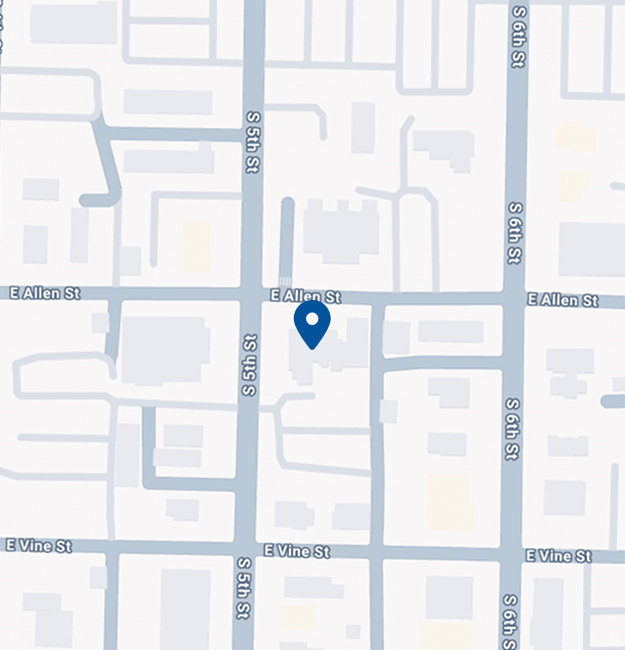
Address
Our offices are located at the corner of South Fifth Street and Vine, in the historic Mary Bryant Home for the Blind.