- Free Consultation: (217) 544-4057 Tap Here To Call Us














Probation Revocation in Springfield, Illinois: Your Questions Answered


By: W. Scott Hanken | Former Sangamon County Prosecutor | Springfield Criminal Defense & DUI Attorney |
Voted “Best Attorney” — Illinois Times Best of Springfield & State Journal-Register Reader’s Choice | Springfield, IL • Sangamon County • (217) 544-4057 • hankenlaw.com
The short answer:
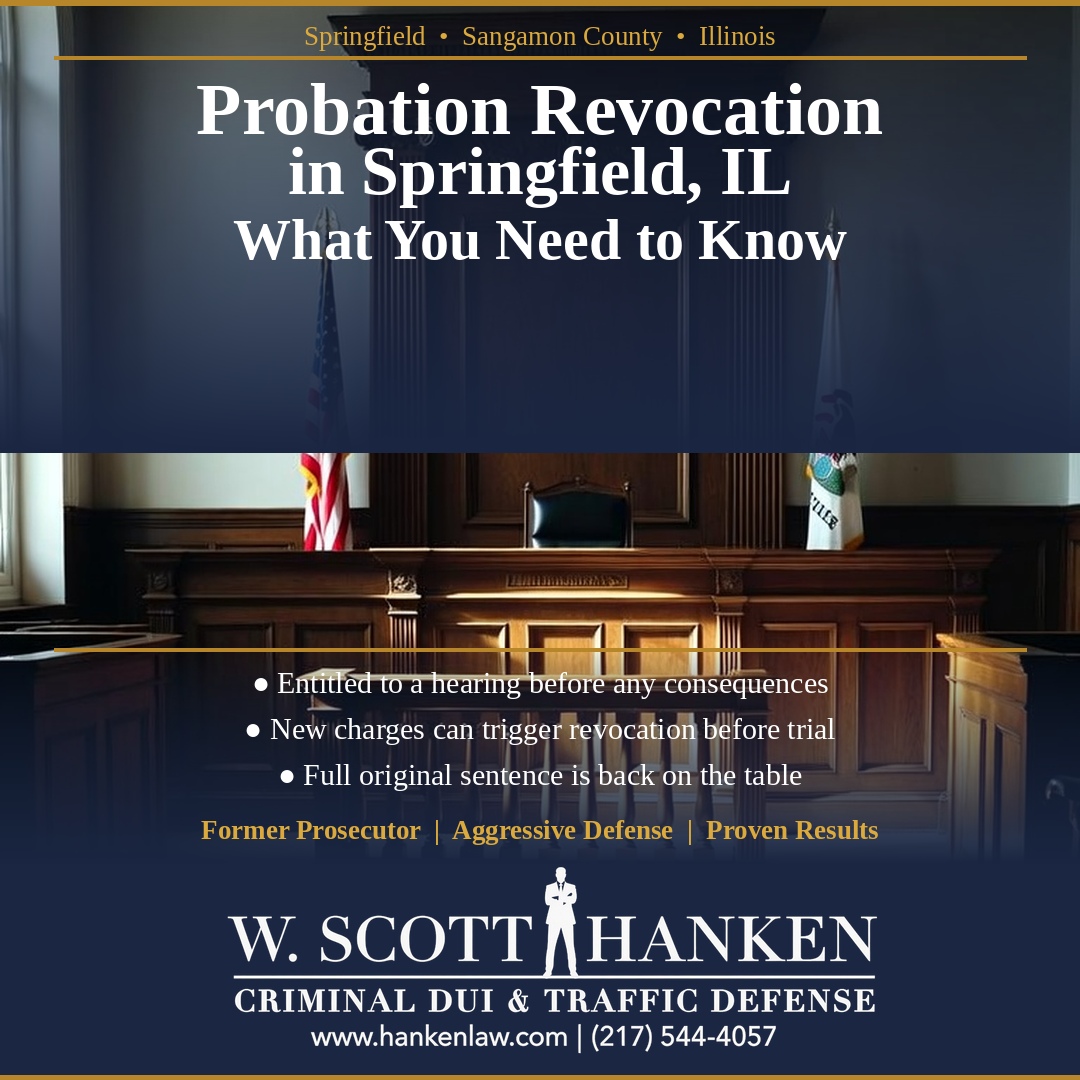
If Sangamon County alleges you violated probation, you are entitled to a hearing before any consequences hit. The State has to prove the violation by a preponderance of the evidence, and for financial conditions they must show your failure was willful. If the judge revokes probation, you face re-sentencing on the original charge — including everything that was on the table the day you were first sentenced.
Got a letter, a warrant, or a call from your probation officer? Call (217) 544-4057. Don’t wait for the court date to start building your response.
Why This Matters More Than You Think
A probation violation isn’t a slap on the wrist. It’s a second chance at the sentence you avoided the first time around.
I started my career as a prosecutor in the Sangamon County State’s Attorney’s Office. That experience gave me invaluable insight into how the State prepares, presents, and evaluates these cases — insight I’ve carried into decades of defense work since. Here’s what I’ve learned: most people don’t lose probation because they’re bad people. They lose it because nobody explained the rules clearly, or because life got in the way and they didn’t know what to do next.
This document walks through the most common questions I get about petitions to revoke probation (often called a “PTR”) in Springfield and across Sangamon County. It is not a substitute for legal advice on your specific case. But it should help you understand what’s coming, and why getting ahead of it matters.
What Is a Petition to Revoke Probation?
A petition to revoke probation is a formal filing asking the court to find that you violated one or more conditions of your probation. It’s filed by the probation department or the State’s Attorney’s Office, and it kicks off a new court process separate from your original case.
Under Illinois law, specifically 730 ILCS 5/5-6-4, filing this petition (or the issuance of a related warrant or summons) actually pauses your probation clock. Your probation term stops running until the violation is resolved. So even if you’re three months from completing probation, a pending petition can leave you in limbo well past that date.
What Has to Be Alleged in the Petition?
The petition has to identify what condition of probation you allegedly violated and how. While the statute doesn’t spell out a detailed pleading standard for the petition itself, Illinois courts have long held that a probationer is entitled to fair notice of what they’re accused of doing or failing to do. That principle flows from basic due process, not from a single statutory subsection.
What does that mean practically? Vague or conclusory petitions that simply assert a “violation of probation” without identifying the specific condition or the underlying conduct are challengeable. The defense has every right to demand specificity, and judges expect it.
Common allegations I see in Sangamon County include:
- Missing a required check-in with your probation officer
- Failing or missing a drug or alcohol test
- Not completing court-ordered classes, treatment, or community service
- Failing to pay fines, fees, or restitution
- Picking up a new criminal charge while on probation
- Leaving the county or state without permission
The underlying point stands regardless: the more vague the petition, the more room there is to challenge it.
What Happens at the Hearing?
The hearing process looks different from your original criminal trial in a few important ways.
First, there’s no jury. A judge alone decides whether the violation happened.
Second, the burden of proof is lower. The State doesn’t have to prove the violation beyond a reasonable doubt. They only need to show it’s more likely than not that the violation occurred — what’s called a “preponderance of the evidence” standard.
Third, you still have real rights. Under 730 ILCS 5/5-6-4(c), the evidence has to be presented in open court, and you have the right to confront and cross-examine the witnesses against you. You also have the right to be represented by counsel. These aren’t formalities. I’ve seen cases where the State’s only “evidence” was an unsworn report or a probation officer’s secondhand account — and that kind of thin record can be challenged hard.
One example from my caseload: a client missed two scheduled drug screens because of a work schedule change his employer made without warning. The petition characterized it as noncompliance. Once we documented the new work schedule and showed he’d called his probation officer the same week to explain, the judge continued probation without any added jail time. Context matters, and the court is allowed to consider it.
A New Arrest Can Hurt You Even Before Trial
This surprises a lot of people, and it’s one of the most important things to understand if you’re on probation and you get arrested again.
You don’t need a conviction on the new charge for it to count against you in a probation revocation proceeding. The State can file a petition to revoke based solely on the new arrest, point to the police report, and ask the judge to find — by a preponderance of the evidence — that you committed the new offense.
That finding can happen months, sometimes over a year, before the new case ever sees a trial date.
At a criminal trial, the State has to prove guilt beyond a reasonable doubt, and a jury or judge decides. At a probation revocation hearing, a single judge decides using the lower preponderance standard, and the underlying conduct doesn’t need to be proven as a separate criminal case at all. It’s entirely possible to beat the new charge later at trial and still have already lost your probation months earlier, based on the same conduct.
Suppressed Evidence and Probation Hearings: Why “Thrown Out” Doesn’t Always Mean “Gone”
If you’ve been arrested on a new charge, your defense attorney may file a motion to suppress evidence, arguing the police violated your rights during the stop, search, or interrogation. If that motion succeeds, the evidence generally can’t be used against you in that new criminal case.
Here’s the part that catches people off guard: a successful suppression motion in the new case does not automatically keep that same evidence out of your probation revocation hearing.
Illinois courts have recognized that probation revocation proceedings are not part of a criminal prosecution in the constitutional sense. They’re considered civil in nature, even though the consequences can include prison time. Because of that, the full exclusionary rule that applies at a criminal trial doesn’t carry over the same way to a PTR hearing. Hearsay, for example, can be considered at a revocation hearing — something that would never fly at trial — though it generally should not be the sole basis for a finding against you.
What this means practically: even if your attorney gets the gun, the drugs, or the statement thrown out of the new criminal case entirely, the State may still be able to introduce that same evidence at your probation violation hearing. Two separate proceedings, two different sets of rules — and the outcome in one doesn’t bind the other.
This is exactly why, if you’re on probation and facing a new charge, both cases need to be handled together, by someone thinking about both proceedings from day one. Fighting the suppression issue only in the new case, while ignoring how that same evidence plays in the PTR, can mean winning one battle and losing the war.
Why “Willfulness” Is the Word That Matters Most
Not every missed obligation is treated the same. Illinois law draws a clear line when it comes to financial conditions. Under 730 ILCS 5/5-6-4(d), probation can’t be revoked for failing to pay fines, fees, costs, or restitution unless that failure was due to a willful refusal to pay. If you genuinely couldn’t afford to pay — and that’s not the same as choosing not to — the court can’t revoke your probation on that basis alone.
Illinois courts didn’t need to wait for the U.S. Supreme Court to establish this protection. The statute already required willfulness before People v. Boucher, 57 Ill. 2d 225 (1974) reached the Illinois Supreme Court. In that case, the defendant had lost his job and was living on a $256-per-month welfare stipend while trying to meet a $2,800 restitution obligation. The court resolved the case entirely on the statutory willfulness requirement under what is now 5-6-4(d), without needing to reach any constitutional question. The message was straightforward: a court has to look at whether the failure to pay was a choice before treating it as a violation.
Nine years later, the U.S. Supreme Court reached the same destination from the constitutional direction. In Bearden v. Georgia, 461 U.S. 660 (1983), the Court held that punishing someone for poverty, rather than for defiance, violates due process under the Fourteenth Amendment. Illinois was already there. But Bearden added the constitutional floor, meaning no Illinois court can revoke probation for an inability to pay regardless of what any individual statute might say.
Did you lose your job? Did a medical emergency wipe out your savings? Did your employer cut your hours without notice? Those facts matter, and they need to be put in front of the court with documentation.
The same logic extends, in practice, to a lot of technical violations beyond just money. Did you miss a check-in because your car broke down and you had no way to call? Was a missed treatment session the result of the program canceling, not you skipping it? The more the violation looks like circumstance rather than defiance, the stronger the argument against revocation.
That said, willfulness isn’t a magic word that erases every violation. New criminal charges are evaluated differently than a missed appointment. If the alleged violation is itself a new offense, the analysis shifts toward whether that offense actually occurred.
What Sentences Are Actually on the Table?
When probation is revoked, the court doesn’t just pick up where things left off. Under 730 ILCS 5/5-6-4(e), re-sentencing follows the same sentencing article that governed your original sentence. That means everything legally available to the judge the day you were first sentenced is back on the table. If your original charge carried a sentencing range of probation up to three years in prison, and the judge gave you probation the first time, revocation doesn’t cap your new sentence at some lesser amount. The full range is available again.
Possible outcomes include:
- Continued probation — same conditions, if the judge finds no violation or finds it minor and excusable.
- Modified conditions — added drug testing, electronic monitoring, or treatment requirements, under 730 ILCS 5/5-6-4(f).
- Extended probation term — more time to complete requirements.
- Full revocation — resentencing within the original statutory range, which can include jail or prison time even if your first sentence did not.
I’ve had clients ask me, half-joking, “So it can actually be worse than what I got the first time?” Yes. That’s exactly right — and it’s why a probation violation should never be treated as a minor inconvenience.
One more example: a client picked up a new misdemeanor while on felony probation. Rather than letting the petition proceed straight to a revocation hearing on the worst possible reading of events, we worked with the prosecution to address both matters together — which kept the original probation intact with added conditions instead of a prison sentence. Early, coordinated handling of both the new charge and the petition gave the court a fuller picture.
What Should You Do If You Get a Petition to Revoke?
Don’t ignore it, and don’t try to “explain yourself” to your probation officer or the court without talking to a lawyer first. Anything you say can end up in the petition or used against you at the hearing.
- Read the petition carefully. Note exactly what’s alleged and when it supposedly happened.
- Gather documentation. Pay stubs, medical records, treatment attendance logs — anything that contradicts or explains the allegation.
- Don’t miss the court date. A failure to appear on a PTR can result in a warrant on top of the existing problem.
- Get an attorney involved before the hearing, not after. Once a judge revokes probation, undoing that is much harder than preventing it.
Frequently Asked Questions (FAQs)
Timing varies by case and by the Sangamon County court’s schedule, but the petition itself tolls your probation period, so there’s no need to panic about a deadline passing on its own. What matters is being prepared by the date the court sets.
Possibly. The statute allows the court to order a warrant, summons, or notice. If the alleged violation is itself a new criminal offense, you may be held under different release terms than a purely technical violation.
Not automatically. The two proceedings use different standards of proof and can reach different conclusions on the same facts. A not guilty verdict later doesn’t undo a revocation finding that already happened, which is why both cases need attention from the start.
The original conviction stands regardless. What changes is your sentence on that conviction, which is why the resentencing range matters so much.
It’s harder for the State to prove willfulness — or even that a violation occurred — if you genuinely weren’t informed of a condition. This is exactly the kind of issue that needs to be raised at the hearing, not after.
This comes up often and is exactly the kind of factual dispute a hearing exists to resolve. Documentation from your prescribing physician can make a real difference.
Related Reading
- The Ultimate Guide to DUI Defense in Sangamon County
- 2026 Guide to BAIID & MDDP for First-Time DUI in Springfield, IL
- 2026 Guide to Sangamon County DUI & Traffic Court
Ready to Fight Your Criminal Charge in Springfield?
Call W. Scott Hanken at (217) 544-4057 or contact us online for a free consultation. We serve clients throughout Springfield, Sangamon County, and Central Illinois.
About the Author: W. Scott Hanken, Attorney at Law
Scott Hanken is a Springfield, Illinois criminal defense attorney with over 37 years of experience, including service as a former Sangamon County prosecutor. He has been voted Best Attorney by the Illinois Times and State Journal-Register, holds an Avvo 10.0 “Superb” rating, and has earned over 270 five-star Google reviews. His firm handles DUI defense, drug crimes, traffic violations, violent crimes, and weapons offenses throughout Sangamon County and Central Illinois.
📍 1100 S 5th St, Springfield, IL 62703 | ☎ (217) 544-4057 | 🌐 hankenlaw.com
This article is for general educational purposes only and does not constitute legal advice. Every case is unique — contact an experienced Springfield criminal defense attorney for guidance on your specific situation.

Address
Our offices are located at the corner of South Fifth Street and Vine, in the historic Mary Bryant Home for the Blind.