- Free Consultation: (217) 544-4057 Tap Here To Call Us















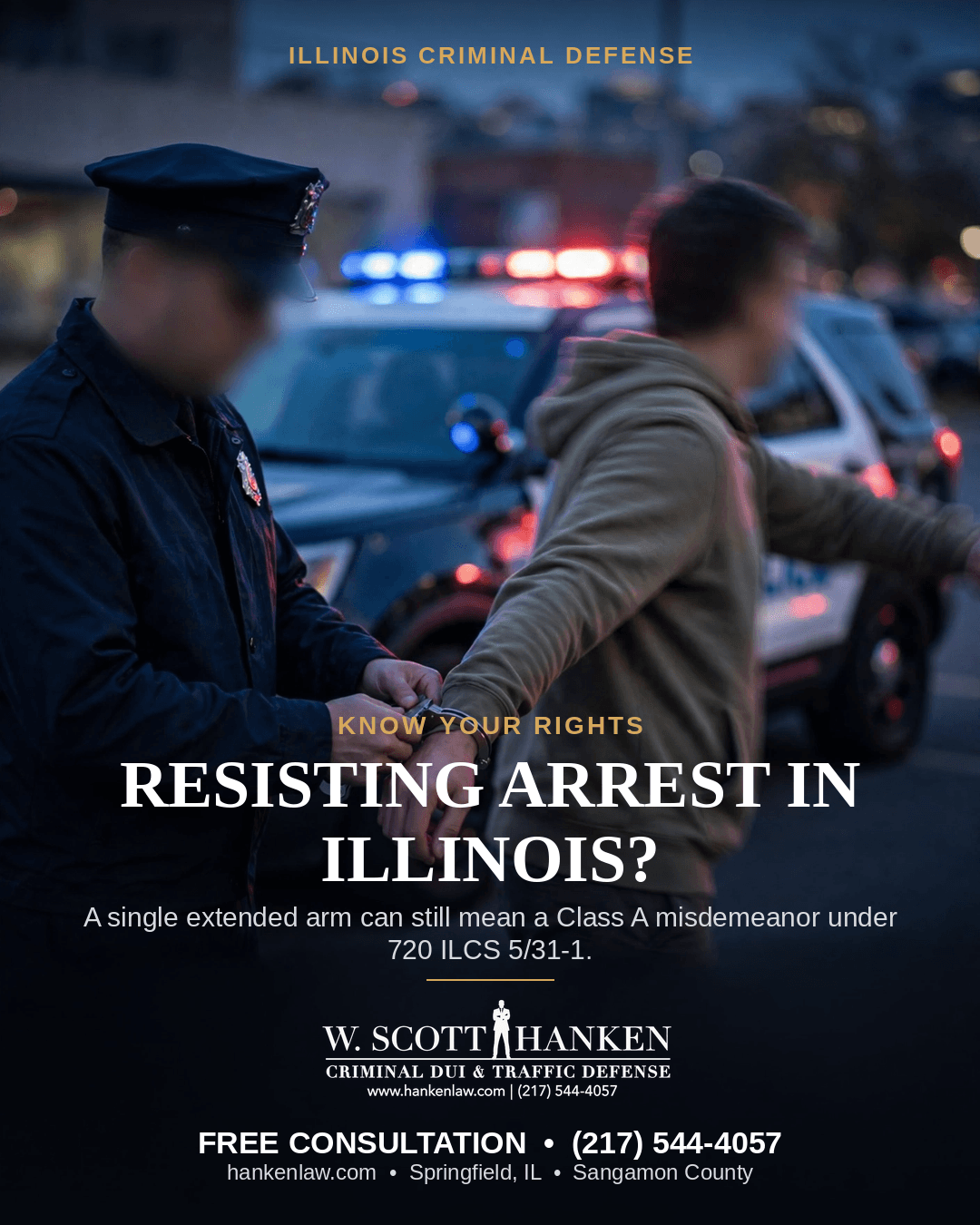
Resisting a Peace Officer in Illinois (720 ILCS 5/31-1)


Last Reviewed & Updated: July 25, 2026
By: W. Scott Hanken | Former Sangamon County Prosecutor | Springfield Criminal Defense & DUI Attorney |
Voted “Best Attorney” — Illinois Times Best of Springfield & State Journal-Register Reader’s Choice | Springfield, IL • Sangamon County • (217) 544-4057 • hankenlaw.com
The Short Answer:
In Illinois, resisting or obstructing a peace officer under 720 ILCS 5/31-1 is a Class A misdemeanor that carries a mandatory minimum of 48 hours in jail or 100 hours of community service, even for a first offense. Two 2026 appellate decisions, People v. Carswell and People v. Hill, have now clarified that you can still be convicted of resisting even if the underlying arrest that triggered the confrontation turns out to have been unlawful. What actually gets people convicted, or acquitted, in Sangamon County is whether their conduct amounted to a “material impediment,” not whether they were technically in the right.
Bottom Line: If you’re facing this charge in Springfield or anywhere in Sangamon County, don’t assume it’s a throwaway misdemeanor. It carries a guaranteed jail exposure with no probation option to avoid it, and a conviction is difficult to expunge later. Call (217) 544-4057 to talk through the facts of your stop before you appear in court.
What Is Resisting a Peace Officer Under Illinois Law?
Under 720 ILCS 5/31-1(a), a person commits this offense when they knowingly resist arrest or obstruct the performance of an authorized act by someone they know to be a peace officer, firefighter, or correctional institution employee. The State must prove three things: the person had that official status, the defendant knew it, and the defendant’s conduct actually resisted or obstructed an authorized act. It’s a Class A misdemeanor.
Statute callout — 720 ILCS 5/31-1(a):
“A person who knowingly: (1) resists arrest, or (2) obstructs the performance by one known to the person to be a peace officer, firefighter, or correctional institution employee of any authorized act within his or her official capacity commits a Class A misdemeanor.”
In practice, this statute shows up constantly in Sangamon County. In 37 years of criminal defense here, I’ve seen it charged most often as an add-on to a traffic stop, a domestic disturbance call, or a low-level arrest that escalated once handcuffs came out. It’s rarely the only count on the docket, and it’s rarely the count the client expected to be fighting hardest.
What Are the Penalties for Resisting a Peace Officer in Sangamon County?
A conviction under section 31-1(a) triggers a mandatory minimum under subsection (a-5): at least 48 consecutive hours of jail or 100 hours of community service, and the court cannot use probation to reduce or replace that minimum. That floor applies even to someone with no prior record. If the resistance is found to be the proximate cause of an injury to the officer, the charge becomes a Class 4 felony under subsection (a-7), with an entirely different sentencing range.
Statute callout — 720 ILCS 5/31-1(a-5):
“In addition to any other sentence that may be imposed, a court shall order any person convicted of resisting or obstructing a peace officer, firefighter, or correctional institution employee to be sentenced to a minimum of 48 consecutive hours of imprisonment or ordered to perform community service for not less than 100 hours as may be determined by the court. The person shall not be eligible for probation in order to reduce the sentence of imprisonment or community service.”
A related but more serious charge, disarming a peace officer under 720 ILCS 5/31-1a, is often confused with basic resisting. It isn’t the same offense, and the penalty gap is enormous.
How the penalties compare:
| Charge | Statute | Class | Prison/Jail Range | Mandatory Min. | Max Fine |
|---|---|---|---|---|---|
| Resisting/obstructing a peace officer | 720 ILCS 5/31-1(a) | Class A misdemeanor | Up to 364 days county jail | 48 hrs jail or 100 hrs comm. service; no probation reduction | $2,500 |
| Resisting/obstructing causing officer injury | 720 ILCS 5/31-1(a-7) | Class 4 felony | 1–3 yrs IDOC (3–6 extended) | None specified | $25,000 |
| Attempting to disarm a peace officer | 720 ILCS 5/31-1a(b) | Class 2 felony | 3–7 yrs IDOC | None specified | $25,000 |
| Disarming a peace officer (completed) | 720 ILCS 5/31-1a(a) | Class 1 felony | 4–15 yrs IDOC (15–30 extended) | None specified | $25,000 |
Additional Sources: 730 ILCS 5/5-4.5-55 & 730 ILCS 5/5-4.5-45
Does the State Have to Prove My Arrest Was Lawful?
No, not anymore, and this is the single biggest misconception people bring into my Springfield office. Illinois added subsection (d) to the resisting statute effective January 1, 2023, stating that a person cannot be arrested for resisting arrest unless there was an underlying offense that justified the arrest in the first place. Many people, understandably, read that as a built-in defense: if the original stop or arrest was bad, the resisting charge should fall too.
Two 2026 appellate decisions closed that door. In People v. Carswell, 2026 IL App (1st) 231884 (decided February 4, 2026), the First District held that subsection (d) restricts police authority to make a pure resisting arrest without a predicate offense, but it does not create a trial defense and does not require the State to prove the underlying offense as an element of the crime. The Third District reached the same conclusion in People v. Hill, 2026 IL App (3d) 250131 (decided June 24, 2026), a case out of Will County. Both courts relied on the long-standing rule in 720 ILCS 5/7-7 that a person may not use force to resist an arrest, even one the person reasonably believes is unlawful and which is in fact unlawful.
Statute callout — 720 ILCS 5/7-7:
“A person is not authorized to use force to resist an arrest which he knows is being made either by a peace officer or by a private person summoned and directed by a peace officer to make the arrest, even if he believes that the arrest is unlawful and the arrest in fact is unlawful.”
Here’s the wrinkle no generic legal site is tracking: the Illinois Supreme Court granted the defendant’s petition for leave to appeal in Carswell on May 27, 2026. That means this exact question, whether subsection (d) creates an element the State must prove, is currently pending in front of the Illinois Supreme Court as of this writing. The Third District decided Hill a month later and still followed Carswell’s reasoning, but the doctrine is not fully settled at the highest level. If you’re charged in Sangamon County Circuit Court today, the current rule favors the State. That could change depending on how the Supreme Court rules.
What if the Officer Had No Warrant, or the Arrest Was Later Found Unlawful?
An unlawful arrest does not, by itself, defeat a resisting charge under current Illinois law. The rule comes from Carswell and Hill, both decided in 2026, applying the older rule in section 7-7 that force may not be used to resist even an unlawful arrest. In Sangamon County, I see this most often in domestic-call situations, where officers make a warrantless arrest on the spot and the defendant, correctly or not, believes the arrest has no legal basis and physically pulls away. That belief, even if later proven correct, will not defeat the resisting count on its own. What can still work is a suppression motion aimed at the evidence flowing from the unlawful stop or arrest itself, and a separate argument that whatever the person did did not rise to a material impediment in the first place.
What Counts as “Resisting” vs. Just Talking Back to an Officer?
Illinois courts require that resistance or obstruction be a material impediment to the officer’s duties, not a technical or trivial one. The Illinois Supreme Court’s decision in People v. Casler, 2020 IL 125117, established this materiality requirement for obstruction offenses, and the appellate courts have since applied the same standard to resisting a peace officer. Brief delays, verbal arguing, and momentary non-compliance that doesn’t threaten officer safety or meaningfully slow down the arrest usually fall short of the statute.
Statute callout, case-based standard:
In People v. Gotschall, 2022 IL App (4th) 210256, the Fourth District held that a defendant’s brief refusal to place his foot inside a squad car, resolved in under 30 seconds, did not materially impede the officer’s authorized act of transporting him to jail. In People v. Mehta, 2020 IL App (3d) 180020, the Third District laid out the factors courts weigh: the length of the delay, whether the act threatened officer safety, and the surrounding circumstances of the stop. And in People v. Sadder-Bey, 2023 IL App (1st) 190027, the First District reversed a resisting conviction outright, finding that the defendant’s “quarrelsome” exchange with officers and brief hesitation before exiting his vehicle were nothing more than “token acts of resistance.”
In Sangamon County, this is where body-worn camera footage decides most of these cases. A charge built on 20 seconds of arguing looks very different once a judge actually watches the video and times it.
What if I Only Argued Verbally?
Purely verbal disagreement with an officer, without an accompanying physical act, generally does not satisfy the resisting or obstructing statute. This comes directly from Sadder-Bey, 2023 IL App (1st) 190027, where the First District found that quarreling with officers and briefly questioning their instructions amounted only to token resistance, insufficient to sustain a conviction. In a typical Springfield traffic stop, I see officers write up “argumentative” or “uncooperative” language in the report, but if the body cam shows the driver eventually complying within a reasonable window and never physically obstructing anything, that report language rarely survives a well-prepared cross-examination.
What if I Pulled Away by Reflex or Panic, Not Intentional Resistance?
The statute requires that the defendant knowingly resist or obstruct, so an involuntary flinch, a reflexive pull-away, or confusion during a chaotic arrest can undercut the mental-state element the State must prove. Courts still look at the totality of the circumstances rather than accepting a bare claim of reflex, and Mehta, 2020 IL App (3d) 180020, specifically flags officer safety concerns as a factor that can turn even a brief physical movement into a material impediment. A single involuntary flinch during handcuffing in a low-tension domestic call reads very differently to a Sangamon County judge than the same movement during a high-tension stop where officers reasonably believed a weapon was involved.
What Defenses Apply to a Resisting Charge in Sangamon County Circuit Court?
Several defenses come up regularly in these cases, and which one fits depends heavily on the facts caught on camera:
- Lack of knowledge of officer status — plainclothes officers, no verbal announcement, or a chaotic scene where the person reasonably didn’t realize they were dealing with law enforcement.
- No knowing resistance — an accidental movement, a medical condition, or genuine confusion rather than intentional obstruction.
- No material impediment — the conduct, viewed on body cam or dash cam, caused only a trivial delay and posed no safety risk.
- Self-defense against excessive force — under 720 ILCS 5/7-1, force may be justified if the officer used unlawful force first.
- Officer not performing an “authorized act” — a narrower argument than most people expect, since Illinois courts are reluctant to treat even a flawed arrest as unauthorized for purposes of this statute.
- Statutory firefighter-rescue defense under subsection (c), which applies only when someone resists a firefighter while trying to rescue a person from a structure.
- Suppression of evidence from an unlawful underlying stop, which won’t defeat the resisting count after Carswell and Hill but can still gut the State’s broader case.
Statute callout — 720 ILCS 5/7-1(a):
“A person is justified in the use of force against another when and to the extent that he reasonably believes that such conduct is necessary to defend himself or another against such other’s imminent use of unlawful force. However, he is justified in the use of force which is intended or likely to cause death or great bodily harm only if he reasonably believes that such force is necessary to prevent imminent death or great bodily harm to himself or another, or the commission of a forcible felony.”
How Do Sangamon County Prosecutors Actually Charge This Offense?
This is where 37 years of watching charging decisions from both sides of the courtroom in Springfield actually matters. As a former Sangamon County Assistant State’s Attorney, I’ve seen resisting counts get tacked onto police reports almost reflexively any time an arrest takes longer than the officer expected, regardless of whether the delay was material under the case law. The charge is cheap for the State to file and expensive for a defendant to carry, since it isn’t eligible for the kind of easy court supervision available on many other Class A misdemeanors and it leaves a permanent conviction that’s difficult to expunge. In my experience, the cases that get reduced or dismissed in Sangamon County almost always turn on a careful, second-by-second review of body-worn camera footage against the Gotschall and Mehta timing factors, not on courtroom argument alone.
Frequently Asked Questions (FAQs)
Usually not. Under 720 ILCS 5/31-1(a), it’s a Class A misdemeanor. It becomes a Class 4 felony under subsection (a-7) only if the resistance is the proximate cause of an injury to the officer, firefighter, or correctional employee.
Yes, at least in the sense that a court must order a minimum of 48 hours of jail or 100 hours of community service under subsection (a-5), and probation cannot be used to eliminate that requirement. The maximum exposure is up to 364 days in county jail.
This is one of the reasons the charge is heavier than it looks. Because subsection (a-5) requires a mandatory minimum with no probation reduction, resisting convictions don’t get the same easy court-supervision treatment available for many other Class A misdemeanors.
Lack of knowledge that the person was a peace officer is a recognized defense. Plainclothes officers, no verbal identification, and chaotic scenes are all facts that can support this argument, but the State will often argue the circumstances made the officer’s status obvious.
Yes. It’s a criminal conviction, and because of its limited eligibility for supervision, it’s generally harder to get sealed or expunged compared to many other misdemeanors.
Not automatically, and not after Carswell, 2026 IL App (1st) 231884, and Hill, 2026 IL App (3d) 250131. Both cases held that subsection (d) restricts when police may make an arrest for pure resisting without a predicate offense, but it does not require the State to prove that predicate offense to convict on the resisting charge itself.
Ready to Fight Your Criminal Charge in Springfield?
Call W. Scott Hanken at (217) 544-4057 or contact us online for a free consultation. We serve clients throughout Springfield, Sangamon County, and Central Illinois.
About the Author: W. Scott Hanken, Attorney at Law
Scott Hanken is a Springfield, Illinois criminal defense attorney with over 37 years of experience, including service as a former Sangamon County prosecutor. He has been voted Best Attorney by the Illinois Times and State Journal-Register, holds an Avvo 10.0 “Superb” rating, and has earned over 270 five-star Google reviews. His firm handles DUI defense, drug crimes, traffic violations, violent crimes, and weapons offenses throughout Sangamon County and Central Illinois.
📍 1100 S 5th St, Springfield, IL 62703 | ☎ (217) 544-4057 | 🌐 hankenlaw.com
This article is for general educational purposes only and does not constitute legal advice. Every case is unique — contact an experienced Springfield criminal defense attorney for guidance on your specific situation.

Address
Our offices are located at the corner of South Fifth Street and Vine, in the historic Mary Bryant Home for the Blind.