- Free Consultation: (217) 544-4057 Tap Here To Call Us














Springfield’s Police Transparency Dashboard: A Defense Tool


Last Reviewed & Updated: August 10, 2026
By: W. Scott Hanken | Former Sangamon County Prosecutor | Springfield Criminal Defense & DUI Attorney |
Voted “Best Attorney” — Illinois Times Best of Springfield & State Journal-Register Reader’s Choice | Springfield, IL • Sangamon County • (217) 544-4057 • hankenlaw.com
Direct Answer
The Springfield Police Department launched a new Transparency Dashboard in August 2026, publishing crime statistics, enforcement activity, and, as it becomes available, Internal Affairs and use-of-force data. For anyone facing criminal charges in Sangamon County, that public data is more than a transparency gesture. Enforcement-pattern statistics and officer conduct records are the kind of material a defense attorney can use to challenge a stop, a search, or an officer’s credibility in court.
Bottom Line
The dashboard makes some police data public that used to require a formal records request. It does not replace a Freedom of Information Act request for the specific records tied to your case, and it does not tell you whether that data helps your defense. That takes legal analysis by someone who knows how Sangamon County courts treat this kind of evidence.
Key Takeaways
- Springfield Police Department’s Transparency Dashboard went live in August 2026, covering crime statistics, enforcement activity, and city responses to the Massey Commission’s Calls to Action.
- Internal Affairs and use-of-force data are being added as the department finalizes them with a third-party vendor; they are not fully live yet.
- Enforcement and stop-pattern data can support a Motion to Suppress Evidence under 725 ILCS 5/114-12.
- If the dashboard does not have the specific record your case needs, a Freedom of Information Act request under 5 ILCS 140 usually will.
- Public dashboard data is a starting point, not a substitute for the case-specific discovery your attorney obtains directly from the prosecution and the department.
In This Article
- What Does Springfield’s New Transparency Dashboard Actually Show?
- How Can Police Data Help My Criminal Defense Case?
- What if the Dashboard Doesn’t Have the Record My Case Needs?
- What if the Officer in My Case Is Under Internal Affairs Investigation?
- What if My Case Happened Before the Dashboard Launched?
- Can This Data Support a Motion to Suppress Evidence?
- Dashboard Data vs. What Requires a FOIA Request
- Frequently Asked Questions
What Does Springfield’s New Transparency Dashboard Actually Show?
Springfield Police Department announced its Transparency Dashboard in early August 2026, hosted on the city’s public GIS portal. The department describes it as a resource giving the community greater access to information about its operations and public safety efforts, and it currently includes crime statistics and police enforcement activity. Internal Affairs investigations and use-of-force incident data are being added as the department finishes coordinating with its third-party vendor. The dashboard also houses the city’s and department’s responses to the Massey Commission’s Calls to Action, and it has already been used to post updates on two specific incidents: a January 2026 officer-involved shooting and a July 2026 incident involving an off-duty department sergeant. City officials have said some information will stay withheld while investigations, internal reviews, or court proceedings remain active.
The dashboard updates every 24 hours and was built in-house by the department and the city’s IT staff. That matters for a defendant because it means the numbers you see reflect recent department activity, not a snapshot frozen at some point in the past.
How Can Police Data Help My Criminal Defense Case in Sangamon County?
Public enforcement data is not just useful to journalists and watchdog groups. It is useful to a defense attorney building a specific argument about a specific officer’s conduct in a specific case.
In 37 years of criminal defense work in Sangamon County, I have seen cases turn on exactly this kind of pattern evidence. An officer’s stop history, use-of-force history, or documented disciplinary record can support a challenge to the legality of a stop, undercut the credibility of testimony at a suppression hearing, or reveal a pattern the prosecution would rather not put in front of a judge. A dashboard that puts some of this information in one place, updated regularly, makes the first stage of that investigation faster. It does not replace the deeper case-specific record pull your attorney has to do through discovery and, where necessary, a formal records request.
Two areas where this data does the most work:
- Challenging a stop or search. If enforcement statistics show a pattern of stops concentrated in a specific area or against a specific demographic without matching patterns in reported crime, that can support an argument that a stop lacked the individualized reasonable suspicion the Fourth Amendment requires.
- Impeaching officer credibility. Under Brady v. Maryland, 373 U.S. 83 (1963), the prosecution has a due process obligation to disclose evidence favorable to the defense, including material that could be used to impeach a testifying officer. A documented use-of-force history or sustained Internal Affairs finding is exactly the kind of material that obligation covers, and a public dashboard entry can be the first thread that leads to a formal discovery demand for the underlying file.
What if the Dashboard Doesn’t Have the Record My Case Needs?
The dashboard is incomplete by design right now. Internal Affairs and use-of-force data are still being finalized, and the department has said some records will stay withheld while an investigation or court proceeding is active. Illinois law gives you a separate path when the public dashboard does not go far enough: the Freedom of Information Act, 5 ILCS 140. A public body must comply with or deny a written FOIA request within 5 business days of receiving it, with a possible 5 business day extension for enumerated reasons such as needing to locate records at another office or requiring legal review for exemptions. 5 ILCS 140/3.
In Sangamon County, this comes up most often when a client’s case involves an officer with a use-of-force incident that has not yet worked its way onto the public dashboard. Law enforcement records connected to a pending investigation are exempt from FOIA disclosure only to the extent release would interfere with that investigation, deprive someone of a fair trial, or reveal a confidential source, among other narrow grounds. 5 ILCS 140/7(1)(d). That exemption is not a blanket shield. Once the specific concern driving the exemption no longer applies, for example once an internal investigation closes, the records generally become available.
What if the Officer in My Case Is Under Internal Affairs Investigation?
An open Internal Affairs investigation into the arresting officer does not pause your criminal case, but it can become part of your defense strategy. Illinois discovery rules and the Brady obligation described above require the prosecution to disclose material impeachment evidence about a testifying officer, and an active or recently closed Internal Affairs matter can qualify. In practice, this means your attorney should be filing a specific, written discovery request for any disciplinary or Internal Affairs record connected to the officer in your case, rather than waiting to see whether the dashboard happens to post it. The dashboard’s public numbers are a useful public-record starting point. They are not a substitute for a targeted discovery demand tied to your specific officer and your specific case.
What if My Case Happened Before the Dashboard Launched?
The dashboard only started publishing in August 2026, but that does not limit what data is available for an earlier case. The department’s underlying enforcement and use-of-force records existed before the dashboard did. If your arrest happened in 2024 or 2025, the relevant records for that period are the ones that matter, not whatever the current dashboard happens to display. Those older records are obtained the same way they always have been: through a FOIA request under 5 ILCS 140, or through formal criminal discovery once charges are filed. The dashboard changes how easily some current data is found. It does not change your right to the records behind an older case.
Can Enforcement Data Support a Motion to Suppress Evidence?
Yes, when it is tied to the specific facts of your stop or arrest. Illinois law allows a defendant to move to suppress evidence obtained through an unlawful search or seizure.
Statute Callout: 725 ILCS 5/114-12
Sec. 114-12. Motion to Suppress Evidence Illegally Seized. A defendant aggrieved by an unlawful search and seizure may move the court for the return of property and to suppress as evidence anything so obtained on the ground that the search and seizure without a warrant was illegal, or that the search and seizure with a warrant was illegal because the warrant was insufficient on its face, the evidence seized was not that described in the warrant, there was no probable cause for the warrant, or the warrant was illegally executed. The motion must be in writing, state the facts showing why the search and seizure were unlawful, and the burden of proof is on the defendant.
Enforcement-pattern data supports this kind of motion when it corroborates the specific claim you are making about your own stop. If the officer’s report says the stop was based on a routine traffic violation, and public data shows that officer’s stops in that area rarely lead to citations for the violation cited, that discrepancy is worth raising. The statute puts the burden on the defendant to show the search was unlawful, so having documented, public data to point to is far stronger than an unsupported assertion.
Dashboard Data vs. What Requires a FOIA Request
| Type of Record | Available Now | Requires FOIA Request |
|---|---|---|
| Aggregate crime statistics | Yes | No |
| Aggregate enforcement activity | Yes | No |
| Massey Commission Calls to Action responses | Yes | No |
| Use-of-force data (general) | Being finalized | Yes, until published |
| Internal Affairs outcomes | Being finalized | Yes, until published |
| Case-specific officer disciplinary file | No | Yes |
| Records tied to an active investigation | No | Limited (5 ILCS 140/7(1)(d)) |
Frequently Asked Questions (FAQs)
The dashboard itself is a public information tool, not a courtroom exhibit. The underlying records it summarizes, such as use-of-force reports or Internal Affairs findings, can become admissible evidence depending on how they are obtained and what they are used to prove. An attorney needs to pull the underlying record, not just cite the dashboard number.
You can request it through a FOIA request under 5 ILCS 140, though some records may be exempt while an investigation is pending under 5 ILCS 140/7(1)(d). In an active criminal case, your attorney can also pursue this through formal discovery, which is often faster and broader than FOIA once charges are filed — particularly in a felony case, where Illinois Supreme Court Rule 412 applies.
No. Discovery in a criminal case is governed by separate rules requiring the prosecution to turn over evidence, including material that could help your defense. The dashboard is a public information resource. It does not substitute for that legal obligation.
That kind of conflict is worth flagging to your attorney immediately. A discrepancy between an officer’s individual report and the department’s own published enforcement patterns can be useful in cross-examination or in a suppression hearing, but it needs to be verified and presented correctly to matter in court.
Yes. The dashboard did not create new records; it made some existing ones easier to find, and its charts reach back to January 2021. The records connected to your specific arrest, whenever it happened, are still available through FOIA or criminal discovery.
The department has said this data is being finalized with a third-party vendor and will be added as it becomes available. Until then, the fastest way to get case-specific information is a direct FOIA request or a discovery demand tied to your case.
Ready to Fight Your Criminal Charge in Springfield?
Call W. Scott Hanken at (217) 544-4057 or contact us online for a free consultation. We serve clients throughout Springfield, Sangamon County, and Central Illinois.
About the Author: W. Scott Hanken, Attorney at Law
Scott Hanken is a Springfield, Illinois criminal defense attorney with over 37 years of experience, including service as a former Sangamon County prosecutor. He has been voted Best Attorney by the Illinois Times and State Journal-Register, holds an Avvo 10.0 “Superb” rating, and has earned over 270 five-star Google reviews. His firm handles DUI defense, drug crimes, traffic violations, violent crimes, and weapons offenses throughout Sangamon County and Central Illinois.
📍 1100 S 5th St, Springfield, IL 62703 | ☎ (217) 544-4057 | 🌐 hankenlaw.com
This article is for general educational purposes only and does not constitute legal advice. Every case is unique — contact an experienced Springfield criminal defense attorney for guidance on your specific situation.
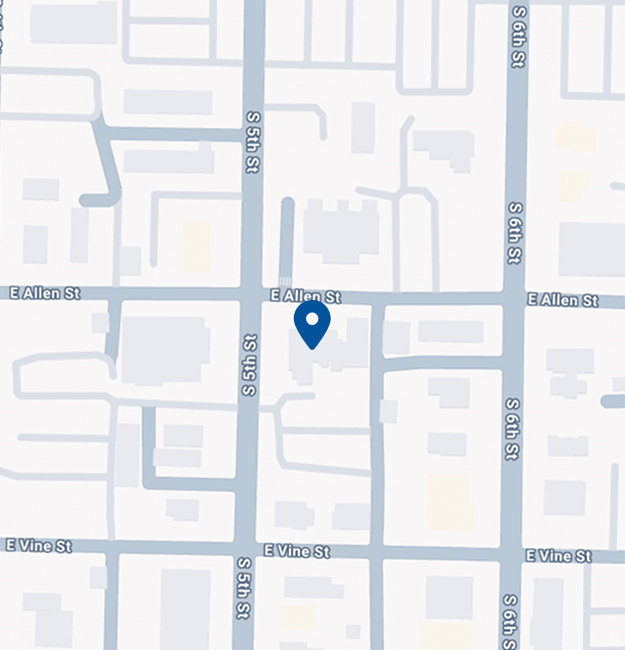
Address
Our offices are located at the corner of South Fifth Street and Vine, in the historic Mary Bryant Home for the Blind.