- Free Consultation: (217) 544-4057 Tap Here To Call Us








Do I Have to Get Out of My Car When a Police Officer Asks?


By: W. Scott Hanken Former Sangamon County Prosecutor | Springfield Criminal Defense & DUI Attorney Voted “Best Attorney” — Illinois Times Best of Springfield & State Journal-Register Reader’s Choice Springfield, IL • Sangamon County • (217) 544-4057 • hankenlaw.com
Bottom line up front: Yes — in Illinois, you almost certainly must exit your vehicle if a police officer lawfully orders you to do so during a traffic stop. Refusing can result in broken windows, a forcible removal, and criminal charges including obstruction of justice or resisting a peace officer under 720 ILCS 5/31-1. Knowing why — and what your actual rights are — is what keeps you safe and gives you the best chance in court.
☎️ Arrested after a traffic stop in Springfield or Sangamon County? Call W. Scott Hanken at (217) 544-4057 for a free consultation.
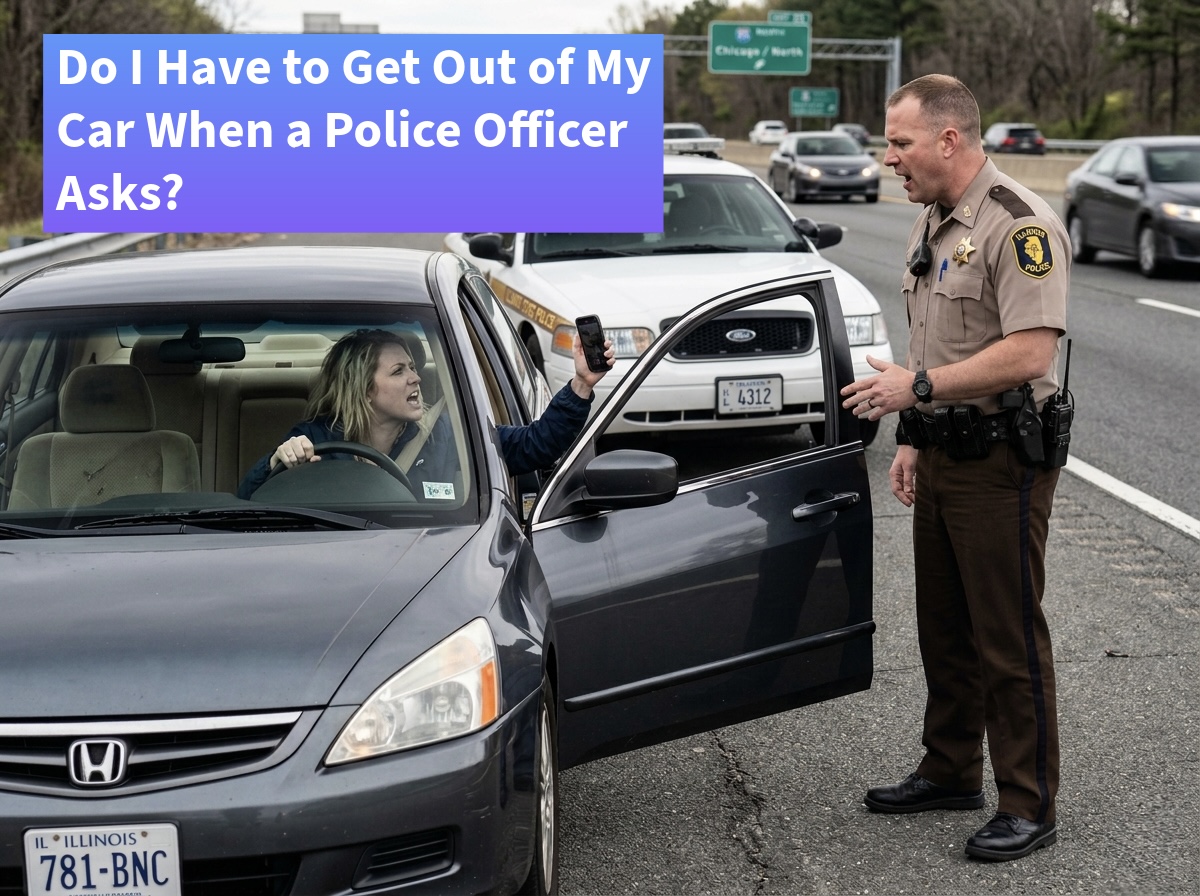
Scroll TikTok, YouTube Shorts, or X (Twitter) for five minutes and you will find them: viral videos of drivers telling police officers “I don’t have to get out of my car” or “You need a warrant.” The comments are full of people cheering them on. Some videos rack up millions of views.
What those videos almost never show you is what comes next — and as a Springfield, Illinois criminal defense attorney with 37 years of experience, I can tell you exactly what that is:
- A window gets smashed.
- The driver is physically extracted from the vehicle.
- Handcuffs go on.
- The original traffic stop — maybe a busted tail light or a rolling stop — now comes with a felony or misdemeanor charge for resisting or obstructing a peace officer under 720 ILCS 5/31-1.
I have represented Central Illinois clients who came to me after precisely this scenario. The social media “sovereignty” advice they followed cost them far more than the original citation ever would have. The law on this question is well-settled and not on their side.
The dangerous misinformation: Thousands of videos suggest drivers have a constitutional right to remain in their vehicle. They do not — at least not when a law enforcement officer issues a lawful order during a valid traffic stop.
What the U.S. Supreme Court Actually Says: Pennsylvania v. Mimms (1977)
The controlling federal precedent on this issue has been settled law for nearly five decades.
In Pennsylvania v. Mimms, the United States Supreme Court held:
A police officer may order the driver of a vehicle to exit the car during a lawful traffic stop — full stop.
The Supreme Court, applying a balancing test, concluded:
- The intrusion on the driver is minimal — A person already lawfully detained during a traffic stop experiences only a “de minimis” additional liberty restriction when ordered to exit.
- The officer’s safety interest is substantial — Statistics showed officers were being killed during routine stops at alarming rates. Permitting an officer to control the positioning of the detainee — outside the vehicle, in plain view — directly reduces that risk.
- The driver’s privacy expectation is already reduced — Once lawfully stopped, a driver’s reasonable expectation of privacy in remaining seated is significantly diminished.
The Court’s holding is unambiguous: the order to exit is lawful, and compliance is required.
What Mimms Does NOT Cover
It is equally important to understand the boundaries of Mimms:
- It does not authorize an officer to demand you exit your vehicle during a consensual encounter (i.e., when you have not been detained).
- It does not authorize a search of the vehicle without separate legal justification (probable cause, consent, or a recognized exception).
- It does not authorize an unlimited extension of the stop beyond its original purpose.
- It does not address passengers — only drivers.
The Critical Distinction: Lawful vs. Unlawful Stop
Here is where an experienced Springfield criminal defense attorney matters enormously:
- If the stop was lawful, the exit order is lawful, and you must comply.
- If the stop was unlawful — lacking reasonable articulable suspicion — the entire encounter may be subject to a motion to suppress under the Fourth Amendment and Article I, Section 6 of the Illinois Constitution.
You do not determine the lawfulness of the stop on the side of the road. I determine it in a Sangamon County courtroom, with legal briefs and case law. Resisting in the moment does not vindicate your rights — it creates new criminal exposure that complicates everything else.
Obstruction and Resisting Arrest in Illinois: What You Face If You Refuse
Under 720 ILCS 5/31-1 — Obstructing a Peace Officer, a person commits a Class A misdemeanor when they knowingly resist or obstruct the performance by one known to the person to be a peace officer of any authorized act within his or her official capacity.
A Class A misdemeanor in Illinois carries:
- Up to 364 days in county jail
- Up to $2,500 in fines
- A permanent criminal record
If physical force is used against the officer during the refusal — even pushing a hand away — charges can escalate to 720 ILCS 5/31-1(a-7), a Class 4 felony, carrying 1–3 years in the Illinois Department of Corrections.
What You Should Actually Do During a Traffic Stop in Illinois
As a former Sangamon County prosecutor who has handled thousands of criminal, traffic, and DUI cases, here is the practical advice I give every client:
- Pull over safely and promptly. Hesitating or driving further gives officers legitimate concern and is noted in every police report.
- Keep your hands visible. Do not reach for anything until asked. Officer safety concerns are real. Sudden movements escalate encounters.
- Provide your license, registration, and proof of insurance when asked. Illinois law requires this. Refusing creates immediate legal exposure under 625 ILCS 5/6-112.
- If asked to exit the vehicle, exit calmly and comply. Pennsylvania v. Mimms controls. This is not the battle to fight on the roadside.
- You may — and should — politely decline to answer questions beyond identification. “Officer, I’d prefer not to answer questions without my attorney present.” This is your Fifth Amendment right and it is fully preserved when exercised calmly and respectfully.
- Do NOT consent to a vehicle search. Consenting waives Fourth Amendment protections. Say clearly: “I do not consent to a search.” Then comply if the officer conducts one anyway — your attorney will address it in court.
- Do NOT argue, resist, or escalate. The roadside is not a courtroom. Everything you say and do will be in the report and potentially on video. The courtroom is where you win.
- Contact a Springfield DUI and criminal defense attorney immediately. The sooner I am involved, the more options remain available to protect your rights and your record.
Why Springfield Drivers Trust W. Scott Hanken
W. Scott Hanken, Attorney at Law has defended Central Illinois drivers, DUI defendants, and criminal defendants for 37+ years from his office at 1100 South Fifth Street, Springfield, Illinois 62703.
A Former Prosecutor Now Fighting for You
Scott Hanken began his career as an Assistant State’s Attorney in Sangamon County, where he prosecuted criminal, traffic, and DUI cases. He knows exactly how prosecutors think, what evidence they rely on, and where the weaknesses in a case lie — because he built cases from the other side of the courtroom for years.
That insider perspective is the cornerstone of every defense strategy at Hanken Law.
Awards & Recognition
- Super Lawyer — DUI
- Top 100 Criminal Defense Lawyers — Illinois, American Society of Legal Advocates
- Top 200 DUI Attorneys — Illinois, National Advocacy for DUI Defense
- Superb 10.0 Rating, AVVO
- Client’s Choice Award — Criminal Defense, AVVO
- Top Contributor — Criminal Defense, AVVO
- Distinguished Peer Review Rating, Martindale-Hubbell
- Best Attorney, Illinois Times
- Best Attorney, State Journal-Register
What Clients Say
“Mr. Hanken is the definition of a genuine person. My experience was nothing short of amazing. Scott made me comfortable and heard from the moment I walked into his office. He gave me back my reputation and dignity by receiving a not guilty verdict, but most importantly, he fought for me as if my life and the situation at hand actually mattered to him.” — Allie B., Verified Client, February 2026
“Scott is the best around! He was honest and straight forward. His staff was on top of things and he was always prepared at court. Very personable and easy to talk to. The outcome was exactly what he said to expect.” — Anonymous Verified Client, January 2026
“One of the most well-rounded and acclaimed attorneys in Springfield, IL. I highly recommend Scott Hanken for any legal service.” — Peer Review, LinkedIn
Internal Resources — Related Topics on This Site
- Springfield DUI Defense Overview — What to expect if you have been charged with DUI in Sangamon County
- Criminal Defense Overview — Complete guide to criminal charges in Central Illinois
- The Illinois Law of Accountability (720 ILCS 5/5-2) — When can you be charged for someone else’s crime?
- Springfield Mental Health Crisis & Police Contact — What happens when mental health intersects with criminal charges
- Cannabis DUI Defense in Illinois — Critical differences in cannabis vs. alcohol DUI cases
Ready to Fight Your Traffic Case in Springfield? Call W. Scott Hanken at (217) 544-4057 or contact us online for a free consultation. We serve clients throughout Springfield, Sangamon County, and Central Illinois.
About the Author: W. Scott Hanken, Attorney at Law Scott Hanken is a Springfield, Illinois criminal defense attorney with over 37 years of experience, including service as a former Sangamon County prosecutor. He has been voted Best Attorney by the Illinois Times and State Journal-Register, holds an Avvo 10.0 “Superb” rating, and has earned over 190 five-star Google reviews. His firm handles DUI defense, drug crimes, traffic violations, violent crimes, and weapons offenses throughout Sangamon County and Central Illinois.
📍 1100 S 5th St, Springfield, IL 62703 | ☎ (217) 544-4057 | 🌐 hankenlaw.com
This article is for general educational purposes only and does not constitute legal advice. Every case is unique — contact an experienced Springfield criminal defense attorney for guidance on your specific situation.

Address
Our offices are located at the corner of South Fifth Street and Vine, in the historic Mary Bryant Home for the Blind.