- Free Consultation: (217) 544-4057 Tap Here To Call Us















The Difference Between Assault and Battery in Illinois


Last Reviewed & Updated: August 20, 2026
By: W. Scott Hanken | Former Sangamon County Prosecutor | Springfield Criminal Defense & Violent Crimes Attorney | Voted “Best Attorney” — Illinois Times Best of Springfield & State Journal-Register Reader’s Choice | Springfield, IL | Sangamon County | (217) 544-4057 | hankenlaw.com
In a lot of states, “assault and battery” is a single phrase — one charge, spoken as one breath. Illinois does not work that way. Here they are two separate crimes, defined in two separate statutes, with two different sets of elements and two very different sentencing ranges.
That distinction is not academic. Simple assault is a Class C misdemeanor — the least serious criminal classification Illinois has. Simple battery is a Class A misdemeanor — the most serious one. Same argument, same parking lot, same two people: whether a hand ever made contact can be the difference between a 30-day maximum and a 364-day maximum. And when aggravating factors enter the picture, either charge can climb into felony territory fast.
If you’ve been charged in Springfield or anywhere in Sangamon County, understanding which offense you’re actually facing is the first step toward understanding what your defense looks like.
The Short Answer
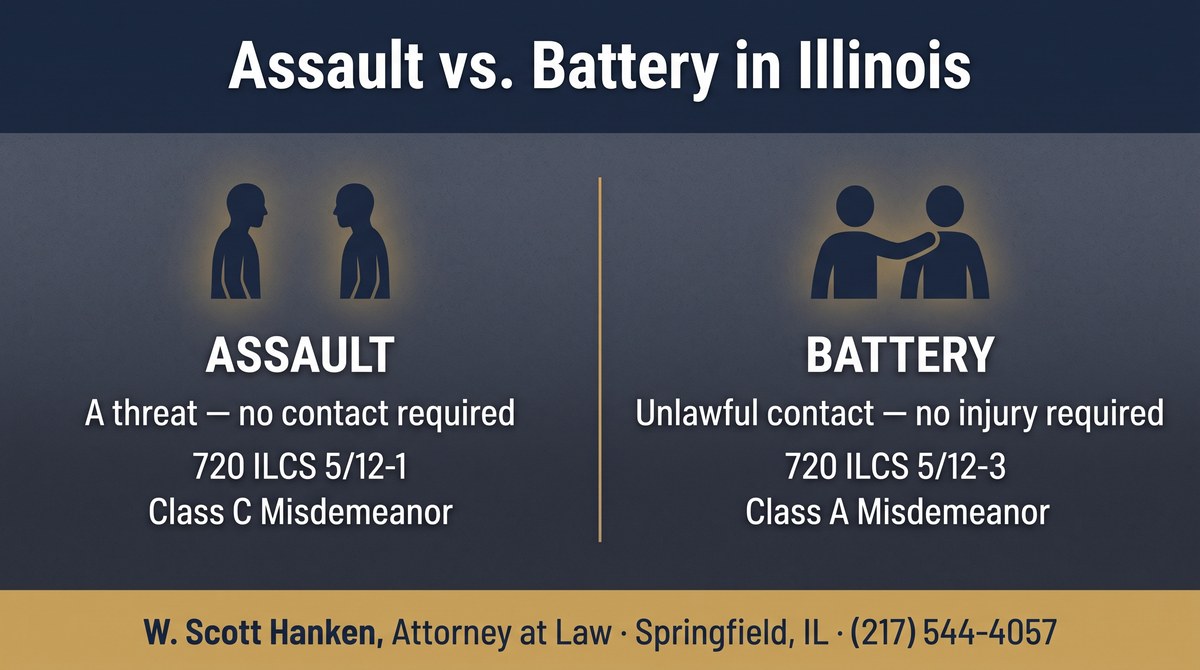
Assault is a threat. Battery is contact.
| Assault | Battery | |
|---|---|---|
| Statute | 720 ILCS 5/12-1 | 720 ILCS 5/12-3 |
| Physical contact required? | No | Yes |
| Injury required? | No | No |
| Core element | Placing someone in reasonable apprehension of receiving a battery | Causing bodily harm, or insulting/provoking contact |
| Base classification | Class C misdemeanor | Class A misdemeanor |
| Maximum jail | 30 days | Less than 1 year |
| Maximum fine | $1,500 | $2,500 |
| Felony version | Aggravated assault (720 ILCS 5/12-2) | Aggravated battery (720 ILCS 5/12-3.05) |
Note what is not on that list: injury. Neither offense requires one. This surprises people constantly, and it is the reason so many Sangamon County cases that started as a shouting match end up as criminal charges.
Assault in Illinois: A Threat, Not a Touch
Under 720 ILCS 5/12-1, a person commits assault when, without lawful authority, he or she knowingly engages in conduct which places another in reasonable apprehension of receiving a battery.
Break that into its working parts:
- Knowingly — accidental conduct doesn’t qualify. The State has to prove you were aware your conduct was of that nature.
- Conduct — the statute requires conduct, not merely a state of mind. This is a genuinely contested area, and it is where a lot of assault charges are vulnerable.
- Reasonable apprehension — the standard is objective, not just what the complaining witness says they felt. Would a reasonable person in that position have expected a battery?
- Of receiving a battery — the anticipated harm has to be the kind of unlawful contact that would itself be a battery. Vague unpleasantness is not enough.
Statute Callout — Assault is one of the very few Illinois offenses carrying a mandatory community service component. Under 720 ILCS 5/12-1(c), a court shall order a person convicted of assault to perform 30 to 120 hours of community service, if community service is available and funded in that county. The same condition attaches to court supervision. The only exception is when the court imposes a sentence of incarceration instead.
What Assault Is Not
Assault does not require that you touched anyone. It also does not require that you intended to actually follow through, or that you were physically capable of following through. What matters is what a reasonable person in the complaining witness’s position would have apprehended.
Aggravated Assault: When a Threat Becomes a Felony
720 ILCS 5/12-2 takes the same underlying assault and elevates it based on three categories of aggravating circumstance.
Location. An assault committed against someone on or about a public way, public property, a public place of accommodation or amusement, a sports venue, or inside a church, synagogue, mosque, or other place of worship.
Status of the alleged victim. The statute lists more than a dozen protected categories, including a person 60 or older, a person with a physical disability, teachers and school employees on school grounds, park district employees, peace officers, firefighters, emergency management workers, EMS personnel, correctional and probation officers, transit employees and passengers, sports officials and coaches, and process servers.
Use of a firearm, device, or motor vehicle. Using a deadly weapon or a realistic firearm replica; discharging a firearm; discharging a firearm from a vehicle; wearing a hood, robe, or mask to conceal identity; shining a laser sight near a person; using a firearm against a peace officer without discharging it; operating a vehicle so as to place someone in apprehension of being struck; or recording the offense with intent to disseminate it.
How Aggravated Assault Is Sentenced
| Classification | Which subsections | Range |
|---|---|---|
| Class A misdemeanor | (a), (b)(1), (b)(2), (b)(3), (b)(4), (b)(7), (b)(8), (b)(9), (c)(1), (c)(4), (c)(9) | Under 1 year; fine to $2,500 |
| Class 4 felony | (b)(4.1), (b)(5), (b)(6), (b)(10), (c)(2), (c)(5), (c)(6), (c)(7) — plus (b)(4) and (b)(7) if a Category I, II, or III weapon was used | 1–3 years |
| Class 3 felony | (c)(3) and (c)(8) | 2–5 years |
The practical takeaway: the identity of the person you allegedly threatened, and the place it happened, can matter more to your exposure than what you actually did. A raised fist in an empty private garage and the identical gesture on a public sidewalk are not the same charge in Illinois.
Battery in Illinois: Contact, With or Without Injury
Under 720 ILCS 5/12-3, a person commits battery by knowingly and without legal justification, by any means, either:
- Causing bodily harm to an individual, or
- Making physical contact of an insulting or provoking nature with an individual.
That second prong is the one people underestimate. No injury is required. A shove during an argument, grabbing someone’s arm, spitting, knocking a phone out of a hand, poking someone in the chest — all of it can support a battery charge in Illinois with zero bruising and zero medical treatment.
Battery is a Class A misdemeanor: up to 364 days in county jail, a fine from $75 to $2,500, and probation or conditional discharge up to two years, under 730 ILCS 5/5-4.5-55.
Aggravated Battery: The Felony Escalators
720 ILCS 5/12-3.05 is one of the longest sentencing provisions in the Illinois Criminal Code. It escalates battery along six separate axes:
- (a) Injury — great bodily harm, permanent disability or disfigurement; caustic or flammable substances, poisonous gas, biological or chemical agents, radioactive material, or explosives; harm to a peace officer or similar protected worker; harm to a person 60 or older; strangulation.
- (b) Child or person with an intellectual disability — where the accused is 18 or older and the alleged victim is under 13 or has a severe or profound intellectual disability.
- (c) Location — a public way, public property, place of public accommodation or amusement, sports venue, domestic violence shelter, or a place used for religious worship.
- (d) Status of the alleged victim — a long list including people 60 or older, pregnant people, people with physical disabilities, teachers, peace officers, judges, EMS personnel, utility workers, transit employees and passengers, taxi drivers, nurses, process servers, and merchants.
- (e) Firearm discharge — the most severely punished category in the section.
- (f) and (g) Weapon or conduct — deadly weapons other than firearms, air rifles, concealing identity with a hood or mask, laser sights, recording the offense to disseminate it, delivering a controlled substance that causes great bodily harm, and administering an intoxicating or poisonous substance without consent.
How Aggravated Battery Is Sentenced
| Classification | Examples of what triggers it | Range |
|---|---|---|
| Class 3 felony (default) | Any aggravated battery not otherwise specified | 2–5 years |
| Class 2 felony | Great bodily harm to a person 60+; battery of a peace officer or similar under (d)(4); throwing bodily fluids at a correctional employee; great bodily harm to a person engaged in worship | 3–7 years |
| Class 1 felony | Great bodily harm to a peace officer or similar; delivering a controlled substance causing great bodily harm; intentional infliction of torture; strangulation with a dangerous instrument, resulting great bodily harm, or a prior strangulation conviction | 4–15 years |
| Class X felony | Discharging a firearm and causing injury; great bodily harm to a child under 13; caustic substance cases (6–45 years); with firearm-related mandatory add-ons of 15, 20, or 25 years to natural life | 6–30 years and up |
Every felony class above also carries a fine ceiling of $25,000 under 730 ILCS 5/5-4.5-50(b).
Bottom Line: A single fact — the alleged victim’s age, their job, whether the incident happened on a sidewalk instead of inside a house — can move an aggravated battery case across two or three felony classes. This is exactly why these cases are worth fighting on the details rather than treating the charging document as settled.
Domestic Battery Is a Separate Charge, and It Is Treated Differently
If the person allegedly battered is a family or household member, the State can charge domestic battery under 720 ILCS 5/12-3.2 instead of simple battery. It is also a Class A misdemeanor at baseline — but the resemblance ends there.
Domestic battery is one of the few Illinois misdemeanors for which court supervision is not available under 730 ILCS 5/5-6-1(c). Supervision is a non-conviction disposition; it is what most first-time misdemeanor defendants are hoping for. Without it, a finding of guilt on a domestic battery means a conviction, and a domestic battery conviction cannot later be expunged or sealed.
That single procedural difference is often more consequential than the sentencing range. It is also why an early, informed conversation about how a case gets charged matters so much.
Illinois Sentencing Ranges at a Glance
| Classification | Prison or jail | Maximum fine |
|---|---|---|
| Class C misdemeanor | Up to 30 days | $1,500 |
| Class B misdemeanor | Up to 6 months | $1,500 |
| Class A misdemeanor | Less than 1 year | $2,500 |
| Class 4 felony | 1–3 years | $25,000 |
| Class 3 felony | 2–5 years | $25,000 |
| Class 2 felony | 3–7 years | $25,000 |
| Class 1 felony | 4–15 years | $25,000 |
| Class X felony | 6–30 years | $25,000 |
Extended-term sentencing under 730 ILCS 5/5-8-2 can roughly double the upper end of each felony range when statutory aggravating factors apply.
Self-Defense: When Force Is Legally Justified
Because battery turns on unlawful contact, self-defense is frequently the central issue rather than a side argument.
Under 720 ILCS 5/7-1, a person is justified in using force against another when, and to the extent that, he reasonably believes the conduct is necessary to defend himself or another against that person’s imminent use of unlawful force. Force intended or likely to cause death or great bodily harm requires more: a reasonable belief that such force is necessary to prevent imminent death or great bodily harm, or to prevent the commission of a forcible felony.
Two things worth understanding about how this works in practice:
- Self-defense is an affirmative defense. You are not denying the contact occurred. You are arguing it was legally justified — which shifts what the case is actually about.
- Proportionality matters. The response has to be reasonable relative to the threat. A justified shove does not automatically make a justified punch.
The justification is also generally unavailable to someone who was the initial aggressor, subject to the exceptions in 720 ILCS 5/7-4.
Why the Distinction Matters to Your Defense
Because assault and battery have different elements, they have different vulnerabilities.
Assault cases turn on perception. There is no physical evidence of a threat. There is no injury to photograph. The State’s case rests on what the complaining witness says they apprehended and whether that apprehension was objectively reasonable. That opens real avenues: whether a reasonable person would have expected imminent contact at all, whether the account is internally consistent, whether identification is reliable, and whether the conduct element is met.
Battery cases turn on contact and justification. Here there may be physical evidence, medical records, or video. The questions shift: did contact occur, was it insulting or provoking, was there bodily harm, and — often the whole case — was the contact legally justified.
Aggravated charges turn on the enhancer. Even where the underlying conduct is not seriously disputed, the aggravating element frequently is. Did the accused know the alleged victim held a protected status? Does the injury actually meet the legal definition of “great bodily harm,” or is the State stretching it? Was the location really a “public way” within the statute? Defeating the enhancer alone can move a case from a Class 1 felony to a Class A misdemeanor without disputing that anything happened.
What Happens After an Assault or Battery Arrest in Sangamon County
Assault and battery cases in Sangamon County are heard in the Sangamon County Circuit Court, part of Illinois’s Seventh Judicial Circuit, at the Sangamon County Courts Complex, 200 South 9th Street in Springfield. Appeals go to the Illinois Fourth District Appellate Court, also located in Springfield.
Two practical points:
- The charge you are arrested on is not necessarily the charge you are prosecuted on. Charging decisions get made and revised. Both upgrades and reductions happen, and the early record shapes which direction it moves.
- What you say at the scene follows the case. These charges frequently arise from mutual altercations where both people have a version of events. Statements made to explain yourself in the moment tend to become the State’s evidence later.
Frequently Asked Questions (FAQs)
Yes. That is precisely what assault is in Illinois. Physical contact is not an element of 720 ILCS 5/12-1. The offense is knowingly engaging in conduct that places someone in reasonable apprehension of receiving a battery.
Yes. Battery has two prongs, and the second — physical contact of an insulting or provoking nature — requires no injury at all. A shove, a grab, or spitting can support a battery charge without any visible mark.
Yes. If you allegedly threatened someone and then made contact, the State can charge both, and frequently does. It is also common for the State to charge in the alternative and let the evidence sort out which one holds.
Simple assault is a Class C misdemeanor, the lowest criminal classification in Illinois. It becomes felony aggravated assault only when a statutory aggravating factor applies — a weapon, a protected victim category, or certain locations. Depending on which subsection, aggravated assault is a Class A misdemeanor, a Class 4 felony, or a Class 3 felony.
Up to 30 days in county jail and a fine between $75 and $1,500, plus probation or conditional discharge up to two years. Separately, the court must order 30 to 120 hours of community service unless it imposes incarceration.
Battery is a Class A misdemeanor: less than one year in county jail, a fine between $75 and $2,500, and probation or conditional discharge up to two years.
Six broad categories: the severity of the injury, the alleged victim being a child or person with a severe intellectual disability, the location, the alleged victim’s status or occupation, the discharge of a firearm, and the use of certain weapons or conduct. Aggravated battery starts at a Class 3 felony and rises to Class X.
No. Domestic battery under 720 ILCS 5/12-3.2 applies when the alleged victim is a family or household member. It is also a Class A misdemeanor, but court supervision is not available for it, meaning a finding of guilt results in a conviction that cannot later be expunged or sealed.
Often, yes. Self-defense under 720 ILCS 5/7-1 requires a reasonable belief that force was necessary to prevent someone’s imminent use of unlawful force, and the force used has to be proportional to the threat. It is generally unavailable if you were the initial aggresso
At the Sangamon County Circuit Court in the Sangamon County Courts Complex, 200 South 9th Street, Springfield — part of Illinois’s Seventh Judicial Circuit.
Further Reading
Practice Area
Related Articles
- 4 Ways to Boost a Defense Against Aggravated Battery Charges — If you’re facing the felony version rather than the misdemeanor, start here.
Browse by Topic
Ready to Fight Your Violent Crime Charge in Springfield?
Call W. Scott Hanken at (217) 544-4057 or contact us online for a free consultation. We serve clients throughout Springfield, Sangamon County, and Central Illinois.
About the Author: W. Scott Hanken, Attorney at Law
Scott Hanken is a Springfield, Illinois criminal defense attorney with over 37 years of experience, including service as a former Sangamon County prosecutor. He has been voted Best Attorney by the Illinois Times and State Journal-Register, holds an Avvo 10.0 “Superb” rating, and has earned over 270 five-star Google reviews. He serves clients throughout Sangamon County and Central Illinois.
📍 1100 S 5th St, Springfield, IL 62703 | ☎ (217) 544-4057 | 🌐 hankenlaw.com
This article is for general educational purposes only and does not constitute legal advice. Every case is unique — contact an experienced Springfield criminal defense attorney for guidance on your specific situation.
Address
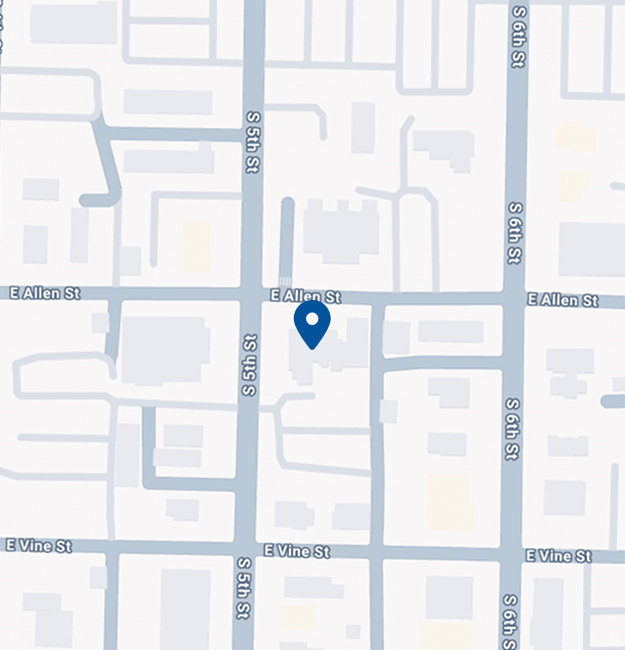
Our offices are located at the corner of South Fifth Street and Vine, in the historic Mary Bryant Home for the Blind.