- Free Consultation: (217) 544-4057 Tap Here To Call Us














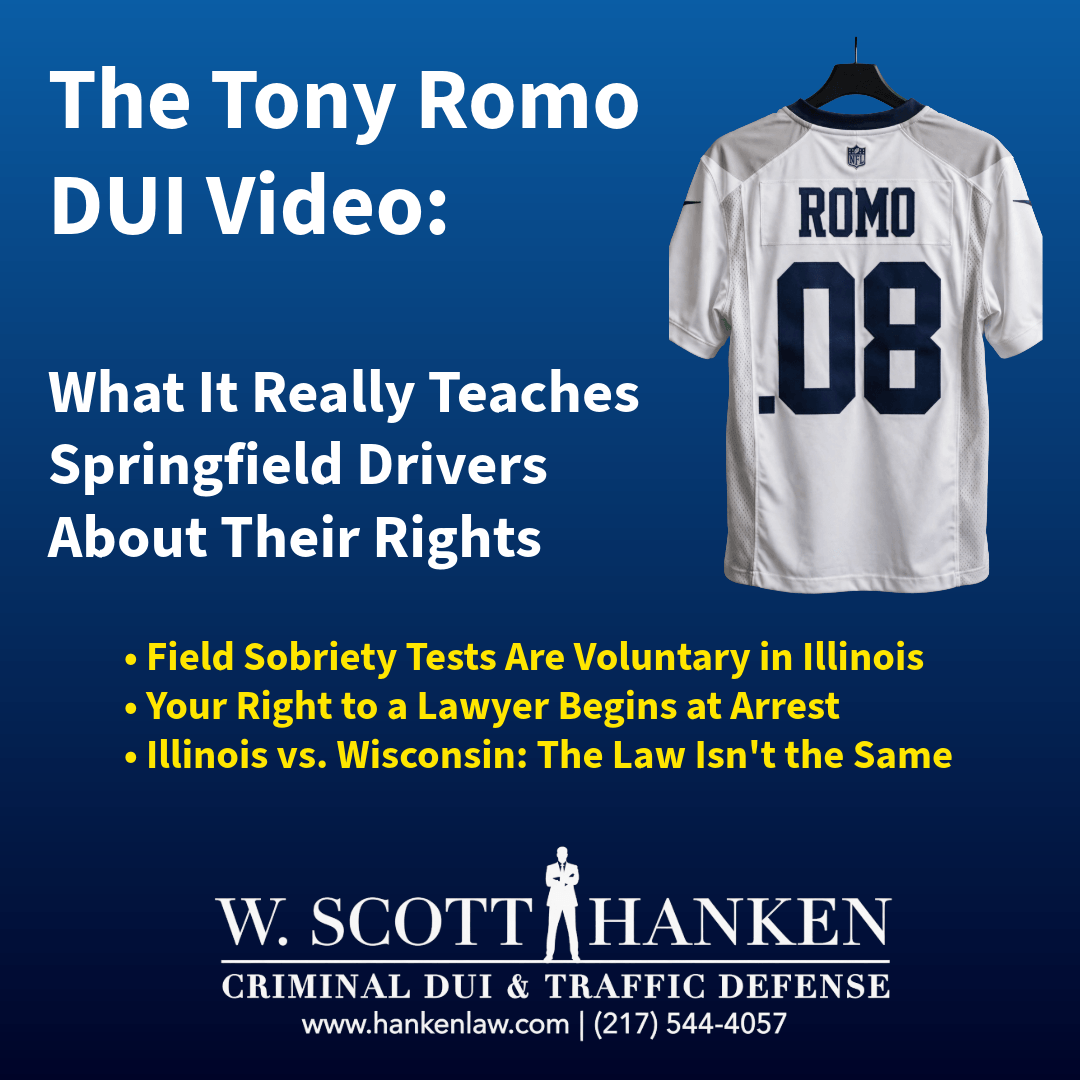
The Tony Romo DUI Video: What It Really Teaches Springfield Drivers About Their Rights


By: W. Scott Hanken | Former Sangamon County Prosecutor | Springfield Criminal Defense & DUI Attorney |
Voted “Best Attorney” — Illinois Times Best of Springfield & State Journal-Register Reader’s Choice | Springfield, IL • Sangamon County • (217) 544-4057 • hankenlaw.com
No, Illinois law does not give you the right to call a lawyer before deciding whether to perform a field sobriety test. That decision has to be made on the roadside, in the moment. You do, however, have the right to refuse the test itself, and that right exists whether or not you ever get your phone out.
Key Takeaways
- Bodycam video from Tony Romo’s July 2026 DUI arrest in Milwaukee shows him asking to call his lawyer before a field sobriety test. The officer told him no.
- That exchange happened under Wisconsin law. Illinois has its own rules, and they’re worth understanding before you’re ever standing on the shoulder of I-55.
- Illinois charges a first DUI as a criminal misdemeanor from the start. Wisconsin, unusually, treats a standard first OWI as a civil forfeiture unless a minor passenger or an injury is involved.
- In Illinois, field sobriety tests and the roadside breath test are voluntary. You can decline both without a license penalty.
- The chemical test after an arrest is different. Refusing that one triggers an automatic suspension under Illinois’s implied consent law.
- What you say during the stop matters more than most drivers realize. Silence, paired with basic cooperation, is usually the safest move.
What Actually Happened in the Tony Romo Arrest Video?
A Milwaukee County deputy pulled Romo over on an elevated stretch of I-43. The reason: unsafe passing on the right and lane deviation during rush hour traffic. Romo tells her he’s driving from a golf course to visit his grandparents, and that he’s had “zero” drinks.
When the deputy asks him to step out for field sobriety testing, Romo repeatedly asks if he can call his lawyer first. She declines, telling him it’s an active OWI investigation, and orders him out of the vehicle. Once outside, he pushes back, asking her if coming from a golf course automatically makes him a suspect. She cuffs him, citing red, glassy eyes and the smell of alcohol. Then she transports him off the busy bridge to a level surface at a nearby station.
There, Romo removes his sandals partway through the walk-and-turn test. He tells the deputy the instructions are coming too fast, and mentions two prior back surgeries more than once. At the end of testing, he declines the breathalyzer. He tells the officer his own lawyers have warned him never to take one. Deputies arrest him on suspicion of OWI and release him the same night.
It’s a striking clip. But here’s the detail that gets lost in the headlines: this happened in Wisconsin, under Wisconsin’s OWI statute. Illinois drivers watching that video and wondering “could that happen to me on Veterans Parkway?” deserve a straight answer, and the answer is a little more nuanced than the video suggests.
How Is a First-Offense DUI in Illinois Different From a First OWI in Wisconsin?
Very different, and the gap catches a lot of people off guard. Illinois treats a first DUI as a criminal offense from the moment of arrest. Wisconsin, alone among all fifty states, treats a standard first OWI as a civil forfeiture instead, more like a serious traffic ticket than a crime.
| Illinois (first DUI) | Wisconsin (first OWI) | |
|---|---|---|
| Classification | Criminal, Class A misdemeanor | Civil forfeiture, non-criminal |
| Jail exposure | Up to 1 year | None, absent aggravating factors |
| Fine | Up to $2,500 | Roughly $150–$300, plus surcharges |
| License consequence on conviction | Minimum 1-year revocation | 6–9 month revocation |
| Refuse the post-arrest chemical test | 12-month statutory summary suspension | 1-year revocation, plus mandatory 1-year ignition interlock |
| Take the test and fail | 6-month statutory summary suspension | Covered by the 6–9 month revocation above |
| Refuse the roadside test (FST or PBT) | No license penalty | No direct license penalty |
| What makes it criminal | Already criminal at first offense | A passenger under 16, or an injury/death |
| Counts as a prior for the criminal mandatory minimum | No lookback. Every past DUI counts forever | 10 years to count as a 2nd offense; lifetime for a 3rd or later |
| License revocation length if there’s a prior | 20-year window: 5-year revocation within 20 years, 1-year if priors are older | Escalates with each countable prior above, no separate window |
The practical difference is real. A first-time Illinois driver is defending a criminal record starting on day one. A first-time Wisconsin driver, in most cases, is not, even though the license and financial fallout can still be significant. Romo’s situation, based on what’s been publicly reported, falls into that civil category. Nothing in the record so far points to a minor passenger or an injury, so barring new facts, this stays a forfeiture case rather than a criminal one.
That distinction is exactly why copying advice from one state to the other is risky. A strategy that makes sense for a Wisconsin forfeiture case can be the wrong move entirely for an Illinois misdemeanor, and vice versa.
Do Illinois Drivers Have the Right to Call a Lawyer During a Field Sobriety Test?
Not in the way most people assume. The right to counsel under the Sixth Amendment attaches once you’re in custody and facing formal questioning, not during the roadside decision about whether to walk a straight line. Courts have consistently held that a field sobriety test is not the kind of “critical stage” that requires a lawyer’s presence first.
So could an Illinois officer tell you the same thing that deputy told Romo? Yes, and it wouldn’t violate your rights. What changes the picture is what happens after an arrest, when your right to consult an attorney before further questioning becomes very real.
Are Field Sobriety Tests Mandatory in Springfield and Sangamon County?
No. Under Illinois law, standardized field sobriety tests, the walk-and-turn, one-leg stand, and horizontal gaze nystagmus, are voluntary. You can decline all three, and there’s no automatic license consequence for doing so.
That doesn’t mean refusal is consequence-free in the bigger picture. An officer who suspects impairment can still make an arrest based on driving pattern, odor, or general observations. But declining the test does mean the prosecution has less to work with. We’ve written in detail about exactly how these tests fall apart under real-world conditions, gravel shoulders, wind off the interstate, poor lighting, in our breakdown of common field sobriety test mistakes we see in Sangamon County.
What Happens If You Refuse the Breathalyzer After an Illinois DUI Arrest?
This is where the rules shift, and where a lot of drivers get confused. Once you’re arrested, Illinois’s implied consent law kicks in. Refusing the official chemical test at the station, not the roadside version, triggers an automatic statutory summary suspension of your license, separate from the criminal charge itself.
It’s a real tradeoff. A refusal means a longer suspension, but it also means the state has no BAC number to point to in court. We walk through that exact tradeoff, along with what a Monitoring Device Driving Permit can do for you in the meantime, in our full guide to Illinois DUI checkpoints, stops, and what to do.
Could the Romo Bodycam Video Have Helped or Hurt a Defense?
Both, honestly, and that’s part of what makes it worth studying. Moving the test into a parking garage took one common defense angle off the table before it could even come up. Uneven pavement and highway wind can’t be blamed when the surface was flat and controlled.
What’s left still cuts both ways. Romo told the deputy the instructions were coming too fast, and mentioned prior back surgery more than once. The arrest itself also leaned on subjective observations, red, glassy eyes and the smell of alcohol, rather than a hard number. Those are exactly the kind of administration and credibility issues defense attorneys look for in every case, not just celebrity ones.
A documented poor performance on the test becomes part of the police report. Dismantling that record, rather than hoping it disappears, becomes the defense’s job from there. Would the outcome have looked different if he’d said nothing at all beyond handing over his license? Nobody can say for certain, but it’s rarely the wrong instinct.
What Should You Do If You’re Pulled Over for a Suspected DUI in Springfield?
Stay calm, hand over your license, registration, and insurance, and stop there. You don’t have to explain where you’re coming from or whether you’ve had a drink. Politely decline the field sobriety tests and the handheld roadside breath test. Ask to speak with an attorney once you’re under arrest, and mean it.
A Springfield Scenario
A client came to me after being pulled over on MacArthur Boulevard for a rolling stop. The officer asked if he’d been drinking, and he answered honestly: one beer, three hours earlier. That single sentence became the centerpiece of the officer’s report. He agreed to the field tests, stumbled slightly reaching for his registration in a low-light parking lot, and was arrested. Once we reviewed the dashcam, it showed a coherent, steady driver and an officer who never checked for the environmental factors NHTSA guidelines require. The case was resolved with the DUI charge dropped. The lesson wasn’t complicated: what he said mattered as much as what the test showed.
Frequently Asked Questions (FAQs)
No. You must provide your license, registration, and insurance. Beyond that, you’re allowed to stay silent, and it’s usually the smarter choice.
Yes. Field sobriety tests are voluntary in Illinois, and there’s no license penalty for declining them.
It’s a tradeoff. Refusal after arrest triggers a longer license suspension, but it also removes a BAC number from the prosecution’s evidence.
No. Illinois charges a first DUI as a criminal misdemeanor. Wisconsin treats a standard first OWI as a civil forfeiture, not a crime, unless a minor passenger or an injury is involved.
Video shows Romo asking to call his lawyer during a Wisconsin traffic stop, being told he couldn’t, performing field sobriety tests at a nearby police garage, and refusing the breathalyzer before his arrest on suspicion of OWI.
Only as an illustration. His arrest falls under Wisconsin’s OWI law, not Illinois’s DUI statute, so the specific legal rules that apply to him don’t directly apply here.
Say as little as possible, and call an attorney before answering further questions. The clock on challenging a license suspension starts running fast.
Ready to Fight Your DUI Charge in Springfield?
Call W. Scott Hanken at (217) 544-4057 or contact us online for a free consultation. We serve clients throughout Springfield, Sangamon County, and Central Illinois.
About the Author: W. Scott Hanken, Attorney at Law
Scott Hanken is a Springfield, Illinois criminal defense attorney with over 37 years of experience, including service as a former Sangamon County prosecutor. He has been voted Best Attorney by the Illinois Times and State Journal-Register, holds an Avvo 10.0 “Superb” rating, and has earned over 270 five-star Google reviews. His firm handles DUI defense, drug crimes, traffic violations, violent crimes, and weapons offenses throughout Sangamon County and Central Illinois.
📍 1100 S 5th St, Springfield, IL 62703 | ☎ (217) 544-4057 | 🌐 hankenlaw.com
This article is for general educational purposes only and does not constitute legal advice. Every case is unique — contact an experienced Springfield criminal defense attorney for guidance on your specific situation.

Address
Our offices are located at the corner of South Fifth Street and Vine, in the historic Mary Bryant Home for the Blind.