- Free Consultation: (217) 544-4057 Tap Here To Call Us













Can You Carry a Firearm in Your Vehicle in Illinois?


Last Reviewed & Updated: October 2, 2026
By: W. Scott Hanken | Former Sangamon County Prosecutor | Springfield Criminal Defense & Weapons Offenses Defense Attorney | Voted “Best Attorney” — Illinois Times Best of Springfield & State Journal-Register Reader’s Choice | Springfield, IL | Sangamon County | (217) 544-4057 | hankenlaw.com
Yes, you can have a gun in your car in Illinois. How you can legally carry it depends on two things: whether you have a concealed carry license, and what kind of gun it is. Get either one wrong, and a routine traffic stop on Veterans Parkway or Interstate 55 can end in a felony charge.
This guide covers the rules for concealed carry license holders, FOID card holders, and nonresidents passing through. It explains what the law requires at a traffic stop, and what the charges look like when something goes wrong.
Key Takeaways:
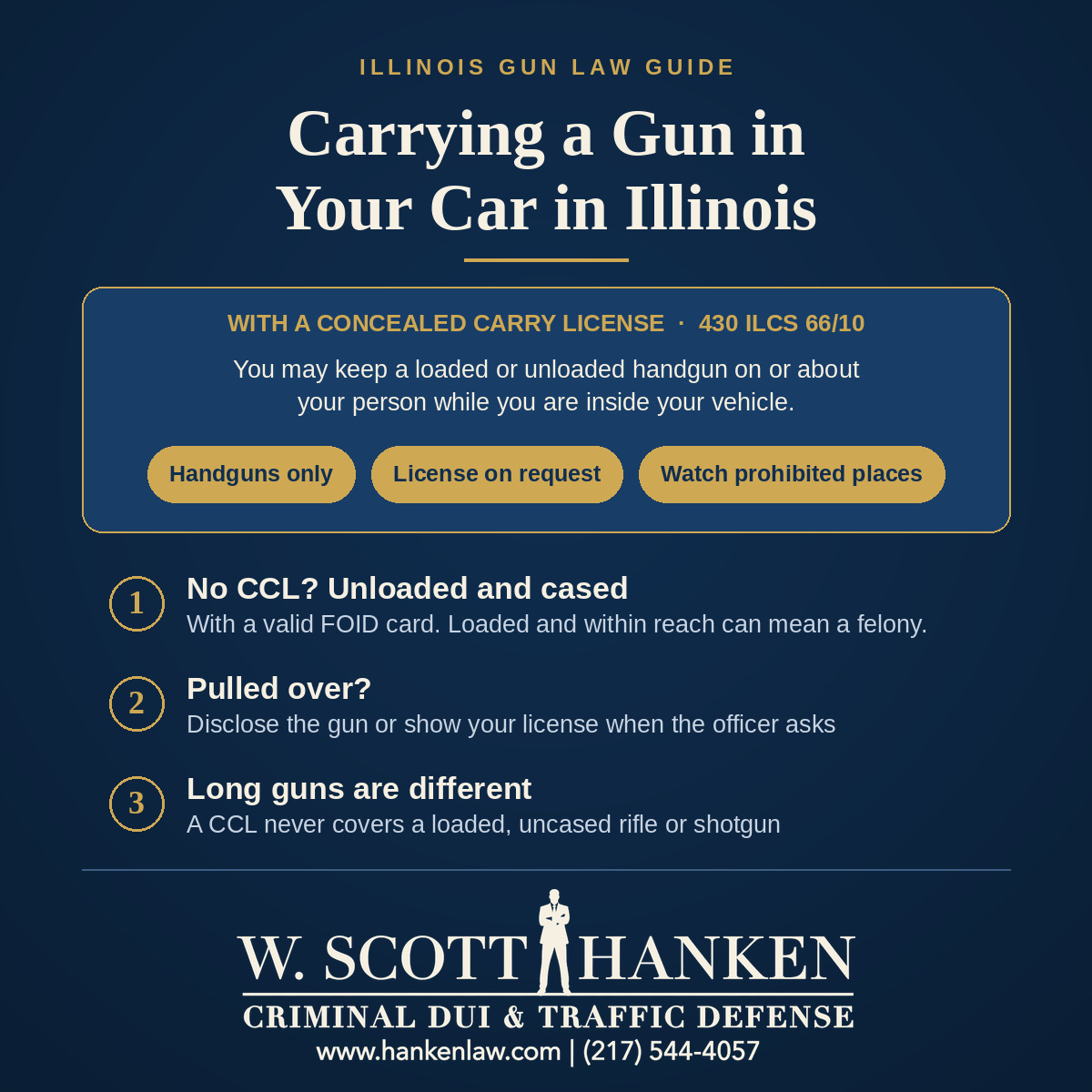
- With an Illinois concealed carry license (CCL), you may keep a loaded or unloaded handgun on or about your person in your vehicle.
- Without a CCL, the safe rule is unloaded, enclosed in a case, and a valid FOID card in hand.
- A CCL covers handguns only. A loaded, uncased, accessible rifle or shotgun can be a felony even for a license holder.
- At a traffic stop, a license holder must disclose the gun or show the license when the officer asks.
- Most CCL rule violations are misdemeanors, but carrying without a license, or without a FOID card, can be a felony.
The Short Answer: It Depends on Your License
| Your Situation | Handgun | Rifle or Shotgun |
|---|---|---|
| Valid Illinois CCL | Loaded or unloaded, on or about your person in the vehicle | Unloaded and enclosed in a case, not immediately accessible, or broken down |
| FOID card, no CCL | Unloaded and enclosed in a case, not immediately accessible, or broken down | Same as handgun |
| Illinois resident with neither | Possessing any firearm is generally illegal | Same as handgun |
Nonresidents have their own rules, covered below.
If You Have a Concealed Carry License
Under 430 ILCS 66/10, a license lets you keep or carry a loaded or unloaded concealed firearm on or about your person within a vehicle. Outside the vehicle, it lets you carry one on your person, fully or partially concealed. A few rules trip up even careful license holders:
- It covers handguns only. The Act’s definition of “concealed firearm” is limited to handguns. Rifles, shotguns, and stun guns are not covered by your license.
- Carry the license. You must have your license with you whenever you carry. Exceptions apply when the handgun is unloaded and cased, not immediately accessible, or broken down. While your license is in your physical possession, it also satisfies the FOID card possession requirement under Section 2 of the FOID Card Act.
- Don’t carry after drinking. Under 430 ILCS 66/70, carrying while under the influence of alcohol or drugs is judged by the same standards as DUI. It is a Class A misdemeanor for a first or second violation and a Class 4 felony for a third.
- An expired license is no license. It stays valid only if you submitted a renewal application before it expired and you are otherwise eligible.
There is also a safety net. If you have a valid license and are otherwise eligible, breaking a rule of the concealed carry law exposes you to that law’s own penalties instead of the felony weapons statutes. Leaving your license card at home is an example.
Prohibited Places and the Parking-Lot Rule
430 ILCS 66/65 bars licensees from carrying in many places. In Springfield, the ones drivers run into most are:
- buildings and parking areas controlled by the executive or legislative branch, such as the Capitol complex
- courthouses
- city and county government buildings
- hospitals
- public transit
- bars that earn more than half their receipts from alcohol
- stadiums, libraries, and airports
- any private property posted with the official no-firearms sign
The parking-lot rule keeps most of these manageable. You may drive into the parking area of a prohibited place with your handgun on you. You may then store the gun, concealed in a case, inside your locked vehicle or a locked container, out of plain view. For this purpose, a glove compartment or console that completely encloses the gun counts as a case, as does the trunk. You may carry the gun in the area right around your car only to move it to or from the trunk.
The parking-lot rule does not apply to nuclear facilities or to areas where federal law prohibits firearms.
If You Have a FOID Card but No Concealed Carry License
Without a CCL, 720 ILCS 5/24-1 makes it a crime to carry a firearm in a vehicle unless it is:
- broken down in a non-functioning state, or
- not immediately accessible, or
- unloaded and enclosed in a case, firearm carrying box, shipping box, or other container, and you have a currently valid FOID card.
That offense, now called unlawful possession of weapons, is a Class A misdemeanor. It becomes a felony under 720 ILCS 5/24-1.6 in either of these situations:
- a handgun is uncased, loaded, and immediately accessible
- a handgun is uncased and unloaded, but ammunition is within reach
Keep the ammunition cased or out of reach, too.
The Illinois Supreme Court held in People v. Diggins (2009) that a vehicle’s center console can count as a “case.” It later applied the same reasoning to a closed, latched armrest in People v. Holmes. But the transport exception requires the gun to be both unloaded and in a case. A loaded handgun in a closed console still isn’t lawful transport without a CCL.
Rifles and Shotguns: A CCL Doesn’t Cover Them
Anyone, licensed or not, who carries a rifle or shotgun in a vehicle that is uncased, loaded, and immediately accessible can face felony aggravated unlawful possession of a weapon. The same goes for an uncased, unloaded long gun with ammunition within reach. Your concealed carry license gives no protection here. For a deer rifle or a shotgun headed to the range, the rule is the same for everyone: unloaded and in a case.
Traffic Stops: What You Have to Tell the Officer
Under 430 ILCS 66/10, if an officer stops a license holder and asks, the license holder must do two things:
- Disclose or show. Disclose that they’re carrying a concealed firearm, or show their license. Showing the license satisfies the disclosure requirement.
- Locate and allow securing. If the officer asks, identify where the gun is and let the officer secure it for the duration of the stop.
A licensed passenger must follow the same rules. An officer may also secure the gun whenever it’s necessary for safety. If the officer then determines you aren’t a threat, the gun must be returned to you before you are released from the scene.
The legal duty is triggered by the officer’s request. Many gun owners still choose to mention the gun calmly at the start of the stop, keeping their hands on the wheel, because it avoids surprises for everyone.
If you don’t have a CCL, the concealed carry disclosure rule doesn’t apply to you. Either way, you can decline to consent to a search of your car. Police may still search if they have legal grounds of their own, but the lawfulness of that search often becomes the central issue in the case.
Nonresidents Driving Through Illinois
Illinois doesn’t recognize other states’ carry permits for carrying on foot. But 430 ILCS 66/40 lets a nonresident transport a concealed firearm in their vehicle if all of the following are true:
- the gun stays in the vehicle
- the person isn’t prohibited from having firearms under federal law
- the person is eligible to carry in their home state, shown by a home-state permit if that state issues one
- the person meets the statute’s other conditions
If you leave the vehicle unattended, the gun must be stored in the locked vehicle or a locked container inside it. Nonresidents carrying this way must follow the same traffic stop disclosure rules as Illinois license holders.
Nonresidents who are licensed or registered to possess a firearm in their home state are also exempt from Illinois’s FOID card requirement. In Holmes, the Illinois Supreme Court applied that exemption to the aggravated weapons statute.
Same Car, Very Different Charges
Here is a hypothetical. Two drivers are stopped on Interstate 55 outside Springfield, and each has a loaded handgun in the car.
The first driver has a valid concealed carry license but left the license card on his dresser at home. His FOID card is in his wallet. Because he holds a valid license and is otherwise eligible, he generally faces the concealed carry law’s penalty, a Class B misdemeanor for a first violation, not a felony weapons charge.
The second driver has a FOID card but no concealed carry license, and her handgun is loaded under the seat. That fits the felony offense of aggravated unlawful possession of a weapon: a loaded, uncased, accessible handgun without a license.
Real cases turn on details such as whether a gun was “immediately accessible” and whose gun it was. But the example shows how much a single piece of paper can matter.
What the Charges Look Like
| Situation | Classification | Statute |
|---|---|---|
| CCL holder breaks a concealed carry rule (for example, license not on person, or a prohibited place) | Class B misdemeanor; second or subsequent violation: Class A misdemeanor | 430 ILCS 66/70(e) |
| CCL holder carrying while under the influence | Class A misdemeanor (first and second violations); Class 4 felony (third) | 430 ILCS 66/70(d) |
| No CCL, and the gun isn’t unloaded and cased, inaccessible, or broken down | Class A misdemeanor | 720 ILCS 5/24-1(a)(4) |
| No CCL, and a handgun is loaded, uncased, and accessible (or unloaded with ammunition in reach) | Class 4 felony | 720 ILCS 5/24-1.6 |
| Rifle or shotgun loaded, uncased, and accessible, with or without a CCL | Class 4 felony | 720 ILCS 5/24-1.6 |
| Never issued a FOID card, carrying in a vehicle | Class 4 felony | 720 ILCS 5/24-1.6 |
Each firearm counts as a separate violation. A weapons conviction can also cost you your FOID card and your concealed carry license. For how that works, see Illinois FOID Card Requirements: Who Qualifies, What Disqualifies You, and How Criminal Charges Affect Your Card.
How a Springfield Weapons Defense Lawyer Can Help
Vehicle gun cases are often won or lost on details that police reports gloss over:
- The search. Many of these cases begin with a traffic stop and a search of the car. If the stop or the search was unlawful, the gun may be suppressed as evidence.
- Possession. In a shared car, the State must prove you knew about the gun and controlled it. A gun under a passenger seat is not automatically the driver’s.
- “Case” and “immediately accessible.” Whether a console, armrest, or bag counts as a case, and whether a gun was within reach, are fact questions courts have resolved both ways.
- Your paperwork. A valid license you didn’t have on you can change a felony exposure into a misdemeanor.
Scott has handled cases on both sides of the courtroom in Sangamon County.
Bottom Line: With a concealed carry license, you can keep a handgun with you in your car. Without one, keep it unloaded and cased, with your FOID card in hand. Never assume your license covers a rifle or shotgun. If a traffic stop has already turned into a gun charge, talk to a lawyer before you talk about it with anyone else.
Frequently Asked Questions (FAQs)
With a CCL, the license allows a handgun on or about your person in the vehicle. In a prohibited place’s parking lot, a closed glove box counts as a case for storing it in your locked car. Without a CCL, a closed glove box may count as a case, but the gun must also be unloaded, and you must have a valid FOID card.
Generally, yes, if you are a license holder. Even when an employer posts its property against firearms, the law lets a licensee store a handgun, concealed in a case, in a locked vehicle in the parking area. The main exceptions are nuclear facilities and places where federal law bans firearms.
A passenger with their own valid CCL may carry, and must follow the same traffic stop disclosure rules as a licensed driver. Each person needs their own authorization. When police can’t tell whose gun it is, more than one person in the car can end up charged.
Only if you submitted your renewal application before the license expired and you’re otherwise eligible. If you didn’t, treat yourself as unlicensed: unloaded, cased, and FOID card in hand.
No. Illinois renamed the offenses. “Unlawful use of weapons” is now “unlawful possession of weapons,” and the aggravated offense is now “aggravated unlawful possession of a weapon.” The aggravated rename took effect January 1, 2025. Older police reports and court records still use the former names.
Further Reading
Practice Area
Related Articles
- Illinois FOID Card Requirements: Who Qualifies, What Disqualifies You, and How Criminal Charges Affect Your Card — Your FOID card is the foundation of every rule in this post. Make sure yours is valid.
- Can I Carry a Firearm While Drinking in Illinois? — If you carry and drink, even one stop on the way home matters.
- Federal Gun Deregulation Won’t Save You From an Illinois Weapons Charge — Changes in federal gun policy don’t change Illinois’s rules for your car.
Browse by Topic
Ready to Fight Your Weapons Charge in Springfield?
Call W. Scott Hanken at (217) 544-4057 or contact us online for a free consultation. We serve clients throughout Springfield, Sangamon County, and Central Illinois.
About the Author: W. Scott Hanken, Attorney at Law
Scott Hanken is a Springfield, Illinois criminal defense attorney with over 37 years of experience, including service as a former Sangamon County prosecutor. He has been voted Best Attorney by the Illinois Times and State Journal-Register, holds an Avvo 10.0 “Superb” rating, and has earned over 270 five-star Google reviews. He serves clients throughout Sangamon County and Central Illinois.
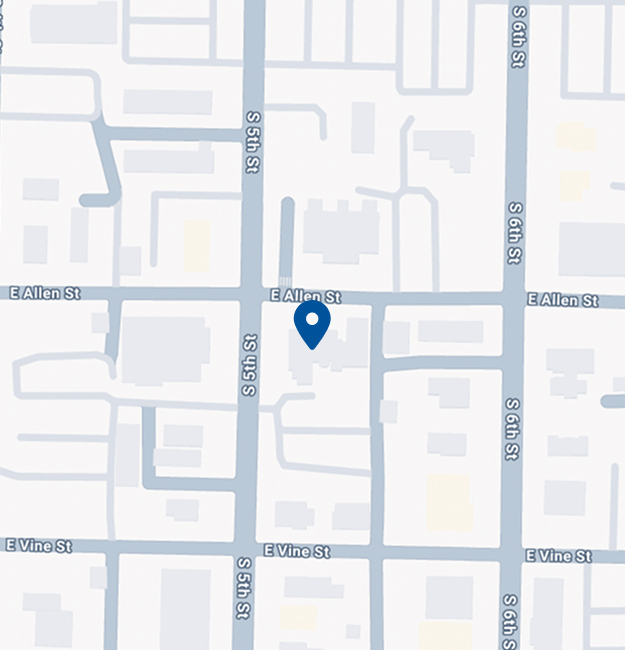
📍 1100 S 5th St, Springfield, IL 62703 | ☎ (217) 544-4057 | 🌐 hankenlaw.com
This article is for general educational purposes only and does not constitute legal advice. Every case is unique — contact an experienced Springfield criminal defense attorney for guidance on your specific situation.
Address
Our offices are located at the corner of South Fifth Street and Vine, in the historic Mary Bryant Home for the Blind.