- Free Consultation: (217) 544-4057 Tap Here To Call Us















What Should I Know About a Firearm Owners Identification?


Last Reviewed & Updated: October 2, 2026
By: W. Scott Hanken | Former Sangamon County Prosecutor | Springfield Criminal Defense & Weapons Offenses Defense Attorney | Voted “Best Attorney” — Illinois Times Best of Springfield & State Journal-Register Reader’s Choice | Springfield, IL | Sangamon County | (217) 544-4057 | hankenlaw.com
In Illinois, you need a state-issued card just to own a gun, not only to carry one. That card is the Firearm Owner’s Identification card, or FOID card. Without a valid one, having a handgun in your nightstand, a box of ammunition in your garage, or even a stun gun in your purse can lead to a criminal charge.
For most people in Springfield and Sangamon County, the FOID card only becomes a problem when something goes wrong. A renewal slips past its expiration date. A traffic stop turns up a handgun in the center console. An arrest leads to a judge ordering you to turn in your guns. This guide covers who qualifies for a FOID card, what disqualifies you, how a criminal charge can cost you your card, and how to fight back.
Key Takeaways:
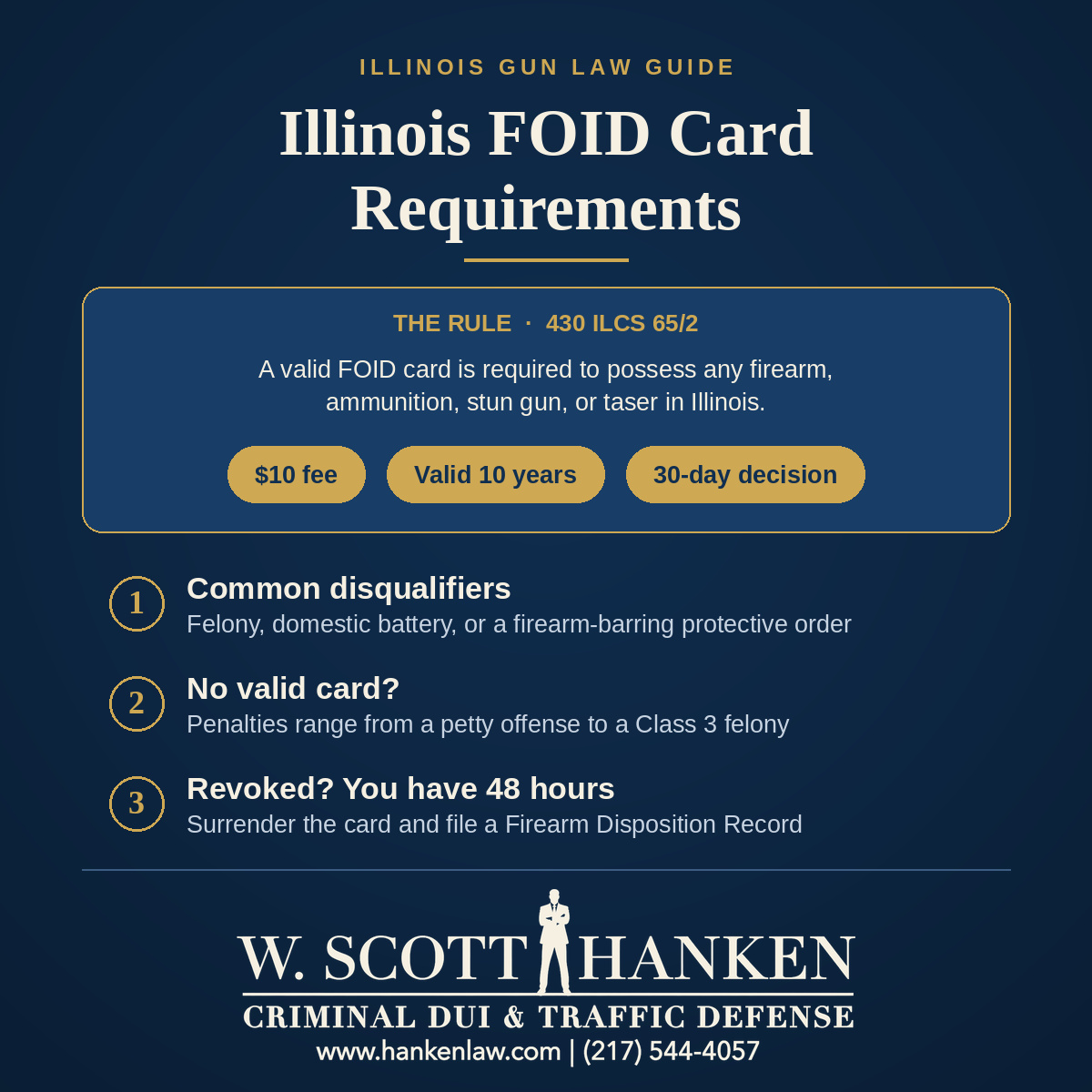
- A valid FOID card is required to acquire or possess any firearm, firearm ammunition, stun gun, or taser in Illinois, with limited exceptions.
- The card costs $10, is valid for 10 years, and the Illinois State Police must approve or deny a new application within 30 days.
- Possessing a firearm without a valid card can be anything from a petty offense to a felony, depending on why you don’t have one.
- A pending charge can cost you your guns through release conditions or a protective order. The way your case ends decides whether you keep your card.
- If your card is revoked, you have 48 hours to surrender it and account for your firearms.
Who Needs a FOID Card in Illinois?
Under Section 2 of the FOID Card Act, no one may acquire or possess any firearm, stun gun, taser, or firearm ammunition in Illinois without a FOID card issued in their name by the Illinois State Police. The rule applies at home as much as in public.
The most common exceptions are:
- Concealed carry license holders. A person with a valid Illinois concealed carry license (CCL) who has the license physically on them is covered for firearm and ammunition possession.
- New Illinois residents. A new resident who isn’t otherwise prohibited has until 60 calendar days after getting an Illinois driver’s license or state ID card. The clock starts with the license or ID, not the move.
- Nonresidents. Visitors are covered if their firearms are unloaded and enclosed in a case, or if they are currently licensed or registered to possess a firearm in their home state.
- Minors under supervision. Minors are covered while in the custody and immediate control of a parent or guardian who holds a valid FOID card.
- Supervised shooters. Anyone who would qualify for a FOID card is covered while directly supervised by a FOID holder age 21 or older at a shooting range or a recognized firearms safety course.
- On-duty officials. Law enforcement, military, and certain federal officials are covered while performing their official duties.
Who Qualifies for an Illinois FOID Card?
To qualify under 430 ILCS 65/4, an applicant must meet all of the following:
- Age. You must be 21 or older. If you are under 21, you must have no conviction for a misdemeanor other than a traffic offense and no delinquency adjudication. You must also either be on active military or Illinois National Guard duty, or have written consent from a parent or guardian who isn’t prohibited from holding a FOID card.
- Residency. You must be an Illinois resident, with limited exceptions for certain out-of-state law enforcement officers, armed security officers, and military members permanently assigned in Illinois.
- Identification. You must provide an Illinois driver’s license or state ID number.
- Photograph. You must submit a photo, or fingerprints instead if you have a recognized religious objection.
- No disqualifier. You must not fall into any of the disqualifying categories covered in the next section.
Fingerprints are otherwise optional. A parent who signs consent for an applicant under 21 is liable for any damages that result from the applicant’s use of firearms or ammunition. Knowingly giving false information on an application is a Class 2 felony.
What Disqualifies You From Getting a FOID Card?
The Illinois State Police can deny or revoke a card only on the grounds listed in 430 ILCS 65/8. The ones that come up most often are:
| Disqualifier | How Long It Lasts | Statute |
|---|---|---|
| Felony conviction in any jurisdiction | Indefinitely, unless relief is granted | 65/8(c) |
| Domestic battery or aggravated domestic battery conviction, no matter when the offense occurred | Indefinitely, unless relief is granted | 65/8(l) |
| Battery, assault, aggravated assault, or violating an order of protection, where a firearm was used or possessed | 5 years from conviction | 65/8(k) |
| An order of protection that prohibits you from possessing a firearm | While the order is in effect | 65/4(a)(2)(vii) |
| Patient in a mental health facility | 5 years, then a certification from a qualified clinician is required | 65/8(e), (u) |
| Involuntary admission to a mental health facility, or adjudication as a person with a mental disability | Until relief is granted | 65/8(r), (t) |
| Under 21 with a non-traffic misdemeanor conviction or a delinquency adjudication | Until age 21 | 65/8(a) |
Other grounds include:
- addiction to narcotics
- a mental condition posing a clear and present danger
- intellectual or developmental disability
- being prohibited from having firearms under federal law or another Illinois statute
- unlawful presence in the U.S., or admission on most nonimmigrant visas
- felony-level juvenile adjudications
- intentionally false statements on the application
- not being an Illinois resident
New in 2026: Since January 1, 2026, failing two or more times to report a lost or stolen firearm to local police within 48 hours of discovering it is also grounds for denial or revocation.
Three points people often get wrong:
- You don’t have to be a U.S. citizen. The bar applies to noncitizens unlawfully present in the U.S. and most people admitted on nonimmigrant visas. Citizenship status alone doesn’t disqualify a lawful permanent resident.
- Not every battery conviction is a bar. Ordinary battery or assault disqualifies you only for five years, and only if a firearm was used or possessed. Domestic battery disqualifies you regardless of when it happened or whether a gun was involved.
- A past mental health admission isn’t necessarily permanent. A former patient is barred for five years. After that, the person needs a certification from a qualified clinician that they are not a clear and present danger. Involuntary admission is a separate ground that requires relief.
How to Apply for or Renew a FOID Card
Applications and renewals go through the Illinois State Police Firearms Services Bureau online portal. Under 430 ILCS 65/5 and 430 ILCS 65/7:
- Fee. The fee is $10 plus electronic processing fees. Active-duty, National Guard, and Reserve members are exempt.
- Decision deadlines. The State Police must decide a new application within 30 days, and a timely renewal within 60 business days.
- Validity. A FOID card is valid for 10 years.
- Renew before it expires. A renewal submitted before your card’s expiration date keeps the card valid while the State Police process it, unless you become subject to revocation. This is the single easiest way to avoid a charge.
- Concealed carry holders. If your FOID card expires during the term of your concealed carry license, both stay valid, and the State Police may renew your FOID card automatically.
- Address changes. If you move after applying, you must notify the State Police immediately. Cardholders can update a name or address through the online portal.
The Firearms Services Bureau is headquartered in Springfield at 801 South Seventh Street. ISP lists a FOID kiosk at its Troop 6 facility at that address for people who need help with the online application. Check the ISP website for current hours before you go.
What Happens If You’re Caught Without a Valid FOID Card?
Under 430 ILCS 65/14, the penalty for possessing a firearm without a valid FOID card depends on why you don’t have one:
| Situation | Classification | Statute |
|---|---|---|
| Card expired 6 months or less, and you are otherwise not prohibited from owning firearms | Petty offense | 65/14(a-5) |
| Card expired, and you are eligible to renew, but the petty-offense rule doesn’t apply | Class A misdemeanor | 65/14(a) |
| Never had a card, but you are otherwise eligible | Class A misdemeanor; a second or subsequent violation is a Class 4 felony | 65/14(b) |
| Card revoked or subject to revocation, or you are not eligible for a card | Class 3 felony | 65/14(c) |
| Knowingly giving false information on a FOID application | Class 2 felony | 65/14(d-5) |
A Class A misdemeanor carries less than one year in jail under 730 ILCS 5/5-4.5-55. A Class 3 felony carries 2 to 5 years in prison under 730 ILCS 5/5-4.5-40, though probation may be available.
Same Gun Law, Very Different Charges
Here is a hypothetical. Two drivers are stopped on Interstate 55 outside Springfield. Neither has a concealed carry license, and both are otherwise eligible to own guns.
The first driver has an unloaded rifle in a case in the trunk, and her FOID card expired four months ago. Because the gun isn’t immediately accessible, the aggravated weapons statute generally doesn’t apply. The FOID Act treats a card expired six months or less as a petty offense.
The second driver has a loaded handgun in the center console and has never applied for a FOID card. He faces a felony charge with a statutory prison term of one to three years for a first offense.
Real cases turn on details. Whether a gun was “immediately accessible,” for example, is often disputed. But this is why the first question in any FOID case is why the card wasn’t valid.
Without a FOID Card, a Carry Case Can Become a Felony
Illinois renamed “aggravated unlawful use of a weapon” to aggravated unlawful possession of a weapon, effective January 1, 2025. Under 720 ILCS 5/24-1.6, the offense applies when you carry a firearm on your person or in a vehicle outside your home, land, or business, and you have not been issued a currently valid FOID card. It also covers carrying on public streets and lands within a city, village, or town.
- First offense. It is a Class 4 felony.
- Loaded, uncased, accessible handgun without a FOID card or concealed carry license. A first offense calls for 1 to 3 years in prison under the statute.
- Second or subsequent offense. It is a Class 2 felony with 3 to 7 years.
- Body armor. The offense is a Class X felony if you are wearing or possessing body armor without a valid FOID card.
- Multiple guns. Each firearm counts as a separate violation.
The Illinois Supreme Court struck down part of an earlier version of this statute in People v. Aguilar (2013). In People v. Mosley (2015), it upheld the provision that makes carrying without a FOID card an aggravating factor.
A valid FOID card is also what makes it legal to transport a gun that is unloaded and enclosed in a case. For more, see Can You Carry a Firearm in Your Vehicle in Illinois?
How Criminal Charges Affect Your FOID Card
Being charged with a crime and being convicted of one affect your FOID card in different ways.
While Your Case Is Pending
For adults, the criminal-history grounds in Section 8 are triggered by convictions, not by charges alone. Juveniles are treated differently: a pending delinquency petition for a felony-level offense is itself disqualifying. Even so, a pending adult case can still take your guns away:
- Pretrial release conditions. A judge can order you to surrender your firearms and FOID card as a condition of pretrial release. For certain charges, Illinois law has long made surrender a standard condition under 725 ILCS 5/110-10. Those charges include forcible felonies, stalking, domestic battery, Class 2 or greater drug felonies, and felony weapons offenses.
- Orders of protection. In domestic cases, an order of protection that bars firearm possession disqualifies you while it’s in effect, whether or not you’re ever convicted. See Illinois Orders of Protection & No Contact Orders for how these orders work.
How Your Case Ends Matters
The outcome of your case decides whether you keep your card. That means not only whether you’re convicted, but what you’re convicted of:
- A felony conviction disqualifies you indefinitely. If it’s a forcible felony or a felony weapons offense, getting relief later requires a court petition rather than a State Police review board appeal.
- A domestic battery conviction disqualifies you indefinitely. Pleading to a different offense isn’t always a way around it. Suppose you give up your right to a jury and are convicted of an offense that doesn’t require a domestic relationship. If the court makes a finding under the federal domestic-violence firearm law, that conviction disqualifies you too.
- Battery, assault, aggravated assault, or an order of protection violation disqualifies you for five years, but only when a firearm was used or possessed.
- If you’re under 21, any misdemeanor conviction other than a traffic offense disqualifies you until age 21.
- Many other misdemeanor convictions are not listed grounds for adults. But a prohibition under federal law or another Illinois statute also counts, so check before you plead.
FOID consequences belong in plea negotiations from the first conversation, not as an afterthought at sentencing.
If Your FOID Card Is Revoked: The 48-Hour Rule
Under 430 ILCS 65/9.5, within 48 hours of receiving a revocation notice you must do two things:
- Surrender your FOID card to the local law enforcement agency where you live.
- Complete a Firearm Disposition Record and place your firearms with the person or at the location listed on it. The record asks for the name, address, and FOID card number of anyone who takes custody of your guns.
If your card has been lost or destroyed, you still have to complete the Firearm Disposition Record. If you don’t comply, police can seek a warrant to search for and seize your card and firearms, and being seen with a revoked card is enough by itself to justify an arrest. The State Police’s revoked-card instructions state that failing to comply is a Class A misdemeanor.
Comply first, then fight. The appeal statute ties your right to seek relief to complying with these surrender requirements.
How to Appeal a FOID Denial or Revocation
430 ILCS 65/10 provides three paths:
| Path | When It Applies | Timeline |
|---|---|---|
| Record challenge to the ISP Director | The record is wrong (for example, mistaken identity or an incorrect case disposition), or the State Police didn’t act within 30 days | 60 business days after receiving all supporting information |
| FOID Card Review Board | Most denials and revocations | 45 days after receiving complete appeal documents (extensions are allowed) |
| Circuit court petition in your county of residence | Denials and revocations based on a forcible felony, stalking, aggravated stalking, domestic battery, a Class 2 or greater drug felony, a felony weapons offense, or a felony-level juvenile adjudication | Court hearing; the State’s Attorney must be served at least 30 days in advance |
For Sangamon County residents, a court petition is filed in Sangamon County. The State’s Attorney’s Office, where Scott once served as a prosecutor, can object and present evidence against it.
Whether you go to the Board or to the court, you generally must show all of the following:
- You have no forcible felony conviction within 20 years of your application, or at least 20 years have passed since any prison term for one ended.
- Your record and reputation show you’re not likely to endanger public safety.
- Granting relief would not be contrary to the public interest.
- Granting relief would not be contrary to federal law.
A court cannot order a card issued to someone who is still prohibited under federal law. This can make some disqualifications, such as domestic battery convictions, especially hard to overcome.
For older felony records, see Can a Convicted Felon Ever Legally Own a Firearm Again?
How a Springfield Weapons Defense Lawyer Can Help
If you’ve been charged with a weapons offense. Why the card wasn’t valid can be the difference between a petty offense and a felony. An expired card, a pending renewal, and never being eligible each lead to very different charges. Many weapons cases also turn on how the gun was found. If the search was unlawful, the evidence may be suppressed.
If you’ve been charged with something else. Your FOID card may be on the line even though the charge has nothing to do with guns. That’s especially true in domestic battery, assault, and felony cases. Release conditions, protective orders, and the exact offense of any plea all affect whether you keep your card.
If you’ve been denied or revoked. Choosing the wrong forum wastes time, and a thin petition rarely succeeds. A strong request for relief documents your history, your character, and why restoring your card serves the public interest.
Scott has handled cases on both sides of the courtroom in Sangamon County.
Bottom Line: In Illinois, a gun, a box of ammunition, or a stun gun without a valid FOID card can mean a criminal charge. A criminal charge can mean losing your FOID card. Renew early, report lost or stolen guns promptly, and get advice before you plead to anything.
Frequently Asked Questions (FAQs)
Yes. Illinois requires a FOID card to acquire or possess firearm ammunition, even if you don’t own a gun. A valid concealed carry license on your person also satisfies the requirement.
For possession, largely yes. A CCL holder carrying the license is exempt from the FOID possession requirement. If your FOID card expires during your CCL term, both stay valid. Anything that would disqualify you from a FOID card still matters, though, so a revocation affects both.
For adults, a charge alone isn’t a listed ground for revocation; a conviction is. But a judge can order you to surrender your guns and card as a condition of pretrial release, and an order of protection that bars firearms disqualifies you while it’s in effect.
It depends on the offense. Domestic battery disqualifies you indefinitely. Battery or assault involving a firearm disqualifies you for five years. If you’re under 21, almost any non-traffic misdemeanor disqualifies you until you turn 21. Talk to a lawyer about FOID consequences before you accept any plea.
Renew right away so you’re compliant going forward, but don’t assume renewing makes the charge go away. How long the card was expired, where the gun was, and whether you were otherwise eligible can turn a petty offense into a felony. Avoid explaining yourself to police without a lawyer.
Since January 1, 2026, failing two or more times to report a lost or stolen firearm within 48 hours is grounds for denial or revocation. The related weapons charge was also renamed as of January 1, 2025: “aggravated unlawful use of a weapon” is now aggravated unlawful possession of a weapon.
Further Reading
Practice Area
Related Articles
- Can a Convicted Felon Ever Legally Own a Firearm Again? — If a felony is what’s standing between you and a FOID card, start here.
- Illinois Orders of Protection & No Contact Orders: Not Just for Celebrities — This Happens Every Day to Ordinary People — An order of protection can cost you your FOID card. Learn how these orders work before a hearing.
- Can You Carry a Firearm in Your Vehicle in Illinois? — Most FOID-related charges begin with a traffic stop. Know the transport rules before you drive.
- Federal Gun Deregulation Won’t Save You From an Illinois Weapons Charge — Changes in federal gun policy don’t change what Illinois requires of you.
Browse by Topic
Ready to Fight Your Weapons Charge in Springfield?
Call W. Scott Hanken at (217) 544-4057 or contact us online for a free consultation. We serve clients throughout Springfield, Sangamon County, and Central Illinois.
About the Author: W. Scott Hanken, Attorney at Law
Scott Hanken is a Springfield, Illinois criminal defense attorney with over 37 years of experience, including service as a former Sangamon County prosecutor. He has been voted Best Attorney by the Illinois Times and State Journal-Register, holds an Avvo 10.0 “Superb” rating, and has earned over 270 five-star Google reviews. He serves clients throughout Sangamon County and Central Illinois.
📍 1100 S 5th St, Springfield, IL 62703 | ☎ (217) 544-4057 | 🌐 hankenlaw.com
This article is for general educational purposes only and does not constitute legal advice. Every case is unique — contact an experienced Springfield criminal defense attorney for guidance on your specific situation.
Address
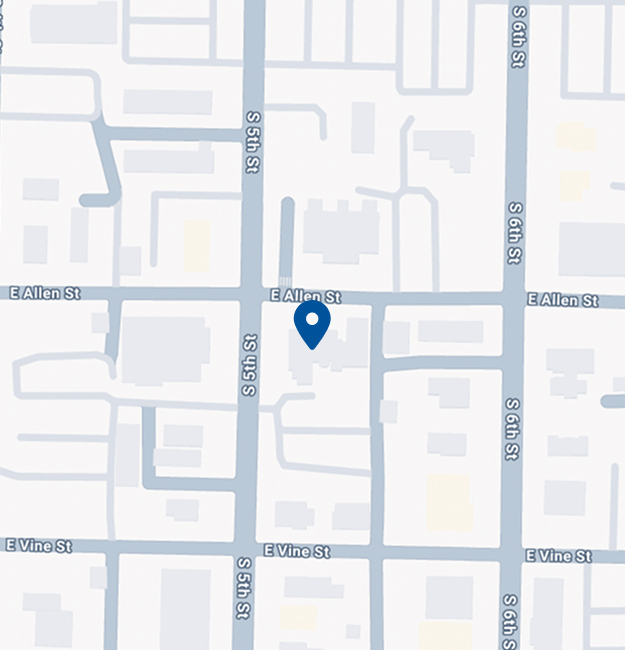
Our offices are located at the corner of South Fifth Street and Vine, in the historic Mary Bryant Home for the Blind.