- Free Consultation: (217) 544-4057 Tap Here To Call Us















Defend Against Assault Charges by Arguing Self Defense


Last Reviewed & Updated: September 27, 2026
By: W. Scott Hanken | Former Sangamon County Prosecutor | Springfield Criminal Defense & Violent Crimes Defense Attorney | Voted “Best Attorney” — Illinois Times Best of Springfield & State Journal-Register Reader’s Choice | Springfield, IL | Sangamon County | (217) 544-4057 | hankenlaw.com
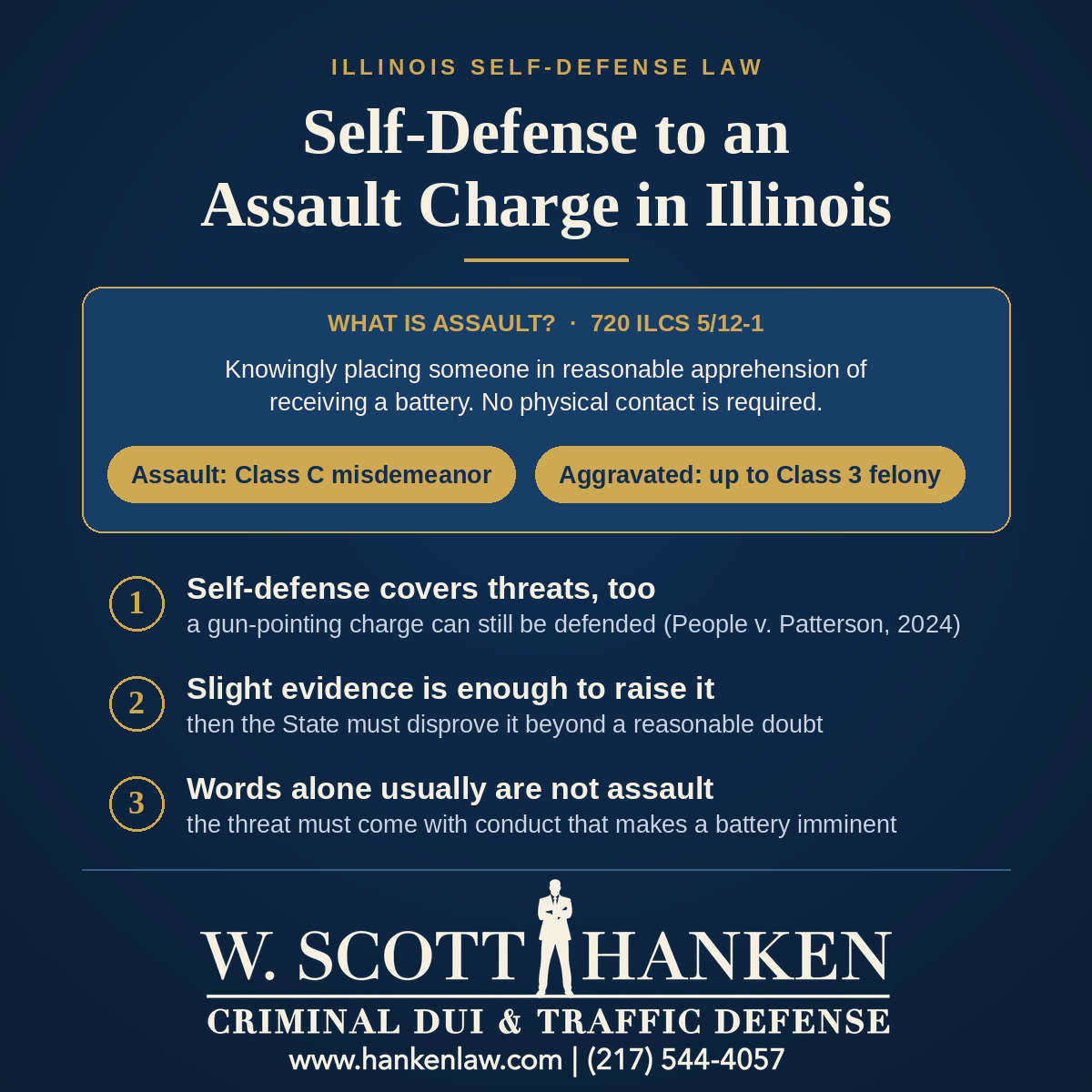
Yes. Self-defense is a defense to assault and aggravated assault in Illinois, just as it is to battery. You may threaten or use force when you reasonably believe it is necessary to protect yourself or someone else from another person’s imminent unlawful force. That covers raising your fists, stepping forward, or drawing a weapon.
You need only some evidence to raise self-defense. The State must then disprove it beyond a reasonable doubt. In People v. Patterson, 2024 IL App (1st) 221619, a man was charged with aggravated assault for pointing a handgun at another driver. The appellate court reversed his conviction because the jury was never instructed on self-defense.
Key Takeaways:
- Assault in Illinois requires no contact at all. It means knowingly placing someone in reasonable apprehension of receiving a battery.
- Simple assault is a Class C misdemeanor. Aggravated assault ranges from a Class A misdemeanor to a Class 3 felony.
- Self-defense applies to threats as well as to physical force, and “some evidence, however slight” entitles you to a self-defense instruction.
- Words alone usually are not an assault, and words alone usually do not justify a physical response.
- If you did not start the confrontation, Illinois does not require you to retreat before defending yourself.
Update, September 2026: An earlier version of this post overstated the penalty for simple assault. It also misdescribed what assault is, called the dwelling statute a “defense of property” law, and said deadly force could be used to prevent any felony. This version corrects those statements.
If you have been charged with assault in Springfield or Sangamon County after defending yourself, call W. Scott Hanken, Attorney at Law at (217) 544-4057 before you give a statement to police.
What Is Assault in Illinois?
Assault is a threat, not a touch. Under 720 ILCS 5/12-1(a), you commit assault when, without lawful authority, you knowingly engage in conduct that places another person in reasonable apprehension of receiving a battery. If the contact actually happens, the charge is battery instead.
Two parts of that definition matter in almost every case:
- The apprehension must be reasonable. Courts use an objective standard. The question is whether a reasonable person in the other person’s position would have expected to be struck, not just whether that person felt afraid.
- The battery must be imminent. A threat about some future time is not enough.
Are words alone an assault?
Usually not. In People v. Taylor, 2015 IL App (1st) 131290, a woman yelled “I’m going to kick your ass” at a sheriff’s deputy standing on the other side of courthouse airlock doors. The appellate court reversed her aggravated assault conviction. Words without a gesture or action did not objectively place the deputy in reasonable apprehension of a battery. Some action or condition must accompany the words.
What Are the Penalties for Assault and Aggravated Assault?
| Charge | Statute | Classification | Maximum penalty |
|---|---|---|---|
| Assault | 720 ILCS 5/12-1 | Class C misdemeanor | Up to 30 days in jail and a fine up to $1,500 (730 ILCS 5/5-4.5-65), plus 30–120 hours of community service where available |
| Aggravated assault, most forms (including using a deadly weapon without firing it) | 720 ILCS 5/12-2 | Class A misdemeanor | Less than one year in jail and a fine up to $2,500 (730 ILCS 5/5-4.5-55) |
| Aggravated assault, certain forms (including discharging a firearm) | 720 ILCS 5/12-2 | Class 4 felony | 1 to 3 years in prison |
| Aggravated assault, discharging a firearm from a motor vehicle | 720 ILCS 5/12-2(c)(3) | Class 3 felony | 2 to 5 years in prison |
An assault becomes aggravated based on where it happened, who the other person was (for example, a peace officer or someone 60 or older), or how it was done (for example, with a deadly weapon). The community service requirement for simple assault comes in addition to any other sentence, not instead of it, and it does not apply when the court imposes jail.
Can You Claim Self-Defense to an Assault Charge?
Yes. The self-defense statute, 720 ILCS 5/7-1, justifies force “when and to the extent” you reasonably believe it is necessary to defend yourself or another person against someone’s imminent use of unlawful force. It applies whether you are charged with battery for contact or with assault for a threat.
The Illinois Supreme Court’s six elements of self-defense, restated in People v. Gray, 2017 IL 120958, ¶ 50, apply the same way to an assault charge:
- Unlawful force was threatened against you.
- You were not the aggressor.
- The danger was imminent.
- The force you used or threatened was necessary.
- You actually believed a danger existed that required it.
- Your belief was objectively reasonable.
What happened in People v. Patterson?
A taxi driver cut off another motorist on Randolph Street in Chicago. At the next red light, the motorist got out of his car and confronted the taxi driver from about six feet away. The driver pointed a handgun at him and told him to leave. He was charged with aggravated assault under 720 ILCS 5/12-2(c)(1) and gave notice that he would claim self-defense under Section 7-1.
The trial judge refused to instruct the jury on self-defense, calling the evidence for it “close to non-existent.” The appellate court reversed. A defendant is entitled to self-defense instructions if there is “some evidence, however slight” to support the defense, and a motorist getting out of his car to confront the driver was enough. The jury had sent notes asking whether self-defense could be considered, so the error was not harmless, and the case was sent back for a new trial.
The court also faulted the trial judge for not answering the jury’s questions about whether the driver was allowed to carry the gun. Whether he could lawfully carry it was not the charge in front of the jury.
Does the Threat Have to Match the Danger You Faced?
Your response must be one you reasonably believed was necessary. Illinois has no rule that you must match the other person weapon for weapon.
The statute does draw a hard line at deadly force. Force intended or likely to cause death or great bodily harm is justified only to prevent imminent death, great bodily harm, or a forcible felony (720 ILCS 5/7-1). When the threat you made involves a gun or a knife, expect the State to argue that it had to be justified by a danger that serious.
Raising your fists at someone who is closing in on you is judged very differently from drawing a knife on someone who is only yelling. In Patterson, the jury was entitled to decide the question. It was not a defense the driver was sure to win.
Do You Have to Walk Away Before Defending Yourself?
Not if you did not start it. Illinois has no stand-your-ground statute, but a person who did not provoke the confrontation has no duty to retreat, in public or at home. The pattern jury instruction on this point is IPI Criminal No. 24-25.09X. Whether you could easily have left can still come up as evidence about whether your response was necessary.
The rules change for the person who started it. Under 720 ILCS 5/7-4, an initial aggressor generally loses self-defense. There are two narrow exceptions: the other person’s response put the aggressor in reasonable fear of imminent death or great bodily harm and every reasonable means of escape was exhausted, or the aggressor clearly withdrew and the other person kept going.
Can You Threaten Force to Protect Someone Else or Your Home?
Yes to both, within limits.
- Another person: Section 7-1 protects force used to defend “himself or another.” The same elements apply when you step in for a friend, a family member, or a stranger.
- Your home: 720 ILCS 5/7-2 allows force you reasonably believe is necessary to prevent or stop someone’s unlawful entry into or attack on your dwelling, with stricter conditions for deadly force.
- Other property: 720 ILCS 5/7-3 allows reasonable force against trespass or interference with property, but deadly force only to prevent a forcible felony.
What if the Other Person Was a Police Officer?
Different rules apply. Assaulting someone you know is a peace officer performing official duties is aggravated assault. And under 720 ILCS 5/7-7, you may not use force to resist an arrest you know is being made by an officer, even if you believe the arrest is unlawful. Self-defense against an officer’s excessive force is a separate, fact-specific question that needs a lawyer’s review before you say anything.
Who Has to Prove Self-Defense in an Assault Case?
You do not. Self-defense is an affirmative defense under 720 ILCS 5/7-14. Once there is some evidence of it, 720 ILCS 5/3-2 requires the State to disprove it beyond a reasonable doubt, along with every element of the assault. That evidence can come from the State’s own witnesses, as it did in Patterson.
What Other Defenses Apply to an Assault Charge?
Self-defense is not the only defense. Many assault cases are won on the definition of assault itself:
- No reasonable apprehension: If a reasonable person would not have expected to be struck, there was no assault.
- No imminent battery: A threat about the future, or one made where a battery was not physically possible, may not qualify.
- No knowing conduct: The State must prove you knowingly engaged in the conduct that caused the fear.
- No aggravating factor: For aggravated assault, the State must also prove the factor that raised the charge, such as the other person’s status or a deadly weapon.
What Should You Do if You Are Charged With Assault After Defending Yourself?
- Write down what happened while you remember it clearly: who approached whom, what was said, and where everyone was standing.
- Preserve evidence: save surveillance, dashcam, doorbell, or phone video before it is overwritten, and get the names of witnesses.
- Keep your statement short: tell police you were the one threatened, then say you want to speak with a lawyer before answering detailed questions.
In a case with no physical contact, the case often comes down to one person’s word against another’s, which makes independent evidence especially valuable.
Frequently Asked Questions (FAQs)
Yes. Assault is conduct that places someone in reasonable apprehension of receiving a battery. No contact is required. If contact happened, the charge is usually battery.
Usually not by itself. Illinois courts require some action or condition along with the words, such as moving toward the person or raising a fist or a weapon.
Yes. In People v. Patterson, 2024 IL App (1st) 221619, a driver charged with aggravated assault for pointing a gun was entitled to self-defense instructions. Whether the threat was justified depends on the danger you reasonably believed you faced.
Not if you did not start the confrontation. Illinois does not impose a duty to retreat on a non-aggressor, in public or at home.
The State. Once there is some evidence of self-defense, the State must disprove it beyond a reasonable doubt.
Simple assault is a Class C misdemeanor. Aggravated assault is usually a Class A misdemeanor but can be a Class 4 or Class 3 felony, depending on how and against whom it was committed.
Assaulting someone you know is a peace officer performing official duties is aggravated assault, and you may not use force to resist a known arrest, even an unlawful one. Talk to a lawyer before giving any statement.
Further Reading
Practice Area
Related Articles
- The Difference Between Assault and Battery in Illinois — Start here if you are not sure which charge you are facing.
- When Is Self-Defense a Legitimate Defense to Battery Charges? — If the confrontation turned physical, self-defense works the same way against a battery charge.
- Can You Use a Weapon in Self-Defense? — If a gun or knife was involved, this covers deadly force and gun-possession issues.
- 4 Ways to Boost a Defense Against Aggravated Battery Charges — Covers defenses beyond self-defense if contact was made and the charge is a felony.
Browse by Topic
Ready to Fight Your Violent Crime Charge in Springfield?
Call W. Scott Hanken at (217) 544-4057 or contact us online for a free consultation. We serve clients throughout Springfield, Sangamon County, and Central Illinois.
About the Author: W. Scott Hanken, Attorney at Law
Scott Hanken is a Springfield, Illinois criminal defense attorney with over 37 years of experience, including service as a former Sangamon County prosecutor. He has been voted Best Attorney by the Illinois Times and State Journal-Register, holds an Avvo 10.0 “Superb” rating, and has earned over 270 five-star Google reviews. He serves clients throughout Sangamon County and Central Illinois.
📍 1100 S 5th St, Springfield, IL 62703 | ☎ (217) 544-4057 | 🌐 hankenlaw.com
This article is for general educational purposes only and does not constitute legal advice. Every case is unique — contact an experienced Springfield criminal defense attorney for guidance on your specific situation.

Address
Our offices are located at the corner of South Fifth Street and Vine, in the historic Mary Bryant Home for the Blind.