- Free Consultation: (217) 544-4057 Tap Here To Call Us






Illinois Expands Cyberbullying Law to Cover AI Deepfakes: What Sangamon County Families Need to Know


By: W. Scott Hanken Former Sangamon County Prosecutor | Springfield Criminal Defense & DUI Attorney |
Voted “Best Attorney” — Illinois Times Best of Springfield & State Journal-Register Reader’s Choice
Springfield, IL • Sangamon County • (217) 544-4057 • hankenlaw.com
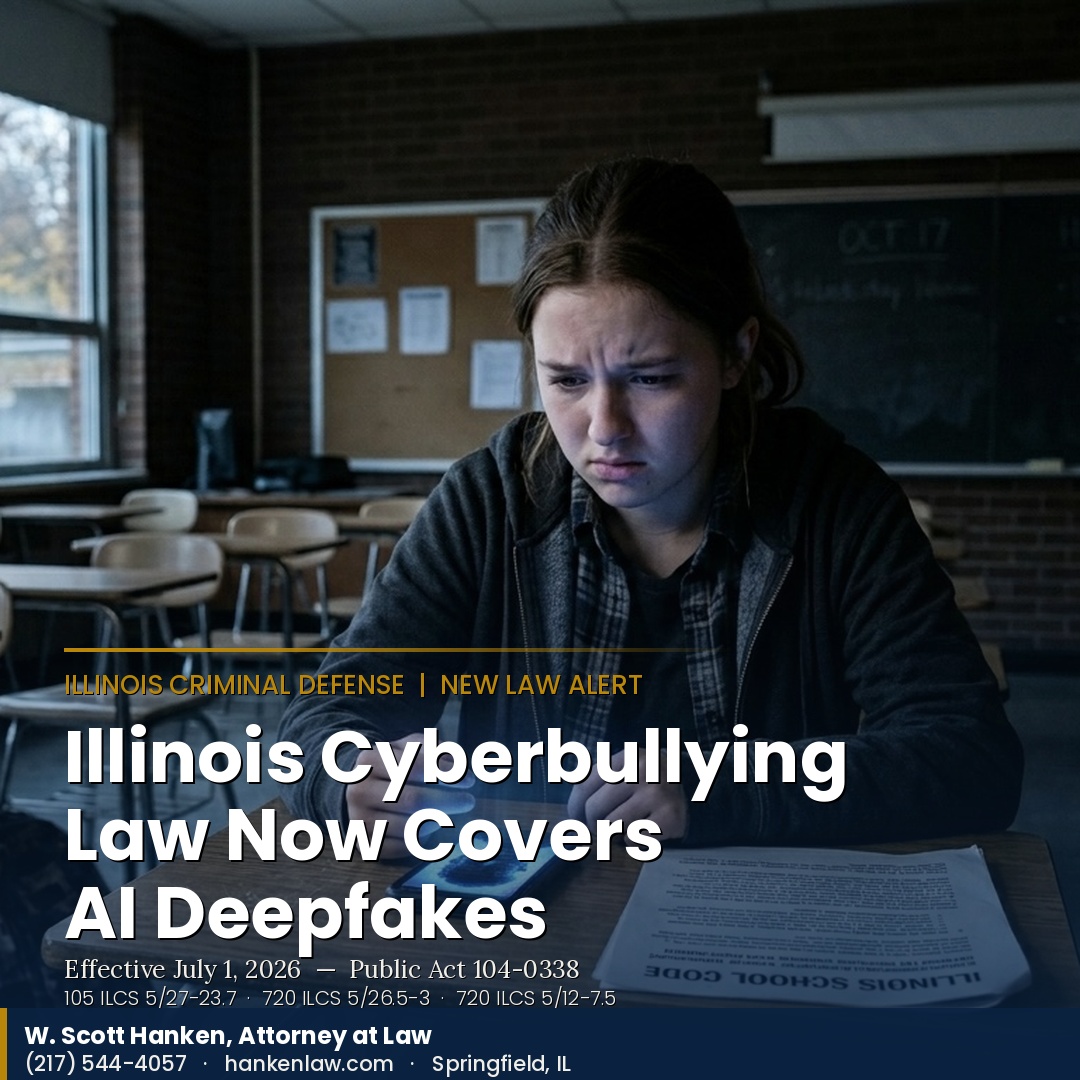
The short version: Starting July 1, 2026, Illinois law treats the posting or distribution of a realistic AI-generated image, audio, or video of a student without that student’s consent as cyberbullying. Public Act 104-0338 amends 105 ILCS 5/27-23.7 — the Illinois School Code’s bullying prevention statute. Beyond school discipline, a student who posts such content may face criminal charges under multiple Illinois statutes, with penalties ranging from 6 months in jail to 1 to 3 years in prison. Schools must update their policies. Families must understand what the law now covers.
What Happened: A New Law Takes Effect July 1, 2026
The Illinois General Assembly passed HB 3851 with overwhelming bipartisan support — 116-0 in the House and 57-0 in the Senate. Governor Pritzker signed it. The bill became Public Act 104-0338, with an effective date of July 1, 2026.
The target was a specific and growing problem: students using generative AI tools to fabricate convincing images, audio clips, or short videos of other students. Fake posts. Fabricated voices. Digitally altered faces placed in humiliating or sexually explicit contexts. Technology now makes this possible in minutes, and existing Illinois cyberbullying law had not caught up.
This new law closes that gap — and it does so with teeth that extend well beyond the principal’s office.
What the Statute Actually Says
The law amends Section 27-23.7 of the Illinois School Code (105 ILCS 5/27-23.7) in two important ways.
First, the definition of general “bullying” now expressly includes posting or distributing sexually explicit images — whether AI-generated or not. That language was not in the prior version of the statute.
Second, and more significantly, the definition of “cyber-bullying” is expanded. Beginning with the 2026–2027 school year, cyberbullying includes:
“the posting or distribution of an unauthorized digital replica by electronic means if the posting or distribution creates any of the effects enumerated in the definition of ‘bullying’ in this Section.” — 105 ILCS 5/27-23.7 (as amended by P.A. 104-0338, eff. July 1, 2026)
To trigger the statute, the conduct must produce one or more of four effects. The AI-generated content must: (1) place a student in reasonable fear of harm; (2) cause a substantially detrimental effect on physical or mental health; (3) substantially interfere with academic performance; or (4) substantially interfere with the student’s ability to participate in school activities. Not every embarrassing deepfake automatically qualifies — the law requires real, demonstrable harm.
Defining the Key Terms
“Artificial intelligence” and “digital replica”
The statute borrows its definitions from the Digital Voice and Likeness Protection Act (815 ILCS 550). Artificial intelligence means a machine-based system that infers from inputs how to generate outputs — predictions, content, recommendations, or decisions. That definition includes generative AI tools like image synthesizers and voice cloners.
A “digital replica” is a newly created electronic representation of an actual individual created using AI or other technology, fixed in a sound recording or audiovisual work in which that individual did not actually perform or appear, and realistic enough that a reasonable observer would believe it is a genuine performance by that person. The key word is “newly created” — this covers fabricated content, not edited photographs or genuine recordings.
“Unauthorized digital replica”
This is the operative concept for the cyberbullying statute. The law defines it simply: the use of a digital replica of an individual without the consent of the depicted individual. No commercial motive is required. No intent to profit. If a student creates or posts a realistic AI-generated likeness of another student without that student’s permission, and the content causes qualifying harm, it falls within the new definition of cyberbullying.
| Element | What It Means in Practice |
|---|---|
| AI-generated content | Created using software, algorithm, or generative AI tool — not genuine footage of the person |
| Realistic enough to deceive | A reasonable observer would believe it is the actual student performing or appearing |
| Without consent | The depicted student did not authorize the creation or distribution |
| Distributed electronically | Posted, shared, sent — by any electronic means |
| Causes qualifying harm | Fear, mental/physical health impact, academic interference, or loss of school participation |
Off-Campus Conduct Still Counts
A common misconception: “my child made that post from home, on a personal phone, so school has nothing to do with it.” That is not how Illinois cyberbullying law works, and it was not how it worked even before this amendment.
105 ILCS 5/27-23.7 already covers conduct from non-school devices at off-campus locations — as long as the bullying causes a substantial disruption to the educational process or the orderly operation of a school. That standard is fact-specific, but it is not a high bar when a deepfake of a classmate circulates widely before first period on Monday morning.
The school can act. And depending on the content, so can law enforcement — under multiple criminal statutes that operate entirely independently of the School Code.
The Criminal Exposure: This Is Not Just a School Discipline Matter
105 ILCS 5/27-23.7 is a school discipline statute, not a criminal statute. But the conduct it targets may simultaneously violate three separate criminal provisions of Illinois law. Each carries its own penalties.
A student who posts a deepfake of a classmate could face school expulsion, a criminal charge, or both. The fact that the content was “fake” or “just AI” is not a legal defense under any of them.
Harassment by Electronic Communication — 720 ILCS 5/26.5-3
This statute makes it a crime to use any electronic communication — text, social media, email, messaging apps — to knowingly harass, threaten, or cause emotional distress to another person. Posting a fabricated AI image of a classmate with intent to embarrass or humiliate fits squarely within its scope.
Penalties Under 720 ILCS 5/26.5-3
- First offense: Class B misdemeanor — up to 6 months in county jail and a fine up to $1,500
- Second offense against the same victim, or victim under 18 / accused adult: Class 4 felony — 1 to 3 years in IDOC, fine up to $25,000
- Fourth harassment offense within 10 years: Class 4 felony
- A Class 4 felony conviction also carries 1 year of mandatory supervised release (parole) following imprisonment and a permanent felony record affecting housing, employment, and professional licensing.
Cyberstalking — 720 ILCS 5/12-7.5
Cyberstalking applies when a person engages in a course of conduct — meaning two or more acts — using electronic communication directed at a specific person, knowing or having reason to know it would cause a reasonable person to fear for their safety or suffer serious emotional distress. A pattern of deepfake posts targeting the same student, or a single post combined with follow-up electronic harassment, can cross into cyberstalking territory. The statute also specifically covers creating a webpage or online profile intended to harass someone through threats or humiliating statements.
Penalties Under 720 ILCS 5/12-7.5
- First conviction: Class 4 felony — 1 to 3 years in IDOC, fine up to $25,000
- Second or subsequent conviction: Class 3 felony — 2 to 5 years in IDOC, fine up to $25,000
- Hate crime enhancement (conduct motivated by victim’s race, religion, gender, sexual orientation, disability, or national origin, occurring in or near a school): First offense Class 3 felony; repeat offense Class 2 felony (3 to 7 years)
- A prior order of protection or stalking no contact order already in place can result in immediate arrest for any contact.
Nonconsensual Dissemination of Private Sexual Images — 720 ILCS 5/11-23.5
When the AI-generated deepfake is sexual in nature, this statute independently applies. Illinois amended its nonconsensual sexual images law to cover “digitally altered sexual images” — meaning an AI-generated image placing a real student in a sexual context is explicitly covered, even if no authentic sexual image of that person ever existed. The depicted person’s consent to the original photograph (if any existed) is irrelevant; what matters is consent to distribution. If the person depicted in the sexual deepfake is under 18, the conduct may separately constitute child pornography under Illinois law — a much more serious charge.
Penalties Under 720 ILCS 5/11-23.5
- Criminal penalty: Class 4 felony — 1 to 3 years in IDOC, fine up to $25,000
- Civil liability (740 ILCS 190): The victim may separately sue for actual damages or statutory damages up to $10,000 per defendant, plus attorney’s fees, punitive damages, and injunctive relief
- If the depicted person is under 18: Potential child pornography charges under Illinois and federal law — far more severe penalties apply
What Schools in Sangamon County Must Do
Public Act 104-0338 is not merely advisory. Every school district, charter school, and non-public non-sectarian school in Illinois is required under 105 ILCS 5/27-23.7(d) to maintain a policy on bullying that incorporates the statutory definitions. Now that those definitions have changed, policies must be updated to reflect the new language before the 2026–2027 school year begins.
That means Springfield Public Schools District 186 and every other Sangamon County district should be revising written policies, student handbooks, and anti-bullying program materials before fall. Failure to do so does not insulate the district from liability when an incident occurs — it just means the district is operating with an outdated policy that no longer accurately reflects Illinois law.
Parents have every right to ask their school administration for the current written anti-bullying policy and to confirm it has been updated to reflect the new law.
The Bigger Picture: AI and Youth Conduct Law Is Moving Fast
HB 3851 did not emerge from nowhere. It is part of a broader legislative response to the misuse of generative AI tools in ways that harm real people. Illinois has already enacted the Digital Voice and Likeness Protection Act (815 ILCS 550) to safeguard adults’ digital likenesses in commercial contexts, and the Civil Remedies for Nonconsensual Dissemination of Private Sexual Images Act (740 ILCS 190) to provide civil remedies for deepfake sexual content. This new law extends analogous protections into the school environment — a setting where young people are both the most frequent users of AI tools and the most vulnerable to having those tools turned against them.
The law passed without a single “no” vote in either chamber. That unanimity reflects how seriously legislators across both parties view AI-facilitated harassment. It also signals that this area of law is going to keep developing. The 2026 version of this statute is not the last word on AI and student conduct.
As a former Sangamon County Assistant State’s Attorney with 37 years of criminal defense experience, I have watched Illinois expand its harassment and stalking statutes repeatedly in response to emerging technology — email, then texting, then social media. The pattern with AI will be the same. The conduct gets ahead of the law; the legislature responds; the definitions expand; the penalties grow. Families and students who understand where the law is today are better positioned when the next round of changes arrives.
What Families Should Do Right Now
If your student is accused of posting or sharing an AI-generated image of a classmate, do not allow your child to speak with school administrators or police before consulting an attorney. What your child says in those conversations — even in an informal meeting — can and will be used against them. The instinct to cooperate and explain is understandable, but it often does more harm than good when the stakes include suspension, expulsion, or criminal investigation under statutes that carry felony penalties.
If your student is the victim, document everything. Screenshot and preserve the content before it disappears. Note dates, times, and which platforms were involved. Report to school administration in writing, not just by phone. Keep copies of all communications. If the content is sexual in nature, contact law enforcement directly and request they investigate under 720 ILCS 5/11-23.5 and potentially federal law — that is not just a school matter, and you have civil remedies available to you under 740 ILCS 190 as well.
Either way, knowing the law is the first step. The second step is making sure you have someone in your corner who knows the Sangamon County court system and the Springfield school discipline process from the inside out.
W. Scott Hanken has represented Sangamon County clients in criminal defense matters for 37 years. He is a former prosecutor, an Avvo 10.0 Superb rated attorney, and a perennial Super Lawyers selectee since 2007.
Frequently Asked Questions (FAQs)
Starting July 1, 2026, Public Act 104-0338 amends 105 ILCS 5/27-23.7 to add AI-generated “unauthorized digital replicas” to the definition of cyberbullying. Posting or distributing a realistic AI-generated image, audio, or video of a student without that student’s consent — if it causes fear, emotional harm, academic disruption, or interferes with school participation — is now cyberbullying under Illinois law.
Beyond school discipline, conduct violating the new statute may simultaneously support criminal charges under three separate statutes. Harassment by electronic communication under 720 ILCS 5/26.5-3 starts as a Class B misdemeanor (up to 6 months in jail) but becomes a Class 4 felony (1 to 3 years in prison) when the victim is a minor and the accused is an adult, or when it is a repeat offense against the same victim. Cyberstalking under 720 ILCS 5/12-7.5 is a Class 4 felony on a first conviction and a Class 3 felony (2 to 5 years) on a repeat. If the content is sexual, nonconsensual dissemination under 720 ILCS 5/11-23.5 is a Class 4 felony, with additional civil liability up to $10,000 in statutory damages.
The statute defines it as the use of a digital replica of an individual without the consent of the depicted individual. A “digital replica” — defined by reference to the Digital Voice and Likeness Protection Act (815 ILCS 550) — is a newly created, electronic representation of a real person created using AI or other technology that a reasonable observer would believe is an actual performance or appearance by that person.
Yes. 105 ILCS 5/27-23.7 already covered off-campus conduct from personal devices when the bullying causes a substantial disruption to the educational process. A deepfake posted at home can trigger school discipline and other consequences if it meets that standard — and most that circulate among classmates will. The criminal statutes have no school-location requirement at all.
Do not allow your child to make statements to school administrators or law enforcement without speaking to an attorney first. The facts matter — what was actually posted, whether the depicted person consented, whether the content caused demonstrable harm — and those facts need to be developed carefully before any statement is made. Contact W. Scott Hanken at (217) 544-4057 for a consultation.
Under 105 ILCS 5/27-23.7, no specific intent to harm is required — what matters is whether the posted content caused one of the four qualifying effects and whether the depicted student consented. Under the criminal statutes, intent requirements vary by charge. A student who thought the post was “just a joke” is not automatically shielded from prosecution under 720 ILCS 5/26.5-3 or 720 ILCS 5/12-7.5.
Ready to Fight Your Criminal Charge in Springfield?
Call W. Scott Hanken at (217) 544-4057 or contact us online for a free consultation. We serve clients throughout Springfield, Sangamon County, and Central Illinois.
About the Author: W. Scott Hanken, Attorney at Law
Scott Hanken is a Springfield, Illinois criminal defense attorney with over 37 years of experience, including service as a former Sangamon County prosecutor. He has been voted Best Attorney by the Illinois Times and State Journal-Register, holds an Avvo 10.0 “Superb” rating, and has earned over 190+ five-star Google reviews. His firm handles DUI defense, drug crimes, traffic violations, violent crimes, and weapons offenses throughout Sangamon County and Central Illinois.
📍 1100 S 5th St, Springfield, IL 62703 | ☎ (217) 544-4057 | 🌐 hankenlaw.com
This article is for general educational purposes only and does not constitute legal advice. Every case is unique — contact an experienced Springfield criminal defense attorney for guidance on your specific situation.
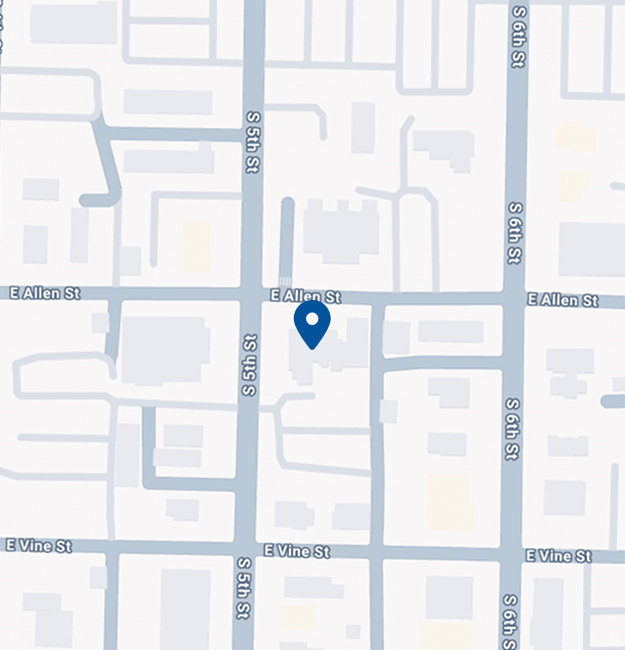
Address
Our offices are located at the corner of South Fifth Street and Vine, in the historic Mary Bryant Home for the Blind.