- Free Consultation: (217) 544-4057 Tap Here To Call Us








Illinois Hate Crime Charges: Penalties and Defenses


Last Reviewed & Updated: October 8, 2026
By: W. Scott Hanken | Former Sangamon County Prosecutor | Springfield Criminal Defense & Violent Crimes Defense Attorney | Voted “Best Attorney” — Illinois Times Best of Springfield & State Journal-Register Reader’s Choice | Springfield, IL | Sangamon County | (217) 544-4057 | hankenlaw.com
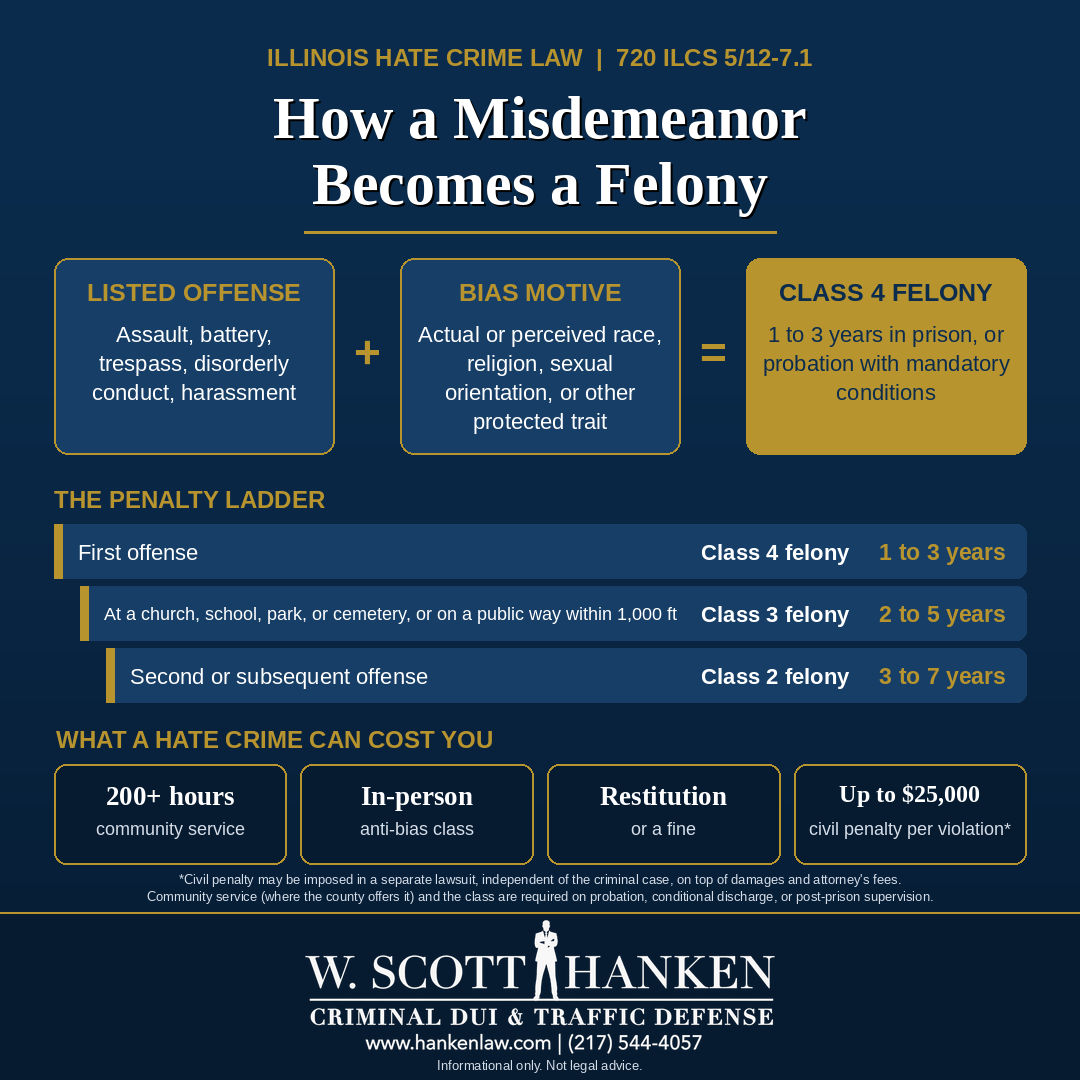
In Illinois, a first-offense hate crime under 720 ILCS 5/12-7.1 is a Class 4 felony. Probation is available, and the prison range is 1 to 3 years. The charge takes an ordinary misdemeanor, such as assault, battery, or trespass, and makes it a felony when the State alleges the act was motivated by the victim’s race, religion, sexual orientation, or another protected trait.
Bottom Line: In Sangamon County, an overt slur during an arrest-worthy incident usually leads the State to file a hate crime charge, and that charge is a felony. It rises to a Class 3 felony if the State places the incident at or within 1,000 feet of a church, school, public park, or cemetery. A conviction carries mandatory restitution or a fine; probation adds at least 200 hours of community service and an in-person anti-bias class. The alleged victim can also sue for actual and punitive damages and attorney’s fees, plus a civil penalty of up to $25,000 per violation. Filing the charge is easy for the State. Proving the motive behind it is not.
Charged with a hate crime in Sangamon County? Call W. Scott Hanken, Attorney at Law at (217) 544-4057 before you talk to police or the alleged victim.
What Makes a Crime a “Hate Crime” in Illinois?
An Illinois hate crime is one of 16 listed offenses committed because of another person’s actual or perceived protected trait. Without both the underlying offense and the bias motive, there is no hate crime.
Statute Callout — 720 ILCS 5/12-7.1(a)
“A person commits hate crime when, by reason of the actual or perceived race, color, creed, religion, ancestry, gender, sexual orientation, physical or mental disability, citizenship, immigration status, or national origin of another individual or group of individuals, regardless of the existence of any other motivating factor or factors, he or she commits [one of the listed offenses].”
Most recently amended by P.A. 102-813, effective May 13, 2022 (also P.A. 102-235 and P.A. 102-468, both effective January 1, 2022).
Three phrases in that sentence do most of the work in a courtroom:
- “Actual or perceived.” The alleged victim does not have to actually belong to the group. What matters is what the defendant believed.
- “Regardless of the existence of any other motivating factor.” Bias does not have to be the only reason. The State can pursue the charge even when the incident began over money, a parking space, or being refused service.
- “By reason of.” Bias still has to be a reason for the act. Offensive words spoken during an offense are evidence of motive, but they are not automatically proof of it.
The statute also covers conduct aimed at a “group of individuals.” A slur directed at a room full of people counts the same as one directed at a single person.
Gender identity is covered, although the statute does not use that phrase. Subsection (d) gives “sexual orientation” the meaning it has in the Illinois Human Rights Act, and that definition includes gender-related identity (720 ILCS 5/12-7.1(d); 775 ILCS 5/1-103(O-1)).
Which Crimes Can Be Charged as a Hate Crime in Illinois?
Only 16 offenses can be charged as a hate crime, including assault, battery, trespass, disorderly conduct, misdemeanor theft, and several harassment offenses. Felonies like aggravated battery are not on the list; bias in those cases is handled at sentencing instead.
The listed offenses fall into four groups.
- Violence and threats: assault, aggravated assault, battery, intimidation, and mob action.
- Stalking and harassment: stalking, cyberstalking, harassment by telephone, transmission of obscene messages, and two specific subsections of harassment through electronic communications (720 ILCS 5/26.5-3(a)(2) and (a)(5)).
- Property: misdemeanor theft, misdemeanor criminal damage to property, criminal trespass to a residence, criminal trespass to a vehicle, and criminal trespass to real property.
- Public order: disorderly conduct.
Serious felonies like aggravated battery and murder are not on the list. For those offenses, bias is a factor in aggravation under 730 ILCS 5/5-5-3.2(a)(10). That factor covers offenses committed by reason of another individual’s actual or perceived race, color, creed, religion, ancestry, gender, sexual orientation, physical or mental disability, or national origin, including offenses against that person’s friends, spouse, or relatives. Unlike 12-7.1, it does not list citizenship or immigration status. It does not change the offense class; it pushes the judge toward a harsher sentence within the existing range.
Intimidation deserves its own note. Under 720 ILCS 5/12-6, intimidation is a Class 3 felony with a special range of 2 to 10 years, not the ordinary Class 3 range of 2 to 5. A first-offense hate crime built on it is only a Class 4 felony, so the State can file both counts, and the intimidation count then drives the exposure. The hate crime statute also incorporates only 12-6(a)(1) through (a)(3): threats of physical harm, of confinement or restraint, or to commit a felony or Class A misdemeanor. Threats to accuse someone of a crime, expose them to ridicule, take official action, or bring about a strike are not predicates.
Are Hate Crime Charges Actually Being Filed in Springfield?
Yes. In Sangamon County, when a police report documents an overt slur alongside a listed offense, the State will usually file a hate crime charge, and these filings are becoming more frequent.
In 37+ years of practice in Sangamon County, my experience is consistent: an overt slur about race, sexual orientation, religion, or another protected trait in the police report means the State files the case as a hate crime. I am seeing these charges more often.
A recent Springfield filing shows how this plays out. NewsChannel 20 reported on September 23, 2026 that a man was charged with hate crime, criminal trespass, and assault after an incident at an LGBTQ+ bar on East Washington Street in downtown Springfield. According to police, he returned to the bar on September 7 after having been banned. When he was refused service, he allegedly threatened to beat an employee and directed a homophobic slur at employees and patrons. The case is pending, the charges may change, and like every person accused of a crime, he is presumed innocent.
Look at what the State built the felony on. No one alleges a punch was thrown. Assault under 720 ILCS 5/12-1 is a Class C misdemeanor, carrying up to 30 days in jail. Criminal trespass to real property under 720 ILCS 5/21-3 is ordinarily a Class B misdemeanor, carrying up to 6 months. Both are listed predicates. Add an alleged slur, and two low-level misdemeanors become a Class 4 felony with a prison range of 1 to 3 years. That is the practical reality of this statute in Sangamon County: the slur is what drives the charging decision.
What Are the Penalties for a Hate Crime in Illinois?
A first-offense hate crime is a Class 4 felony, with probation available and a prison range of 1 to 3 years. At a protected location it is a Class 3 felony with a range of 2 to 5 years, and a second offense is a Class 2 felony with a range of 3 to 7 years.
Illinois hate crime sentencing under 720 ILCS 5/12-7.1 and 730 ILCS 5/5-4.5:
| Scenario | Class | Jail / prison | Max probation | Max fine |
|---|---|---|---|---|
| Assault alone (no bias) | Class C misdemeanor | Up to 30 days in jail | 1 year | $1,500 |
| Battery alone (no bias) | Class A misdemeanor | Up to 364 days in jail | 2 years | $2,500 |
| Hate crime, first offense | Class 4 felony | 1 to 3 years in prison (extended term 3 to 6 years) | 30 months | $25,000 |
| Hate crime, first offense, protected location | Class 3 felony | 2 to 5 years in prison (extended term 5 to 10 years) | 30 months | $25,000 |
| Hate crime, second or subsequent offense | Class 2 felony | 3 to 7 years in prison (extended term 7 to 14 years) | 4 years | $25,000 |
Sources: 730 ILCS 5/5-4.5-35 (Class 2), 5-4.5-40 (Class 3), 5-4.5-45 (Class 4), 5-4.5-55 (Class A misdemeanor), 5-4.5-65 (Class C misdemeanor).
Probation and conditional discharge are available, but subsection (b-10) attaches conditions a judge cannot waive.
Statute Callout — 720 ILCS 5/12-7.1(b-10), mandatory sentencing terms
- The court must order restitution to the victim or impose a fine, based on the severity of the crime and the harm caused.
- Probation or conditional discharge must include at least 200 hours of public or community service, where the county has such a program.
- Probation or conditional discharge must include an anti-hate-crime educational program focused on the protected class involved in the offense.
- The program must be attended in person. Online or remote programs are expressly prohibited.
- A prison sentence carries the same 200 hours and the same educational program as conditions of mandatory supervised release.
The in-person requirement matters. If you work shifts or lack reliable transportation, attending an approved program in Springfield becomes a real burden, and missing it is a probation violation.
Court supervision is not an option on a hate crime charge. Under 730 ILCS 5/5-6-1(c), a court cannot enter supervision for a defendant charged with a felony. Supervision becomes possible only if the felony count is dismissed and the case resolves as an eligible underlying misdemeanor.
A felony conviction is also grounds to deny or revoke a FOID card under 430 ILCS 65/8(c), absent statutory relief under 430 ILCS 65/10, and federal law separately bars firearm possession by a person with a felony conviction under 18 U.S.C. § 922(g)(1). It also shows up on employment and housing background checks.
Can a Hate Crime Conviction Be Expunged or Sealed in Illinois?
A hate crime conviction cannot be expunged, but it can generally be sealed by petition. The wait is two years after your last sentence ends if the case closed on probation or conditional discharge that was not revoked, and three years if it closed on a jail or prison sentence.
Expungement is reserved mostly for cases that did not end in a conviction, such as dismissals, acquittals, and completed court supervision. For a conviction, the remedy is sealing under 20 ILCS 2630/5.2. The statute’s exclusion list and related bars cover offenses such as DUI, domestic battery, animal cruelty, and Article 11 sex offenses. Hate crime is not among them.
The Clean Slate Act (P.A. 104-0459, effective June 1, 2026) created the two-year track, which fits the most common outcome for a first-offense Class 4 hate crime: probation completed without revocation. Two details matter. The clock runs from the end of your last sentence on any case in any jurisdiction, so another sentence still running pushes the date back. And if you earn a high school diploma, GED, or college degree while serving the sentence, you may petition as soon as it ends. (See 5.2(a)(1)(F), (c)(2)(D), and (c)(3)(B), (C), and (E).)
Automated sealing under the Act does not begin until January 1, 2029, and it will not reach every offense, so for now sealing means filing a petition. The Sangamon County State’s Attorney can object, and a judge decides. Unpaid fines and fees cannot be the reason a judge denies the petition, but unpaid restitution can be, unless it has been converted to a civil judgment (5.2(d)(6)(C)). Because subsection (b-10) makes restitution or a fine part of every hate crime sentence, paying restitution in full protects your sealing eligibility. Sealing hides the record from the public and most employers, but law enforcement and certain licensing agencies can still see it, and it does not restore FOID eligibility.
A resolution on an eligible misdemeanor with court supervision can open the door to expungement instead, generally two years after the supervision is successfully completed (5.2(b)(2)(B)(ii)).
Does the Location of the Incident Make a Hate Crime Charge Worse?
Yes. A first offense becomes a Class 3 felony if it happens in or on the grounds of a place of worship, cemetery, school, public park, or ethnic or religious community center, or on a public way within 1,000 feet of one.
Subsection (b-5) covers conduct in, upon the exterior or grounds of, or on the real property of these places, or on a public way within 1,000 feet of them:
- A church, synagogue, mosque, or other place of religious worship or purpose
- A cemetery, mortuary, or other burial or memorial facility
- A school or educational facility, including administrative buildings and dormitories
- A public park, or an ethnic or religious community center
As a rough reference, 1,000 feet is about three city blocks, but that is an approximation, not a legal measure. With churches, schools, and parks in nearly every Springfield neighborhood, the enhancement can reach a sidewalk argument that had nothing to do with the nearby building. The State must prove the actual distance, and “about a block from the church” in a police report is not a measurement.
Does the Victim Have to Belong to the Protected Group?
No. Illinois hate crime law focuses on the defendant’s motive, so the charge applies even if the person targeted is not actually a member of the group.
In In re B.C., 176 Ill. 2d 536 (1997), the Illinois Supreme Court held that the statute is directed at the defendant’s biased motivation rather than the victim’s status, and it allowed the charge to proceed even though the alleged victim was not a member of the group targeted by the offensive material. The word “perceived” in the statute means the State only has to prove what the defendant believed or was reacting to.
This cuts both ways. The State does not need proof of the victim’s background, but its case rests on proving what was in your head, which usually comes down to words, texts, posts, and witness recollection.
Charged in Springfield or anywhere in Sangamon County? Call W. Scott Hanken, Attorney at Law at (217) 544-4057. Early decisions about what to say and what to preserve shape the entire case.
What If My Situation Doesn’t Fit the Textbook Hate Crime?
Two situations come up constantly: a dispute that started over something else, and a case built only on words. Neither one blocks a hate crime charge, but both give the defense real ground to fight on.
What if the dispute started over something else, and a slur came out in the heat of it?
The State will likely still charge it, but it must prove bias was a reason for the act. The phrase “regardless of the existence of any other motivating factor” in 720 ILCS 5/12-7.1(a) allows mixed-motive prosecutions. The words “by reason of” still require a real connection between the bias and the conduct. The downtown Springfield case shows the tension. By the police account, the dispute began over a refusal of service, and the slur came after. The State will argue the slur reveals the motive; the defense will argue the motive was the refusal.
In my experience, an overt slur is enough to get the charge filed in Sangamon County. Filing is not conviction. The timeline is the defense: did the words come before the threat or the first push, or after the confrontation was underway? Witness statements, 911 audio, surveillance video, and earlier texts often answer that better than the police narrative.
What if it was only words or online posts, with no physical contact?
Words alone can support a hate crime charge only if they amount to a listed offense. Assault can be a verbal threat, and disorderly conduct, telephone harassment, obscene messages, cyberstalking, and the listed electronic-harassment subsections can all be committed with words. Offensive speech by itself is not a crime. The First Amendment protects hateful opinions, but not true threats. In Counterman v. Colorado, 600 U.S. 66 (2023), the U.S. Supreme Court held that the State must prove the speaker at least recklessly disregarded that the statement would be understood as threatening violence. The Illinois Supreme Court has also struck down speech-based statutory language that reached too far. In People v. Relerford, 2017 IL 121094, it invalidated the “communicates to or about” language in the stalking and cyberstalking statutes as overbroad.
For a Springfield resident charged over a post, a text, or a phone call, the questions are whether the speech meets each element of the predicate offense and, if it does, whether it is constitutionally protected anyway. Wisconsin v. Mitchell, 508 U.S. 476 (1993), allows states to punish bias-motivated conduct more harshly. It does not allow them to punish the bias itself.
Can the Alleged Victim Sue Me Even If the Criminal Case Is Dismissed?
Yes. Subsection (c) allows a civil lawsuit regardless of the criminal outcome, with actual and punitive damages, mandatory attorney’s fees, and a civil penalty of up to $25,000 per violation.
Subsection (c) creates a civil claim “independent of any criminal prosecution or the result of a criminal prosecution.” An acquittal in Sangamon County Circuit Court does not end your exposure. The civil claim carries serious stakes.
- Damages: actual damages, including emotional distress, plus punitive damages.
- Civil penalty: up to $25,000 per violation, on top of damages.
- Attorney’s fees: a judgment for the plaintiff must include attorney’s fees and costs.
- Attorney General: after consulting the local State’s Attorney, the Illinois Attorney General can sue for injunctive relief and request its own $25,000-per-violation penalty.
- Parents: parents of an unemancipated minor are liable for a judgment against the minor, up to the cap in the Parental Responsibility Law.
A guilty plea, even to a reduced charge, and any statement you make to police can become evidence in a later civil suit. Plea negotiations need to account for that.
How Does a Hate Crime Case Move Through Sangamon County Court?
A hate crime is a felony, so the case is heard in the Sangamon County Circuit Court, part of Illinois’s Seventh Judicial Circuit, and it moves on the felony track. It starts with a first appearance and a decision on detention or release.
At that first stage, the State decides whether to seek pretrial detention. If you are released, conditions commonly include no contact with the alleged victim or the location. Then come a formal charge by indictment or information, arraignment, discovery, and pretrial motions. If you were detained after arrest, my post on what happens at a SAFE-T Act detention hearing in Springfield explains what the State must prove to keep you in custody.
As a former Sangamon County ASA, I know how early the hate crime count gets attached. It usually rests on a police report written the same night, and the slur quoted in it is often the entire basis for the felony. The first weeks matter: memories fade, surveillance video gets overwritten, and the context around the words disappears unless the defense preserves it.
What Defenses Work Against an Illinois Hate Crime Charge?
The strongest defenses attack the motive element, the underlying offense, or the location enhancement, and some cases turn on the First Amendment. The right choice depends on which element the State’s evidence supports least.
- Attack the motive element. Show that the dispute had an independent cause and that any offensive words were incidental, came late, or were misheard or misattributed.
- Attack the predicate offense. If the underlying assault, battery, trespass, or harassment charge fails, the hate crime charge fails with it. Self-defense, lack of intent, and misidentification all apply.
- Raise the First Amendment. Speech-based predicates must meet constitutional limits under Counterman and Relerford.
- Challenge the location enhancement. Make the State prove the 1,000-foot distance and the character of the protected site.
- Negotiate from the evidence. Where the bias evidence is thin, the realistic goal may be resolving the case as the underlying misdemeanor. That outcome avoids the felony record, the FOID consequences, and the mandatory (b-10) conditions, and it may open the door to supervision.
For a broader look at how assault, battery, and related charges are defended, see my violent crimes defense page and my Springfield criminal defense overview.
Frequently Asked Questions (FAQs)
Yes, in Springfield and everywhere else in Illinois. A first offense under 720 ILCS 5/12-7.1 is a Class 4 felony, with 1 to 3 years if a prison sentence is imposed. It is a Class 3 felony at or within 1,000 feet of a church, school, park, or cemetery. A second offense is a Class 2 felony.
No. The slur must accompany a listed offense, such as assault, trespass, or disorderly conduct. In Sangamon County, an overt slur plus one of those offenses is usually enough for the State to file the felony.
Yes. The statute covers sexual orientation as defined in the Illinois Human Rights Act, and that definition includes gender-related identity under 775 ILCS 5/1-103(O-1).
Probation is available, but it must include at least 200 hours of community service, an in-person anti-hate-crime educational program, and restitution or a fine. Court supervision is not available on a felony charge under 730 ILCS 5/5-6-1(c).
A hate crime charge under 12-7.1 raises a listed misdemeanor to a felony. The aggravator under 730 ILCS 5/5-5-3.2(a)(10) applies to other offenses and leaves the offense class unchanged, but it supports a harsher sentence within the existing range.
It cannot be expunged, but it can generally be sealed by petition under 20 ILCS 2630/5.2. Since the Clean Slate Act, the wait is two years after your last sentence ends if the case closed on probation or conditional discharge that was not revoked, and three years after a jail or prison sentence. The State’s Attorney can object, and a judge decides.
Not before speaking with a lawyer. Motive is the central issue in a hate crime case, and your own explanation is the State’s most direct evidence of what you were thinking.
Further Reading
Practice Area
Related Articles
- The Difference Between Assault and Battery in Illinois: most hate crime charges rest on one of these two predicates, so it pays to know which one you are facing.
- Pleading the Fifth in Illinois: What You Need to Know: when motive is the whole case, knowing how to stay silent is the first defense.
- Can You Use a Weapon in Self-Defense?: a valid self-defense claim defeats the predicate offense, and the hate crime count falls with it.
- 4 Ways to Boost a Defense Against Aggravated Battery Charges: aggravated battery is not a hate crime predicate, so bias gets argued at sentencing instead.
- Sangamon County Expungement Process Guide: walks through the local petition process this post says sealing still requires.
Browse by Topic
Ready to Fight Your Violent Crime Charge in Springfield?
Call W. Scott Hanken at (217) 544-4057 or contact us online for a free consultation. We serve clients throughout Springfield, Sangamon County, and Central Illinois.
About the Author: W. Scott Hanken, Attorney at Law
Scott Hanken is a Springfield, Illinois criminal defense attorney with over 37 years of experience, including service as a former Sangamon County prosecutor. He has been voted Best Attorney by the Illinois Times and State Journal-Register, holds an Avvo 10.0 “Superb” rating, and has earned over 270 five-star Google reviews. He serves clients throughout Sangamon County and Central Illinois.
📍 1100 S 5th St, Springfield, IL 62703 | ☎ (217) 544-4057 | 🌐 hankenlaw.com
This article is for general educational purposes only and does not constitute legal advice. Every case is unique — contact an experienced Springfield criminal defense attorney for guidance on your specific situation.
Address
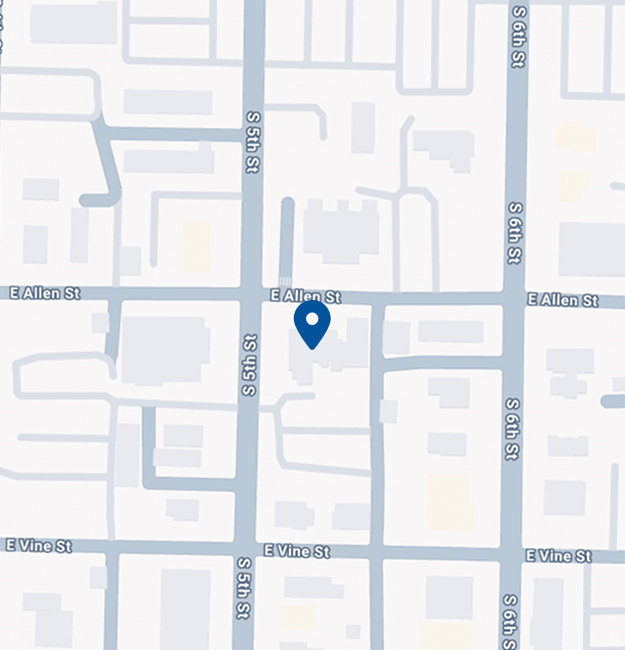
Our offices are located at the corner of South Fifth Street and Vine, in the historic Mary Bryant Home for the Blind.