- Free Consultation: (217) 544-4057 Tap Here To Call Us











What Counts as Violating an IL Protective Order?


Last Reviewed & Updated: July 23, 2026
By: W. Scott Hanken | Former Sangamon County Prosecutor | Springfield Criminal Defense & DUI Attorney |
Voted “Best Attorney” — Illinois Times Best of Springfield & State Journal-Register Reader’s Choice | Springfield, IL • Sangamon County • (217) 544-4057 • hankenlaw.com
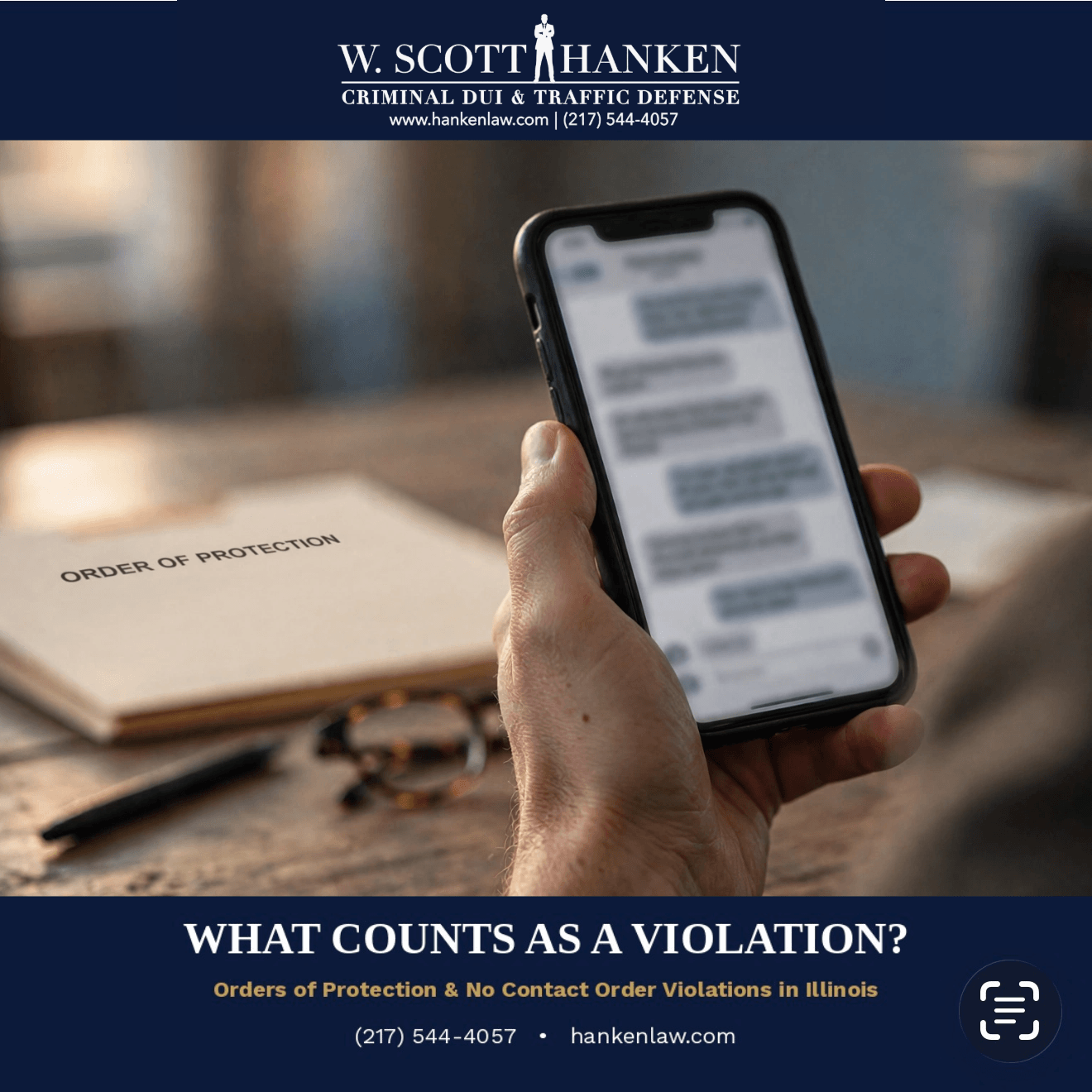
In Illinois, you violate an order of protection or no contact order any time you knowingly do something the order forbids, or fail to do something it requires, after you’ve been served or otherwise learned what the order says. That covers far more than showing up in person. A text message, a social media “like,” a gift passed through a mutual friend, or simply standing in a prohibited location can each support criminal charges under 720 ILCS 5/12-3.4, 720 ILCS 5/12-3.8, or 720 ILCS 5/12-3.9.
Bottom Line:
If you’re subject to any of these orders, assume every form of contact counts, including indirect and digital contact, and that the protected person inviting you back in does not protect you from arrest. If you’ve already been accused of a violation, get a lawyer before you talk to police or the state’s attorney’s office.
What Is the Difference Between an Order of Protection and a No Contact Order?
The dividing line is the relationship between the parties, not the severity of the conduct. An order of protection is issued under the Illinois Domestic Violence Act of 1986 (750 ILCS 60) and requires a domestic or family relationship between petitioner and respondent — spouses, former spouses, co-parents, dating partners, or people who share a household. A civil no contact order (740 ILCS 22) and a stalking no contact order (740 ILCS 21) exist precisely because not every dangerous relationship is domestic. Those two orders cover sexual assault, sexual abuse, human trafficking, and stalking between people with no family or household connection, including coworkers, neighbors, acquaintances, or strangers.
All three are civil orders in origin, and all three carry independent criminal violation statutes. That is the part most people miss: violating the civil order is itself a separate crime, prosecuted regardless of whether any new “underlying” offense occurred. For the full breakdown of emergency versus plenary orders, duration, and how these orders interact with a pending criminal case, see our complete guide to Illinois orders of protection and no contact orders.
What Actions Count as a Violation Under Illinois Law?
A violation requires two things under all three statutes: (1) you knowingly did something the order prohibited, or knowingly failed to do something it required, and (2) you had already been served with the order or otherwise actually knew what it said. Once those two elements are met, the range of conduct that qualifies is broad by design. Illinois courts and prosecutors read “contact” and “prohibited act” expansively, because the entire point of these orders is to close every avenue a respondent might use to reach a protected person.
Statute Callout — 720 ILCS 5/12-3.4(a): A person commits violation of an order of protection if they knowingly commit an act prohibited by the order, or knowingly fail to commit an act ordered by the court, after being served notice of the order’s contents. Full text: 720 ILCS 5/12-3.4 (Source: P.A. 100-987, eff. 7-1-19.)
The Full List: Specific Actions That Can Trigger a Violation Charge
Direct and physical contact:
- Approaching or speaking to the protected person anywhere, including “just saying hi”
- Showing up at their home, even if a third party who lives there lets you in
- Following the protected person’s vehicle or walking behind them
- Handing them any item, note, gift, or document in person
Communication and technology-based contact:
- Calling, texting, emailing, or voicemailing, even a single message
- Messaging through Instagram, Facebook, Snapchat, or any DM platform
- Reconnecting through a dating app the protected person also uses
- Messaging inside a shared video game’s voice or text chat
- Sending a communication indirectly, such as posting something you know they’ll see even without tagging them
Third-party and indirect contact:
- Asking a mutual friend or relative to pass along a message
- Sending flowers, gifts, or letters through someone else
- Directing anyone else to make contact on your behalf — under 720 ILCS 5/12-3.4(f), you’re accountable for a third party’s actions taken at your direction, regardless of what that third party knew
Location and proximity violations:
- Entering a residence, workplace, school, or place of worship the order names as off-limits
- Coming within a court-specified distance of the protected person in public
- Remaining somewhere after you become aware the protected person has arrived, when the order requires you to leave
- Attending an event you know the protected person will attend, when the order bars contact at shared locations
Failure-to-act violations:
- Failing to surrender firearms and your FOID card when the order includes that remedy
- Failing to vacate a shared residence when the order grants the petitioner exclusive possession
- Failing to return a shared vehicle, wireless number, or specified property by the order’s deadline
What If the Contact Wasn’t on Purpose? Gray-Area Scenarios Sangamon County Courts See Every Week
What If the Protected Person Contacts Me First?
Illinois law requires the State to prove you knowingly violated the order, but it does not recognize the protected person’s invitation as a defense, because only a judge can modify or lift the order. People v. Witherspoon, 2019 IL 123092 — an Illinois Supreme Court decision arising from a home invasion charge based on a no-contact bond condition — held that a protected party’s consent to entry does not override a court’s order barring it; the order controls regardless of who initiates contact. Sangamon County prosecutors and defense attorneys alike cite that reasoning routinely in protective-order violation cases for the same principle. In my 37 years of Sangamon County practice, this is the single most common way people end up charged with a violation they never saw coming: they answer a text from the protected person, and six months later that reply is the exhibit at their bench trial.
What If the Only Contact Was a Social Media Like, Comment, or Group Chat Message?
The statutes prohibit “any act” the order forbids, not just direct one-on-one communication, and courts construe that language broadly to include electronic contact routed through a public or semi-public platform. Liking a photo, commenting on a mutual friend’s post the protected person will see, or replying inside a group chat the protected person is part of can each support a charge if the State can show it was knowing and intended to reach them. In Sangamon County, this pattern shows up constantly in cases involving shared social circles, church groups, or workplace group texts, where a screenshot becomes the entire evidentiary record.
What If I Ran Into Them by Accident in Public?
The “knowingly” element matters here more than in almost any other scenario. If you end up at the same grocery store, courthouse hallway, or restaurant with no advance knowledge the protected person would be there, and you make no effort to approach, follow, or linger, that generally does not satisfy the knowing-act requirement the statute demands. What separates an accidental encounter from a violation is what you do next: leaving immediately supports a lack-of-intent argument, while staying, approaching, or engaging does not.
What Penalties Apply to Each Type of Violation?
| Violation | Governing Statute | First Offense | Second/Subsequent Offense |
|---|---|---|---|
| Order of Protection | 720 ILCS 5/12-3.4 | Class A misdemeanor — up to 364 days jail, $2,500 fine | Class 4 felony — 1-3 yrs prison; mandatory min. 24 hrs jail unless manifestly unjust |
| Civil No Contact Order | 720 ILCS 5/12-3.8 | Class A misdemeanor — up to 364 days jail, $2,500 fine | Class 4 felony — 1-3 yrs prison (no mandatory-minimum jail provision) |
| Stalking No Contact Order | 720 ILCS 5/12-3.9 | Class A misdemeanor — up to 364 days jail, $2,500 fine | Class 4 felony — 1-3 yrs prison (no mandatory-minimum jail provision) |
(Source note for both 12-3.8 and 12-3.9: P.A. 100-199, eff. 1-1-18.) An order of protection violation escalates to a Class 4 felony immediately, without a second violation, if you have a qualifying prior conviction for domestic battery, aggravated domestic battery, or a list of other enumerated violent offenses committed against a family or household member.
Why Do Most Violation Charges in Sangamon County Start With a Phone, Not a Confrontation?
In three-plus decades of handling these cases in Sangamon County, from both sides of the courtroom, I’ve watched the evidence shift dramatically. Violation charges used to hinge on witness testimony about a face-to-face encounter. Now, the overwhelming majority of the violation cases that come across my desk start with a screenshot: a text thread, a call log pulled from a phone, a location ping from a shared app, or a comment on someone else’s public post. That shift matters for defense strategy. Digital evidence can prove a violation more definitively than a witness ever could, but it can also be incomplete, taken out of context, or missing the messages the protected person sent first. Reviewing the full digital record, not just the exhibit the State chooses to introduce, is often where these cases are won or lost.
Can You Be Denied Pretrial Release for a Violation Charge?
Yes. Under 725 ILCS 5/110-6.1(a)(3), a violation of an order of protection, a stalking no contact order, or a civil no contact order is a detainable offense under the SAFE-T Act if the State alleges your pretrial release poses a real and present threat to a person or the community. The State still has to prove that threat with specific, articulable facts, and no condition of release could mitigate it, but the charge alone is enough to get a detention petition filed in Sangamon County. For the full detention-hearing process, see our guide to SAFE-T Act detention hearings in Springfield.
Frequently Asked Questions (FAQs)
Potentially, yes. Some prosecutors distinguish between a reply that clearly rejects contact and one that engages further, but the safest course is never to respond at all — forward the message to your attorney or the police instead.
Yes. Both violation elements require that you were served or otherwise had actual knowledge of the order’s contents. If you genuinely had neither, that’s a defense worth raising, but the State only needs to show actual knowledge, not formal service, so informal knowledge (a call from a friend, a shared court notice) can still count.
Custody exchanges are usually addressed separately in the order itself or in a parallel family court order specifying a neutral exchange location. Never assume a custody arrangement overrides a no-contact provision; get the order modified first.
Yes, in two ways: any second violation of the same type of order is automatically a Class 4 felony, and a first-time order of protection violation is a felony immediately if you have certain qualifying prior convictions.
Not necessarily. These are charges brought by the State of Illinois, not the protected person individually. The Sangamon County State’s Attorney’s Office can proceed even if the protected person asks them not to.
Yes. Prosecution for a violation does not bar prosecution for any other crime committed during the same incident, and a violation charge while another case is pending can affect bond conditions and detention arguments in that case as well.
Ready to Fight Your Criminal Charge in Springfield?
Call W. Scott Hanken at (217) 544-4057 or contact us online for a free consultation. We serve clients throughout Springfield, Sangamon County, and Central Illinois.
About the Author: W. Scott Hanken, Attorney at Law
Scott Hanken is a Springfield, Illinois criminal defense attorney with over 37 years of experience, including service as a former Sangamon County prosecutor. He has been voted Best Attorney by the Illinois Times and State Journal-Register, holds an Avvo 10.0 “Superb” rating, and has earned over 270 five-star Google reviews. His firm handles DUI defense, drug crimes, traffic violations, violent crimes, and weapons offenses throughout Sangamon County and Central Illinois.
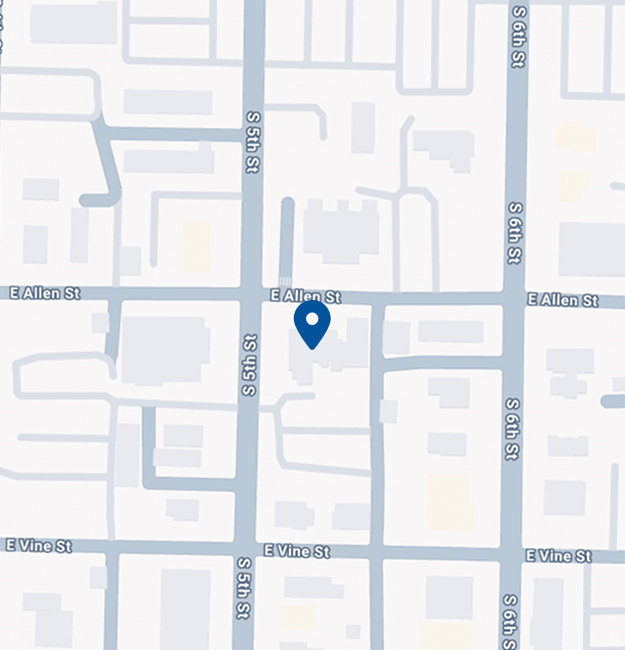
📍 1100 S 5th St, Springfield, IL 62703 | ☎ (217) 544-4057 | 🌐 hankenlaw.com
This article is for general educational purposes only and does not constitute legal advice. Every case is unique — contact an experienced Springfield criminal defense attorney for guidance on your specific situation.
Address
Our offices are located at the corner of South Fifth Street and Vine, in the historic Mary Bryant Home for the Blind.