- Free Consultation: (217) 544-4057 Tap Here To Call Us
















Is an Ordinance Violation a Crime in Illinois?


Last Reviewed & Updated: November 13, 2026
By: W. Scott Hanken | Former Sangamon County Prosecutor | Springfield Criminal Defense & Expungement & Record Sealing Attorney | Voted “Best Attorney” — Illinois Times Best of Springfield & State Journal-Register Reader’s Choice | Springfield, IL | Sangamon County | (217) 544-4057 | hankenlaw.com
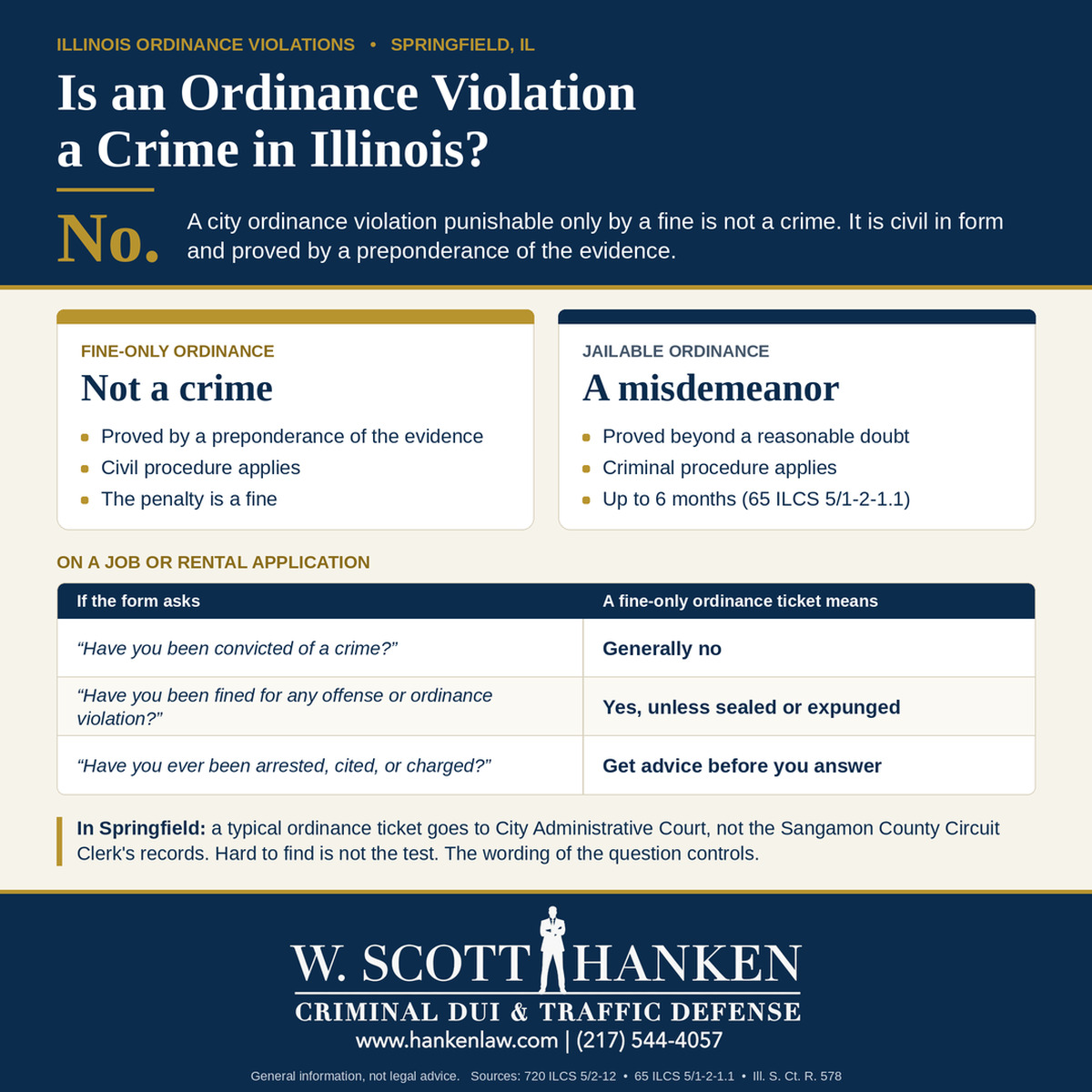
No. In Illinois, a municipal ordinance violation punishable only by a fine is not a crime. It is quasi-criminal, civil in form, and proved by a preponderance of the evidence. Whether you must disclose it depends on the wording of the question.
People ask this in different ways. Is a city ticket a misdemeanor in Illinois? Does an ordinance violation show up on a background check? Do I have to disclose a Springfield ordinance ticket on a job application? This guide answers all three.
Bottom Line: If your only matter is a fine-only city ordinance violation, you can generally answer “no” when a job or rental application asks whether you have been convicted of a crime. Read the question first. A form that asks about arrests, citations, charges, guilty pleas, or “any violation of law or ordinance” is asking something broader. A typical ordinance ticket in Sangamon County is hard for an employer or landlord to find, but that does not change what a truthful answer is.
Quick Definitions
- Crime: Under the Criminal Code, an “offense” is a violation of a penal statute of this State. 720 ILCS 5/2-12.
- Fine-only ordinance violation: Not a crime. Proved by a preponderance of the evidence. Civil procedure.
- Jailable ordinance violation: A misdemeanor. Proved beyond a reasonable doubt. Up to 6 months.
- Typical Springfield ticket: City Administrative Court, not the Sangamon County Circuit Clerk’s records.
- Disclosure: Controlled by the words of the question, not by whether the record is easy to find.
Unsure how to answer a question on an application? Call W. Scott Hanken, Attorney at Law at (217) 544-4057 before you sign it.
Is an Ordinance Violation a Crime in Illinois?
No. A fine-only ordinance violation is a local offense, not a crime under the Illinois Criminal Code.
The Criminal Code defines an “offense” as a violation of a penal statute of this State. 720 ILCS 5/2-12. A city ordinance is not a state statute. For decades, the Illinois Supreme Court has described ordinance prosecutions as quasi-criminal in character but civil in form. City of Danville v. Hartshorn, 53 Ill. 2d 399 (1973) (fine-only ordinance cases are tried under civil procedure); City of Danville v. Clark, 63 Ill. 2d 408 (1976) (same characterization applied to a $25 disorderly conduct fine).
The court rules say the same thing. When a fine-only ordinance case is filed in circuit court, Illinois Supreme Court Rules 570 through 579 govern it. Those rules were adopted December 7, 2011, and Rule 570 was last amended October 27, 2022, effective September 18, 2023. Rule 571 applies the Code of Civil Procedure. Rule 578 sets the burden: the city must prove the violation by a preponderance of the evidence, meaning more likely true than not. A criminal charge requires proof beyond a reasonable doubt.
In Springfield, this is the difference between a city disorderly conduct ticket and a state charge under 720 ILCS 5/26-1. The conduct can be identical. The legal category is not. For the state version, see our guide to disorderly conduct charges in Springfield.
Statute Callout — 65 ILCS 5/1-2-1: The Illinois Municipal Code lets cities pass ordinances and attach fines. For municipalities bound by this section, no fine may exceed $750. Springfield is a home rule city and sets its penalties in its own City Code.
When Does an Ordinance Violation Become a Criminal Case?
It becomes a criminal case when the ordinance carries possible jail time. That version is prosecuted as a misdemeanor.
A separate section of the Municipal Code allows a city to make an ordinance violation a misdemeanor punishable by up to 6 months of incarceration. 65 ILCS 5/1-2-1.1. The statute requires those cases to be filed in the circuit court under the rules of criminal procedure, and the city must prove guilt beyond a reasonable doubt. Rule 570 confirms that jailable ordinance violations fall outside the civil ordinance rules.
Look at your citation and the ordinance it cites. If the only penalty is a fine, you are in the civil-form category. If jail is possible, treat the case and any later application question as criminal.
Ordinance violation vs. state misdemeanor:
| Type of case | Burden of proof | Maximum penalty | A crime? |
|---|---|---|---|
| Fine-only ordinance violation | Preponderance of the evidence | Fine set by the ordinance. $750 cap under 65 ILCS 5/1-2-1 for non-home-rule municipalities. Springfield, as a home rule city, sets its own. | No |
| Jailable ordinance violation | Beyond a reasonable doubt | Up to 6 months (65 ILCS 5/1-2-1.1) | Yes, a misdemeanor |
| State Class C misdemeanor | Beyond a reasonable doubt | 30 days, $1,500 (730 ILCS 5/5-4.5-65) | Yes |
| State Class A misdemeanor | Beyond a reasonable doubt | Less than one year, $2,500 (730 ILCS 5/5-4.5-55) | Yes |
Not paying a fine does not turn the ordinance into a crime. Under 65 ILCS 5/1-2-1, a defaulted fine may be collected by any means available for collecting a money judgment. That section still cross-references a 6-month cap on imprisonment “authorized in Section 1-2-9” for failure to pay, but the current text of 1-2-9 does not itself authorize that imprisonment. In a circuit court ordinance case, failure to appear can lead to a warrant or a default judgment under Supreme Court Rule 575(b). A warrant can also issue at the start of a case under 65 ILCS 5/1-2-9, on a sworn complaint showing reasonable grounds. Neither of those is the rule in Springfield Administrative Court.
Where Are Springfield Ordinance Violations Heard, and Who Can See the Record?
Usually at City Hall, not the courthouse, and the record is much harder to find than a criminal case.
The rule that a fine-only ordinance violation is not a crime is the same in every Illinois city. What changes from city to city is where the record is kept.
In my 37+ years of practice in Sangamon County, the typical ordinance violation issued by Springfield or another Sangamon County municipality never appears in the Sangamon County Circuit Clerk’s records. It is not easily viewable. That is the single biggest practical difference between a city ticket and a state charge, and it is one a statewide legal website will not tell you.
Springfield handles many City Code matters in its own Administrative Court. The City’s Corporation Counsel office says that court sits on scheduled Wednesdays at 8:30 a.m. in the City Council Chambers. An administrative hearing is not a circuit court case. Rule 570 states that the Supreme Court ordinance rules do not apply to administrative adjudications. Home rule cities can use administrative adjudication under Division 2.1 of the Municipal Code. There, the hearing officer may not impose incarceration. The officer may fine up to $50,000, or at the city’s option up to the Supreme Court’s mandatory arbitration limit, not counting enforcement costs. 65 ILCS 5/1-2.1-4 (as amended by P.A. 104-200, eff. 1-1-26).
Two limits on that privacy matter. First, the Springfield City Clerk has posted Administrative Court files online through an “AC Court” search since January 2023, so anyone who knows to look there can find a city record. Second, some ordinance matters do land in the Sangamon County Circuit Court: jailable ordinance charges, enforcement actions the City chooses to file there, and state misdemeanors later amended to an ordinance violation. Those leave a courthouse record.
Does an Ordinance Violation Show Up on a Background Check?
A typical fine-only city ticket usually does not, because it sits in neither of the two places most background checks search.
The first place is the Illinois State Police database. Police agencies must send fingerprints to the State Police for arrests on felonies and Class A or B misdemeanors under state penal statutes. 20 ILCS 2630/5 (P.A. 102-538, eff. 8-20-21). A fine-only city ticket is not on that list.
The second place is the county court docket, and a typical Sangamon County ordinance ticket is not there either.
Three situations break that pattern:
- You were arrested first. If you were arrested and fingerprinted on a Class A or B state misdemeanor that was later amended to an ordinance violation, the original arrest was already reported, and the case has a circuit court file.
- The case was filed in circuit court. Anyone can search for an ordinance matter filed at the courthouse there.
- Someone checks the City’s records. Springfield’s Administrative Court files are online through the City Clerk.
Federal law limits how far back background-check companies may report. Under the Fair Credit Reporting Act, 15 U.S.C. § 1681c, a consumer reporting agency generally may not report arrests and other non-conviction items older than 7 years. Jobs paying $75,000 or more are an exception. Convictions of crimes have no federal time limit. 15 U.S.C. § 1681c(a)(5). That is one more reason the line between a fine-only ticket and a misdemeanor conviction matters.
Do not confuse “hard to find” with “no need to disclose.” They are separate questions. A false answer on an application can cost you the job or the lease if it surfaces later, even when the underlying ticket never would have.
What if I just paid the ticket and never went to court?
Paying the fine ends the matter against you. It is not a dismissal. The City keeps a record of the citation and the payment. If a form asks whether you have ever “paid a fine for any violation other than minor traffic,” the truthful answer is yes.
Charged or ticketed in Springfield and worried about what it does to your record? Call (217) 544-4057. The time to protect a record is before the case closes.
Do I Have to Disclose an Ordinance Violation on a Job Application?
Only if the question, read literally, covers it. Answer the question asked, no more and no less.
Illinois gives job applicants four layers of protection.
- Timing. An employer with 15 or more employees may not ask about criminal history until you are selected for an interview or, if there is no interview, given a conditional offer. 820 ILCS 75/15 (eff. 1-1-15).
- Arrest records. Unless another law authorizes it, an employer may not inquire into or use an “arrest record.” That term means an arrest not leading to a conviction, a juvenile record, or a record ordered expunged, sealed, or impounded. 775 ILCS 5/2-103 (P.A. 102-538, eff. 8-20-21); 775 ILCS 5/1-103(B-5) (P.A. 103-785, eff. 1-1-25).
- Conviction records. An employer may not reject you over a conviction record unless it has a substantial relationship to the job or creates an unreasonable risk. Even then, the employer must first complete a written interactive assessment. 775 ILCS 5/2-103.1 (P.A. 101-656, eff. 3-23-21).
- Sealed and expunged records. Applications must state that you are not obligated to disclose them, and employers may not ask whether you have any. 20 ILCS 2630/12.
Here is the part generic sites miss. The Human Rights Act’s definition of “conviction record” includes information that a person was “fined” under law enforcement authority. 775 ILCS 5/1-103(G-5). One could argue that a paid ordinance fine fits that word. That reading is not settled. If it does fit, the substantial-relationship test in 775 ILCS 5/2-103.1 should limit how a Springfield employer uses it. Do not treat that as a court holding.
How to answer a job-application question about a fine-only ordinance violation:
| If the question asks | A fine-only ordinance violation means |
|---|---|
| “Have you been convicted of a felony or misdemeanor?” | No |
| “Have you been convicted of a crime?” | Generally no, unless the form defines “crime” to include ordinance violations |
| “Have you pleaded guilty to or been fined for any offense or ordinance violation?” | Yes, unless sealed or expunged |
| “Have you ever been arrested, cited, or charged?” | Section 2-103 limits questions about an arrest that did not lead to a conviction. A citation issued with no arrest is not clearly covered. Get advice before answering |
What if the application asks about arrests, citations, or charges?
Section 2-103 bars employers from asking about an “arrest record” unless another law authorizes the question. That term covers an arrest that did not lead to a conviction, a juvenile record, and a sealed or expunged record. A city citation issued without an arrest does not clearly fit the definition, so the question may be a lawful one as to that ticket. The statute restricts the employer. It does not expressly authorize an applicant to give a false answer, and some employers, including law enforcement agencies and others authorized by law, may ask. A sealed or expunged record is different: Section 12 says you are not obligated to disclose it.
What if I received court supervision?
Supervision that you completed successfully is not a conviction. A discharge and dismissal after supervision is “without adjudication of guilt” and may not be termed a conviction for disqualifications imposed by law. 730 ILCS 5/5-6-3.1(f). The Criminal Identification Act also provides that a successfully completed order of supervision is not a conviction. 20 ILCS 2630/5.2(a)(1)(C). Supervision is entered by a judge, so this situation means your case was in the Sangamon County Circuit Court and has a file there until it is expunged.
Do I Have to Disclose an Ordinance Violation on a Rental Application?
A private landlord in Springfield may ask about convictions, but generally may not use an arrest record against you.
Under the Human Rights Act, it is a civil rights violation to refuse to rent, or to change rental terms, because of an arrest record. That includes a juvenile record or a sealed or expunged record. 775 ILCS 5/3-102 (arrest-record protection added by P.A. 101-565, eff. 1-1-20). A landlord may still prohibit unlawful activity on the premises. 775 ILCS 5/3-102.5. Some rentals, such as certain small owner-occupied buildings, are exempt. 775 ILCS 5/3-106.
A dismissed ordinance case is an arrest record only if there was an arrest, or the record has been sealed or expunged. A Springfield Administrative Court citation that never involved an arrest does not fit that definition. A landlord still may not use a sealed or expunged record. A private job application that asks about an arrest that did not lead to a conviction is a separate problem under 775 ILCS 5/2-103.
Illinois has no statewide rule for conviction records in private housing that matches Section 2-103.1. On the federal side, HUD withdrew its 2015, 2016, and 2022 criminal-record screening guidance in a letter dated November 25, 2025, addressed to public housing authorities and owners of federally assisted housing. The 2016 and 2022 memos had been used more widely in Fair Housing Act screening. The letter did not change the Fair Housing Act or any Illinois statute.
The wording of the form still controls. A rental form that asks “Have you ever been convicted of a crime?” does not reach a fine-only ordinance violation. A form that asks about “any offense, including ordinance violations” does.
What if I’m applying for public housing?
A housing authority has narrower limits than a private landlord. 310 ILCS 10/25(e-5) applies when an Illinois housing authority reviews an application for federally assisted housing. Unless federal law requires otherwise, the authority may not consider:
- arrests
- charges that did not result in a conviction
- convictions that were vacated, sealed, or expunged
- juvenile matters
- convictions more than 180 days old
For an applicant to the Springfield Housing Authority, an old administrative ticket that never entered a criminal-history report is a practical non-issue.
Can I Get an Ordinance Violation Sealed or Expunged in Sangamon County?
Yes, when there is an arrest record or a court file to clear. The outcome of your case decides the remedy.
The Criminal Identification Act counts a municipal ordinance violation that is “criminal in nature” as a criminal offense for sealing and expungement. 20 ILCS 2630/5.2(a)(1)(D), (H). A dismissal or acquittal can be expunged. Completed supervision can be expunged after the waiting period, which is usually 2 years. A finding of guilty with a fine can be sealed.
The Clean Slate Act, P.A. 104-0459, signed January 16, 2026, changed the timing. Since June 1, 2026, you can petition to seal most ordinance convictions 2 years after your last sentence ends. 20 ILCS 2630/5.2(c)(3)(B).
Automatic sealing has not started yet, and the Act sets it on two tracks:
- Circuit clerks: Beginning January 1, 2028, and every January 1 and July 1 after that, circuit clerks are to seal court records of municipal ordinance violations and Class C misdemeanors once one year has passed since the case closed.
- Illinois State Police: Broader automatic sealing begins January 1, 2029. Older records are phased in through January 1, 2034.
Both tracks run on circuit court and State Police criminal records. Neither is built to reach a file kept only in a city’s administrative hearing system. If your ordinance matter involved an arrest or a Sangamon County Circuit Court file, a petition can clear it sooner than waiting.
Once a record is sealed or expunged, the answer changes for good. You are not obligated to disclose it on a job application, and neither an employer nor a landlord may use it. Our Sangamon County expungement process guide walks through the filing, and our expungement and record sealing page covers eligibility.
Key Takeaways:
- A fine-only ordinance violation in Illinois is quasi-criminal and civil in form. It is not a crime.
- A jailable ordinance violation is a misdemeanor, with up to 6 months.
- A typical Springfield or Sangamon County municipal ordinance ticket does not appear in the Circuit Clerk’s records and is not fingerprint-reported to the State Police.
- Hard to find is not the test. The wording of the question controls your answer.
- An employer may not ask about or use an arrest that did not lead to a conviction, and a landlord generally may not use one. A citation with no arrest is not an arrest record.
- Sealing or expungement is the only step that removes the disclosure question entirely.
Primary Authorities
- 720 ILCS 5/2-12 (definition of offense)
- 65 ILCS 5/1-2-1, 1-2-1.1, 1-2-9, and 1-2.1-4 (Illinois Municipal Code; 1-2.1-4 as amended by P.A. 104-200)
- Illinois Supreme Court Rules 570, 571, 575, and 578
- City of Danville v. Hartshorn, 53 Ill. 2d 399 (1973)
- City of Danville v. Clark, 63 Ill. 2d 408 (1976)
- 775 ILCS 5/1-103, 2-103, 2-103.1, 3-102, 3-102.5, and 3-106 (Illinois Human Rights Act)
- 820 ILCS 75/15 (Job Opportunities for Qualified Applicants Act)
- 20 ILCS 2630/5, 5.2, and 12 (Criminal Identification Act)
- 730 ILCS 5/5-6-3.1, 5-4.5-55, and 5-4.5-65 (Unified Code of Corrections)
- 310 ILCS 10/25 (Housing Authorities Act)
- 15 U.S.C. § 1681c (Fair Credit Reporting Act)
- P.A. 104-0459 (Clean Slate Act, HB 1836)
Frequently Asked Questions (FAQs)
No, unless the ordinance allows jail. A fine-only ordinance violation is a civil-form matter proved by a preponderance of the evidence. An ordinance that carries up to 6 months is prosecuted as a misdemeanor under 65 ILCS 5/1-2-1.1.
Usually not. A typical fine-only ticket from Springfield or another Sangamon County municipality is not in the Circuit Clerk’s records and is not fingerprint-reported under 20 ILCS 2630/5. It can surface in three ways: you were arrested first, the case was filed in circuit court, or someone searches the City’s Administrative Court files.
Generally yes, if your only matter is a fine-only ordinance violation and the form does not define “crime” to include ordinance violations. If the question mentions ordinance violations, fines, or guilty pleas, it covers you.
Not if the question covers it. Whether a record is easy to find and whether a truthful answer requires disclosing it are two different questions.
It depends on whether there was an arrest. Under 775 ILCS 5/1-103(B-5), an “arrest record” is an arrest not leading to a conviction, a juvenile record, or a sealed or expunged record. Most landlords may not refuse to rent because of one. A dismissed Administrative Court citation that never involved an arrest does not fit that definition unless it has been sealed or expunged.
No. Under 730 ILCS 5/5-6-3.1(f), a successful supervision ends in discharge and dismissal without an adjudication of guilt.
For most ordinance convictions, 2 years after your last sentence ends. That waiting period took effect June 1, 2026, under the Clean Slate Act (P.A. 104-0459). Dismissals and acquittals can be expunged without that wait.
Those questions are usually written far more broadly than a private job application. They often ask about citations, fines, and arrests, not “convictions of a crime,” and a fine-only ordinance violation can be responsive to that broader wording. Read each one word for word and get advice before you answer.
Further Reading
Practice Area
Related Articles
- Is Your Record Really Clean? Understanding the Illinois “Clean Slate” Act (HB1836) in Springfield: How automatic sealing will work for convictions beyond ordinance tickets.
- Sangamon County Expungement Process Guide: The filing steps if your ordinance case left a courthouse record.
- Charged With Disorderly Conduct in Springfield? Here’s What 720 ILCS 5/26-1 Actually Means For You: What happens when the same conduct is charged under state law instead of city code.
- Is Public Intoxication a Crime in Springfield, IL? What Festival-Goers Should Know: A common Springfield city-code ticket, and what it means for you.
Browse by Topic
Ready to Clear Your Record in Springfield?
Call W. Scott Hanken at (217) 544-4057 or contact us online for a free consultation. We serve clients throughout Springfield, Sangamon County, and Central Illinois.
About the Author: W. Scott Hanken, Attorney at Law
Scott Hanken is a Springfield, Illinois criminal defense attorney with over 37 years of experience, including service as a former Sangamon County prosecutor. He has been voted Best Attorney by the Illinois Times and State Journal-Register, holds an Avvo 10.0 “Superb” rating, and has earned over 270 five-star Google reviews. He serves clients throughout Sangamon County and Central Illinois.
📍 1100 S 5th St, Springfield, IL 62703 | ☎ (217) 544-4057 | 🌐 hankenlaw.com
This article is for general educational purposes only and does not constitute legal advice. Every case is unique — contact an experienced Springfield criminal defense attorney for guidance on your specific situation.

Address
Our offices are located at the corner of South Fifth Street and Vine, in the historic Mary Bryant Home for the Blind.