- Free Consultation: (217) 544-4057 Tap Here To Call Us















Charged With Disorderly Conduct in Springfield? Here’s What 720 ILCS 5/26-1 Actually Means For You


Last Reviewed & Updated: August 21, 2026
By: W. Scott Hanken | Former Sangamon County Prosecutor | Springfield Criminal Defense Attorney | Voted “Best Attorney” — Illinois Times Best of Springfield & State Journal-Register Reader’s Choice | Springfield, IL | Sangamon County | (217) 544-4057 | hankenlaw.com
So you got a citation, or maybe handcuffs, for “disorderly conduct,” and now you’re sitting there wondering what you actually did wrong. Honestly? A lot of people ask me that exact question. I spent years on the other side of this, as a Sangamon County prosecutor, and I can tell you the disorderly conduct statute is one of the broadest, most elastic charges in the entire Illinois criminal code. It can mean almost anything. That’s the problem, and that’s also where the defense usually lives.
Let’s slow down and walk through this together. We’ll cover what the law says, what the State has to prove at trial, how Sangamon County police and prosecutors typically use this charge, and what defenses actually move the needle. I’ll throw in some real-world examples too, because reading a statute in a vacuum doesn’t help anybody.
What Does Illinois Law Actually Say About Disorderly Conduct?
The controlling law is 720 ILCS 5/26-1 of the Illinois Criminal Code. It’s a long statute — subsection (a) alone runs thirteen separate paragraphs, covering everything from breach of peace to false bomb threats to “peeping tom” violations to telephone harassment by debt collectors. Most of the disorderly conduct charges I see walk through my office door in Springfield fall under one specific paragraph.
Statute Callout — 720 ILCS 5/26-1(a)(1), Breach of the Peace: A person commits disorderly conduct when he or she knowingly does any act in such unreasonable manner as to alarm or disturb another and to provoke a breach of the peace.
Under subsection (b), a violation of (a)(1) is classified as a Class C misdemeanor. Doesn’t sound like much, right? But a Class C misdemeanor in Illinois still carries up to 30 days in jail and a fine of up to $1,500. And under subsection (c), the judge must order between 30 and 120 hours of community service where community service is available in the jurisdiction and funded and approved by the county board. That requirement doesn’t only attach to a conviction — the statute says that whenever a person is placed on supervision for a disorderly conduct offense, the supervision must be conditioned on performing the community service. The one carve-out: it doesn’t apply when the court imposes a sentence of incarceration.
Here’s the thing nobody tells you up front. A disorderly conduct case follows you until you do something about it. Employers see it. Landlords see it. If you’re applying for certain licenses, the State sees it too. Illinois does provide a path to clear it — supervision successfully completed isn’t a conviction and the underlying arrest record can generally be expunged after a statutory waiting period, and a misdemeanor conviction generally becomes eligible for sealing after a longer one. But none of that happens automatically. Somebody has to file the petition. Until then, a Class C misdemeanor that felt small in the moment sits on every background check you’ll ever be run through. Our Sangamon County expungement process guide walks through how that works locally.
What Kinds of Behavior Actually Get Charged as Disorderly Conduct?
Because the statute uses the word “unreasonable,” and because police officers have a lot of discretion in the moment, disorderly conduct gets applied to an enormous range of conduct. I’ve seen it charged for situations that, frankly, probably shouldn’t have ended in an arrest. And I’ve seen it charged for situations where, yeah, things had gotten genuinely out of hand.
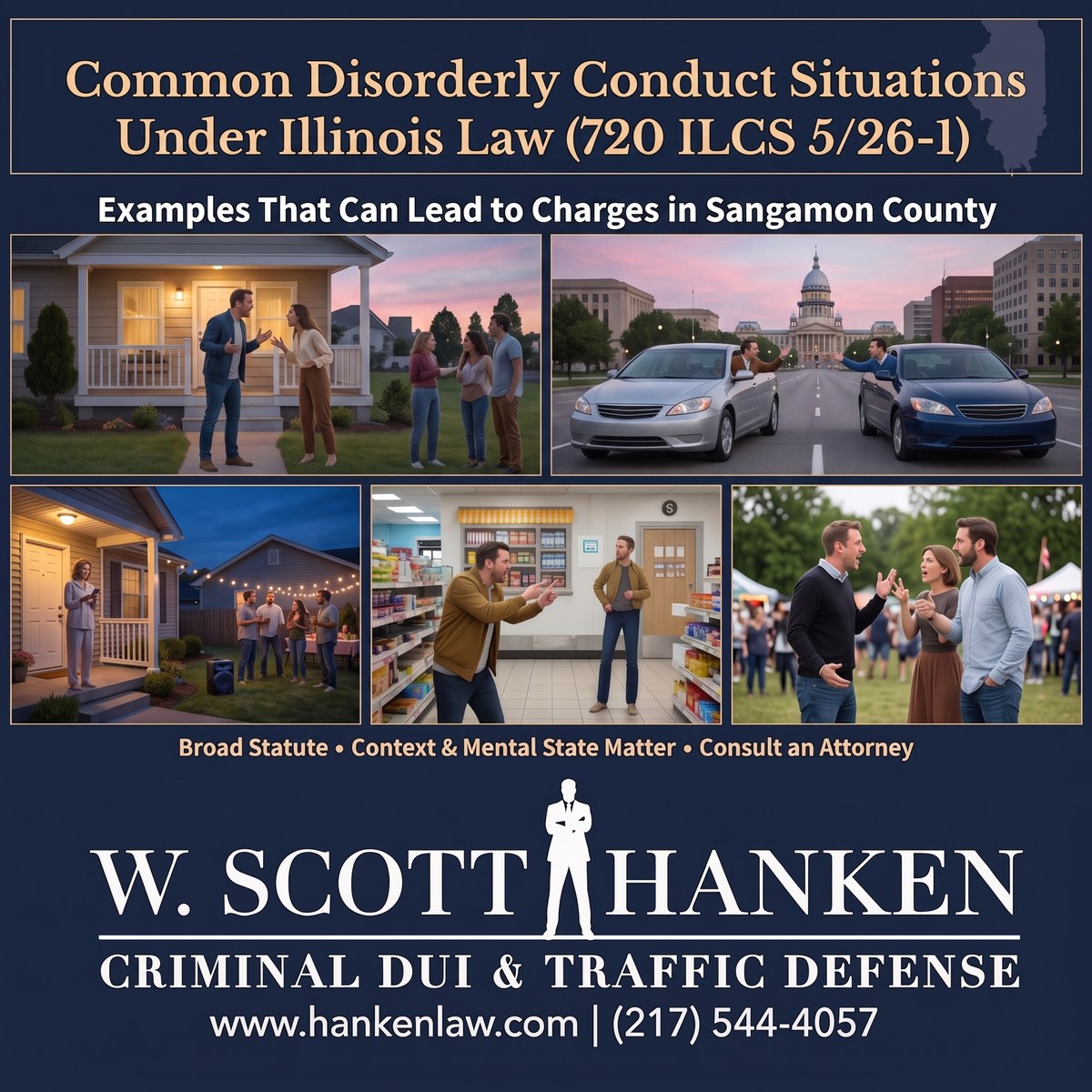
Some examples of conduct commonly charged under 720 ILCS 5/26-1(a)(1) in and around Springfield include:
- Loud, escalating arguments in public — think a domestic dispute that spills out onto a porch or driveway on the east side, loud enough that neighbors call it in.
- Screaming matches outside bars and restaurants — downtown Springfield on a weekend night sees its share of these, especially after closing time near the bar district.
- Aggressive confrontations in parking lots — road rage incidents, shopping center disputes, that sort of thing.
- Excessive noise late at night — loud music, fireworks set off in a residential neighborhood at 2 a.m., that kind of complaint.
- Public intoxication combined with belligerent behavior — this one overlaps a lot with public consumption ordinances and sometimes with DUI stops.
- Threatening gestures or language directed at another person — even without physical contact, if it’s alarming enough to provoke a response.
- Disrupting a public event or gathering — a heated confrontation at a youth sports game, a festival, or a public meeting.
- Confrontations with store employees or security — sometimes tacked onto a retail theft allegation, which is a topic I’ve written about separately.
Notice something? None of these require a weapon. None of them require an injury. The statute doesn’t care whether anyone got hurt. It cares whether the manner of the act was unreasonable and whether it was likely to provoke a breach of the peace. That’s a context-dependent standard, and context-dependent standards are exactly where good defense lawyering happens.
Disorderly Conduct and the Illinois State Fair
Every August, Springfield’s population effectively swells for eleven days. The 2026 Illinois State Fair runs Thursday, August 13 through Sunday, August 23 at the Fairgrounds on East Sangamon Avenue, with the grounds open from 7 a.m. to midnight. Hundreds of thousands of people, alcohol service, August heat, and long days on your feet — that combination produces exactly the fact pattern this statute was written for, and the Illinois State Police handle law enforcement out there.
A few things worth knowing before you go, because they come up in my office every year:
Removal from the Fair is not the same as a criminal charge. The Fair publishes a Disruptive Conduct Policy saying that any conduct security or law enforcement deems a safety risk or a disruption can get you notified and removed from the grounds for the remainder of the Fair, with warnings issued at law enforcement’s discretion. That’s an administrative decision by the venue. It happens fast, and it doesn’t require anybody to prove anything beyond a reasonable doubt. But the same incident can also generate a disorderly conduct citation, and that one does go through the Sangamon County court system. Being escorted out doesn’t mean the matter is over, and it doesn’t mean a charge is coming either — those are two separate tracks.
Weapons are a different and far more serious problem than disorderly conduct. The Fair’s published policy prohibits firearms everywhere on the Fairgrounds, states that concealed carry is prohibited anywhere on the grounds, and warns that violators will be arrested and firearms confiscated. “Weapons” is defined broadly there — knives, pepper spray, stun guns, brass knuckles, batons, and bats are all listed, along with anything else security or law enforcement deems a weapon. All bags are subject to search on entry, and the Grandstand runs enhanced walk-through screening with a clear-bag requirement. If a Fair incident turns into a weapons allegation, you are no longer talking about a Class C misdemeanor. That’s a different category of case entirely.
Context still matters, even in a crowd. Illinois courts assess whether conduct was unreasonable and whether it breached the peace by looking at the defendant’s conduct in relation to the surrounding circumstances. A raised voice in a packed Happy Hollow at 9 p.m. reads differently than the same raised voice in an empty parking lot at 2 a.m. — and it can cut either direction. Crowd density is part of the analysis, not a shortcut around it.
What Must the State Prove? The Jury Instruction Breaks It Down
This is where things get interesting, and where I think most people facing this charge feel a little relieved once they understand it. The State doesn’t get to convict you just because an officer felt like the situation was disorderly. They have to prove specific elements, beyond a reasonable doubt, to a judge or jury.
The Illinois Pattern Jury Instructions, Criminal, set out exactly what those elements are. For a charge under 720 ILCS 5/26-1(a)(1), the relevant instructions are IPI Criminal 19.07 (Definition of Disorderly Conduct) and IPI Criminal 19.08 (Issues in Disorderly Conduct).
IPI Criminal 19.08 — Issues in Disorderly Conduct (breach of peace form): To sustain the charge of disorderly conduct, the State must prove the following proposition: that the defendant knowingly performed an act in such an unreasonable manner as to alarm or disturb another and provoke a breach of the peace. If you find from your consideration of all the evidence that this proposition has been proved beyond a reasonable doubt, you should find the defendant guilty. If you find that this proposition has not been proved beyond a reasonable doubt, you should find the defendant not guilty.
Break that down and you’ve really got two elements bundled together. First, the mental state. The defendant has to have acted knowingly. Not accidentally. Not negligently. Knowingly. Second, the conduct itself has to be unreasonable in a way that alarms or disturbs another person and provokes a breach of the peace.
Both of those elements have to be proven. Not one or the other. Both. And if a jury has reasonable doubt about either piece, even just one, the verdict has to be not guilty. That’s not a technicality. That’s the whole ballgame in a lot of these cases.
Why “Knowingly” Matters So Much
I’ve tried cases where the entire defense came down to mental state. Did my client know their conduct would alarm or disturb someone? Or were they just upset, scared, reacting to something someone else did, without any awareness of how it looked from the outside? There’s a real difference between someone who deliberately escalates a situation to scare another person, and someone who’s just having the worst day of their life in public. The law only punishes the first one.
One more thing on the charging paper itself. The Fourth District — the appellate district that covers Sangamon County — has held that where a statute doesn’t define or describe the specific act constituting the offense, a charge that merely recites the statutory language isn’t good enough. The facts that constitute the crime have to be specifically set forth. If the complaint against you says nothing more than that you acted “in such an unreasonable manner as to alarm or disturb another and to provoke a breach of the peace,” that’s worth a hard look.
Defenses to Disorderly Conduct Charges Under Illinois Law
Now for the part you actually clicked on. What can be done about this? Quite a bit, honestly. Here’s a rundown of the defenses that come up most often in Sangamon County disorderly conduct cases.
1. The Conduct Wasn’t “Unreasonable”
This is the most common defense, and it’s built right into the statute. Reasonableness is judged by context. Raising your voice during a heated but private conversation that happens to occur on a public sidewalk isn’t automatically a crime. Neither is being visibly upset after a car accident, or arguing loudly with a family member during a stressful moment. The State has to show the manner of the act crossed a line into unreasonable territory, not just that someone found it annoying.
2. Lack of Knowing Mental State
As I mentioned above, if the conduct wasn’t done knowingly — meaning the person didn’t consciously realize their actions would alarm or disturb someone and provoke a breach of the peace — the State’s case has a hole in it. Intoxication, medical conditions, mental health crises, and situations of genuine confusion can all factor into this analysis.
3. First Amendment Protection — Free Speech
Here’s one that surprises people. Loud, even offensive speech, including profanity directed at police officers, is often constitutionally protected. In People v. Redwood, 335 Ill. App. 3d 189 (4th Dist. 2002), the Fourth District held that when the only conduct alleged is spoken words, § 26-1 can be applied only if those words are “fighting words” — and that fighting words must contain an explicit or implied threat. Vulgarities and epithets, standing alone, don’t get there. The court affirmed dismissal of both a disorderly conduct charge and the hate crime charge built on top of it.
Redwood also collects the earlier authority. City of Chicago v. Blakemore, 15 Ill. App. 3d 994 (1973), held that absent evidence of overt acts, offensive language addressed to a police officer doesn’t cause a breach of the peace even with bystanders present. And the Illinois Supreme Court in People v. Raby, 40 Ill. 2d 392 (1968), was explicit that under no circumstances does the statute allow people to be punished merely for peacefully expressing unpopular views.
If your charge is essentially “you yelled at an officer,” that’s a defense worth exploring hard.
4. Self-Defense or Defense of Another
If the underlying conduct involved a physical confrontation, and the person charged was reacting to being attacked or was protecting someone else, self-defense principles under Illinois law can apply. A person defending themselves from an aggressor generally isn’t “provoking” a breach of the peace; they’re responding to one someone else started.
5. Insufficient Proof of a Breach of the Peace
The statute requires that the act provoke a breach of the peace. But understand the limits here, because this defense gets oversold. Illinois courts have held that the State can establish a breach of the peace by showing either that the defendant threatened another person or that the defendant’s actions had an effect on the surrounding crowd — and that the act doesn’t have to occur in public at all, only that it disturbed the public order. A direct threat isn’t required either.
What that means practically: “no fight broke out” isn’t, by itself, a defense. The real question is whether the State can put evidence in front of a judge or jury on either of those routes. If nobody was threatened, nobody reacted, the situation was already resolved before officers arrived, and the “disturbance” exists mostly in a complainant’s retelling, the State has a proof problem. That’s a fact-specific fight, and it’s often a winnable one.
6. Mistaken Identity or Insufficient Evidence
In crowded situations — parking lots, bar districts, public events, the Fairgrounds — it’s not unusual for officers to identify the wrong person as the instigator. If the State can’t establish beyond a reasonable doubt that the defendant was the one who committed the act in question, that’s a complete defense.
7. Necessity
Rare, but it happens. Illinois recognizes necessity as an affirmative defense. If someone’s conduct, while technically disorderly, was necessary to prevent a greater harm — like creating a commotion to get help during a medical emergency — necessity can come into play.
8. Diversion, Court Supervision, and Negotiated Resolutions
This isn’t a “defense” in the courtroom sense, but it’s part of the picture. Court supervision is available for Class C misdemeanors under 730 ILCS 5/5-6-1(c), and for first-time offenders, Sangamon County prosecutors and judges sometimes agree to supervision rather than a conviction. Successfully completing supervision means no conviction is entered — though remember two things: the community service requirement in 26-1(c) attaches to supervision too, and the arrest and charge records stay visible until somebody petitions to clear them. An experienced local attorney who knows the players in the Sangamon County State’s Attorney’s office can often negotiate this kind of outcome, particularly when the underlying facts are sympathetic.
A Quick Word on Penalties
| Provision | Classification | Maximum Penalty |
|---|---|---|
| 720 ILCS 5/26-1(a)(1) — breach of peace | Class C misdemeanor | Up to 30 days jail, fine up to $1,500, plus 30–120 hours community service |
| 720 ILCS 5/26-1(a)(8), (a)(10) | Class B misdemeanor | Up to 6 months jail, fine up to $1,500 |
| 720 ILCS 5/26-1(a)(5), (a)(11) | Class A misdemeanor | Up to 364 days jail, fine up to $2,500 |
| 720 ILCS 5/26-1(a)(12) — collection agency phone harassment | Business offense | Fine up to $3,000 |
| 720 ILCS 5/26-1(a)(2), (a)(3.5), (a)(4), (a)(6), (a)(7), (a)(9) | Class 4 felony | 1–3 years prison, fine up to $25,000 |
| 720 ILCS 5/26-1(a)(3) — false bomb threat | Class 3 felony | 2–5 years prison, plus a mandatory fine of $3,000–$10,000 in addition to any other penalty |
Repeat violations escalate. A second or subsequent violation of (a)(5) or (a)(7) is a Class 4 felony, and a third or subsequent violation of (a)(11) is a Class 4 felony.
Notice how dramatically the penalties shift depending on which paragraph applies. That’s why it matters, a lot, exactly what you’re charged with and exactly how the complaint is worded. Sometimes a charge gets filed under the wrong paragraph entirely, and catching that early can change the whole trajectory of a case.
An Illustrative Scenario From the Sangamon County Courthouse
The following is a composite illustration, not an actual case — the facts are a blend drawn from the kinds of cases that come through this courthouse, and no real client is described. Every case turns on its own facts, and past results never guarantee a similar outcome. I use it because it shows how the elements above play out in practice.
Picture a man in his thirties having a loud argument with his girlfriend in a parking lot near downtown Springfield. Voices get raised. A passerby calls the police, worried things might turn physical. By the time officers arrive, the couple has already calmed down and is sitting in the car talking quietly.
The responding officer writes a disorderly conduct citation anyway, based largely on what the passerby reported rather than on what the officer personally observed. Sound familiar? It happens more than you’d think. In court, the question becomes: does the State have evidence the defendant knowingly acted in an unreasonable manner and that the peace was actually breached — or does it have a secondhand account of a loud but otherwise unremarkable argument?
Some disorderly conduct charges involve genuinely serious conduct: threats, repeated harassment, situations where someone really was put in fear. But a lot of them look more like the scenario above. Isn’t that worth fighting?
Why Local Experience in Sangamon County Matters
I’ve spent 37+ years practicing criminal defense and DUI law right here in Springfield. Before that, I was a Sangamon County prosecutor, handling DUI and criminal cases from the other side of the table. That background means I know how the Sangamon County State’s Attorney’s office evaluates these cases. I know which judges in the Sangamon County Courthouse tend to favor supervision for first offenders. I know the police departments, the patrol patterns, and the kinds of reports that get written after a busy Friday night downtown — or after a long night at the Fairgrounds in August.
That local knowledge isn’t just a marketing line. It’s the difference between a generic defense and one tailored to how things actually work in this courthouse, on this docket, with these prosecutors.
What to Do Right Now If You’re Facing This Charge
First, don’t talk your way into a worse situation. Anything said to police after a disorderly conduct citation can end up in a report, and reports get read by prosecutors. If the encounter also involved a struggle or a refusal to comply, understand that resisting a peace officer is a separate charge with its own elements.
Second, write down what you remember while it’s fresh — who said what, where everyone was standing, whether there were witnesses. If it happened at a public event, note whether there were cameras or security nearby.
Third, call a lawyer before your court date, not the morning of.
Cases involving disorderly conduct move fast through the Sangamon County court system. A Class C misdemeanor docket can churn through dozens of cases in a single morning. Going in unrepresented means going in without anyone who’s actually read the police report, checked the statute, or thought about whether the State can even prove its case. That’s not a position you want to be in.
If you or someone you know has been cited or arrested for disorderly conduct in Springfield or anywhere in Sangamon County, reach out. A former prosecutor who now works the defense side brings a perspective that’s hard to find, and it might be exactly what your case needs.
Frequently Asked Questions (FAQs)
Usually not. Most disorderly conduct charges in Springfield are filed under 720 ILCS 5/26-1(a)(1), which is a Class C misdemeanor. But the statute reaches much further than that — other paragraphs are Class B and Class A misdemeanors, one is a business offense, and several are Class 4 or Class 3 felonies. The paragraph you’re charged under determines everything.
For a Class C misdemeanor under (a)(1), the maximum is 30 days in jail plus a fine of up to $1,500. Jail is not the typical outcome for a first offense, but the exposure is real, and the charge carries a mandatory community service component where the county has an approved program.
Not necessarily, but nothing clears itself. Court supervision successfully completed is not a conviction, and the underlying arrest record can generally be expunged after a statutory waiting period. A misdemeanor conviction generally becomes eligible for sealing after a longer waiting period. Both require filing a petition with the court.
Where the only conduct alleged is speech, Illinois courts require that the words be “fighting words” containing an explicit or implied threat. Vulgar or offensive language directed at an officer, standing alone, generally does not meet that standard.
No. Illinois courts have held that the act need not occur in public. What matters is whether the conduct disturbed the public order — which can be shown by a threat to another person or by an effect on the people around you.
Generally yes. Section 26-1(c) directs the court to order 30 to 120 hours of community service where the program is available in the jurisdiction and funded and approved by the county board. The requirement also attaches when a person is placed on supervision. It does not apply when the court imposes a sentence of incarceration.
Removal is an administrative action by Fair staff or law enforcement under the Fair’s Disruptive Conduct Policy, and it can bar you from the grounds for the remainder of the Fair. It is separate from any criminal charge. The same incident may or may not also produce a disorderly conduct citation — those are two different tracks with two different standards.
It depends entirely on the facts, the charging paragraph, how the complaint is worded, and your record. Dismissal, reduction, and court supervision are all possible outcomes in appropriate cases. No lawyer can promise a particular result, and anyone who does should worry you.
Further Reading
Related Articles
- Resisting a Peace Officer in Illinois (720 ILCS 5/31-1) — Disorderly conduct is frequently charged alongside resisting; this explains what the State has to prove on the second charge.
- Springfield’s Police Transparency Dashboard: A Defense Tool — When your case turns on one officer’s account of what happened, here’s public data you can use to test it.
- Sangamon County Expungement Process Guide — The step-by-step for actually clearing the record this post says won’t clear itself.
- Federal Gun Deregulation Won’t Save You From an Illinois Weapons Charge — If a Fairgrounds or bar-district incident turns into a weapons allegation, this is the charge you’re now facing.
- Illinois Retail Theft Charges: Why the $300 Line Matters — For the store-confrontation scenario, where disorderly conduct often rides along with a theft allegation.
Browse by Topic
Ready to Fight Your Criminal Charge in Springfield?
Call W. Scott Hanken at (217) 544-4057 or contact us online for a free consultation. We serve clients throughout Springfield, Sangamon County, and Central Illinois.
About the Author: W. Scott Hanken, Attorney at Law
Scott Hanken is a Springfield, Illinois criminal defense attorney with over 37 years of experience, including service as a former Sangamon County prosecutor. He has been voted Best Attorney by the Illinois Times and State Journal-Register, holds an Avvo 10.0 “Superb” rating, and has earned over 270 five-star Google reviews. He serves clients throughout Sangamon County and Central Illinois.
📍 1100 S 5th St, Springfield, IL 62703 | ☎ (217) 544-4057 | 🌐 hankenlaw.com
This article is for general educational purposes only and does not constitute legal advice. Every case is unique — contact an experienced Springfield criminal defense attorney for guidance on your specific situation.

Address
Our offices are located at the corner of South Fifth Street and Vine, in the historic Mary Bryant Home for the Blind.