- Free Consultation: (217) 544-4057 Tap Here To Call Us















Aggravated Speeding in an Illinois Work Zone: Penalties and Why Court Supervision Is Off the Table


Last Reviewed & Updated: August 27, 2026
By: W. Scott Hanken | Former Sangamon County Prosecutor | Springfield Criminal Defense & Traffic Ticket Defense Attorney | Voted “Best Attorney” — Illinois Times Best of Springfield & State Journal-Register Reader’s Choice | Springfield, IL | Sangamon County | (217) 544-4057 | hankenlaw.com
Key Takeaways:
- 26+ mph over the limit in a posted Illinois work zone is 625 ILCS 5/11-605.1(d-5), a different statute than ordinary aggravated speeding under 11-601.5.
- Court supervision is categorically unavailable for that charge under 730 ILCS 5/5-6-1(f), regardless of your record.
- 1–25 mph over remains a petty offense, and supervision is generally still available there.
- Worker presence is not an element of the aggravated charge. It controls the 90-day repeat-violation suspension and the point value at the petty tier only — the aggravated tier is 55 points either way.
- For CDL holders, 15+ mph over is a serious traffic violation, and supervision does not shield it.
- The real defense ground is signage, equipment calibration, the stop itself, and proof of the speed differential.
A quick definition: court supervision is a deferred disposition. The court withholds entry of a conviction while you meet its conditions, and successful completion ends in the charge being dismissed rather than a conviction being entered (730 ILCS 5/5-1-21).
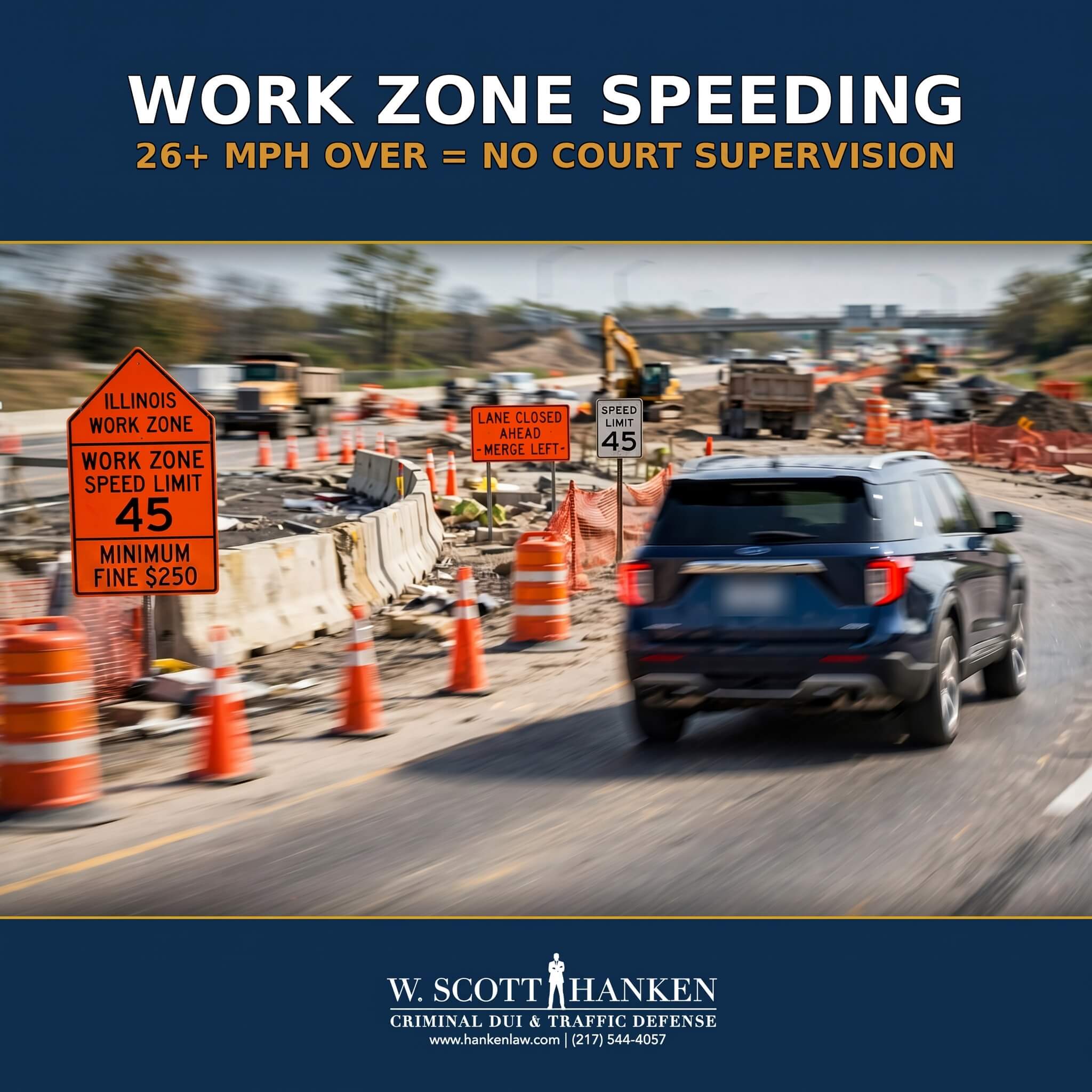
In Illinois, driving 26 miles per hour or more over the posted limit in a highway construction or maintenance zone is not an ordinary speeding ticket. It is a misdemeanor called aggravated special speed limit while traveling through a highway construction or maintenance speed zone under 625 ILCS 5/11-605.1(d-5), charged as a Class B misdemeanor at 26 to 34 mph over and a Class A misdemeanor at 35 mph or more over. Court supervision is not available for this charge, no matter how clean your driving record is.
Bottom Line: Speeding 25 mph or less in a work zone is a petty offense, and a clean record usually means getting court supervision, not just paying the ticket. At 26 mph or more over, supervision is barred outright under 730 ILCS 5/5-6-1(f), and the case ends in a misdemeanor conviction.
What Counts as Speeding in an Illinois Work Zone?
Illinois defines a “construction or maintenance speed zone” at 625 ILCS 5/11-605.1(c) as an area where IDOT, the Illinois State Toll Highway Authority, or a local agency has posted signage warning that a construction or maintenance zone is being approached, or has posted a lower special speed limit after determining the preexisting limit is greater than is reasonable or safe for the conditions expected in the zone. The signs must be of a design approved by the Department, must give due warning that the zone is being approached, must indicate the maximum speed limit in effect, and must state the amount of the minimum fine for a violation. The current version of Section 11-605.1 reflects Public Act 102-538, effective August 20, 2021.
Two separate subsections create the base offense. Subsection (a) prohibits exceeding the posted work zone limit when workers are present. Subsection (a-5) prohibits the same conduct when workers are not present. Under subsection (d), a violation is a petty offense carrying a minimum fine of $250 for a first violation and a minimum fine of $750 for a second or subsequent violation. Those are floors, not ceilings.
One detail catches a lot of drivers off guard. Subsection (b) provides that nothing in the Vehicle Code prohibits using electronic speed-detecting devices within 500 feet of the zone signs, and that evidence obtained from those devices is not inadmissible in a speeding prosecution. In practice, a work zone case is rarely won by arguing that radar should not have been used there. The contested ground is almost always whether the signage satisfied subsection (c) at the time and place of the stop.
What Does a Work Zone Speeding Ticket Actually Cost?
The number on the citation is not the final bill. The $250/$750 minimum fine under subsection (d) is only the base statutory fine. Separately, 705 ILCS 135/15-70(11) imposes a conditional assessment of $250 for a speeding-in-a-construction-zone violation, remitted to the State Treasurer for the Transportation Safety Highway Hire-back Fund, or to the county treasurer for that county’s version of the fund if a county officer wrote the ticket on a non-interstate highway. Section 11-605.1 itself no longer carries this assessment; subsection (e) is now blank in the current compilation, and the conditional-assessment mechanism moved to the Criminal and Traffic Assessment Act. Add standard court costs and Circuit Clerk fees on top of both the base fine and the conditional assessment, and the real cost of a work zone ticket runs well past the number printed on the citation, even before the charge crosses into misdemeanor territory.
Work Zone vs. Regular Aggravated Speeding
Illinois has two aggravated speeding statutes that look nearly identical on the page and behave very differently in practice.
Under 625 ILCS 5/11-601.5 (Public Act 98-511, effective January 1, 2014), driving 26 mph or more but less than 35 mph over the applicable limit anywhere in Illinois is a Class B misdemeanor, and 35 mph or more over is a Class A misdemeanor.
Under 625 ILCS 5/11-605.1(d-5), the same two speed bands inside a posted construction or maintenance zone carry the same Class B and Class A classifications, but Illinois treats it as its own distinct offense. The distinction matters because the two statutes trigger different rules for court supervision, covered in detail below. A charging document that cites 11-605.1 instead of 11-601.5 is not a clerical variation; it changes which outcomes are legally available in your case from the day you are charged.
What Are the Penalties for Aggravated Speeding in a Work Zone?
Once a work zone speeding charge crosses 26 mph over the limit, subsection (d-5) takes it out of the petty-offense fine schedule and puts it under Illinois’s general misdemeanor sentencing statutes.
- A Class B misdemeanor (26 mph or more but less than 35 mph over) carries a sentence of not more than 6 months and a fine of up to $1,500, under 730 ILCS 5/5-4.5-60.
- A Class A misdemeanor (35 mph or more over) carries a sentence of less than one year and a fine of up to $2,500, under 730 ILCS 5/5-4.5-55.
For both classes, the general statutory minimum fine is $75 unless another law specifies a different minimum, and the maximum term of probation or conditional discharge is two years. Jail is not the usual outcome for a first work zone aggravated speeding case in Sangamon County. The real exposure is the fine, the assessments, and a conviction that stays on your record because supervision is unavailable.
Work Zone Speeding by Speed Range
| Speed Over Limit | Statute | Classification | Fine | Sentence | Supervision |
|---|---|---|---|---|---|
| 1–25 mph | 11-605.1(a), (a-5), (d) | Petty offense | $250 min. (1st) / $750 min. (2nd+) | None | Generally available |
| 26–34 mph* | 11-605.1(d-5)(1) | Class B misdemeanor | Up to $1,500 | Not more than 6 months | Not available |
| 35+ mph | 11-605.1(d-5)(2) | Class A misdemeanor | Up to $2,500 | Less than one year | Not available |
*Statutory phrasing: “26 miles per hour or more but less than 35 miles per hour” over the applicable limit.
Is Court Supervision Available if I Was Speeding 26 MPH or More Over the Limit in a Work Zone?
No. Illinois bars court supervision outright for aggravated work zone speeding under 730 ILCS 5/5-6-1(f), regardless of a driver’s record or whether the zone is urban or rural. That is a harder line than ordinary aggravated speeding under 11-601.5, where supervision can survive a first offense outside an urban district.
For ordinary aggravated speeding, Illinois bars supervision only in defined circumstances. Under subsection (p), supervision is barred if the defendant has a prior conviction or supervision disposition for 11-601.5 itself. Under subsection (q), supervision is barred if the violation occurred in an “urban district,” defined at 625 ILCS 5/1-214 as territory built up with business, industrial, or residential structures at intervals of less than 100 feet for a quarter mile or more. Read together, a first-time aggravated speeder outside an urban district can still be considered for supervision under the general standards in subsection (c).
Work zone aggravated speeding does not get that benefit of the doubt. Subsection (f) lists “paragraph (d-5) of Section 11-605.1” by name among a short group of offenses categorically excluded from supervision. There is no first-offense exception and no urban-versus-rural distinction. The current source note for Section 5-6-1 reflects Public Act 100-987, effective July 1, 2019, and Public Act 101-173, effective January 1, 2020.
In 37+ years of defending traffic and criminal cases in Sangamon County, this is the provision that surprises careful drivers the most. They expect the outcome they got on a speeding ticket a decade ago and do not realize the General Assembly pulled work zone aggravated speeding out of the ordinary supervision framework. That does not mean the case cannot be won or reduced; it means the strategy has to attack the charge itself: the adequacy of the signage under subsection (c), the calibration and operation of the speed-detection equipment, the officer’s basis for the stop, and whether the State can prove the speed differential beyond a reasonable doubt.
How Does a Work Zone Speeding Conviction Affect My Driving Privileges?
A conviction affects your Secretary of State record in two separate ways.
Points. The Secretary of State’s offense table at 92 Ill. Admin. Code 1040.20 assigns 55 points to aggravated speeding in a construction zone — both the 26-to-34 mph band under 11-605.1(d-5)(1) and the 35-mph-or-more band under 11-605.1(d-5)(2). Worker presence does not change that number. The table’s 20-point and 10-point entries belong to the petty tier: 20 points for exceeding the construction zone limit under subsection (a), with workers present, and 10 points under subsection (a-5), with workers not present. Both petty-tier entries are flagged as serious traffic violations in a commercial motor vehicle. By comparison, ordinary aggravated speeding under 11-601.5 is 50 points in either speed band — five points fewer than the work zone version.
Points alone do not suspend a license. Under 625 ILCS 5/6-206(a)(2) and 92 Ill. Admin. Code 1040.30, three or more point-assigned convictions within 12 months triggers a review, and the point total sets the suspension length: 15–44 points brings 2 months; 45–74 brings 3 months; 75–89 brings 6 months; 90–99 brings 9 months; 100–109 brings 12 months; 110 or more is a revocation. A driver with a prior suspension in the preceding seven years faces a harsher schedule.
The separate 90-day work zone suspension. The Secretary of State’s authority to act on a repeat violation comes from 625 ILCS 5/6-206(a)(41), which authorizes a suspension for a second or subsequent violation of Section 11-605.1 within 2 years. But the actual condition on that suspension lives in 11-605.1(g) itself: the 90-day suspension applies only if the current violation and at least one prior violation both occurred while workers were present in the zone. Subsection (a)(41) does not repeat that limiter. If your prior ticket was an (a-5) violation, written when no workers were present, that is an argument under (g) that the 90-day suspension should not apply, not something to assume the Secretary of State will sort out correctly on its own.
Why Are There So Many Squad Cars Sitting in Sangamon County Work Zones?
Subsection (f) of Section 11-605.1 continues the Transportation Safety Highway Hire-back Fund — originally created by Public Act 92-619 — as a special fund in the State treasury, and subsection (f-5) requires each county to create its own version. Both are funded in part by the conditional assessment described above. The State fund pays to hire off-duty Illinois State Police officers to monitor construction or maintenance zones; each county fund does the same for non-interstate highways in that county. Subsection (e-5) then gives the Illinois State Police and the local county police department concurrent jurisdiction over any 11-605.1 violation on an interstate highway. For drivers on I-55, I-72, and I-155 through Sangamon County, that combination is exactly why dedicated, funded enforcement shows up, and why either a trooper or a county deputy can lawfully make the stop.
How Does a Work Zone Speeding Charge Affect a Commercial Driver’s License?
Sangamon County sits at a freight crossroads, and for CDL holders a work zone citation carries consequences beyond the point schedule. Under 625 ILCS 5/6-500(26), a “serious traffic violation” includes excessive speeding of 15 mph or more above the legal speed limit, whether in a CMV or in a non-CMV as a CLP or CDL holder. That threshold applies to a posted work zone limit the same as anywhere else.
Under 625 ILCS 5/6-514(e), 2 serious traffic violations from separate incidents within 3 years brings a CDL disqualification of not less than 2 months; 3 within 3 years brings not less than 4 months. Where all the violations occurred in a non-CMV, the disqualification applies only if those convictions would also suspend or revoke the driver’s non-CMV privileges. And under 625 ILCS 5/6-500(8), “conviction” for CDL purposes includes paying a fine even when sentence is deferred and the charge is ultimately dismissed, which captures a supervision disposition. Federal anti-masking regulation 49 C.F.R. § 384.226 reinforces this by barring states from hiding a CDL holder’s conviction from the CDLIS record. For a commercial driver, realistically only two outcomes protect a CDL: a dismissal, or an amendment to a charge that is not a reportable serious violation.
Is This the Same as an Automated Work Zone Camera Ticket?
No, and the distinction matters for your defense. An officer-written ticket under 625 ILCS 5/11-605.1 does not require the State to prove workers were present; subsections (a) and (a-5) separately cover both scenarios. Automated enforcement is governed by a different statute, the Automated Traffic Control Systems in Highway Construction or Maintenance Zones Act, 625 ILCS 7, which does not require an officer to be present or to witness the violation, but does require the State to prove workers were present in the zone when the camera recorded the violation. If an officer wrote your ticket, that camera-specific proof requirement does not apply to your case, and the two statutes should not be confused.
What If I Was Speeding in a Work Zone but No Workers Were Present?
You can still be charged. Subsection (a-5) covers exactly this scenario, and the aggravated tier in subsection (d-5) is written in terms of speed differential without a worker-presence element. Worker presence matters in two places, neither of which is the aggravated charge itself: whether the 90-day suspension under subsection (g) can apply to a repeat violation, and whether a petty-tier conviction is assessed at 20 points under subsection (a) or 10 points under subsection (a-5). At the aggravated tier, the assessment is 55 points either way.
Rural Stretch, Not an Urban District?
For ordinary aggravated speeding under 11-601.5, being outside an urban district can preserve supervision eligibility on a first offense, since the bar in 730 ILCS 5/5-6-1(q) is written to apply specifically to urban-district violations. Many stretches of I-55 and I-72 through rural Sangamon County do not meet the 1-214 definition. If that same rural stretch is inside a posted work zone, the analysis changes completely: the bar in subsection (f) applies to 11-605.1(d-5) by name and says nothing about urban districts.
CDL Ticket in My Personal Vehicle?
It still counts, subject to one condition. “Serious traffic violation” under 625 ILCS 5/6-500(26) expressly reaches convictions incurred while operating a non-CMV as a CDL or CLP holder. Where all the convictions occurred in a non-CMV, 6-514(e) applies the disqualification only if those convictions would result in suspension or revocation of your non-CMV privileges. The vehicle you were driving does not insulate the license you hold.
Primary Authorities
- 625 ILCS 5/11-605.1, Special limit while traveling through a highway construction or maintenance speed zone (P.A. 102-538, eff. 8-20-21)
- 625 ILCS 5/11-601.5, Driving 26 miles per hour or more in excess of applicable limit (P.A. 98-511, eff. 1-1-14)
- 730 ILCS 5/5-6-1, Sentences of probation and conditional discharge and disposition of supervision (P.A. 100-987, eff. 7-1-19; P.A. 101-173, eff. 1-1-20)
- 730 ILCS 5/5-1-21, Supervision (definition)
- 730 ILCS 5/5-4.5-55, Class A misdemeanors; sentence
- 730 ILCS 5/5-4.5-60, Class B misdemeanors; sentence
- 705 ILCS 135/15-70, Conditional assessments
- 625 ILCS 5/1-214, Urban district
- 625 ILCS 5/6-206, Discretionary authority to suspend or revoke license or permit
- 625 ILCS 5/6-500, Definitions, including “conviction” and “serious traffic violation”
- 625 ILCS 5/6-514, Commercial driver’s license; disqualifications (P.A. 103-179, eff. 6-30-23)
- 625 ILCS 7, Automated Traffic Control Systems in Highway Construction or Maintenance Zones Act
- 92 Ill. Admin. Code 1040.20, Illinois Offense Table
- 92 Ill. Admin. Code 1040.30, Suspension or Revocation for Three or More Traffic Offenses Committed Within 12 Months
- 49 C.F.R. § 383.51, Disqualification of drivers
- 49 C.F.R. § 384.219, Third serious traffic violation
- 49 C.F.R. § 384.226, Prohibition on masking convictions
Frequently Asked Questions (FAQs)
No. Exceeding the posted limit by 1 to 25 mph is a petty offense under 625 ILCS 5/11-605.1(d). It becomes a Class B misdemeanor at 26 mph or more but less than 35 mph over, and a Class A misdemeanor at 35 mph or more over.
Generally yes. The categorical bar in 730 ILCS 5/5-6-1(f) is written to reach paragraph (d-5), the aggravated tier only. Petty-offense work zone speeding remains eligible for supervision under the general framework in subsection (c), subject to the usual limits.
Yes, for the aggravated (d-5) charge. It is a misdemeanor, and misdemeanors require a court appearance; they are not resolved by mailing in a fine.
Generally only if it results in a conviction. Supervision, successfully completed, does not add a conviction or points to your public driving record. A misdemeanor conviction under 11-605.1(d-5), which cannot be supervised away, is the kind of entry insurers look for at renewal.
That goes directly to the requirements in 625 ILCS 5/11-605.1(c), which specifies what the signage must state and how it must be posted. Signage that does not meet those requirements is one of the more fact-specific defenses available in these cases.
The statutory fine under subsection (d) is only part of it. A separate $250 conditional assessment under 705 ILCS 135/15-70(11) applies on top of the fine, and standard court costs and Circuit Clerk fees apply on top of both.
It depends on the facts: whether the signage complied with subsection (c), whether the speed-detection equipment was properly calibrated, and whether the officer had a lawful basis for the stop. Sangamon County prosecutors evaluate every case on its own merits.
Failing to appear or resolve the citation can result in a warrant, a suspension for failure to comply, and additional charges stacked on top of the original violation.
Further Reading
Practice Area
Related Articles
- LiDAR Speed Enforcement in Illinois: Patrol Guns vs. Work-Zone Vans — and Why the Law Treats Them Differently — This post says the speed reading is the thing to attack; that one shows how the two enforcement tools actually differ.
- Can a Lawyer Handle a Traffic Ticket for Me in Sangamon County Court? — The (d-5) charge requires a court appearance, and this explains when an attorney can make it instead of you.
- Missed a Traffic Court Date in Illinois? What Happens Next — Picks up where the last FAQ leaves off if you have already missed a date.
- DUI Court Supervision Won’t Protect Your Illinois CDL — The same anti-masking rule that reaches a work zone ticket, applied where the stakes are highest.
- Illinois School Bus Stop-Arm Fines Jump to $300-$1,000 in 2027: Camera vs. Officer Tickets Explained — Another offense on the same no-supervision list, with the same camera-versus-officer split.
Browse by Topic
Ready to Fight Your Traffic Case in Springfield?
Call W. Scott Hanken at (217) 544-4057 or contact us online for a free consultation. We serve clients throughout Springfield, Sangamon County, and Central Illinois.
About the Author: W. Scott Hanken, Attorney at Law
Scott Hanken is a Springfield, Illinois criminal defense attorney with over 37 years of experience, including service as a former Sangamon County prosecutor. He has been voted Best Attorney by the Illinois Times and State Journal-Register, holds an Avvo 10.0 “Superb” rating, and has earned over 270 five-star Google reviews. He serves clients throughout Sangamon County and Central Illinois.
📍 1100 S 5th St, Springfield, IL 62703 | ☎ (217) 544-4057 | 🌐 hankenlaw.com
This article is for general educational purposes only and does not constitute legal advice. Every case is unique — contact an experienced Springfield criminal defense attorney for guidance on your specific situation.
Address
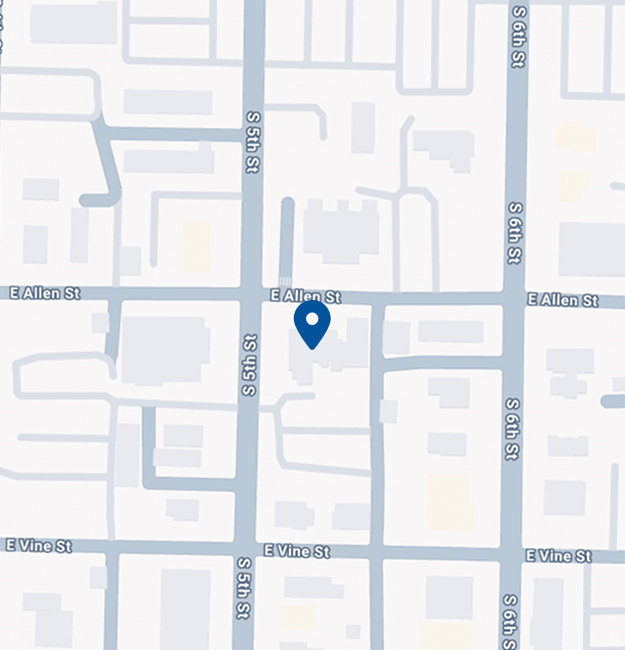
Our offices are located at the corner of South Fifth Street and Vine, in the historic Mary Bryant Home for the Blind.