- Free Consultation: (217) 544-4057 Tap Here To Call Us














Charged With Resisting or Obstructing a Peace Officer in Illinois? Here’s What the Law Actually Says — and What Just Changed


By: W. Scott Hanken | Former Sangamon County Prosecutor | Springfield Criminal Defense & DUI Attorney |
Voted “Best Attorney” — Illinois Times Best of Springfield & State Journal-Register Reader’s Choice | Springfield, IL • Sangamon County • (217) 544-4057 • hankenlaw.com
A lot of people walk into my office convinced they have a winning argument: “They had no right to arrest me in the first place, so I couldn’t be guilty of resisting.” It’s an intuitive argument. It’s also one that Illinois courts have now rejected — twice — in 2026 alone.
On June 24, 2026, the Illinois Third District Appellate Court decided People v. Hill, 2026 IL App (3d) 250131. The ruling is short — eight paragraphs — and the holding is direct: the predicate offense clause buried in 720 ILCS 5/31-1(d) does not give you a defense at trial. If you physically resisted a known officer’s attempt to arrest you, you can be convicted. Full stop.
That’s not a technicality. It’s the law that governs every resisting and obstructing case in Sangamon County and across the state. If you’re facing a charge under this statute right now, here’s what you need to understand before your next court date.
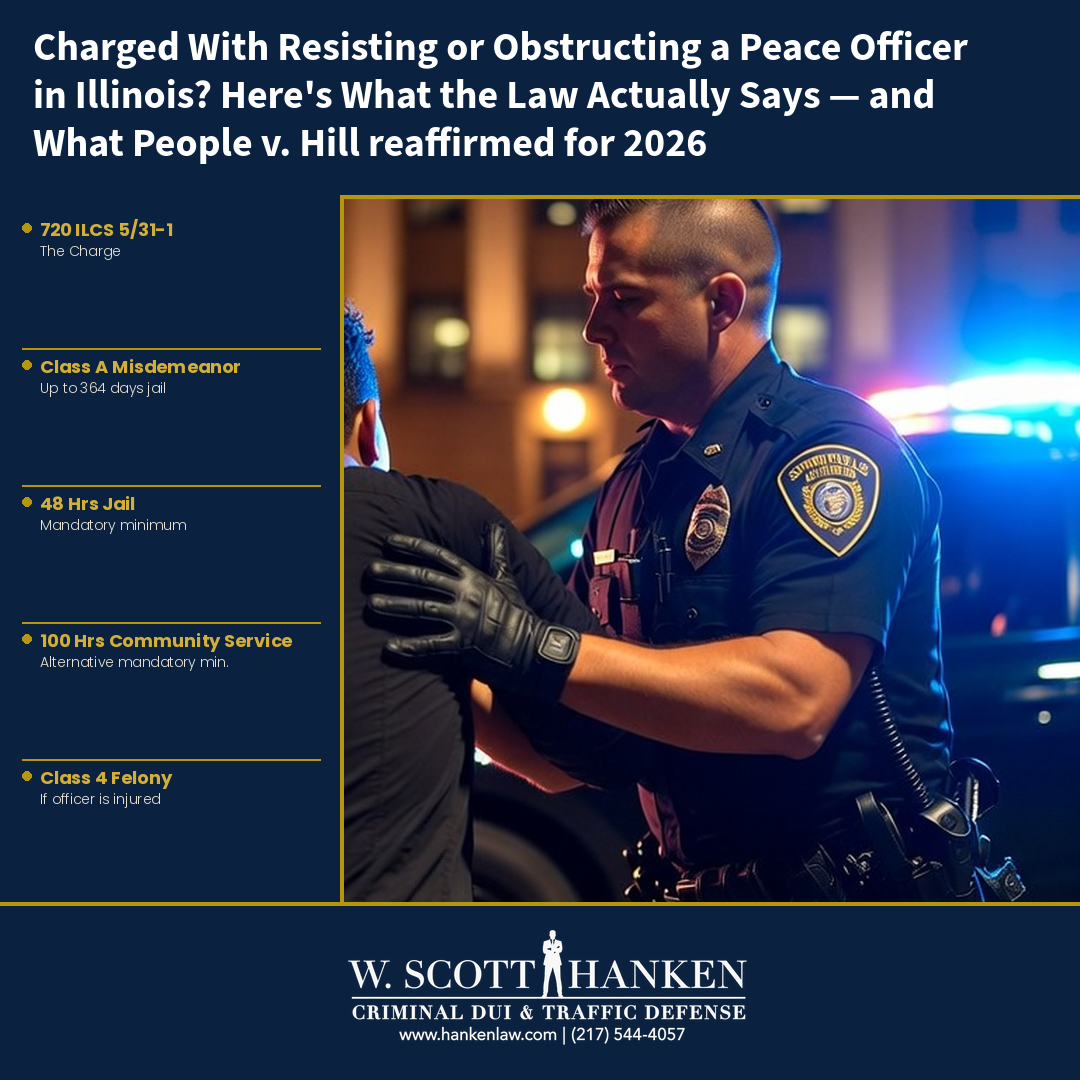
The bottom line up front: Resisting or obstructing a peace officer under Illinois law carries a mandatory minimum sentence — either 48 consecutive hours in jail or 100 hours of community service. Probation alone does not satisfy that requirement. These are not typical misdemeanor charges.
What the Statute Actually Says: 720 ILCS 5/31-1
The resisting and obstructing statute — 720 ILCS 5/31-1 — covers two distinct categories of conduct under a single Class A misdemeanor umbrella.
Under subsection (a)(1), a person who knowingly resists arrest commits the offense. This typically means physical conduct: pulling your arms away, locking your legs, struggling during handcuffing, or fighting back against an officer placing you under arrest.
Under subsection (a)(2), a person who obstructs an officer’s performance of any authorized act within their official capacity commits the same offense. This is broader. It can include refusing a lawful order, interfering with an investigation or crime scene, physically blocking an officer from reaching a subject, or — as alleged in Hill — refusing repeated direct orders to leave an area.
The penalty structure matters enormously:
| Provision | Classification | Potential Sentence | Mandatory Minimum |
|---|---|---|---|
| 720 ILCS 5/31-1(a) — base offense | Class A Misdemeanor | Up to 364 days jail; up to $2,500 fine | 48 consecutive hours jail or 100 hours community service (probation does not satisfy this) |
| 720 ILCS 5/31-1(a-7) — injury to officer | Class 4 Felony | 1–3 years IDOC; up to $25,000 fine | Felony probation or imprisonment |
The mandatory minimum in subsection (a-5) is the feature most defendants learn about the hard way. Even if the judge wants to give you straight probation, the statute prohibits it unless the mandatory time or community service has been served first. In 37 years of practice in Sangamon County, I can tell you that is not a theoretical consequence — it is imposed.
The Predicate Offense Clause — and Why People v. Hill Matters
In 2021, the Illinois legislature amended the statute to add subsection (d): “A person shall not be subject to arrest for resisting arrest under this Section unless there is an underlying offense for which the person was initially subject to arrest.” (Pub. Act 101-652, eff. Jan. 1, 2023.)
The legislative history was explicit. Representative Slaughter’s statement on the floor: the bill was intended to stop law enforcement from charging people with resisting arrest when there was no predicate offense to begin with.
Defendants and their lawyers — reasonably — read subsection (d) as creating a defense. If the police had no valid basis to arrest you in the first place, the argument went, then a charge of resisting that arrest cannot stand either.
Two 2026 appellate decisions have now closed that door.
What Happened in People v. Hill
Renitta Hill was involved in a dispute during a court-ordered personal property recovery at a residence in University Park. Officers were present to assist. After the property transfer, Hill drove away — then came back. An altercation developed. Officers repeatedly told her to leave. She refused and entered a neighbor’s residence. She was placed under arrest. During the arrest, she pulled her arms away from the officer attempting to handcuff her.
The trial court convicted her of one count of resisting a peace officer. At trial and on appeal, her defense centered on subsection (d): she argued the State had to prove she was subject to arrest for a valid predicate offense — disorderly conduct — and that the evidence fell short.
The Third District rejected that argument entirely. Relying on People v. Carswell, 2026 IL App (1st) 231884 — a First District decision from earlier in 2026 with nearly identical facts — the court held:
“Subsection (d) merely makes an arrest for resisting arrest without a predicate offense unlawful” but “does not give rise to an exception or defense” because such an interpretation would “effectively permit persons to resort to self-help in contravention of section 7-7.” Carswell, 2026 IL App (1st) 231884, ¶ 18.
Section 7-7 of the Criminal Code — 720 ILCS 5/7-7 — prohibits using force to resist an arrest, even an unlawful one. The Illinois Supreme Court has held since People v. Locken, 59 Ill. 2d 459 (1974), that resistance of even an unlawful arrest by a known officer is a criminal violation. Hill and Carswell together confirm that subsection (d) does nothing to change that.
What Subsection (d) Actually Does
This is a critical distinction for anyone charged under this statute. Subsection (d) is a restriction on law enforcement’s authority to arrest — not a defense that eliminates criminal liability at trial. The court in Hill put it plainly: the statute “does not mention conviction; it only makes an arrest for resisting arrest contingent on the existence of an underlying offense.”
In other words, if police arrested you for resisting without a valid predicate offense, that arrest may be unlawful — which could matter for suppression motions, civil rights claims, or challenging whether the initial encounter was constitutionally proper. But it does not translate into an acquittal on the resisting charge itself.
Key takeaway from Hill: Whether the predicate arrest was lawful, and whether the State proved the predicate offense beyond a reasonable doubt, are separate questions from whether you physically resisted a known officer. The conviction can stand independently.
Resisting vs. Obstructing: What’s the Difference in Practice?
Both offenses live under the same statute and carry identical base penalties, but they describe different conduct and are prosecuted differently in Sangamon County cases.
Resisting arrest almost always involves some form of physical contact or active physical opposition — pulling away during handcuffing, struggling, or fighting. The State needs to show that an arrest was being effectuated and that you knowingly resisted it. This is where Hill speaks most directly: once the officer is in the act of arresting you, any physical resistance is the offense, regardless of what brought you to that moment.
Obstructing a peace officer is broader, and in practice it gets charged in a wider range of situations. It does not require an arrest to be underway. Illinois courts have found obstruction in cases involving: physically blocking an officer from accessing a subject; interfering with an ongoing investigation; ignoring direct orders at a crime or incident scene; and refusing to comply with lawful commands during a police response. In Hill itself, the obstruction charge was based on refusing the officer’s repeated orders to stop and leave — conduct entirely separate from the eventual physical resistance during the arrest.
One important limitation: verbal argument or disagreement alone does not constitute obstruction. Illinois courts have consistently held that words, by themselves, are not enough — there must be some act that physically or practically impedes the officer’s performance of an authorized duty.
What the Prosecution Has to Prove
For either a resisting or obstructing charge under 720 ILCS 5/31-1(a), the State must establish:
- Knowledge: You knew the person you were resisting or obstructing was a peace officer. This is why body camera footage and witness testimony about whether the officer was in uniform or identified themselves matters.
- Knowing act: Your conduct was intentional, not accidental or reflexive.
- Authorized act: The officer was performing an act within their official capacity. If the officer was acting outside their lawful authority — improperly escalating, or acting on a constitutionally infirm stop — the defense of an unauthorized act may have traction.
- The act itself: Physical resistance to an arrest, or an overt act obstructing performance of an official duty.
After Hill, the State does not have to prove: (a) the predicate offense beyond a reasonable doubt; (b) that you were actually guilty of whatever underlying charge prompted the arrest; or (c) that the arrest was lawful. The resistance or obstruction is the crime.
Defense Strategies That Still Matter
The closing of the subsection (d) defense door does not mean there are no defenses. It means you need an attorney who understands where the real leverage is.
The “Authorized Act” Challenge
The statute requires that the officer be performing an authorized act. If the underlying stop or police contact was constitutionally infirm — if, for example, officers had no lawful basis to be on the premises, or the order you refused was itself unlawful — then the “authorized act” element is in play. This is a Fourth Amendment and constitutional argument that lives separately from the subsection (d) analysis.
Knowledge
If the officer was plainclothes, did not identify themselves as law enforcement, or the circumstances were genuinely ambiguous, knowledge may be a contested issue. It’s a harder argument when there is body camera footage of a uniformed officer, but it remains an element the State must prove.
The Nature of the Act
Jerking back in surprise is different from deliberately pulling away. A flinch is different from a struggle. The mental state element — “knowingly” — can be the difference between a conviction and an acquittal when the facts support it. Body camera footage is critical here. I review it in every case.
Predicate Offense Suppression Arguments
While subsection (d) is not a trial defense after Hill, the illegality of the underlying arrest still matters for suppression. If police lacked probable cause or reasonable articulable suspicion for the initial contact, any evidence gathered as a result of that unlawful encounter may be suppressible. That includes statements you made, physical evidence seized, and potentially the circumstances used to escalate to an arrest. This is a different argument than the one in Hill, and it is very much alive.
Negotiated Resolution
In Sangamon County, as elsewhere in Illinois, the vast majority of misdemeanor cases resolve short of trial. For a first-time defendant with no prior record, a negotiated plea to a reduced charge, court supervision, or an alternative disposition may be available. Whether that option makes sense depends entirely on the specific facts, the prior record, and the strength of a trial defense. I evaluate that in every case — and I do not recommend a plea to anyone who I believe has a winning case at trial.
Why This Charge Deserves Serious Attention
This is not a standard misdemeanor. The mandatory minimum — 48 consecutive hours in jail or 100 hours of community service that probation cannot substitute for — is written directly into the statute. That means even a first-time defendant with zero prior criminal history faces actual incarceration or a significant community service obligation if convicted.
Add to that: a Class A misdemeanor conviction in Illinois is generally not eligible for expungement. It can show up on background checks for employment, housing, and professional licensing. For certain licensed professionals — nurses, teachers, CDL holders, social workers — a conviction can trigger licensing consequences entirely separate from the criminal case.
And if the conduct resulted in any injury to the officer — even minor — the charge steps up to a Class 4 felony. That is state prison territory. That is a permanent felony record.
Frequently Asked Questions (FAQs)
Subsection (d) of 720 ILCS 5/31-1 says you “shall not be subject to arrest” for resisting arrest without an underlying offense. But as People v. Hill (2026) makes clear, that restriction does not translate into a trial defense. It limits police authority to arrest — it does not require the State to prove the predicate offense as an element of the resisting charge.
Yes — but through the right legal theory. An unlawful arrest may support a motion to suppress evidence or a constitutional challenge to the stop. It does not, by itself, defeat the resisting charge at trial under current Illinois law.
That was exactly the conduct charged in Hill. Locking your legs and refusing orders to enter a police vehicle is a form of physical resistance that supports a resisting conviction. It does not require striking, punching, or fighting.
No. Illinois courts have consistently held that verbal disagreement, protest, or argument — standing alone — does not satisfy the actus reus of obstruction. There must be a physical or overt act that actually impedes the officer’s performance of an authorized duty.
Yes, and it happens regularly. The charges are not mutually exclusive. In Hill, the defendant faced one obstruction count and two resisting counts arising from a single encounter. She was ultimately convicted of one count and acquitted of the others.
Do not make any statement to police beyond what identification is legally required. Do not post about the incident on social media. Contact an experienced Sangamon County criminal defense attorney before your first court appearance. The decisions made in the first days after a charge can substantially affect the outcome of the case.
Ready to Fight Your Criminal Charge in Springfield?
Call W. Scott Hanken at (217) 544-4057 or contact us online for a free consultation. We serve clients throughout Springfield, Sangamon County, and Central Illinois.
About the Author: W. Scott Hanken, Attorney at Law
Scott Hanken is a Springfield, Illinois criminal defense attorney with over 37 years of experience, including service as a former Sangamon County prosecutor. He has been voted Best Attorney by the Illinois Times and State Journal-Register, holds an Avvo 10.0 “Superb” rating, and has earned over 270 five-star Google reviews. His firm handles DUI defense, drug crimes, traffic violations, violent crimes, and weapons offenses throughout Sangamon County and Central Illinois.
📍 1100 S 5th St, Springfield, IL 62703 | ☎ (217) 544-4057 | 🌐 hankenlaw.com
This article is for general educational purposes only and does not constitute legal advice. Every case is unique — contact an experienced Springfield criminal defense attorney for guidance on your specific situation.

Address
Our offices are located at the corner of South Fifth Street and Vine, in the historic Mary Bryant Home for the Blind.