- Free Consultation: (217) 544-4057 Tap Here To Call Us









Rushing Your Child to the Hospital? Can Your Traffic Ticket Get Dismissed?


Last Reviewed & Updated: September 24, 2026
By: W. Scott Hanken | Former Sangamon County Prosecutor | Springfield Criminal Defense & Traffic Ticket Defense Attorney | Voted “Best Attorney” — Illinois Times Best of Springfield & State Journal-Register Reader’s Choice | Springfield, IL | Sangamon County | (217) 544-4057 | hankenlaw.com
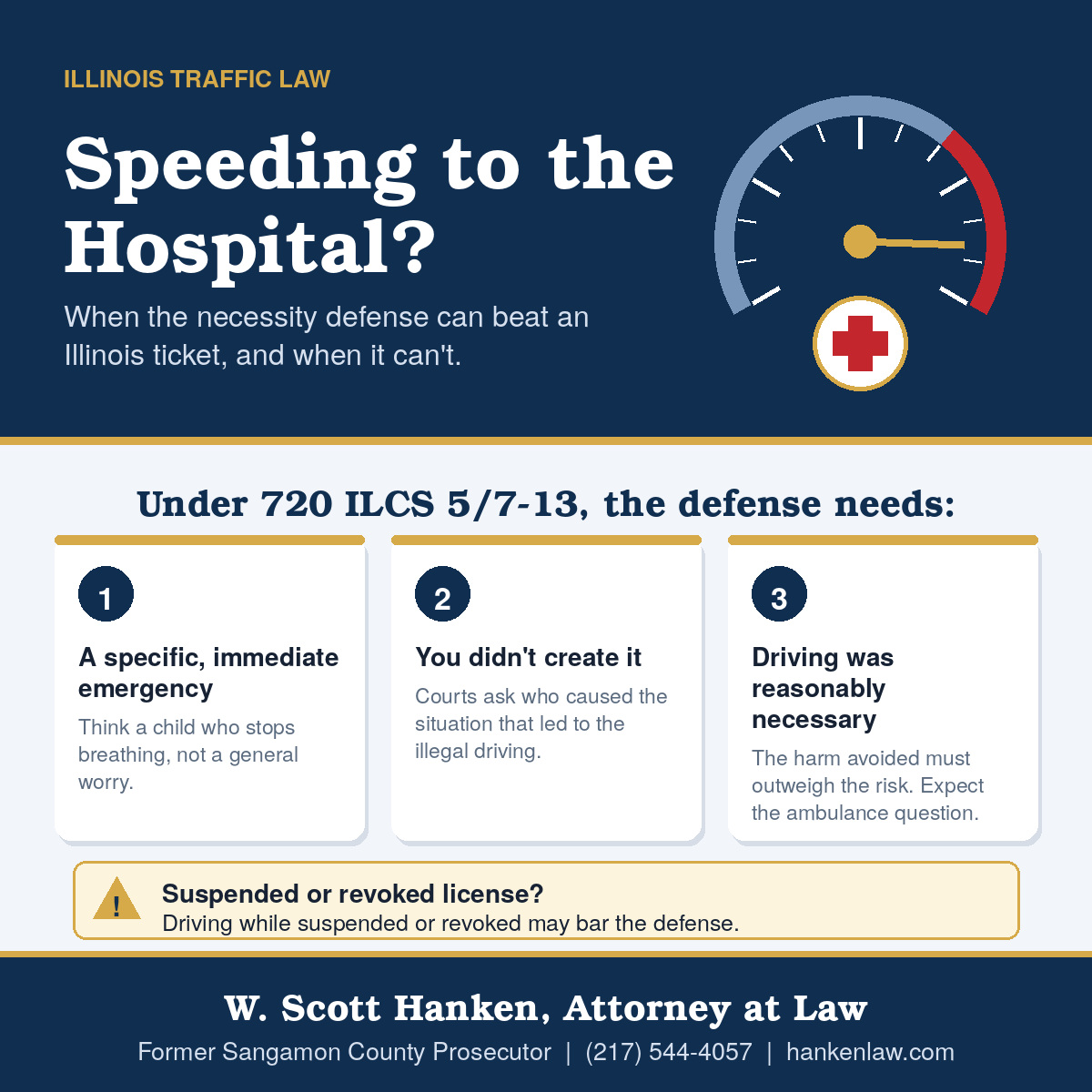
In Illinois, speeding a child to the hospital is not automatically legal. Necessity can justify the ticket if the threat was specific and immediate, you didn’t create it, and you reasonably believed driving was needed to prevent greater injury. You present some evidence; the State must disprove it.
The defense is 720 ILCS 5/7-13. The speed limits are in 625 ILCS 5/11-601. The only statutory permission to exceed them belongs to authorized emergency vehicles under 625 ILCS 5/11-205.
Bottom Line: A real medical emergency can support a necessity defense on a Springfield or Sangamon County traffic ticket. It does not erase the ticket by itself. A necessity finding at trial is a not-guilty verdict, not a dismissal. The defense usually fails when an ambulance was a reasonable option, when the threat was not immediate, or when you helped create the problem. In Sangamon County, the Fourth District Appellate Court’s stricter “sole option” language is what a judge will look to first.
Does Illinois Let a Parent Speed to the Hospital?
No. The Illinois Vehicle Code gives a private driver no medical-emergency exception to the speed limit.
625 ILCS 5/11-601 requires a speed that is reasonable and proper for conditions, and it separately prohibits exceeding the posted or statutory maximum. Driving faster than the limit because a child is sick still violates that section unless another legal doctrine applies.
The written exception belongs to drivers of authorized emergency vehicles. Under 625 ILCS 5/11-205, those drivers may exceed the maximum speed limit only in three situations: when responding to an emergency call, when pursuing a suspected violator, or when responding to a fire alarm. Even then, they may not endanger life or property. Except for police vehicles, the privilege applies only while audible or visual emergency signals are in use. 625 ILCS 5/1-105 defines which vehicles qualify. A parent’s car is not one of them.
That is why the ticket gets written. The officer is applying the Vehicle Code as written. The question in court is whether necessity under the Criminal Code justifies the conduct.
What Is the Necessity Defense on an Illinois Traffic Ticket?
Necessity is a justification. You admit the driving happened. You argue the law does not punish it because you reasonably believed the violation was needed to avoid a greater injury, and you did not create the situation.
Statute Callout — 720 ILCS 5/7-13 (Necessity):
“Conduct which would otherwise be an offense is justifiable by reason of necessity if the accused was without blame in occasioning or developing the situation and reasonably believed such conduct was necessary to avoid a public or private injury greater than the injury which might reasonably result from his own conduct.”
The statute has two elements. Illinois courts add a threshold the text does not spell out: the threat must be specific and immediate (People v. Kite, 153 Ill. 2d 40, 45 (1992)). A general worry, a scheduled appointment, or a child who is uncomfortable but stable is not enough. The Illinois Supreme Court describes necessity as a choice between two admitted evils where other options are unavailable. It also requires that the chosen conduct promote a higher value than literal compliance with the law (People v. Janik, 127 Ill. 2d 390, 399 (1989)).
Necessity is an affirmative defense under 720 ILCS 5/7-14. Section 7-13 covers any “conduct which would otherwise be an offense,” so it reaches traffic offenses, not just felonies. That includes ordinary speeding under 625 ILCS 5/11-601 and aggravated speeding under 625 ILCS 5/11-601.5.
Do I Have to Prove Necessity, or Does the Prosecutor Have to Disprove It?
You do not have to prove necessity at all. You have to present some evidence of both statutory elements. Once you do, the State must prove beyond a reasonable doubt that you did not act out of necessity.
That burden rule is 720 ILCS 5/3-2. Unless the State’s own evidence raises the issue, the defendant must present some evidence to put necessity in the case. Once it is raised, the State must disprove it along with every element of the ticketed offense. Slight evidence is enough to put an affirmative defense before the factfinder (People v. Everette, 141 Ill. 2d 147 (1990)). Most traffic cases in Sangamon County are bench trials, so the judge rather than a jury usually decides whether the State has disproved necessity.
Which Traffic Charges Can a Hospital Emergency Defend?
The charge matters as much as the emergency. Necessity, penalties, and supervision work differently across the charges a hospital run most often produces.
| Charge | Statute | Classification and penalty | Necessity | Court supervision |
|---|---|---|---|---|
| Speeding, 1–25 mph over | 625 ILCS 5/11-601(b) | Petty offense, fine only | Can be raised; State may argue Jackson’s absolute-liability reasoning | Generally available, subject to the exclusions in 730 ILCS 5/5-6-1 |
| Aggravated speeding, 26–34 mph over | 625 ILCS 5/11-601.5(a) | Class B misdemeanor: up to 6 months in jail and a fine up to $1,500 (730 ILCS 5/5-4.5-60) | Can be raised | Barred in an urban district (5-6-1(q)) and after a prior aggravated-speeding supervision or conviction (5-6-1(p)) |
| Aggravated speeding, 35+ mph over | 625 ILCS 5/11-601.5(b) | Class A misdemeanor: less than one year (364 days) in jail and a fine up to $2,500 (730 ILCS 5/5-4.5-55) | Can be raised | Same bars as above |
| Driving while suspended or revoked | 625 ILCS 5/6-303 | Class A misdemeanor at base; felony with qualifying priors | Jackson says unavailable when the suspension or revocation is uncontested | Restricted; review 5-6-1 for the specific charge |
The urban-district bar in 730 ILCS 5/5-6-1 matters in Springfield, where many city streets qualify as urban districts. A parent clocked 26 or more over on one of those streets cannot receive supervision on an aggravated-speeding charge. That raises the stakes of a necessity defense or a negotiated amendment.
What Evidence Does a Hospital-Run Ticket Need in Sangamon County?
A necessity claim is won or lost on facts gathered early. The evidence has to show three things: an immediate injury you did not create, a reasonable belief that the driving was required, and a comparison of harms that favors your choice.
Useful proof usually includes:
- Medical records or discharge papers showing the child’s condition on arrival.
- 911 recordings, ambulance dispatch records, or phone logs showing whether and when help was called.
- Statements from anyone else in the car.
- Timestamped photos, video, or GPS data that fix the route and the time.
- The exact words you said to the officer at the stop.
A story that grows after you hear the charge does not help. Suppose the officer’s report already quotes you saying “I was just trying to get to the hospital.” That sentence is not necessity by itself. Necessity requires a specific greater injury and a driver who was not at fault for the situation.
Medical records and phone logs are easiest to collect in the first weeks. When you meet with a lawyer, bring the ticket, any medical records, and the phone you used that night.
What if I Could Have Called 911 Instead of Driving?
If a reasonable person in your position could have called an ambulance, the State will argue necessity is unavailable. In Sangamon County, that argument has real weight.
People v. Guja, 2016 IL App (1st) 140046, ¶ 47, says necessity applies when the threat was immediate and the defendant’s conduct was the sole option to avoid injury. People v. Kratovil, 351 Ill. App. 3d 1023 (2d Dist. 2004), uses similar language. The Fourth District quoted Guja in People v. Taylor, 2023 IL App (4th) 220381, ¶ 65, a case out of Sangamon County.
The Third District took the other view in People v. Kucavik, 367 Ill. App. 3d 176 (3d Dist. 2006). It held that requiring the “sole” alternative would make the statute’s “reasonably believed” language meaningless, and that the existence of alternatives is usually for the factfinder. When appellate districts conflict, an Illinois circuit court follows the district in which it sits (Aleckson v. Village of Round Lake Park, 176 Ill. 2d 82, 92 (1997)). A Springfield defense lawyer can argue Kucavik, but the Fourth District’s language comes first.
The practical point is simpler. “It was faster if I drove” is an explanation, not a necessity defense. The first question in court will be why an ambulance was not how the child got there.
What if I Was Already Drinking, Already Speeding, or Already Revoked?
Earlier misconduct does not automatically bar the defense. The question is who created the situation, which is the first element of 720 ILCS 5/7-13.
In Kucavik, the driver was intoxicated. The appellate court still found some evidence that she was blameless, because her boyfriend stopped her car in the road and threatened to hurt her if she did not move it.
Compare People v. Brown, 2023 IL App (3d) 210460. There, the defendant was a passenger with a revoked license who told the driver to switch seats so he could drive away from a confrontation. The court held he created the illegal-driving situation himself. A child who stops breathing after you are already on the road is a different fact pattern from a night of drinking followed by a decision to drive. If alcohol was involved, see our DUI defense page.
A suspended or revoked license is a separate problem. In People v. Jackson, 2013 IL 113986, ¶ 23, the Illinois Supreme Court said that necessity is not a defense to a 6-303 charge when the defendant does not contest the suspension or revocation. Defendants argue that statement is non-binding dictum, and the Third District declined to decide the question in Brown. Expect a Sangamon County prosecutor to rely on it.
Jackson rested on the idea that absolute-liability offenses allow no affirmative defense. Petty speeding is generally treated as absolute liability too, so the State may try to extend that reasoning to an ordinary speeding ticket. The best answer is Kite. There, the Supreme Court said an inmate charged with a strict-liability weapons offense may assert necessity, even though it rejected Kite’s own claim for lack of an immediate threat.
Is a Successful Necessity Claim a Dismissal?
No. If necessity is raised and the State fails to disprove it, the conduct was justified and the result is a finding of not guilty.
Many traffic cases resolve before that point, through court supervision under 730 ILCS 5/5-6-1 or an amendment to a lesser or non-moving charge. Those outcomes depend on the charge, the driving abstract, and the facts, and the statute bars supervision in some aggravated-speeding cases. Neither outcome is a necessity verdict, and neither is automatic.
Frequently Asked Questions (FAQs)
It is a legal justification for a driving offense when you did not create the emergency and reasonably believed the violation was needed to prevent a greater injury than your driving might cause. The threat must be specific and immediate. The statute is 720 ILCS 5/7-13.
No. You must present some evidence of the statutory elements, and then the State must disprove necessity beyond a reasonable doubt under 720 ILCS 5/3-2. Whether another reasonable option existed is where the fight happens. It is not a separate element you have to prove.
You can raise it if the emergency was immediate, you did not create it, and driving was reasonably necessary compared with calling an ambulance. Because Sangamon County follows the Fourth District under Aleckson, expect the State to argue that driving had to be your only reasonable option.
No. 625 ILCS 5/11-205 covers authorized emergency vehicles, not a parent in a private car. Necessity is the doctrine that can still justify the ticket after it is written.
Often, for petty speeding. For aggravated speeding, 26 or more mph over the limit, supervision is barred in an urban district and after a prior aggravated-speeding supervision or conviction under 730 ILCS 5/5-6-1, subsections (p) and (q). Many Springfield city streets qualify as urban districts.
It is a criminal misdemeanor, not a petty offense. At 26 to 34 mph over, it is a Class B misdemeanor punishable by up to 6 months in jail and a fine up to $1,500 (730 ILCS 5/5-4.5-60). At 35 or more over, it is a Class A misdemeanor punishable by less than one year in jail and a fine up to $2,500 (730 ILCS 5/5-4.5-55).
Necessity may be unavailable on a 625 ILCS 5/6-303 charge if you do not contest the suspension or revocation, under People v. Jackson, 2013 IL 113986. Tell your lawyer about your license status on the first call.
No. Hospital records help prove the emergency. They do not prove you were without blame or that driving was reasonably necessary, and they do not require the court to dismiss the ticket.
Further Reading
Practice Area
Related Articles
- Aggravated Speeding in an Illinois Work Zone: Penalties and Why Court Supervision Is Off the Table — If you were 26+ mph over, this is what a misdemeanor speeding charge means for supervision.
- LiDAR Speed Enforcement in Illinois: Patrol Guns vs. Work-Zone Vans — and Why the Law Treats Them Differently — Necessity concedes you were speeding; check whether the speed reading holds up first.
- Can a Lawyer Handle a Traffic Ticket for Me in Sangamon County Court? — Whether you have to appear in person while you are still dealing with a sick child.
Browse by Topic
Ready to Fight Your Traffic Case in Springfield?
Call W. Scott Hanken at (217) 544-4057 or contact us online for a free consultation. We serve clients throughout Springfield, Sangamon County, and Central Illinois.
About the Author: W. Scott Hanken, Attorney at Law
Scott Hanken is a Springfield, Illinois criminal defense attorney with over 37 years of experience, including service as a former Sangamon County prosecutor. He has been voted Best Attorney by the Illinois Times and State Journal-Register, holds an Avvo 10.0 “Superb” rating, and has earned over 270 five-star Google reviews. He serves clients throughout Sangamon County and Central Illinois.
📍 1100 S 5th St, Springfield, IL 62703 | ☎ (217) 544-4057 | 🌐 hankenlaw.com
This article is for general educational purposes only and does not constitute legal advice. Every case is unique — contact an experienced Springfield criminal defense attorney for guidance on your specific situation.

Address
Our offices are located at the corner of South Fifth Street and Vine, in the historic Mary Bryant Home for the Blind.