- Free Consultation: (217) 544-4057 Tap Here To Call Us








Traffic Ticket from a Fender Bender in Springfield? Here’s What Actually Happens Next


By: W. Scott Hanken Former Sangamon County Prosecutor | Springfield Criminal Defense & DUI Attorney |
Voted “Best Attorney” — Illinois Times Best of Springfield & State Journal-Register Reader’s Choice –
Springfield, IL • Sangamon County • (217) 544-4057 • hankenlaw.com
The short answer: getting a ticket after a car accident in Springfield is not the same as getting a speeding ticket on Veterans Parkway. The officer who signed that citation is often not the witness who actually saw what happened. That distinction can make all the difference in how your case plays out at the Sangamon County Circuit Court.
What Charges Do Police Typically Write After a Fender Bender in Illinois?
Most accident-related tickets fall into a handful of categories. Officers usually write what the physical evidence suggests — skid marks, point of impact, witness statements — combined with whatever the drivers and passengers told them at the scene.
Failure to reduce speed to avoid an accident — 625 ILCS 5/11-601
Illinois law requires drivers to decrease speed as necessary to avoid colliding with any person or vehicle on or entering the highway. This is the catch-all charge. If you hit someone and the officer can’t pin down exactly why, this is what often gets written.
Failure to yield — 625 ILCS 5/11-901
Intersection accidents, parking lot exits, merges gone wrong. The officer codes who had the right-of-way based on what the parties say and what the physical evidence shows.
Disobeying a traffic control signal (running a red light) — 625 ILCS 5/11-306
If the crash happened at a signalized intersection, this charge appears when the other driver says the light was red.
Improper lane usage — 625 ILCS 5/11-709
Sideswipe accidents, lane-change collisions. The law requires a driver to stay within a single marked lane and confirm the movement can be made safely before changing.
Distracted driving — 625 ILCS 5/12-610.2
Using an electronic communication device while driving is a moving violation on its own. If it contributed to the crash and caused serious injury, the charge escalates to a Class A misdemeanor. Death caused by distracted driving can be charged as a Class 4 felony.
Multiple charges on a single accident are common. The ticket you hold may list two or three violations, each with separate fines and separate consequences for your driving record.
What Are Your Legal Duties Right After an Accident in Illinois?
A lot of people don’t know the rules here. That lack of knowledge can create additional legal problems on top of the original ticket.
Under 625 ILCS 5/11-401, if the crash results in personal injury — meaning any injury requiring immediate professional treatment — you must stop at the scene, remain there, and fulfill the duties under Section 11-403, which includes providing information and rendering reasonable aid. Leaving the scene of an injury accident without stopping is a Class 4 felony. Driving away and failing to report within 30 minutes bumps to a Class 2 felony if no one died, Class 1 if someone did.
For property-damage-only accidents — no injuries, no fatalities — 625 ILCS 5/11-402 still requires you to stop and remain at the scene until you’ve exchanged information. Failing to do so is a Class A misdemeanor. If the damage exceeds $1,000, the Secretary of State will suspend your license on top of that.
In plain terms: stop, stay, exchange information, cooperate with emergency personnel. Those three things keep a bad situation from becoming a criminal one.
What Happens When the Officer Arrives at the Scene?
Here’s what actually happens, in practice.
The officer arrives — usually after the collision is over, the adrenaline is still running high, and everyone has a different account of what happened. The first priority is safety and medical triage. After that, the investigation begins.
Officers will separately interview each driver. Passengers get questioned too. Any third-party witnesses — people who saw the accident from a nearby business, a pedestrian who watched it happen from a corner — those statements get taken as well. What each person says gets recorded in the Illinois Traffic Crash Report (SR 1050), which the officer submits to the Illinois Department of Transportation within 10 days under 625 ILCS 5/11-408.
That report is not just paperwork. It is a legal document. It becomes part of the case file. Defense attorneys and prosecutors both use it.
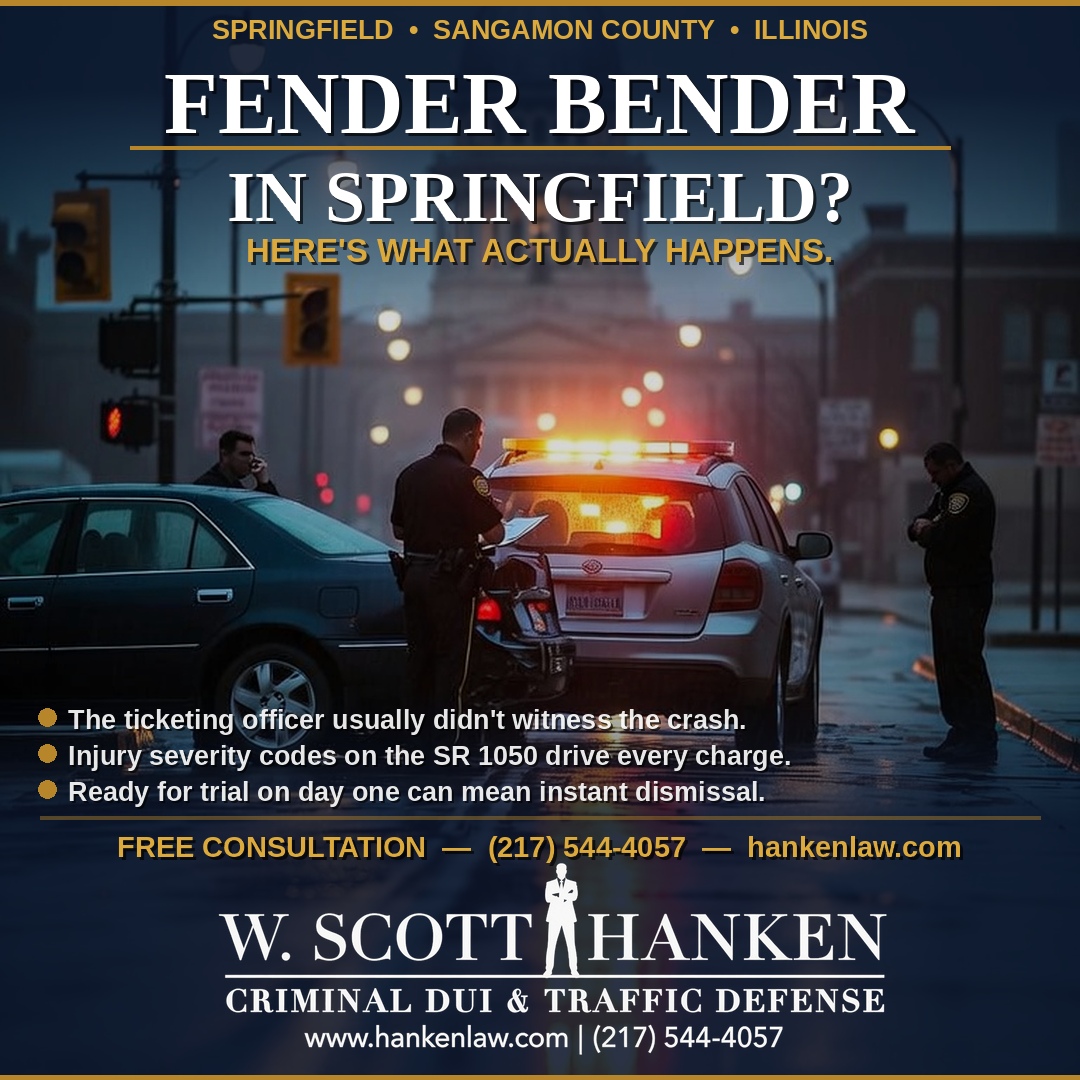
One thing I see misunderstood constantly: the officer writing the ticket typically did not witness the accident. None of them did. They are reconstructing what happened from physical evidence and statements taken after the fact. That matters enormously when it comes to court.
The Injury Factor: How the SR 1050 Classification Changes Everything
When the officer arrives at your accident scene, one of the first decisions is whether your crash is a Type A or a Type B under the Illinois Traffic Crash Report (SR 1050) — the standard form the Illinois Department of Transportation requires for every investigated crash under 625 ILCS 5/11-408.
Type A means no injuries and no vehicle required towing. Property damage only. All vehicles drove away.
Type B means the crash involved death, any injury, or any vehicle towed from the scene due to crash damage. For a Type B crash, the officer must complete the entire SR 1050 — including a Diagram, a Narrative, and injury severity codes for every person involved.
That Type A / Type B designation is the first fork in the road. A Type A crash generally stays a traffic matter. Type B opens the door to elevated charges, heightened prosecutorial attention, and in serious cases, criminal exposure.
Within every Type B crash, the officer assigns an individual injury severity code to each person. The Illinois Department of Transportation defines these codes as follows:
K — Fatal Injury. Someone died within 30 days of the crash.
A — Incapacitating Injury. Severe injury that prevents continuation of normal activities. Broken or distorted limbs, internal injuries, crushed chest, injuries requiring the person to be carried from the scene.
B — Non-Incapacitating Injury. Injury is evident but not incapacitating. Visible cuts, bruising, limping, lacerations that don’t prevent movement.
C — Possible Injury. No visible injury, but the person reports pain — neck pain, back pain, headache. Common in rear-end crashes where symptoms appear hours later.
O — No Indication of Injury. No injury evident, no complaint.
The difference between a B-severity injury and an A-severity injury is the line between a contested traffic ticket and a serious criminal charge. Distracted driving that produces a B-severity injury stays in a different legal universe than distracted driving that produces an A-severity injury involving great bodily harm, permanent disability, or disfigurement. Under 625 ILCS 5/12-610.2(b-5), the latter becomes a Class A misdemeanor. If someone died, it becomes a Class 4 felony.
The injury severity code the officer writes on that SR 1050 is not just a data point for IDOT’s crash statistics. It shapes what charges get filed, whether the State’s Attorney’s office takes a hard line on negotiations, and ultimately what you’re facing in the Sangamon County Circuit Court.
A single client scenario illustrates the stakes. Someone came to me after a rear-end collision on South Grand Avenue in Springfield. The other driver complained of neck pain at the scene — a possible injury, Severity C. No ambulance. Everyone drove away. The officer still classified it Type B because the client’s car was towed. The charge: failure to reduce speed. That pain complaint, documented on the SR 1050, gave the State a basis to argue the ticket deserved serious treatment. That’s exactly why getting an attorney early — before you’ve made additional statements or conceded anything — changes the trajectory.
What Happens When You Walk into Court on a Traffic Ticket?
Most people don’t know this going in. Your first court date in Sangamon County is not a trial. It is an arraignment — a first appearance at which you enter a plea. Most defendants plead “not guilty” and the case gets continued for further proceedings.
Here’s the thing most people miss entirely.
The officer who wrote your ticket is not the primary witness in your case. The other driver is. Maybe a passenger. Maybe the pedestrian who saw everything from the sidewalk at 6th and Jefferson. Those are the people the State needs in court to prove its case.
When a case is set for trial, the prosecution has to have its witnesses present and ready. If the other driver doesn’t show up — and that happens more often than most people expect — the State has no complaining witness. No witness, no evidence, no case. Dismissal.
That’s not a loophole or a technicality. It is how the adversarial system actually works.
Answering “ready for trial” at your very first court appearance is a legitimate defense strategy, and one I’ve used successfully for clients in exactly this situation. A client came to me after a Springfield fender bender — failure to reduce speed ticket, and a prosecutor who wasn’t interested in negotiating. We answered ready for trial. The other party didn’t appear. The case was dismissed. My client never had to set foot in the Sangamon County courthouse himself.
That doesn’t happen in every case. But it happens. And it only works if your attorney is positioned to take advantage of it on day one.
Does the Traffic Ticket Get Worse If There Were Injuries?
Yes. The presence of injuries — and their severity — is one of the most important factors in how a traffic ticket gets treated in Sangamon County.
A minor injury with treatment at a doctor’s office: expect a traffic matter, possibly elevated to a misdemeanor depending on the charge.
Serious injury — the kind that requires an ambulance, emergency surgery, extended hospital care: the State’s Attorney’s office pays closer attention. More charges may be filed. Plea negotiations harden. Cases involving serious injuries are less likely to be dismissed for a missing complaining witness, because the State has a stronger motivation to pursue prosecution.
That’s the calculus you need to understand before you decide how to handle your case.
If serious injuries are involved, contact an attorney before your first court date. Do not give additional statements. Do not post about the accident on social media. Understand that what started as a traffic ticket can evolve into a criminal case depending on how events develop.
What Should You Do If You’ve Been Ticketed After an Accident in Springfield?
Get the crash report. You are entitled to a copy. Review it for accuracy. Officers are human and make mistakes — names misspelled, facts recorded incorrectly. Errors in that report can matter.
Don’t give supplemental statements to anyone — the other driver’s insurance company, the other driver themselves, anyone — without understanding your legal exposure first. Anything you say can be used.
Write down your account of what happened as soon as possible, while the details are fresh. Not to share, just for yourself and your attorney.
Contact a Springfield traffic ticket defense attorney before your first court date. The first appearance is not just paperwork. The decision you make at that first date — whether to answer ready, seek a continuance, or explore negotiation — has strategic consequences.
As a former prosecutor, I’ve sat on the other side of these cases and watched how they move through the system. I know when the State’s case is solid and when it has cracks. That perspective matters in deciding how to proceed.
Related Reading on the Hanken Law Blog
Before your first court date, these posts are worth your time:
- What to Do During a Traffic Stop in Illinois: A Step-by-Step Guide — Understanding your rights in the moments right after a crash is as important as what happens in court.
- Does It Really Matter Whether Your Criminal Defense Lawyer Actually Lives and Works Here in Springfield? — Courthouse relationships and local knowledge are not marketing language — they are a defense asset in Sangamon County.
- License Plate Covers Are Illegal in Illinois — And That Frame on Your Car Could Get You Pulled Over — Minor equipment violations that create traffic stops leading to accident investigations.
Frequently Asked Questions (FAQs)
Q: If the police officer didn’t see my accident, can I still be convicted on the traffic ticket?
A: Yes, you can — but the case is more difficult for the State to prove. When a police officer didn’t witness the accident, the prosecution must rely on the other driver, passengers, or third-party witnesses to testify in court. If those witnesses don’t appear, the State may have no one to present its case. That’s why answering ready for trial at your first court date can be a legitimate strategy — not in every case, but in many. The officer’s crash report is documentation, not eyewitness testimony to the violation itself.
Q: Do I need a lawyer for a minor accident ticket in Sangamon County, or can I just pay the fine?
A: Paying the fine is a conviction. It goes on your driving record, adds points, and can trigger an insurance rate increase that costs far more over time than any attorney’s fee. Certain charges, like failure to reduce speed, are moving violations that accumulate toward a license suspension. Whether an attorney can help depends on the specific charge, your driving history, and whether injuries were involved. At least make one call before you pay — a brief consultation often changes the picture entirely.
Q: What happens if the other driver was injured in my accident in Springfield, Illinois?
A: The presence of injury changes the stakes significantly. Charges may be elevated. The State’s Attorney’s office takes the case more seriously. Distracted driving that causes great bodily harm, permanent disability, or disfigurement is charged as a Class A misdemeanor under 625 ILCS 5/12-610.2. If someone died, it can rise to a Class 4 felony. With injuries in the picture, having a defense attorney before your first court date is essential.
Q: Can a traffic ticket from an accident affect my car insurance even if I’m found not guilty?
A: A not-guilty finding or dismissal generally does not create a conviction on your record. Insurance companies base rate increases on convictions and points assessed by the Secretary of State. No conviction typically means no points, which means no rate increase for that offense. That’s one of the concrete financial reasons to contest a ticket rather than simply pay it.
Q: How long does a traffic ticket case from a car accident take to resolve in Sangamon County?
A: It depends on whether injuries were involved, whether witnesses need to be subpoenaed, whether the case goes to trial, and the Sangamon County Circuit Court’s docket schedule. A straightforward property-damage-only ticket dismissed at first appearance can be over in a single court date. A contested case with injuries, multiple charges, and multiple witnesses can take months. Your attorney can give you a realistic timeline once they’ve reviewed the specific charges and the crash report.
Ready to Fight Your Traffic Case in Springfield?
Call W. Scott Hanken at (217) 544-4057 or contact us online for a free consultation. We serve clients throughout Springfield, Sangamon County, and Central Illinois.
About the Author: W. Scott Hanken, Attorney at Law
Scott Hanken is a Springfield, Illinois criminal defense attorney with over 37 years of experience, including service as a former Sangamon County prosecutor. He has been voted Best Attorney by the Illinois Times and State Journal-Register, holds an Avvo 10.0 “Superb” rating, and has earned over 250 five-star Google reviews. His firm handles DUI defense, drug crimes, traffic violations, violent crimes, and weapons offenses throughout Sangamon County and Central Illinois.
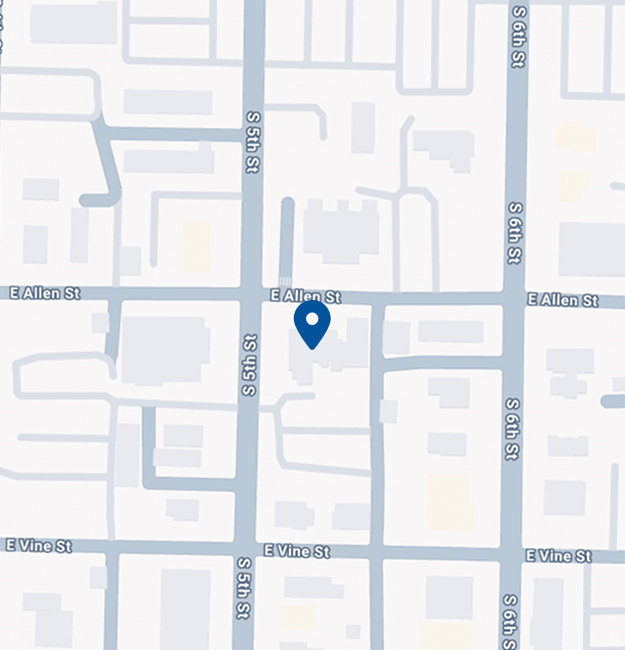
📍 1100 S 5th St, Springfield, IL 62703 | ☎ (217) 544-4057 | 🌐 hankenlaw.com
This article is for general educational purposes only and does not constitute legal advice. Every case is unique — contact an experienced Springfield criminal defense attorney for guidance on your specific situation.
Address
Our offices are located at the corner of South Fifth Street and Vine, in the historic Mary Bryant Home for the Blind.