

I Am a Former Prosecutor Who Will Fight for Your Rights














Illinois DUI Penalty Chart: Jail, Fines & License Loss
Last reviewed and updated: November 2026
Illinois DUI Penalties at a Glance
A first or second Illinois DUI is a Class A misdemeanor, a third is a Class 2 felony, and a sixth is a Class X felony carrying 6 to 30 years.
If you’ve been arrested for DUI in Springfield or anywhere in Sangamon County, three facts drive the sentence under 625 ILCS 5/11-501. The first is how many prior DUIs you have. The second is your blood alcohol concentration. The third is whether an aggravating circumstance was present, such as a crash with injuries, a child in the car, or no valid license. Any one of those can turn the same arrest from a misdemeanor into a felony, and prior DUIs never expire for criminal enhancement purposes.
License consequences run on a separate track. A statutory summary suspension follows the arrest itself, starting on the 46th day after notice, whether or not you are ever convicted. A conviction then brings a revocation that lasts at least one year and can last a lifetime. Court supervision, available once, is the only outcome that avoids a conviction and the revocation that comes with it.
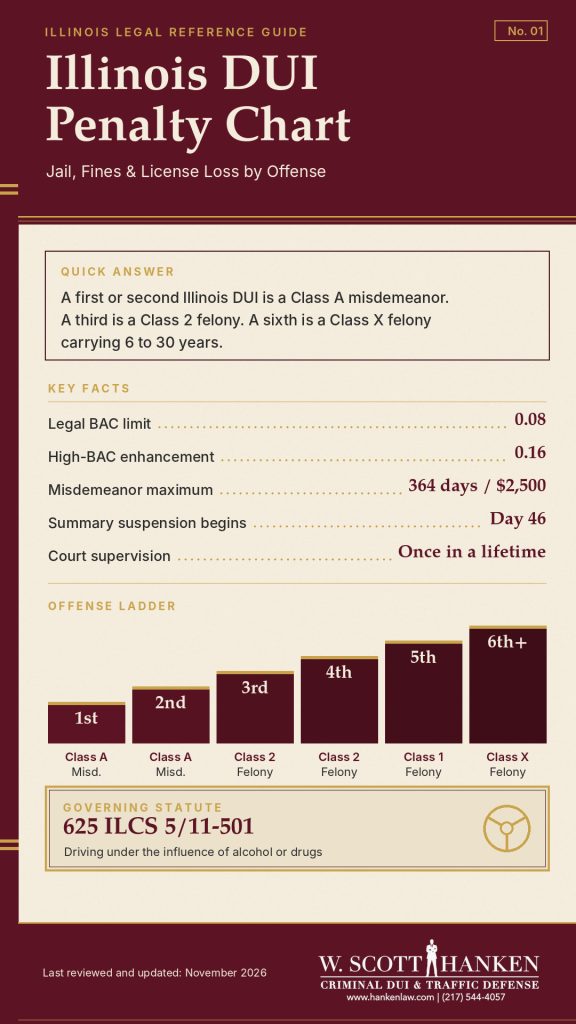
Key Facts: Illinois DUI at a Glance
| Question | Answer | Authority |
|---|---|---|
| Legal BAC limit | 0.08 | 625 ILCS 5/11-501(a)(1) |
| High-BAC enhancement threshold | 0.16 | 625 ILCS 5/11-501(c)(4) |
| First DUI classification | Class A misdemeanor | 625 ILCS 5/11-501(c)(1) |
| Maximum jail, misdemeanor DUI | 364 days | 730 ILCS 5/5-4.5-55 |
| Maximum fine, misdemeanor DUI | $2,500 | 730 ILCS 5/5-4.5-55 |
| When DUI becomes a felony | Third offense, or any aggravating factor in 11-501(d)(1) | 625 ILCS 5/11-501(d) |
| Most serious DUI classification | Class X felony (6th or later offense), 6 to 30 years | 625 ILCS 5/11-501(d)(2)(E) |
| Lookback period for prior DUIs | None for criminal enhancement | 625 ILCS 5/11-501(c), (d) |
| Summary suspension start date | 46th day after notice | 625 ILCS 5/11-501.1(g) |
| Deadline to petition to rescind | 90 days after notice | 625 ILCS 5/2-118.1(b) |
| Court supervision available | Once in a lifetime | 730 ILCS 5/5-6-1(d) |
| License revocation, 1st conviction | 1 year minimum | 625 ILCS 5/6-208(b) |
| License revocation, 4th conviction | Lifetime | 625 ILCS 5/6-208(b)(4) |
A Former Prosecutor on Your Side
A penalty chart tells you the range. It doesn’t tell you where your case will land.
W. Scott Hanken spent years as a Sangamon County prosecutor before turning to defense, and he has 37+ years of experience in Illinois courtrooms. He knows how the State builds a DUI case and where those cases tend to be weak. He has been voted “Best Attorney” by the Illinois Times and the State Journal-Register, holds an Avvo 10.0 “Superb” rating, and has earned 270+ five-star Google reviews. His office is at 1100 S. 5th St. in Springfield.
What the State Must Prove for an Illinois DUI
The State must prove you drove or were in actual physical control of a vehicle in Illinois while one of the following was true.
| Subsection | Basis for the charge |
|---|---|
| (a)(1) | Alcohol concentration of 0.08 or more in blood, breath, or other bodily substance |
| (a)(2) | Under the influence of alcohol |
| (a)(3) | Under the influence of an intoxicating compound to a degree that renders you incapable of driving safely |
| (a)(4) | Under the influence of another drug to a degree that renders you incapable of driving safely |
| (a)(5) | Under the combined influence of alcohol, drugs, or intoxicating compounds to that degree |
| (a)(6) | Any amount of certain controlled substances, intoxicating compounds, or methamphetamine from unlawful use |
| (a)(7) | THC concentration above the statutory limit within 2 hours of driving (registered medical cannabis patients excepted unless impaired) |
“Actual physical control” is broader than driving. In Sangamon County, it comes up most often when a driver is found asleep in a running car in a parking lot.
The (a)(1) and (a)(2) charges are usually filed together, so a BAC under 0.08 does not end the case if the State has impairment evidence.
625 ILCS 5/11-501(c)(2): A person convicted of a second DUI “shall be sentenced to a mandatory minimum term of either 5 days of imprisonment or 240 hours of community service,” in addition to any other criminal or administrative sanction.
Illinois DUI Penalties for a 1st, 2nd, 3rd, and Later Offense
The count of prior DUIs sets the class, and the class sets the range. These are the penalties when there are no injuries and no child passenger.
| Offense | Classification | Jail or prison range | Maximum fine |
|---|---|---|---|
| 1st DUI | Class A misdemeanor | Up to 364 days | $2,500 |
| 2nd DUI | Class A misdemeanor | Up to 364 days | $2,500 |
| 3rd DUI | Class 2 felony | 3 to 7 years | $25,000 |
| 4th DUI | Class 2 felony, non-probationable | 3 to 7 years | $25,000 |
| 5th DUI | Class 1 felony, non-probationable | 4 to 15 years | $25,000 |
| 6th or later DUI | Class X felony | 6 to 30 years | $25,000 |
Extended terms can raise the felony ranges when statutory aggravating factors apply, for example 7 to 14 years for a Class 2.
Aggravated DUI: When a DUI Becomes a Felony
Unless the statute says otherwise, aggravated DUI is a Class 4 felony: 1 to 3 years, with probation of up to 30 months available under 730 ILCS 5/5-4.5-45.
| Aggravating circumstance | Statute | Classification and sentence |
|---|---|---|
| Crash causing great bodily harm, permanent disability, or disfigurement | 11-501(d)(1)(C) | Class 4 felony with a special range of 1 to 12 years |
| Crash causing a death | 11-501(d)(1)(F) | Class 2 felony, 3 to 14 years (6 to 28 for two or more deaths) |
| Driving a school bus with passengers | 11-501(d)(1)(B) | Class 4 felony |
| Crash in a 20 mph school zone causing bodily harm | 11-501(d)(1)(E) | Class 4 felony |
| License revoked or suspended for a prior DUI, summary suspension, or reckless homicide | 11-501(d)(1)(G) | Class 4 felony |
| No valid driver’s license or permit | 11-501(d)(1)(H) | Class 4 felony |
| Knew or should have known the vehicle was uninsured | 11-501(d)(1)(I) | Class 4 felony |
| Crash causing bodily harm to a child passenger under 16 | 11-501(d)(1)(J) | Class 4 felony |
| Second DUI while transporting a child under 16 | 11-501(d)(1)(K) | Class 2 felony |
| Transporting passengers in a for-hire vehicle | 11-501(d)(1)(L) | Class 4 felony |
| Prior reckless homicide conviction involving impairment | 11-501(d)(1)(D) | Class 3 felony, non-probationable |
For fatal-crash cases and proximate cause defenses, see Aggravated DUI With Death in Illinois.
Is my DUI a felony? It is if any of these apply:
- This is your third or later DUI: Class 2, 1, or X depending on the count.
- A crash caused great bodily harm or death: Class 4 with a 1 to 12 year range, or Class 2 for a death.
- Your license was revoked or suspended for a prior DUI, summary suspension, or reckless homicide, or you had no valid license at all: Class 4.
- You were uninsured, driving a school bus, driving for hire, or transporting a child under 16 on a second offense.
If none apply, the charge is most likely a Class A misdemeanor.
What if my license was suspended for something unrelated to DUI? The (d)(1)(G) enhancement applies only when the suspension or revocation was for a prior DUI, a summary suspension, leaving the scene of an injury crash under 11-401(b), or reckless homicide. A suspension for unpaid tickets or an insurance lapse does not trigger it.
You may face a separate driving-while-suspended charge under 6-303, but the DUI itself can remain a misdemeanor. The exact basis shown on your Secretary of State abstract decides which rule governs.
DUI vs. Reckless Driving
A reckless driving plea avoids automatic revocation, but it isn’t a clean slate for a future DUI.
| Issue | DUI (11-501) | Reckless driving (11-503) |
|---|---|---|
| Classification | Class A misdemeanor (1st and 2nd) | Class A misdemeanor |
| Automatic revocation on conviction | Yes | No |
| Counts as a prior DUI | Yes | No |
| Effect on future DUI supervision | Bars it | Bars it if the plea came from a DUI charge under a plea agreement |
How a DUI Affects Your Illinois Driver’s License
Two separate actions hit your license: a statutory summary suspension that follows the arrest, and a revocation that follows a conviction.
The suspension starts on the 46th day after notice under 625 ILCS 5/11-501.1(g). You have 90 days after notice to petition to rescind it under 625 ILCS 5/2-118.1(b).
Statutory summary suspension periods under 625 ILCS 5/6-208.1(a):
| Situation | First offender | Not a first offender |
|---|---|---|
| Test result 0.08 or more, or drugs present | 6 months | 1 year |
| Refused or failed to complete testing | 12 months | 3 years |
Time served on the suspension is credited toward the minimum revocation if you are later convicted for the same incident under 6-208.1(d).
Revocation timeline after conviction under 625 ILCS 5/6-208(b):
| Conviction | Earliest application for reinstatement | Other requirements |
|---|---|---|
| 1st DUI | 1 year | Secretary of State hearing |
| DUI causing a death | 2 years, or 24 months after release from prison, whichever is later | Hearing |
| 2nd DUI within 20 years | 5 years | Restricted permit with interlock for at least 5 continuous years first |
| 3rd DUI | 10 years | Same restricted-permit requirement |
| 4th or later DUI | No reinstatement (lifetime revocation, narrow exceptions) | — |
Revocation is not automatic to undo. You must apply, attend a hearing, and satisfy the Secretary of State that restoring your privileges will not endanger the public. The Secretary of State also requires ignition interlock devices for at least 5 years on all vehicles owned by a person with a second or subsequent conviction under 625 ILCS 5/11-501.01(e).
What if this is my second DUI, but my first was more than 20 years ago? The criminal mandatory minimum still applies, because 11-501(c)(2) has no lookback window. The license side is different: the 5-year waiting period in 6-208(b)(2) applies only to a second violation within 20 years, so outside that window the general 1-year rule governs the application date.
But 6-208(b)(1.3) separately requires anyone with a “second or subsequent” alcohol or drug violation to complete 5 continuous years on a restricted permit before full reinstatement, and it contains no 20-year limit. In practice, a Springfield driver with a decades-old first DUI may apply sooner but still faces a multi-year interlock period.
What if I refused the breath test? Refusal is not a separate crime in Illinois and does not raise the offense class. It does lengthen the summary suspension: 12 months instead of 6 for a first offender, and 3 years instead of 1 for everyone else.
In Sangamon County, refusal cases are usually tried on officer observations, field sobriety tests, and squad video, so the strength of that evidence becomes the whole case. For cannabis cases, see cannabis DUI and implied consent in Springfield.
Court Supervision on an Illinois DUI
Court supervision is not a conviction, and it is available only once. If you complete it, the Secretary of State does not revoke your license for the DUI.
| Situation | Supervision available? |
|---|---|
| First DUI charge, no prior DUI of any kind | Yes, at the court’s discretion (730 ILCS 5/5-6-1(c)) |
| Previously convicted of DUI (Illinois or another state) | No (5-6-1(d)) |
| Previously received supervision for DUI | No (5-6-1(d)) |
| Previously pleaded to reckless driving under a plea agreement that came from a DUI charge | No (5-6-1(d)) |
| Charged with aggravated (felony) DUI | No (felony offense) |
Before any sentence or supervision order, the court must order a professional alcohol and drug evaluation and any recommended treatment under 11-501.01(a). It may also require a victim impact panel under 11-501.01(b).
In Scott Hanken’s experience, especially around the holidays, the typical person charged with DUI is not a repeat offender. More often it is someone who rarely drinks but, because of office parties and the like, ends up in unfamiliar territory. For that person, protecting first-offense supervision is the most important goal in the case.
Probation on an Illinois DUI
Probation is available on a first, second, or third DUI and on most Class 4 aggravated DUIs. It is barred from the fourth DUI on.
| Offense | Probation available? | Maximum probation term |
|---|---|---|
| 1st or 2nd DUI (Class A misdemeanor) | Yes | 2 years |
| 3rd DUI (Class 2 felony) | Yes | 4 years |
| 4th DUI (Class 2 felony) | No | — |
| 5th DUI (Class 1 felony) | No | — |
| 6th or later DUI (Class X felony) | No | — |
| Great bodily harm crash (Class 4) | Yes | 30 months |
| Most other Class 4 aggravated DUIs | Yes | 30 months |
| Crash causing a death (Class 2) | Only in extraordinary circumstances | — |
| Prior reckless homicide (Class 3) | No | — |
Under 11-501(d)(3), probation or conditional discharge on any aggravated DUI requires at least 480 hours of community service or 10 days of imprisonment.
Mandatory Minimum DUI Penalties in Illinois
Some DUI penalties are mandatory no matter how the rest of the case is resolved.
By offense:
| Offense | Mandatory minimum |
|---|---|
| 2nd DUI | 5 days imprisonment or 240 hours community service |
| Any aggravated DUI sentenced to probation | 480 hours community service or 10 days imprisonment |
| 4th, 5th, 6th+ DUI | Prison (no probation) |
High BAC (0.16 or higher):
| Offense | Added mandatory minimum |
|---|---|
| 1st DUI | 100 hours community service and $500 fine |
| 2nd DUI | 2 days imprisonment and $1,250 fine |
| 3rd DUI | 90 days imprisonment and $2,500 fine |
| 4th, 5th, 6th+ DUI | $5,000 fine |
Child passenger under 16:
| Offense | Added mandatory penalty |
|---|---|
| 1st DUI | 6 months of imprisonment as worded in 11-501(c)(3), $1,000 fine, 25 days community service in a program benefiting children |
| 1st DUI, child suffered bodily harm | $2,500 fine and 25 days community service (Class 4 felony) |
| 2nd DUI | $2,500 fine and 25 days community service ($5,000 if the child is hurt) (Class 2 felony) |
| 3rd through 6th+ DUI | $25,000 fine and 25 days community service |
Collateral Consequences of an Illinois DUI
The fine and the sentence are often not the most expensive part of a DUI.
| Area | Consequence |
|---|---|
| Criminal record | A DUI conviction is permanent and cannot be expunged or sealed |
| Commercial driver’s license | A statutory summary suspension alone triggers CDL disqualification, even without a conviction |
| Firearms | A felony DUI conviction makes you a felon and ineligible for a FOID card |
| International travel | Canada can deny entry after a DUI, and problems have arisen even after supervision, dismissal, or a reduction to reckless driving |
| Employment and licensing | Background checks, professional licenses, and jobs that require driving |
| Insurance | Higher premiums and proof-of-insurance filings |
| Costs | Evaluation, treatment, victim impact panel, ignition interlock fees, and reinstatement fees on top of fines and court costs |
Scott Hanken has seen a growing number of clients have problems entering Canada after a DUI, whether the case ended in a conviction, court supervision, or even a dismissal. See Can I Travel Internationally With a DUI Conviction?
How DUI Cases Work in Sangamon County
DUI cases from Springfield and the surrounding communities are filed in the Sangamon County Circuit Court, and felony charges are prosecuted by the Sangamon County State’s Attorney.
Typical traffic enforcement zones in Sangamon County include South Sixth Street at East Linton, the Stanford overpass, West Jefferson between Amos and North Bruns Lane, and the Dirksen overpass near Sangamon Avenue. Expect stepped-up patrols and roadside safety checks around the holidays.
Frequently Asked Questions (FAQs)
Will I go to jail for a first DUI in Illinois?
Not necessarily. A standard first DUI has no mandatory jail. The maximum is 364 days, but many first offenders in Sangamon County receive court supervision, probation, or conditional discharge. A child passenger or a crash with injuries changes that.
How long does a DUI stay on my record in Illinois?
Permanently. A DUI conviction cannot be expunged or sealed, which is why prior DUIs count against you no matter how old they are.
Can I drive while my license is suspended after a DUI arrest?
Possibly. Many first offenders qualify for a Monitoring Device Driving Permit, which requires an ignition interlock device. Confirm eligibility before the suspension starts on day 46.
Is a third DUI always a felony in Illinois?
Yes. A third or subsequent violation is aggravated DUI under 11-501(d)(1)(A), a Class 2 felony with a 3 to 7 year range, though probation remains possible on a third offense.
How much does a DUI cost in Illinois?
Fines can reach $2,500 on a misdemeanor and $25,000 on a felony before mandatory minimums for high BAC or child passengers. Court costs, evaluation, treatment, interlock fees, insurance increases, and reinstatement fees come on top.
Does a DUI from another state count in Illinois?
Yes. Illinois treats a similar law of another state as a prior DUI for supervision eligibility and for revocation periods.
Is Illinois lowering the legal limit to 0.05?
Not as of this review. House Bill 4333 proposed a 0.05 threshold, but 0.08 remains the limit under 11-501(a)(1).
Is a DUI the same as a DWI in Illinois?
Yes. Illinois law uses only the term “driving under the influence” in 625 ILCS 5/11-501. DWI is not a separate charge here.
Schedule Your Free Consultation
DUI deadlines start running the day you’re arrested. You have 90 days to challenge a summary suspension, and the suspension itself starts on day 46.
Call W. Scott Hanken at (217) 544-4057 or contact the office online for a free, confidential consultation. The office serves clients throughout Springfield, Sangamon County, and Central Illinois.
This page is for general informational purposes only and does not constitute legal advice. Every case is unique; contact W. Scott Hanken for guidance on your specific situation.

Address
Our offices are located at the corner of South Fifth Street and Vine, in the historic Mary Bryant Home for the Blind.