- Free Consultation: (217) 544-4057 Tap Here To Call Us















Aggravated DUI With Death in Illinois: Elements & Defenses


Last Reviewed & Updated: October 28, 2026
By: W. Scott Hanken | Former Sangamon County Prosecutor | Springfield Criminal Defense & DUI Attorney | Voted “Best Attorney” — Illinois Times Best of Springfield & State Journal-Register Reader’s Choice | Springfield, IL | Sangamon County | (217) 544-4057 | hankenlaw.com
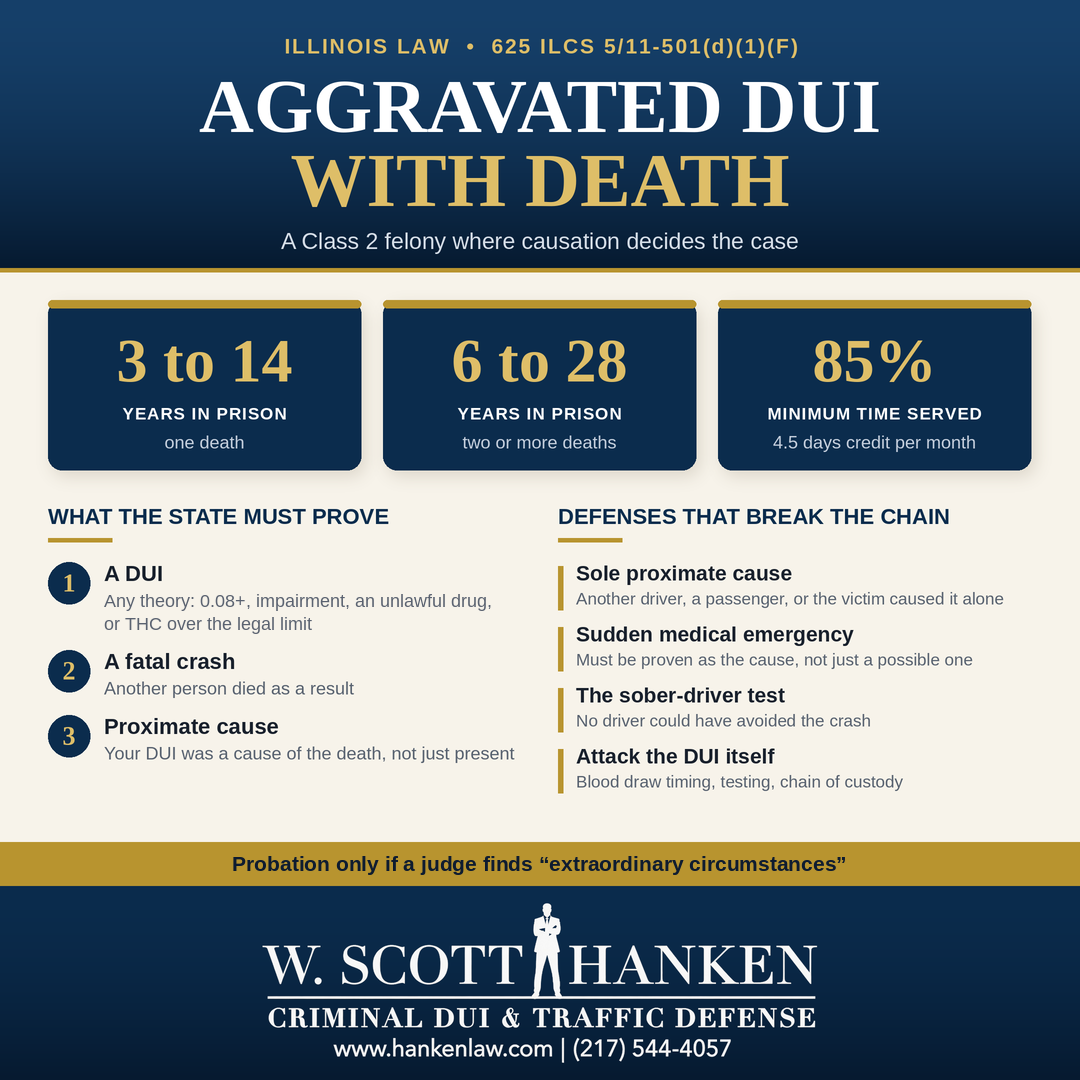
In Illinois, aggravated DUI with death is a Class 2 felony carrying 3 to 14 years in prison, served at 85 percent, with probation only in extraordinary circumstances. The State must prove the DUI violation was a proximate cause of the death, and causation is where most defenses are fought.
Bottom Line: A blood result alone does not convict you of this offense. The State has to connect your DUI to the death. Who else was at fault, what a sober driver could have done in the same few seconds, and which subsection of the DUI statute the State charged can decide whether you face 3 to 14 years in prison or a Class A misdemeanor.
Key Takeaways:
- The offense: a DUI, a crash that kills another person, and proof the DUI was a proximate cause of the death (625 ILCS 5/11-501(d)(1)(F)).
- The penalty: a Class 2 felony with 3 to 14 years in prison for one death and 6 to 28 years for two or more; probation only if the judge finds extraordinary circumstances.
- Time served: at least 85 percent of the sentence, because sentence credit is capped at 4.5 days per month.
- The core defense: proximate cause. If something else was the sole cause, or a sober driver could not have avoided the crash, the felony fails.
- The charge matters: per se charges (a 0.08 or higher BAC, or “any amount” of an unlawful drug) only require a link between your driving and the death; impairment-based charges open the door to the sober-driver test.
Facing charges or an investigation after a fatal crash in Sangamon County? Call (217) 544-4057 before you give any statement.
What Is Aggravated DUI With Death in Illinois?
Aggravated DUI with death under 625 ILCS 5/11-501(d)(1)(F) is an ordinary DUI that becomes a Class 2 felony when the DUI is a proximate cause of another person’s death. It carries 3 to 14 years in prison when one person dies and requires the State to prove causation, not just intoxication.
Illinois does not have a separate “DUI homicide” statute. Instead, the offense is built on top of the misdemeanor DUI statute. If you commit any form of DUI under section 11-501(a), and that violation is a proximate cause of a fatal crash, subsection (d)(1)(F) converts the case into aggravated DUI.
In Sangamon County, these cases are filed as felonies in the Sangamon County Circuit Court, which sits in the Sangamon County Complex at 200 South Ninth Street in Springfield. The crash itself is usually reconstructed before charges are filed. Depending on where the crash happens, the lead agency may be a local police department, the sheriff’s office, or the Illinois State Police. ISP’s Statewide Traffic Crash Reconstruction Unit responds on scene to fatal and life-threatening crashes, including at the request of local agencies. Whoever does the reconstruction, that report becomes the backbone of the State’s causation case.
Statute Callout — 625 ILCS 5/11-501(d)(1)(F): A person is guilty of aggravated DUI if “the person, in committing a violation of subsection (a), was involved in a motor vehicle crash or snowmobile, all-terrain vehicle, or watercraft accident that resulted in the death of another person, when the violation of subsection (a) was a proximate cause of the death.” Section 11-501 was last amended by P.A. 102-982, effective July 1, 2023.
What Does the State Have to Prove for Aggravated DUI With Death?
The State must prove three things beyond a reasonable doubt: you committed a DUI, you were involved in a crash that killed someone, and your DUI violation was a proximate cause of the death.
The first element can be proven under any of the seven DUI theories in section 11-501(a):
- (a)(1): alcohol concentration of 0.08 or more
- (a)(2): under the influence of alcohol
- (a)(3): under the influence of an intoxicating compound to a degree that renders you incapable of driving safely
- (a)(4): under the influence of any other drug to a degree that renders you incapable of safely driving
- (a)(5): under the combined influence of alcohol, drugs, or compounds to that same degree
- (a)(6): any amount of a drug resulting from unlawful use of a controlled substance, an intoxicating compound, or methamphetamine
- (a)(7): a THC concentration in whole blood or other bodily substance, within 2 hours of driving, at the level defined in section 11-501.2
Notice what is missing from the list: intent, recklessness, or carelessness. The State does not have to prove you drove badly in the way a reckless homicide charge requires. In People v. Merritt, 343 Ill. App. 3d 442 (4th Dist. 2003), a McLean County judge acquitted a driver of reckless homicide for striking a jogger, yet convicted her of aggravated DUI on the same facts, and the Fourth District affirmed. (The aggravated count in Merritt was charged under the great-bodily-harm subsection, (d)(1)(C), even though the jogger died; the causation rule is the same.) Sangamon County appeals go to that same Fourth District, which makes Merritt directly relevant to cases filed in Springfield.
What Is the Penalty for Aggravated DUI Causing Death in Illinois?
One death carries 3 to 14 years in the Illinois Department of Corrections; two or more deaths carry 6 to 28 years. Both are Class 2 felonies, and the law presumes prison.
The statute reverses the normal rule. For most Class 2 felonies, probation is available. Under section 11-501(d)(2)(G), the judge must impose prison “unless the court determines that extraordinary circumstances exist and require probation.” Even then, section 11-501(d)(3) requires a minimum of 480 hours of community service or 10 days in jail as a condition.
| Situation | Classification | Prison range | Probation? |
|---|---|---|---|
| DUI was a proximate cause of one death | Class 2 felony | 3 to 14 years | Only if extraordinary circumstances |
| DUI was a proximate cause of two or more deaths | Class 2 felony | 6 to 28 years | Only if extraordinary circumstances |
| New DUI after a prior aggravated DUI death or great-bodily-harm conviction, or a prior DUI-based reckless homicide | Class 3 felony under (d)(1)(D), (d)(2)(J) | Class 3 range | Not available |
| DUI proven, but causation fails (first or second DUI, no other aggravating factor) | Class A misdemeanor | Up to 364 days | Available |
How much of the sentence is actually served? Under 730 ILCS 5/3-6-3(a)(2.3), a person serving a sentence for aggravated DUI under (d)(1)(F) receives no more than 4.5 days of sentence credit per month, which works out to roughly 85 percent of the sentence. Paragraph (4.7) of the same section permits some program credit but never below 85 percent. A 6-year sentence means about 5 years and 1 month in custody. A 14-year sentence means nearly 12.
What happens to your license? Any conviction under section 11-501 triggers mandatory revocation under 625 ILCS 5/6-205(a)(2), last amended by P.A. 102-982, effective July 1, 2023. Restoring driving privileges after an aggravated DUI death conviction requires a formal Secretary of State hearing years down the road. Before any conviction, the DUI arrest itself can also trigger a statutory summary suspension; our Statutory Summary Suspension articles explain how that separate proceeding works.
Can You Get Probation for a DUI That Kills Someone in Illinois?
Yes, but only if the judge finds extraordinary circumstances that require it, and that is a narrow door.
The statute does not define “extraordinary circumstances.” That leaves the judge to weigh the facts of the crash, the degree of fault, the defendant’s history, and what the evidence showed about causation. A case where causation was close, where the victim shared substantial fault, or where the intoxication evidence was thin is in a very different posture at sentencing than a high-BAC, wrong-way crash.
The mitigation that carries weight at an Illinois sentencing hearing is what you would expect: no prior criminal or DUI record, a crash where causation was genuinely close, substantial fault on the part of another driver or the victim, prompt acceptance of responsibility, completed alcohol or drug treatment, and a documented record of steady work, family obligations, and community ties. None of these guarantees probation. Presented together, with evidence rather than argument, they are what a judge needs before finding the circumstances extraordinary.
What Does “Proximate Cause” Mean in an Illinois Aggravated DUI Case?
Proximate cause means your DUI was a cause that, in a natural or probable sequence, produced the death. It does not have to be the only cause or the last cause.
Illinois juries in these cases receive Illinois Pattern Jury Instruction, Criminal, No. 23.28A. It tells jurors a proximate cause “need not be the only cause, nor the last or nearest cause,” and that it is enough if it combines with another cause acting at the same time. The Illinois Supreme Court has held that civil proximate cause principles apply in criminal cases, including foreseeability. People v. Hudson, 222 Ill. 2d 392 (2006).
The Fourth District applied those rules in a Sangamon County case, People v. Cook, 2011 IL App (4th) 090875, and held the pattern instruction adequately covers foreseeability. In practice, that standard is why the “other driver caused it” defense, standing alone, rarely wins. The question is never “who caused this?” It is “was my client’s DUI one of the causes?”
Does the State Have to Prove Your Intoxication Caused the Crash?
It depends on which DUI subsection the State charged. For per se charges, a BAC of 0.08 or more under (a)(1) or “any amount” of an unlawful drug under (a)(6), no: the Illinois Supreme Court treats impairment as not an element of those offenses. For impairment-based charges, the evidence of impairment and its effect on your driving becomes the battleground.
This is the most misunderstood point in aggravated DUI law, and it is where the charging decision quietly shapes the whole defense.
Does the State have to prove I was impaired if I had drugs in my system?
No, not if the State charges the “any amount” theory under (a)(6). The State only has to link your driving to the death, which is why the drug charge you face matters as much as the drug in your system.
In People v. Martin, 2011 IL 109102, 955 N.E.2d 1058, the defendant’s car crossed the center line in Peoria County and killed two people. His blood showed no alcohol or controlled substances; his urine showed methamphetamine, and no one could say when he last used it. The appellate court reversed, reasoning that a trace in urine proved nothing about the crash. The Illinois Supreme Court reinstated the conviction. When the charge rests on (a)(6), the court held, the statute requires “a causal link only between the physical act of driving and another person’s death.” Impairment is not an element. The Supreme Court reaffirmed that reading in People v. Way, 2017 IL 120023, 89 N.E.3d 355, a serious-injury case charged under the parallel great-bodily-harm subsection.
Impairment-based charges are different in practice. When the State proceeds under (a)(2), (a)(4), or (a)(5), it must prove you were actually under the influence. The reported Fourth District cases show how causation is then argued: by asking whether a sober driver would have avoided the crash. In Merritt, the court pointed out that another southbound driver with the same view saw the jogger and slowed down, while witnesses saw no braking or evasive action from the impaired defendant. In Cook, the court held a jury could find a sober driver would have reacted sooner to a trooper’s oncoming emergency lights.
What this means for your defense. Call it the sober-driver test. If credible reconstruction evidence shows that a completely sober, attentive driver in your position could not have avoided the collision, the State’s causation theory weakens sharply on an impairment-based count. Expect the State to answer by adding or relying on per se counts, which is why the specific counts in the charging document matter from the first day.
Cannabis is no longer an “any amount” drug. The current (a)(6) covers controlled substances, intoxicating compounds, and methamphetamine. Cannabis is handled separately under (a)(7), which requires a THC concentration of 5 nanograms or more per milliliter of whole blood (or 10 nanograms per milliliter of another bodily substance) within 2 hours of driving, and under (a)(4) or (a)(5), which require proof of impairment. Way itself involved a cannabis metabolite under the pre-2016 “any amount” version of the statute, a theory Public Act 99-697 eliminated effective July 29, 2016. Keep in mind that (a)(7) is still a per se count. The statute does not make impairment an element, so if the State can prove the THC level, the fight shifts to the timing, collection, and accuracy of the blood test. Registered medical cannabis patients are exempt from (a)(7) unless they were impaired. For more on how cannabis DUI blood evidence is gathered, see Illinois Cannabis DUI: Trooper Blood Draws and Medical Cards.
What Defenses Can Break the Link Between Intoxication and the Death?
The strongest defenses either defeat the underlying DUI or show that something other than your DUI was the sole cause of the death.
- Sole proximate cause. If another driver, a passenger, the victim, or a sudden event was the only cause, the State’s case fails. In Way, the Illinois Supreme Court recognized sole proximate cause as an affirmative defense to aggravated DUI (there, based on a sudden medical condition) and placed the burden of establishing it on the defendant. “Sole” means sole.
- Unavoidable collision. Accident reconstruction, event data recorder (“black box”) downloads, sightlines, lighting, and perception-reaction timing can show a sober driver had no chance to avoid the crash.
- Attacking the DUI itself. If the State cannot prove the underlying DUI, there is no aggravated DUI. Blood draw timing, the legal basis for the draw, hospital serum results versus whole blood, retrograde extrapolation, and chain of custody all matter. Our DUI Defense page covers these in depth.
- Charging errors and multiplicity. Prosecutors often file several aggravated DUI counts for one death. Under the one-act, one-crime rule, only one conviction can stand for a single act of driving and a single death. Cook vacated two of three 14-year convictions on that basis.
What if the other driver caused the crash?
Another driver running a light or crossing the center line helps only if that driver’s conduct was the sole cause; if your DUI was also a cause, you can still be convicted.
Cook is the clearest example, and it happened in Sangamon County. A drunk driver swerved into the path of a state trooper, sending the trooper’s car spinning into the defendant’s lane. The defendant argued the first driver’s conduct was a superseding cause. The Fourth District disagreed, holding the jury could find a sober driver would have reacted to the emergency lights before the first collision. The defense lesson is concrete: reconstruct the entire timeline, not just the final seconds. The State will measure your reaction time from the earliest moment a sober driver would have perceived danger.
What if a passenger suddenly grabbed the steering wheel?
A passenger’s sudden, unforeseeable seizure of the wheel can be the sole proximate cause of the crash, which is a complete defense. You must be able to prove it happened, and that no driver, sober or not, could have prevented it.
This is not a classroom hypothetical. I have defended a case in which a backseat passenger, without any warning, jumped forward over my client, grabbed the steering wheel, and pulled the car into a collision with another vehicle. In a DUI case, the instinct is to focus on the blood or breath result. In that case, the decisive question was a different one: who was steering the car when it left its lane?
The rule. The State must still prove the driver’s DUI violation was a proximate cause. When an independent act of a third person intervenes, the question becomes whether that act was the sole proximate cause. Cook confirms that courts analyze another person’s conduct as a possible intervening or superseding cause. In Way, the Illinois Supreme Court recognized an affirmative defense that a collision was caused solely by a sudden, unforeseeable event beyond the driver’s control (there, a medical condition), even on an “any amount” charge under (a)(6). It placed the burden of establishing sole proximate cause on the defendant. Applying that defense to a passenger’s act builds on the same proximate cause principles.
Why this fact pattern is stronger than most. Martin describes the required link as one between “the physical act of driving” and the death. When a passenger wrenches the wheel, the physical act that sends the car into another vehicle is the passenger’s, not the driver’s. A sudden lunge from the back seat is also hard to call a “natural or probable” consequence of driving after drinking, which is the foreseeability standard built into IPI Criminal 23.28A and Hudson. I am not aware of a published Illinois decision applying these principles to a passenger who grabbed the wheel, so this defense is built from settled rules rather than a reported holding.
Where the State will attack. Prosecutors will use the Cook playbook and ask whether a sober driver would have seen it coming, or recovered control in time.
- Warning signs. Had the passenger been arguing, grabbing at the wheel earlier, or acting erratically? If so, the State will argue a sober driver would have pulled over and ended the ride, making the lunge foreseeable rather than sudden.
- Speed. If the driver was speeding, the State will argue a sober driver at a lawful speed could have corrected after the wheel was released, making the DUI a concurring cause.
- Reaction. Did the driver brake or counter-steer? An impaired driver who never reacted invites the argument that a sober one would have.
How the defense proves it. This defense lives or dies on evidence gathered in the first days:
- Statements from every occupant, taken early. The passenger who grabbed the wheel has every reason to deny it, and any other occupant may be the only independent witness.
- Occupant positions after impact and injury patterns consistent with someone reaching over the driver.
- The event data recorder download: pre-crash speed and braking, and on some vehicles steering input, showing normal driving until an abrupt change.
- Dashcam footage, phone videos taken inside the car, and 911 calls.
- A reconstruction expert who can address whether any driver could have regained control in the time available.
What if the person who died was also at fault?
The victim’s own negligence is not a defense unless it was the sole proximate cause of the death.
Merritt holds that a victim’s conduct can be a proximate cause of his own death without defeating the charge, because the statute requires the DUI to be “a” proximate cause, not the sole and immediate cause. The jogger in Merritt stepped into traffic in the dark wearing headphones. The conviction stood because the evidence showed an attentive driver had time to see him enter the roadway and react, and the impaired defendant did not. Where the evidence instead shows a pedestrian or driver appeared so suddenly that no driver could react, the sole proximate cause defense becomes real.
What if I had a medical emergency or my vehicle failed?
A sudden, unforeseeable medical event can be a complete defense, but only with medical proof that it was the sole cause of the crash.
In Way, the defendant sought to show that her low blood pressure caused her to lose consciousness just before the crash. The Illinois Supreme Court held a driver may raise the sole proximate cause defense based on a sudden, unforeseeable medical condition, even on an “any amount” charge. She still lost, because her doctor could only say the condition was a “possible” cause. The evidence has to establish the condition as the cause, and the only cause, not merely a possibility. The same reasoning, borrowed from civil “act of God” principles, supports an argument based on a sudden mechanical failure such as a tire blowout or brake loss, though I am not aware of a published Illinois aggravated DUI decision applying it to a mechanical failure. Preserve the vehicle immediately.
What if the only drug in my system was a trace from days earlier?
Under an (a)(6) charge, a trace amount from unlawful use can still support the felony if your driving was a proximate cause of the death.
That is Martin’s holding, and it is harsh. It also has limits. The State must still prove the drug resulted from unlawful use of a substance covered by (a)(6), that the substance was in your system while driving, and that your driving, not merely your presence at the scene, caused the death. Lawful prescriptions, cannabis, and lab reliability are all fertile ground.
What if my BAC was under 0.08?
You can still be charged under (a)(2), driving under the influence of alcohol, but the State must prove actual impairment and that the impaired driving was a proximate cause.
A sub-0.08 case removes the per se count and puts the State to its proof on impairment. That is also where the sober-driver test does the most work: if the officer’s impairment observations are thin and reconstruction shows the crash was unavoidable, causation becomes a genuine jury question.
Need a defense built around causation, not just the blood test? Call (217) 544-4057 to speak with W. Scott Hanken, Attorney at Law.
What Has Aggravated DUI With Death Looked Like in Sangamon County?
Sangamon County has produced one of the leading Illinois appellate decisions on causation in aggravated DUI, and a local death is behind a pending bill to raise penalties.
People v. Cook (Sangamon County No. 07-CF-1314). At about 2:40 a.m. on October 28, 2007, a fight broke out at a bar outside Illiopolis. Illinois State Police Trooper Brian McMillen responded on Dye Road, a two-lane, 55 mph road south of I-72. One impaired driver swerved into the trooper’s path; the trooper’s car spun into the defendant’s lane, and the defendant’s car struck it. The defendant’s BAC was estimated at 0.109 to 0.119. He received 14 years, the maximum for one death. On appeal, his reconstruction expert’s point that only 1.23 seconds separated the two collisions did not carry the day, because the jury could measure his reaction time from before the first impact.
How these cases are typically charged. Cook also shows the charging pattern to expect. The State filed 11 counts against one driver for one death: five aggravated DUI counts built on five different DUI subsections, additional aggravated counts for driving uninsured and without a license, and traffic offenses including failure to yield to an emergency vehicle. Stacking counts this way gives the prosecution several routes to a conviction, including per se counts that sidestep the impairment question entirely. The first defense task is mapping every count to the evidence behind it, identifying which counts are vulnerable on causation and which will collapse under the one-act, one-crime rule if the State wins on more than one.
Lindsey’s Law (SB 3124). Lindsey Sharp, 26, was struck by an impaired driver in a Springfield Walmart parking lot in 2015 and died the next day. Senator Steve McClure of Springfield has repeatedly introduced “Lindsey’s Law.” It would create a 4 to 20 year range when a crash kills one person and causes great bodily harm, permanent disability, or disfigurement to others. The current version, SB 3124, was filed February 2, 2026. As of October 2026, the General Assembly’s bill status page showed no action after the bill was assigned to the Senate Criminal Law Committee on February 10, 2026. It is not law. If it passes, it will not apply to crashes that occurred before its effective date.
What Should You Do If You’re Under Investigation After a Fatal Crash in Springfield?
Say nothing about drinking, drugs, or fault, and get a defense lawyer involved before evidence disappears.
- Do not give a statement to police, hospital staff, or insurance adjusters about what you drank, took, or saw. Statements made at a hospital bedside are routinely used at trial.
- Preserve the vehicle. Event data recorder information can show speed, braking, and throttle in the seconds before impact. Once a car is salvaged, that evidence may be gone.
- Identify witnesses inside the car. Passengers’ accounts change over time. Get their names and contact information to your lawyer immediately.
- Identify video. Dashcams, business surveillance, traffic cameras, and doorbell cameras near the scene are often overwritten within days.
- Collect medical records, especially if a medical event, a prescription, or the timing of a blood draw is in question.
- Retain an independent reconstructionist early. The State’s reconstruction will frame the sober-driver comparison. Yours needs to be ready to answer it.
For an overview of the full range of DUI penalties in Illinois, see our DUI Penalties articles.
Frequently Asked Questions (FAQs)
No. Reckless homicide requires proof that you consciously disregarded a substantial risk. Aggravated DUI with death requires only a DUI that was a proximate cause of a death. In Merritt, the same driver was acquitted of reckless homicide and convicted of aggravated DUI on identical facts.
Only if the judge finds extraordinary circumstances that require probation. The statute otherwise mandates 3 to 14 years in prison for one death. Probation, if granted, still carries at least 480 hours of community service or 10 days in jail.
About 85 percent. Sentence credit is capped at 4.5 days per month under 730 ILCS 5/3-6-3(a)(2.3), so a 3-year sentence means roughly 2 years and 7 months in custody.
Not if the charge is under (a)(6). The Illinois Supreme Court held in Martin that the State need only link your driving to the death. That “any amount” rule does not apply to cannabis-only cases. Those proceed under (a)(7), which requires proof of a THC concentration at or above the legal limit within 2 hours of driving, or under (a)(4) or (a)(5), which require proof of impairment.
Their intoxication does not automatically clear you. In Cook, a Sangamon County case, another impaired driver triggered the crash, and the conviction stood because a jury could find a sober driver would have reacted in time. Your defense must show the collision was unavoidable for any driver.
Not if the passenger’s sudden act was the sole proximate cause of the crash. Way recognizes sole proximate cause as an affirmative defense to aggravated DUI, and you carry the burden of establishing it. Expect the State to argue that earlier warning signs, speed, or a slow reaction made your DUI a contributing cause.
A fatal crash in Springfield or elsewhere in Sangamon County is filed as a felony in the Sangamon County Circuit Court in Springfield. Appeals go to the Fourth District Appellate Court, which decided both Cook and Merritt.
A bill called Lindsey’s Law, SB 3124, would add a 4 to 20 year range for crashes that kill one person and seriously injure others. As of October 2026, it had not advanced out of the Senate committee process and is not law.
Further Reading
Practice Area
Related Articles
- DUI Dismissal in Illinois: What Actually Gets Cases Dropped — If the underlying DUI falls, the felony falls with it; start here.
- Is a DUI on a Suspended License a Felony in Illinois After People v. Aguilar? — The State often stacks license-based aggravating counts alongside the death count.
- Falling Asleep at the Wheel: Illinois Criminal Charges — For fatal crashes where fatigue, not intoxication, is the State’s theory.
- The Ultimate Guide to DUI Defense in Sangamon County — How the local DUI case is built and attacked, start to finish.
Browse by Topic
Ready to Fight Your DUI Charge in Springfield?
Call W. Scott Hanken at (217) 544-4057 or contact us online for a free consultation. We serve clients throughout Springfield, Sangamon County, and Central Illinois.
About the Author: W. Scott Hanken, Attorney at Law
Scott Hanken is a Springfield, Illinois criminal defense attorney with over 37 years of experience, including service as a former Sangamon County prosecutor. He has been voted Best Attorney by the Illinois Times and State Journal-Register, holds an Avvo 10.0 “Superb” rating, and has earned over 270 five-star Google reviews. He serves clients throughout Sangamon County and Central Illinois.
📍 1100 S 5th St, Springfield, IL 62703 | ☎ (217) 544-4057 | 🌐 hankenlaw.com
This article is for general educational purposes only and does not constitute legal advice. Every case is unique — contact an experienced Springfield criminal defense attorney for guidance on your specific situation.

Address
Our offices are located at the corner of South Fifth Street and Vine, in the historic Mary Bryant Home for the Blind.