

I Am a Former Prosecutor Who Will Fight for Your Rights














Illinois Traffic Ticket Fines: Complete Fine Guide
Last reviewed and updated: November 2026
Illinois Traffic Ticket Fines at a Glance
Most Illinois traffic tickets are petty offenses carrying a fine of up to $1,000. Paying by mail under Supreme Court Rule 529 costs a flat $164, a ticket resolved in court costs the fine plus a $226 assessment, and speeding 26 mph or more over the limit is a criminal misdemeanor.
If you got a ticket in Springfield or anywhere in Sangamon County, two numbers make up almost every bill. The first is the fine, set by the Vehicle Code and the judge. The second is the assessment, a fixed court cost set by the Criminal and Traffic Assessment Act, 705 ILCS 135. The assessment depends on the type of offense, not the county, so the base figures on this page apply statewide.
Some violations carry mandatory minimum fines that a judge cannot reduce: school zones, work zones, passing a stopped school bus, and Scott’s Law. Others, like aggravated speeding, are criminal charges with jail exposure and a permanent record. Whether court supervision is available often matters more than the fine itself, because supervision keeps a moving violation off your driving record as a conviction.
Local costs note: The fines and assessments on this page are statewide figures. Conditional assessments, traffic safety school fees, and payment-plan or late fees vary by case and county. Confirm the current amount for a specific ticket with the Sangamon County Circuit Clerk.
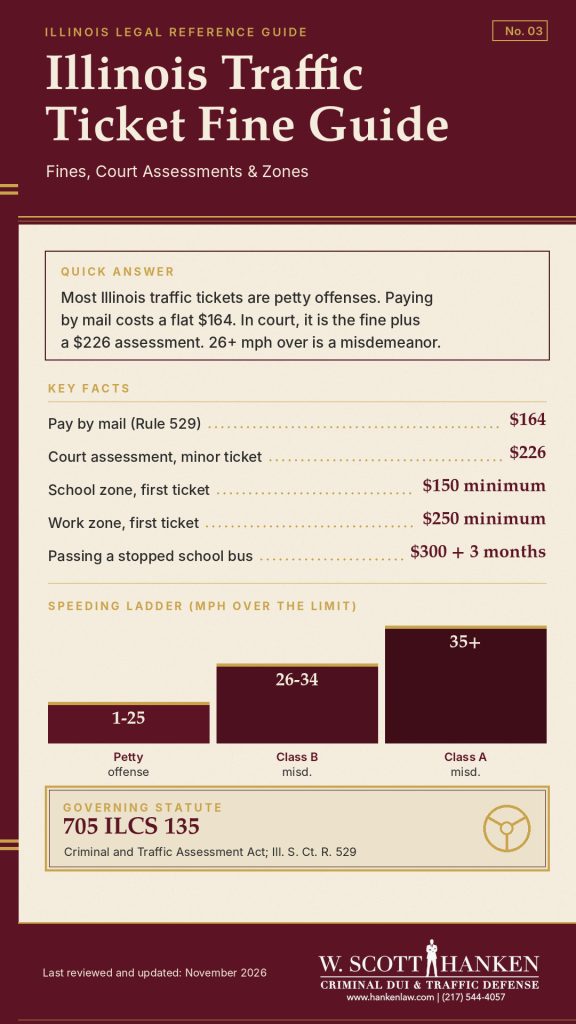
Key Facts: Illinois Traffic Fines at a Glance
| Question | Answer | Authority |
|---|---|---|
| Default classification of a Vehicle Code violation | Petty offense (third within one year: Class C misdemeanor) | 625 ILCS 5/16-104 |
| Maximum petty offense fine | $1,000, unless the offense specifies less | 730 ILCS 5/5-4.5-75(a) |
| Minimum fine, minor traffic offense | $25, unless otherwise specified | 705 ILCS 135/5-5 |
| Pay-by-mail amount (written guilty plea) | $164 (Schedule 12), with no other fines or costs | Ill. S. Ct. R. 529; 705 ILCS 135/15-60 |
| Court assessment, minor traffic offense | $226 (Schedule 10) | 705 ILCS 135/15-50 |
| Court assessment, major traffic offense | $325 (Schedule 9) | 705 ILCS 135/15-45 |
| Speeding 26 to 34 mph over | Class B misdemeanor | 625 ILCS 5/11-601.5(a) |
| Speeding 35 mph or more over | Class A misdemeanor | 625 ILCS 5/11-601.5(b) |
| School zone speeding minimum fine | $150 first, $300 second | 625 ILCS 5/11-605(e) |
| Passing a stopped school bus | $300 fine and 3-month suspension (first) | 625 ILCS 5/11-1414 |
| Scott’s Law fine range | $250 to $10,000 (first) | 625 ILCS 5/11-907(d) |
| Three moving violations in 12 months | Grounds for suspension or revocation | 625 ILCS 5/6-206(a)(2) |
| Typical Sangamon County supervision fine, simple petty ticket | $255 | Local practice |
A Former Prosecutor on Your Side
A traffic ticket looks small until it costs you your license or leaves a criminal record.
W. Scott Hanken spent years as a Sangamon County prosecutor before turning to defense, and he has 37+ years of experience in Illinois courtrooms. He knows how traffic cases are negotiated in Sangamon County, when supervision is realistic, and when a ticket is worth fighting. He has been voted “Best Attorney” by the Illinois Times and the State Journal-Register, holds an Avvo 10.0 “Superb” rating, and has earned 270+ five-star Google reviews. His office is at 1100 S. 5th St. in Springfield.
How Illinois Classifies Traffic Offenses
Every Vehicle Code violation falls into one of four categories, and the category controls the maximum fine, whether jail is possible, and which assessment schedule applies.
| Category | Jail possible? | Maximum fine | Examples | Assessment |
|---|---|---|---|---|
| Petty offense | No | $1,000 (or less if the offense says so) | Speeding 1 to 25 mph over, most moving violations, school and work zone speeding, first or second uninsured vehicle | Schedule 10: $226 |
| Business offense | No | Amount the statute sets | Scott’s Law (no damage or injury), third or later uninsured vehicle | Schedule 10: $226 |
| Class B or C misdemeanor | Up to 6 months (B) or 30 days (C) | $1,500 | Speeding 26 to 34 mph over; third Vehicle Code conviction within one year | Schedule 9: $325 |
| Class A misdemeanor | Up to 364 days | $2,500 | Speeding 35+ mph over; Scott’s Law with vehicle damage | Schedule 9: $325 |
Under 705 ILCS 135/1-5, a “minor traffic offense” is a petty or business offense, and anything higher is a “major traffic offense.” Under 625 ILCS 5/16-104, any Vehicle Code violation without its own penalty is a petty offense for a first or second conviction, and a Class C misdemeanor for a third or subsequent conviction within one year of the first.
Fines for Common Illinois Traffic Tickets
The fine depends on the violation, and several violations carry mandatory minimums a judge cannot reduce.
| Violation | Statute | Classification | Fine | License consequence |
|---|---|---|---|---|
| Speeding 1 to 25 mph over | 11-601 | Petty offense | $25 minimum, up to $1,000 | Counts toward 3-in-12-months suspension |
| Speeding 26 to 34 mph over | 11-601.5(a) | Class B misdemeanor | Up to $1,500; up to 6 months jail | Counts toward suspension |
| Speeding 35+ mph over | 11-601.5(b) | Class A misdemeanor | Up to $2,500; up to 364 days jail | Counts toward suspension |
| School zone speeding (20 mph limit, school days 6:30 a.m. to 4 p.m., children present) | 11-605(e) | Petty offense | $150 minimum first; $300 minimum second; plus community service | Counts toward suspension |
| School zone, 26 to 34 mph over | 11-605(e-5)(1) | Class B misdemeanor | Up to $1,500 | Counts toward suspension |
| School zone, 35+ mph over | 11-605(e-5)(2) | Class A misdemeanor | Up to $2,500 | Counts toward suspension |
| Work zone speeding | 11-605.1(d) | Petty offense | $250 minimum first; $750 minimum second; plus $250 conditional assessment | 90 days for a second violation within 2 years, if workers were present both times |
| Work zone, 26 to 34 mph over | 11-605.1(d-5)(1) | Class B misdemeanor | Up to $1,500 | Same as above |
| Work zone, 35+ mph over | 11-605.1(d-5)(2) | Class A misdemeanor | Up to $2,500 | Same as above |
| Passing a stopped school bus | 11-1414 | Petty offense | $300 mandatory first; $1,000 second; plus community service | 3 months (first); 1 year (second within 5 years) |
| Scott’s Law (move over), including failing to yield to emergency workers at a scene | 11-907(c), (c-5), (c-10), (d) | Business offense | $250 to $10,000 first; $750 to $10,000 second | 90 days to 1 year with property damage; 180 days to 2 years with injury; 2 years with death |
| Scott’s Law causing damage to another vehicle | 11-907(d) | Class A misdemeanor | Up to $2,500 | As above |
| Scott’s Law causing injury or death | 11-907(d) | Class 4 felony | Up to $25,000 | As above |
| Hand-held phone or device while driving | 12-610.2(c) | Moving violation | Maximum $75 first, $100 second, $125 third, $150 fourth or later | Counts toward suspension |
| Device use causing great bodily harm (aggravated) | 12-610.2(b-5), (c) | Class A misdemeanor (Class 4 felony if death results) | $1,000 minimum | Suspension |
| Operating an uninsured vehicle | 3-707(c) | Petty offense (business offense on a third or later violation) | More than $500, up to $1,000; $1,000 for a third or later violation | 3-month suspension plus $100 reinstatement fee |
| Uninsured vehicle causing bodily harm | 3-707(a-5), (a-6) | Class A misdemeanor | Up to $2,500; $2,500 mandatory with two or more priors | 3-month suspension |
625 ILCS 5/11-1414: Any person convicted of violating this Section or a similar provision of a local ordinance shall be subject to a mandatory fine of $300 or, upon a second or subsequent violation, $1,000, and community service in an amount set by the court.
What Court Assessments Add to a Traffic Fine
Only one schedule assessment applies per case, based on the highest-classified offense being sentenced, plus any applicable conditional assessments under 705 ILCS 135/5-10.
| How the ticket is resolved | Assessment | Total cost |
|---|---|---|
| Written guilty plea by mail or online (Rule 529) | Schedule 12: $164 | $164, with no other fines, fees, or costs |
| Minor traffic offense resolved in court | Schedule 10: $226 | Fine plus $226, plus any conditional assessments |
| Major traffic offense (misdemeanor) resolved in court | Schedule 9: $325 | Fine plus $325, plus any conditional assessments |
| Work zone speeding | Conditional: $250 | Added to the schedule assessment |
| Scott’s Law violation | Conditional: $250 | Added to the schedule assessment |
The schedules are set by 705 ILCS 135/15-60 (Schedule 12), 705 ILCS 135/15-50 (Schedule 10), and 705 ILCS 135/15-45 (Schedule 9). Conditional assessments are in 705 ILCS 135/15-70.
What does a ticket actually cost?
| Scenario | Fine | Assessment | Total before local costs |
|---|---|---|---|
| Speeding 15 over, paid by mail under Rule 529 | Included | $164 | $164 |
| Speeding 15 over, resolved in court with a $50 fine | $50 | $226 | $276 |
| First work zone ticket, resolved in court | $250 minimum | $226 + $250 conditional | $726 minimum |
What Traffic Tickets Typically Cost in Sangamon County
The figures above are statewide, and local practice adds the real-world number.
In Scott Hanken’s experience, simple petty traffic violations in Sangamon County typically carry a fine of $255 for court supervision. Higher speeds can raise that to $280 and $402. For Scott’s Law violations, Sangamon County practice typically involves a fine of $735. These are typical amounts, not fixed rates; the final figure depends on the charge, the driver’s record, and the judge.
| Sangamon County ticket type | Typical amount with supervision |
|---|---|
| Simple petty traffic violation | $255 |
| Higher-speed violations | $280 to $402 |
| Scott’s Law violation | $735 |
How Traffic Tickets Affect Your Illinois Driver’s License
Three moving violation convictions within any 12 months give the Secretary of State grounds to suspend or revoke your license under 625 ILCS 5/6-206(a)(2).
| Trigger | Consequence | Authority |
|---|---|---|
| Three moving violation convictions within any 12 months | Discretionary suspension or revocation by the Secretary of State | 625 ILCS 5/6-206(a)(2) |
| Passing a stopped school bus | 3 months (first); 1 year (second within 5 years) | 625 ILCS 5/11-1414 |
| Scott’s Law with damage, injury, or death | 90 days to 2 years | 625 ILCS 5/11-907(e) to (g) |
| Operating an uninsured vehicle | 3 months, plus $100 reinstatement fee; 6 more months if caught driving uninsured during that suspension | 625 ILCS 5/3-707(c-1) |
| Second work zone violation within 2 years, workers present both times | 90 days | 625 ILCS 5/11-605.1(g) |
| Speeding 26+ mph over in a commercial vehicle | “Serious traffic violation” for CDL disqualification | 625 ILCS 5/1-187.001 |
Court supervision is not a conviction, so a completed supervision does not count toward the three-in-twelve-months rule. That is the main reason supervision matters on an ordinary speeding ticket.
In Scott Hanken’s experience, the great majority of driving while suspended or revoked cases come from not dealing with minor offenses or not maintaining insurance. Clients are often caught off guard at the stop because they failed to keep their address updated with the Secretary of State, so notices were never received or went unread. An unpaid or ignored ticket can become a suspension, and a suspension can become a criminal charge.
Court Supervision on a Traffic Ticket
Supervision is available for most petty traffic offenses, but several traffic situations bar it outright under 730 ILCS 5/5-6-1.
Under Rule 529(b), counties designated by the Conference of Chief Circuit Judges may also allow supervision by mail, with or without a traffic safety program.
| Situation | Supervision available? | Subsection |
|---|---|---|
| Ordinary speeding or moving violation, no recent supervisions | Yes, at the court’s discretion | 5-6-1(c) |
| Two supervisions for moving violations in the 12 months before this arrest | No | 5-6-1(k) |
| Speeding 26+ mph over in an urban district | No | 5-6-1(q) |
| Prior conviction or supervision for aggravated speeding (11-601.5) | No | 5-6-1(p) |
| School zone speeding (11-605) or passing a stopped school bus (11-1414) | No | 5-6-1(f) |
| Scott’s Law charged as a Class A misdemeanor | No | 5-6-1(f) |
| Uninsured vehicle, with a prior supervision for the same offense | No | 5-6-1(i) |
| Driver under 21, serious traffic offense or moving violation | Only after completing a traffic safety program | 5-6-1(h), (h-1) |
| Driver under 18 | Only with a personal court appearance and written parent or guardian consent | 5-6-1(n) |
| Violation that caused a death, with a prior non-equipment violation or suspension on the abstract | No | 5-6-1(r) |
What if I was going 26 or more over the limit? Aggravated speeding is a criminal charge, not a ticket. Outside an urban district, and with no prior aggravated speeding, supervision remains possible. Inside an urban district, 5-6-1(q) bars it.
Sangamon County’s typical initial offer for aggravated speeding involves a conviction. In Scott Hanken’s experience, proving mitigating circumstances and the impact on a client’s livelihood is often what decides between a conviction and court supervision. Where the State will not agree to supervision, experienced local counsel can work through a 402 conference before the judge. For work zone cases, see Illinois Work Zone Speeding Penalties.
What if I had insurance but could not show it at the stop? Under 625 ILCS 5/3-707, no person charged with operating an uninsured vehicle may be convicted if they produce satisfactory evidence in court that the vehicle was insured at the time of the stop. Bring the declarations page showing the policy dates, not just a current card.
Even if coverage had lapsed at the time of the stop, 3-707(c-5) gives a first-time offender who shows coverage as of the court date a $100 fine and court supervision, as long as coverage stays in force for the entire supervision period.
What if I already had two supervisions this year? A third supervision for a moving violation within 12 months is barred by 5-6-1(k). The realistic options become a conviction with the lowest fine possible, an amendment to a non-moving or equipment offense, or trial.
Probation or Conditional Discharge on a Traffic Offense
Most traffic cases end with supervision or a fine, but probation and conditional discharge have their own limits.
| Classification | Maximum probation or conditional discharge |
|---|---|
| Petty offense | 6 months |
| Class C or B misdemeanor | 2 years |
| Class A misdemeanor | 2 years |
These limits come from 730 ILCS 5/5-4.5-55 through 5-4.5-75.
Mandatory Minimum Fines for Illinois Traffic Offenses
These minimums apply no matter how the rest of the case is resolved.
| Offense | Mandatory minimum |
|---|---|
| Any minor traffic offense (unless otherwise specified) | $25 |
| School zone speeding | $150 first; $300 second; plus community service |
| Work zone speeding | $250 first; $750 second; plus $250 conditional assessment |
| Passing a stopped school bus | $300 first; $1,000 second; plus community service |
| Scott’s Law | $250 first; $750 second |
| Uninsured vehicle | More than $500 ($100 with supervision under 3-707(c-5) for a first offense with current coverage) |
| Aggravated device use causing great bodily harm | $1,000 |
Collateral Consequences of a Traffic Conviction
The fine is usually the smallest part of what a traffic conviction costs.
| Area | Consequence |
|---|---|
| Driving record | Convictions are reported to the Secretary of State and count toward suspension |
| Commercial drivers | Serious traffic violations, including 26+ mph over, count toward CDL disqualification |
| Insurance | Moving violation convictions commonly raise premiums |
| Criminal record | Aggravated speeding and other misdemeanor traffic offenses create a criminal record |
| Driving while suspended | Ignored tickets can lead to suspension, and driving on a suspended license is a criminal offense under 625 ILCS 5/6-303 |
Frequently Asked Questions (FAQs)
Can I just pay my Illinois speeding ticket online?
Usually. Most minor traffic tickets that do not require a court appearance under Rule 551 can be resolved by a written guilty plea and a $164 payment under Rule 529. Paying is a guilty plea and results in a conviction unless supervision by mail is offered in your county.
How much is a speeding ticket in Illinois?
For speeding 1 to 25 mph over, paying by mail costs $164. Resolved in court, the cost is the fine (at least $25) plus a $226 assessment. Speeding 26 mph or more over is a criminal misdemeanor with fines up to $1,500 or $2,500. In Sangamon County, a simple petty ticket resolved with court supervision typically costs $255.
Is a school zone ticket eligible for supervision?
No. School zone speeding under 11-605 is on the 5-6-1(f) list of offenses barred from supervision, and it carries a $150 minimum fine for a first violation.
How many tickets before my license is suspended in Illinois?
Three moving violation convictions within any 12-month period give the Secretary of State authority to suspend or revoke under 625 ILCS 5/6-206(a)(2). Supervisions do not count as convictions.
What happens if I ignore a traffic ticket?
The court can enter a judgment against you, and unresolved tickets can lead to a license suspension. Driving after that suspension is a separate criminal charge.
Is the cell phone fine really only $75?
For a first offense, the maximum fine under 12-610.2(c) is $75, but the court assessment is added on top, and a device violation counts as a moving violation toward suspension.
Have Scott’s Law penalties changed recently?
Section 11-907 was amended several times in 2025 and 2026. The fine structure in subsection (d) remains $250 to $10,000 for a first violation and $750 to $10,000 for a second. P.A. 104-400, effective June 1, 2026, added subsection (c-10), which expressly requires drivers to yield to emergency workers and pedestrians at an emergency scene.
Schedule Your Free Consultation
The cheapest way to resolve a ticket isn’t always paying it. Paying by mail is a guilty plea, and a conviction can count toward a suspension long after the fine is forgotten.
Call W. Scott Hanken at (217) 544-4057 or contact the office online for a free, confidential consultation. The office serves clients throughout Springfield, Sangamon County, and Central Illinois.
This page is for general informational purposes only and does not constitute legal advice. Every case is unique; contact W. Scott Hanken for guidance on your specific situation.
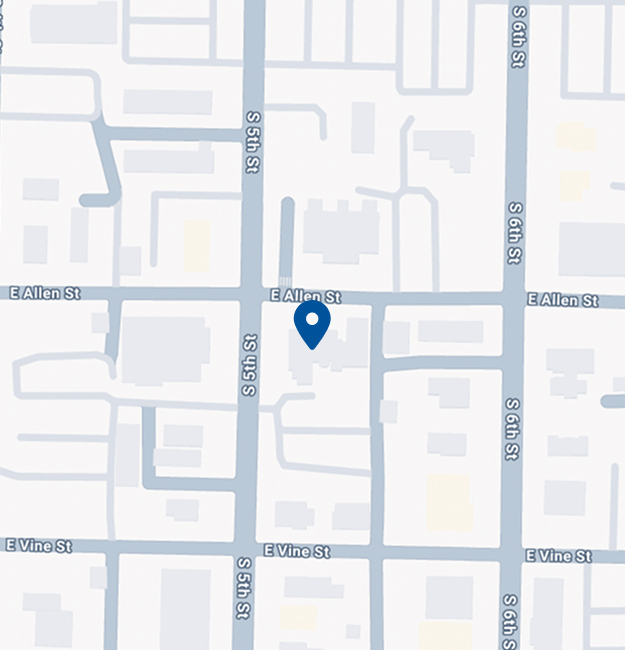
Address
Our offices are located at the corner of South Fifth Street and Vine, in the historic Mary Bryant Home for the Blind.