- Free Consultation: (217) 544-4057 Tap Here To Call Us















Can a Convicted Felon Ever Legally Own a Firearm Again?


Last Reviewed & Updated: October 2, 2026
By: W. Scott Hanken | Former Sangamon County Prosecutor | Springfield Criminal Defense & Weapons Offenses Defense Attorney | Voted “Best Attorney” — Illinois Times Best of Springfield & State Journal-Register Reader’s Choice | Springfield, IL | Sangamon County | (217) 544-4057 | hankenlaw.com
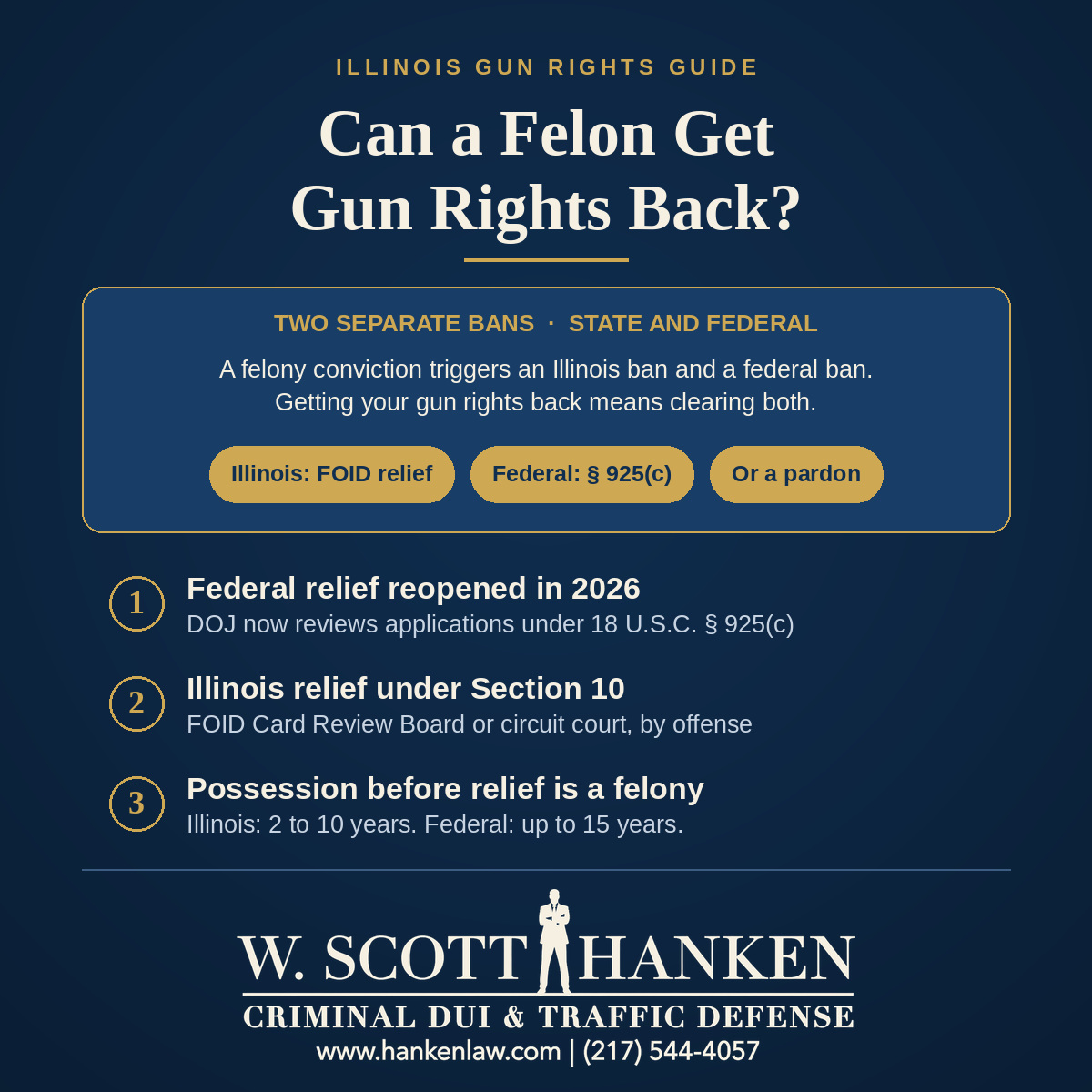
A felony conviction costs you your gun rights twice: once under Illinois law and once under federal law. For a long time, getting them back was close to impossible.
That changed in 2026. The U.S. Department of Justice reopened a federal restoration process that had been shut down for more than 30 years. Illinois has its own process too, one many people don’t know exists.
This guide covers how both bans work, the three realistic paths to restoring your rights, and what happens if you’re caught with a gun before you’ve cleared them.
Key Takeaways:
- A felony triggers two separate firearm bans: one under Illinois law and one under federal law. Restoring your rights means clearing both.
- Illinois has a restoration process. Relief from the FOID Card Review Board or a circuit court can lift the state ban.
- The federal government began accepting restoration applications again in fall 2026, but relief is discretionary and some offenses are presumptively excluded.
- A pardon can address both bans, but clemency is rare.
- Until relief is actually granted, possessing a gun or even ammunition is a felony under both state and federal law.
Why a Felony Takes Away Your Gun Rights Twice
The Illinois ban. A felony conviction from any jurisdiction disqualifies you from holding a FOID card under 430 ILCS 65/8. Separately, 720 ILCS 5/24-1.1 makes it a crime for anyone with a felony conviction to possess a firearm or firearm ammunition. That includes possession inside your own home.
- Sentence. A first violation is a Class 3 felony with 2 to 10 years. It becomes a Class 2 felony with 3 to 14 years if your prior record includes a forcible felony, a felony weapons offense, stalking, or a Class 2 or greater drug felony, or if you are on parole or mandatory supervised release.
- Multiple guns. Each firearm or box of ammunition can be charged as a separate violation.
- Repeat offenders. After two or more qualifying convictions, possessing a firearm becomes a Class X felony under 720 ILCS 5/24-1.7. That offense was formerly called “armed habitual criminal.”
The federal ban. Federal law separately prohibits anyone convicted of a crime punishable by more than one year in prison from possessing firearms or ammunition. A violation carries up to 15 years in federal prison under 18 U.S.C. § 924(a)(8).
The two bans are independent. Clearing one does not clear the other. Illinois relief also can’t be granted if it would be contrary to federal law. In practice, that usually means the federal ban has to be addressed first or at the same time.
Path 1: Illinois Relief Under the FOID Card Act
Illinois law does provide a way back. Under 430 ILCS 65/10, a person prohibited from having firearms because of a felony can ask for relief. Where you apply depends on the conviction.
The FOID Card Review Board. The FOID Card Review Board handles most cases. It must issue a decision within 45 days of receiving a complete appeal, though extensions are allowed.
The circuit court in your county. Some convictions must go to court instead:
- forcible felonies
- stalking and aggravated stalking
- domestic battery
- Class 2 or greater drug felonies
- felony weapons offenses
- felony-level juvenile adjudications
For Springfield residents, that means the Sangamon County Circuit Court. The Sangamon County State’s Attorney must be served with the petition at least 30 days before the hearing and can object.
Whether you go to the Board or to the court, you must establish all of the following:
- you have not been convicted of a forcible felony within 20 years of your application, or at least 20 years have passed since any prison term for it ended
- your record and reputation show you’re not likely to act in a way that endangers public safety
- relief would not be contrary to the public interest
- relief would not be contrary to federal law
That last requirement is where many felony petitions stall, which is why the federal paths below matter.
Path 2: Federal Relief Under 18 U.S.C. § 925(c), Reopened in 2026
Federal law has long allowed the Attorney General to restore federal firearm rights. For more than three decades, though, the program was effectively unavailable. In August 2026, the Department of Justice finalized a rule that moved the process to the Office of the Pardon Attorney. It then opened applications in stages through its Federal Firearm Rights Restoration program:
- September 25, 2026: Applications opened to invited candidates.
- November 4, 2026: Applications open to the public, for the first 5,000 applicants.
- January 4, 2027: Applications open to 500 more applicants, and a $30 application fee takes effect.
Relief is discretionary. The application requires fingerprints and character references. DOJ also publishes presumptive disqualifiers, which lead to denial unless you can show extraordinary circumstances:
- Permanent disqualifiers include felonies involving a death, sexual assault, domestic violence, burglary, robbery, assault or battery, stalking, and similar violent conduct.
- 10-year disqualifiers include felonies involving drug trafficking, threats of violence, and certain firearm offenses.
- 5-year disqualifiers cover any other felony. The clock runs from the conviction or from the end of any part of the sentence, including probation or parole.
Federal relief removes only the federal ban. Under Illinois law you would still need relief under the FOID Card Act before you could legally possess a firearm here.
Path 3: A Pardon
An Illinois pardon comes from the Governor, after the Illinois Prisoner Review Board reviews the petition and makes a confidential recommendation. The clemency petition can specifically ask for a pardon, authorization to seek expungement, and restoration of FOID card rights. The Governor has no deadline to act, and clemency is rare.
The Governor’s power covers only Illinois convictions. A federal conviction requires a presidential pardon through the U.S. Pardon Attorney.
Under federal law, a pardon generally removes a conviction for federal firearm purposes unless the pardon expressly says the person may not possess firearms. That’s why a pardon can address both bans at once.
What About Expungement, Sealing, or an Old “Restoration of Rights” Letter?
Expungement. Illinois generally does not allow felony convictions to be expunged on their own. In clemency cases, expungement becomes available when the Governor authorizes it in a pardon.
Sealing. Since 2017, most Illinois felony convictions can be sealed after a waiting period. Exceptions include DUI, domestic battery, and most sex offenses. Sealing limits who can see a record, but it is not a pardon or an expungement. Don’t treat it as restoring your gun rights. Our Expungement & Record Sealing page covers eligibility.
Old Department of Corrections letters. In Buchmeier v. United States (2009), the federal appeals court covering Illinois considered an Illinois Department of Corrections notice telling a released prisoner his civil rights were restored. The notice said nothing about firearms, so the court held those convictions no longer counted for federal firearm purposes. Illinois revised its letter afterward to include a firearms warning. Whether an older letter helps you depends on its exact wording and date, so have a lawyer review it before you rely on it.
Two Records, Two Very Different Paths
Here is a hypothetical involving two Springfield residents.
The first was convicted of Class 4 felony drug possession in 2012, finished probation in 2014, and has had no trouble since.
- Federal relief. Simple possession isn’t on DOJ’s permanent or 10-year lists, and more than five years have passed, so no presumptive disqualifier applies.
- Illinois relief. A Class 4 possession conviction isn’t one of the offenses that must go to court, so the FOID Card Review Board is the likely forum.
He has a realistic path: federal relief, then Illinois relief.
The second was convicted of robbery in 2019 and released from prison in 2022.
- Federal relief. Robbery is a permanent presumptive disqualifier for federal relief.
- Illinois relief. Robbery is a forcible felony, so Illinois relief requires a court petition, and the 20-year rule bars relief for roughly two decades.
A pardon is realistically his only path.
Every case is decided on its own facts. Even a strong applicant isn’t guaranteed relief.
If You’re Charged Before Your Rights Are Restored
Applying for relief is not the same as having it. Until relief is granted, possessing a firearm or ammunition remains a felony under both Illinois and federal law.
Many of these cases still turn on defensible issues:
- Possession. When guns belong to a spouse or roommate, the State must prove you knowingly possessed them, not just that you lived in the same house.
- The search. Many cases begin with a search of a home or car. An unlawful search can lead to suppression of the evidence.
- The prior conviction. Whether an old conviction actually qualifies as a felony, or was pardoned, expunged, or covered by a rights-restoration notice, can decide the case.
- The charge level. The difference between a Class 3 and a Class 2 charge often depends on how a prior conviction is classified.
Scott has handled cases on both sides of the courtroom in Sangamon County.
Bottom Line: A felony doesn’t have to mean losing your gun rights forever, but getting them back means clearing two separate bans. Illinois offers relief through the FOID Card Review Board or the courts, the federal government reopened its restoration process in 2026, and a pardon can address both. Until relief is granted, don’t touch a firearm, and don’t keep ammunition in your home.
Frequently Asked Questions (FAQs)
That is risky. Illinois’s felon ban covers firearms in your own home, and prosecutors can charge a person who knowingly has access to and control over a gun even if someone else owns it. If you share a home with a gun owner, talk to a lawyer about how the guns are stored before a problem arises.
Yes. Both the FOID disqualification and the Illinois felon-in-possession statute apply to felony convictions from any jurisdiction.
Not by itself. Federal relief under § 925(c) removes only the federal ban. You would still need relief under the Illinois FOID Card Act, and a valid FOID card, before possessing a firearm here.
No. Both Illinois law and federal law prohibit a person with a felony conviction from possessing firearm ammunition, not just firearms.
The timelines vary by path:
FOID Card Review Board. It must decide within 45 days of receiving a complete appeal, though extensions are allowed.
Federal process. It has just opened, so there is no track record yet.
Pardons. The Governor is under no deadline to act on a pardon petition.
Plan for months, not weeks.
Further Reading
Practice Area
Related Articles
- Illinois FOID Card Requirements: Who Qualifies, What Disqualifies You, and How Criminal Charges Affect Your Card — Once your rights are restored, this is what it takes to get and keep your FOID card.
- Can You Carry a Gun in Your Car in Illinois? Rules for CCL Holders, FOID Holders, and Nonresidents — Restored rights still come with transport rules that trip up careful gun owners.
- Federal Gun Deregulation Won’t Save You From an Illinois Weapons Charge — A change in federal policy doesn’t change what Illinois requires.
Browse by Topic
Ready to Fight Your Weapons Charge in Springfield?
Call W. Scott Hanken at (217) 544-4057 or contact us online for a free consultation. We serve clients throughout Springfield, Sangamon County, and Central Illinois.
About the Author: W. Scott Hanken, Attorney at Law
Scott Hanken is a Springfield, Illinois criminal defense attorney with over 37 years of experience, including service as a former Sangamon County prosecutor. He has been voted Best Attorney by the Illinois Times and State Journal-Register, holds an Avvo 10.0 “Superb” rating, and has earned over 270 five-star Google reviews. He serves clients throughout Sangamon County and Central Illinois.
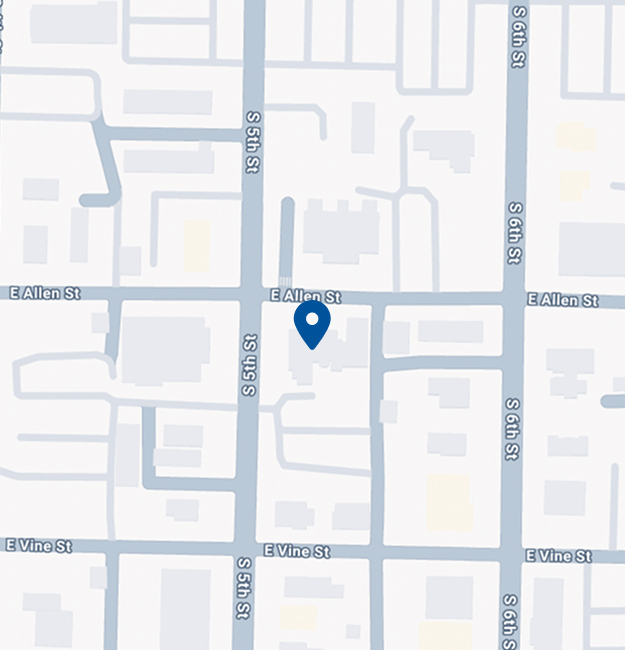
📍 1100 S 5th St, Springfield, IL 62703 | ☎ (217) 544-4057 | 🌐 hankenlaw.com
This article is for general educational purposes only and does not constitute legal advice. Every case is unique — contact an experienced Springfield criminal defense attorney for guidance on your specific situation.
Address
Our offices are located at the corner of South Fifth Street and Vine, in the historic Mary Bryant Home for the Blind.