- Free Consultation: (217) 544-4057 Tap Here To Call Us









Are Golf Carts Street Legal in Springfield, Illinois? Golf Cart Laws, DUI Exposure, and Other Vehicle Code Charges


Last Reviewed & Updated: September 24, 2026
By: W. Scott Hanken | Former Sangamon County Prosecutor | Springfield Criminal Defense & DUI Attorney | Voted “Best Attorney” — Illinois Times Best of Springfield & State Journal-Register Reader’s Choice | Springfield, IL | Sangamon County | (217) 544-4057 | hankenlaw.com
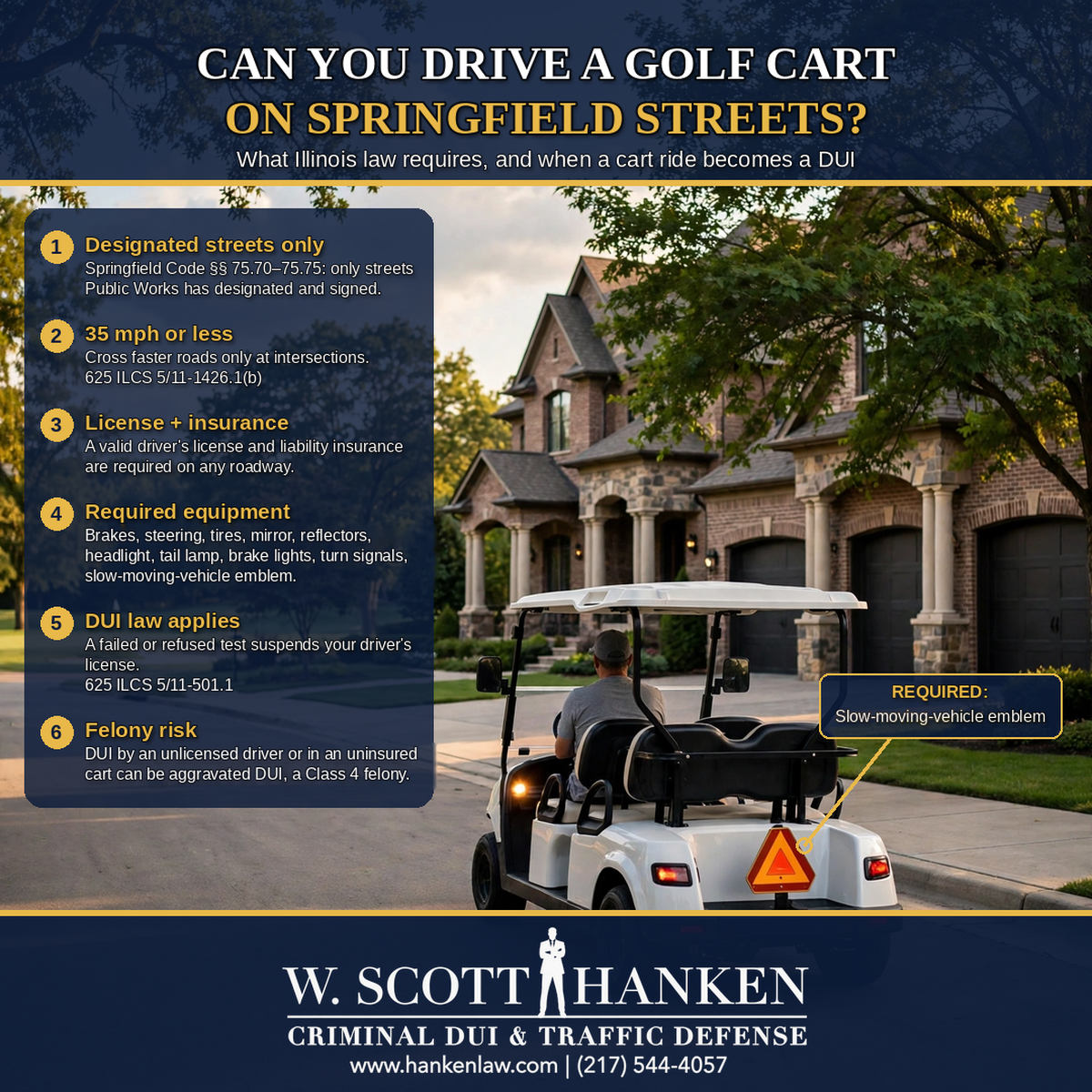
A golf cart is a “non-highway vehicle” under the Illinois Vehicle Code, and it is illegal to drive one on any Illinois street unless a local government has authorized it by ordinance or resolution. Even where carts are allowed, the driver needs a valid license, insurance, and required safety equipment, and can use only streets posted at 35 mph or less. Illinois DUI law applies to a golf cart exactly as it applies to a pickup truck. The DUI statute has no cart-specific penalties. The facts that commonly surround golf cart use, such as an uninsured cart, an unlicensed driver, or children aboard, are what can push a golf cart case into enhanced or felony territory.
I have 37+ years of experience in the Springfield and Sangamon County courts, including service as a Sangamon County Assistant State’s Attorney. Every summer I see the same misunderstanding: people treat a golf cart like a toy. The Illinois Vehicle Code does not, and neither will the officer who stops you.
Are Golf Carts Street Legal in Illinois?
No, not unless a local government authorizes them, and then only on streets posted at 35 mph or less. Section 11-1426.1 of the Illinois Vehicle Code defines a “non-highway vehicle” as a motor vehicle not specifically designed for public highway use, and golf carts are expressly on that list. Except as the statute provides, it is unlawful to drive a non-highway vehicle on any street, highway, or roadway in Illinois.
A municipality, township, county, or other unit of local government may authorize non-highway vehicles on roads under its jurisdiction by ordinance or resolution, after determining public safety will not be jeopardized. Even then, these statewide limits apply:
- Speed limit. Carts may run only on streets posted at 35 mph or less. They may cross a faster road at an intersection.
- Driver’s license. The operator must hold a valid driver’s license issued in his or her own name. Illinois has no golf cart exception for 14-year-olds.
- Restricted roads. No direct crossing of any tollroad, interstate, or controlled-access highway is allowed. Other state highways may be crossed only at an intersection with another public road.
- Equipment. At a minimum, the cart must have brakes, steering, tires, a rearview mirror, front and rear red reflectorized warning devices, a slow-moving-vehicle emblem, a headlight visible at 500 feet, a tail lamp visible at 100 feet, brake lights, and turn signals.
- Insurance. Anyone operating a non-highway vehicle on a roadway is subject to Illinois mandatory insurance requirements.
Can I Drive a Golf Cart on the Streets in Springfield, Illinois?
Only on city streets that the Springfield Office of Public Works has designated and signed for golf carts. Springfield has had a golf cart ordinance since 1999: Springfield Code of Ordinances, Title VII, Chapter 75, Article V, Sections 75.70 through 75.75 (Ord. No. 245-5-99). It is enabling language, not a citywide green light. Under Section 75.70, the article’s stated purpose is to authorize golf carts on designated roadways once it is determined that carts can safely travel on or cross them, considering the volume, speed, and character of traffic. Section 75.75 authorizes the Office of Public Works to designate city roadways where golf carts may travel, and city interchanges where they may cross directly over a roadway. Once Public Works approves a roadway, Section 75.75(b) directs it to post signs.
The ordinance itself lists no designated streets, and I have found no published list. The practical rule is simple: if the street is not designated and signed for golf carts, your cart does not belong on it.
Where the ordinance does apply, it mirrors state law. Section 75.71 defines a golf cart as a vehicle designed to carry people and their golf clubs or maintenance equipment while playing, supervising, or maintaining a golf course. Section 75.72 requires the same ten items of equipment as state law. Section 75.73 requires the headlight and tail lamps to be lit on the roadway. Section 75.74 makes a person who drives or is in actual physical control of a golf cart on a roadway while under the influence subject to 625 ILCS 5/11-500 through 11-502.
Two things the ordinance does not do matter just as much. It does not contain its own license, insurance, or speed-limit rules. It also does not contain its own penalty provision. The license requirement (Section 11-1426.1(b-5)), the insurance requirement (Section 11-1426.1(g)), and the 35 mph cap (Section 11-1426.1(b)) all come from state law, and they apply on every designated Springfield street.
My professional opinion on charging: Springfield’s ordinance authorizes carts on designated streets. It does not legalize undesignated ones. Because Article V has no penalty section of its own, the charge on an undesignated Springfield street is 625 ILCS 5/11-1426.1(b), a state Vehicle Code violation, not a city ordinance ticket. That violation also gives an officer grounds for the stop.
A few other Springfield and Sangamon County points:
- State routes are off-limits. State and U.S. highways, including state-maintained corridors inside Springfield, are under IDOT’s jurisdiction, not the city’s, so Springfield’s ordinance cannot open them to golf carts. Under Section 11-1426.1(d), only IDOT can authorize cart travel on its roadways. Absent that authorization, a golf cart does not belong on them.
- Park District property has its own rules. The Springfield Park District’s General Use Ordinance (Ord. No. 1415-17, as amended through November 26, 2024) defines “motorized vehicle” to include golf carts and low-speed vehicles. Under Section 5.6, they must stay on roads and in designated parking areas, and may not be operated on sidewalks, athletic fields, turf areas, hiking and biking trails, or service roads. Under Section 2.12(E)-(F), carts on District golf courses may be rented only by individuals over 16 who hold a valid driver’s license, no one under 16 may operate one, and carts must stay on golf course property.
- The suburbs are a patchwork. Chatham, Rochester, Sherman, Riverton, and the other villages around Springfield each set their own rules. Authorization in one village does not carry over to the next.
- Designation is a fact question in court. In a case charged under Section 11-1426.1(b), whether the street was designated and signed matters. It does not matter to a DUI charge, which applies either way.
What Is the Difference Between a Golf Cart and a Low-Speed Vehicle in Illinois?
A golf cart is an untitled non-highway vehicle that needs local authorization. A low-speed vehicle (LSV) is a titled, registered, federally certified vehicle that state law allows on streets posted at 30 mph or less.
| Feature | Golf cart (non-highway vehicle) | Low-speed vehicle (LSV) |
|---|---|---|
| Governing statute | 625 ILCS 5/11-1426.1 | 625 ILCS 5/11-1426.2 |
| Street use without local action | Prohibited | Allowed on streets posted 30 mph or less unless prohibited |
| Maximum posted speed with local approval | 35 mph | 35 mph |
| Crossing faster roads | At intersections only | Streets up to 45 mph; faster streets only at a traffic light or four-way stop |
| Title and registration | None | Required |
| Federal safety certification | No | FMVSS 500 |
| Springfield status | Designated and signed streets only (Code 75.70–75.75) | No city ordinance; state default applies |
| DUI law applies | Yes | Yes |
LSVs in Springfield: Springfield has no ordinance that specifically addresses low-speed vehicles, so state law controls. Under 625 ILCS 5/11-1426.2, an LSV may be driven on any street posted at 30 mph or less unless the municipality has prohibited it. Springfield has not prohibited LSVs, and most city residential streets carry the 30 mph default.
A true LSV is one that is FMVSS 500-certified, titled, registered, and insured, with a licensed driver. That vehicle is generally lawful on those streets. It is not lawful on Springfield’s 35 mph streets, because the city has not adopted the authorization Section 11-1426.2(e-5) would require. The practical result is that a registered LSV has broader access to Springfield streets than a golf cart does. If your cart has no VIN, no title, and no plate, it is a golf cart, whatever the dealer called it.
Can You Get a DUI on a Golf Cart in Illinois?
Yes. Illinois DUI law applies to anyone who drives or is in actual physical control of a golf cart while impaired. The golf cart statute makes Sections 11-500 through 11-502 of the Vehicle Code applicable to non-highway vehicles on a roadway. The DUI statute itself, Section 11-501(a), prohibits driving or being in actual physical control of “any vehicle” within Illinois with a 0.08 alcohol concentration, or while under the influence of alcohol, drugs, intoxicating compounds, or any combination of them.
- Criminal charge. A first-offense DUI is a Class A misdemeanor.
- Statutory summary suspension. Failing or refusing chemical testing triggers a suspension of your driver’s license, not just your cart privileges. For a first offender, that means 6 months for a test at or above 0.08, or 12 months for a refusal.
- High-BAC penalties. A first offense at 0.16 or more carries a mandatory minimum of 100 hours of community service and a mandatory minimum $500 fine.
- Underage drivers. Drivers under 21 face Illinois’s zero-tolerance suspension for any trace of alcohol.
When Does a Golf Cart DUI Become a Felony in Illinois?
A golf cart DUI becomes a felony when the same aggravating facts that apply to any vehicle are present, and those facts show up often with golf carts. The DUI statute has no cart-specific penalties. These are the fact patterns I see most:
1. No insurance. A DUI is aggravated DUI when the driver knew or should have known the vehicle was not covered by a liability insurance policy. Unless otherwise provided, aggravated DUI is a Class 4 felony. Many golf carts are not listed on any auto policy. Owners often assume their homeowner’s policy covers the cart on a public street. Whether it does depends on the policy language, and often it does not.
2. No driver’s license. A DUI committed while the driver has no driver’s license, permit, restricted driving permit, judicial driving permit, or monitoring device driving permit is aggravated DUI under Section 11-501(d)(1)(H). Picture a 19-year-old without a license borrowing the family cart after a graduation party. That is a felony fact pattern.
3. Children on board. A first DUI with a passenger under 16 is still a Class A misdemeanor, not aggravated DUI. However, Section 11-501(c)(3) makes the driver subject to 6 months of imprisonment, plus an additional mandatory minimum $1,000 fine and 25 days of community service in a program benefiting children. A first DUI becomes aggravated if the violation causes a crash that injures the child passenger (Section 11-501(d)(1)(J)). A second DUI while transporting a person under 16 is aggravated DUI under Section 11-501(d)(1)(K), a Class 2 felony.
4. Suspended or revoked license. A DUI committed while driving privileges are revoked or suspended for a prior DUI, a summary suspension, leaving the scene of a crash involving injury or death, or reckless homicide is aggravated DUI. People who have lost their license for DUI sometimes switch to a golf cart, believing it does not count. It counts.
What Other Illinois Vehicle Code Charges Can Golf Cart Drivers Face?
Even without alcohol, a golf cart stop can produce license, insurance, equipment, and unauthorized-operation charges.
| Violation | Statute | Common golf cart scenario |
|---|---|---|
| Unauthorized street operation | 625 ILCS 5/11-1426.1(b) | Driving on an undesignated Springfield street or a state route |
| Operating without a valid license | 625 ILCS 5/6-101; 11-1426.1(b-5) | Underage or unlicensed driver |
| Driving while suspended or revoked | 625 ILCS 5/6-303 | Suspended or revoked driver takes the cart onto the street |
| Operating uninsured | 625 ILCS 5/7-601; 3-707 | Cart not listed on any auto policy |
| Equipment violations | 625 ILCS 5/11-1426.1(e) | Missing turn signals, lights, or the slow-moving-vehicle emblem |
| Permitting an unauthorized person to drive | 625 ILCS 5/6-304 | Parent hands the keys to an unlicensed teen |
| Illegal transportation of alcohol | 625 ILCS 5/11-502 | Open drinks in the cup holder, made applicable by 11-1426.1(f) |
The driving-while-suspended charge surprises people most. A golf cart on a public street is treated as a motor vehicle for charging purposes, so a suspended or revoked driver who takes a cart onto the street faces a Section 6-303 charge. Where the original suspension came from a DUI, mandatory minimum jail or community service provisions apply.
Does Illinois DUI Law Apply to Golf Carts on Private Property?
The criminal DUI statute can reach private property, but the statutory summary suspension is tied to the public highways, and that difference matters. Section 11-501 reaches any vehicle “within this State,” so private subdivision roads, campgrounds, and lake communities are not automatic safe zones for a criminal DUI charge. The implied-consent statute behind a statutory summary suspension, however, is tied to driving on the public highways. When a cart was stopped on private property, whether the suspension is valid becomes a real litigation issue.
Springfield Park District property is a separate trap. The District’s General Use Ordinance adopts the Illinois Vehicle Code in its entirety (Section 5.1). It separately prohibits operating any vehicle on District property while under the influence of alcohol, cannabis, a controlled substance, or an intoxicating compound (Section 5.5), and it bars anyone without a valid driver’s license from operating a motorized vehicle on a District roadway or parking lot (Section 5.17(B)). Section 5.18 provides for seizure and impoundment, with a $250 administrative fee, of motor vehicles used in offenses including DUI, driving while suspended or revoked, and driving without a license. Where no other penalty applies, District ordinance violations carry fines of $100 to $1,000 per offense (Section 7.3). A golf cart on a Park District course or park road is not in a DUI-free zone.
Other questions I examine in every golf cart case:
- Was the cart actually on a “highway” or “roadway”?
- Was the street designated and signed?
- Did the officer have a lawful basis for the stop?
- Was my client in “actual physical control” of the cart?
- Did anyone know about an insurance gap, as the uninsured-vehicle felony requires?
Is the Illinois Golf Cart Law Changing?
Not yet. House Bill 4085, which would remove the front red reflector and slow-moving-emblem requirements for non-highway vehicles, passed the House 101-2 and was referred to Senate Assignments on April 16, 2026. As of this update, it has not become law. Two other bills, one raising the speed cap for authorized cart roads from 35 to 55 mph and one expanding who can authorize non-highway vehicles, were sent back to the House Rules Committee in March 2026. None of these bills would change DUI, insurance, or license exposure for golf cart drivers.
Key Takeaways for Springfield Golf Cart Owners
- Illinois law prohibits golf carts on public roads unless a local government has authorized them by ordinance or resolution.
- Springfield’s golf cart ordinance, Code Sections 75.70 through 75.75, allows golf carts only on city streets that the Office of Public Works has designated and signed.
- Springfield’s golf cart ordinance has no license, insurance, or penalty provisions of its own. Those come from 625 ILCS 5/11-1426.1.
- Operating a golf cart on an undesignated Springfield street is chargeable under 625 ILCS 5/11-1426.1(b).
- A properly titled and registered low-speed vehicle may generally use Springfield streets posted at 30 mph or less, because the city has not prohibited LSVs.
- Golf cart drivers are subject to Illinois DUI law, including statutory summary suspension of their driver’s license.
- A golf cart DUI becomes a Class 4 felony when the driver knew or should have known the cart was uninsured.
- A first DUI with a passenger under 16 is a Class A misdemeanor with mandatory enhancements. A second such DUI is a Class 2 felony.
Frequently Asked Questions (FAQs)
Yes. Illinois requires a valid driver’s license to operate a golf cart on any public street, highway, or roadway.
Yes. A golf cart operated on a roadway is subject to Illinois mandatory liability insurance requirements.
No. Without a valid driver’s license, no one may lawfully drive a golf cart on a public street in Illinois.
No. A golf cart may only cross a road posted above 35 mph at an intersection. It may not travel along it.
Yes. A failed or refused chemical test after a golf cart DUI arrest on a public road triggers a statutory summary suspension of your driver’s license.
Yes. The Springfield Park District’s General Use Ordinance prohibits operating any vehicle on District property while under the influence, and state DUI law can also apply.
Yes. Operating on an undesignated street, an equipment violation, or signs of impairment each give an officer grounds for a stop.
Further Reading
Practice Area
Related Articles
- Illinois Zero Tolerance Law: The Complete Guide for Drivers Under 21 in Springfield & Sangamon County — If a driver under 21 was behind the wheel of the cart, this explains the suspension that applies well below 0.08.
- 2026 Guide to BAIID & MDDP for First-Time DUI in Springfield, IL — Read this to see how a first offender can keep driving during a summary suspension after a golf cart arrest.
- Illinois Cocktails-to-Go Is Now Permanent — But the DUI and Open Container Laws Haven’t Moved an Inch — The drink in the cup holder can be its own charge; this covers how Illinois open container law works.
- DUI Dismissal in Illinois: What Actually Gets Cases Dropped — Go here next to learn which defense issues actually end DUI cases.
- Can a Lawyer Handle a Traffic Ticket for Me in Sangamon County Court? — Got a non-DUI golf cart citation? Find out whether you have to appear in court yourself.
Browse by Topic
Ready to Fight Your DUI Charge in Springfield?
Call W. Scott Hanken at (217) 544-4057 or contact us online for a free consultation. We serve clients throughout Springfield, Sangamon County, and Central Illinois.
About the Author: W. Scott Hanken, Attorney at Law
Scott Hanken is a Springfield, Illinois criminal defense attorney with over 37 years of experience, including service as a former Sangamon County prosecutor. He has been voted Best Attorney by the Illinois Times and State Journal-Register, holds an Avvo 10.0 “Superb” rating, and has earned over 270 five-star Google reviews. He serves clients throughout Sangamon County and Central Illinois.
📍 1100 S 5th St, Springfield, IL 62703 | ☎ (217) 544-4057 | 🌐 hankenlaw.com
This article is for general educational purposes only and does not constitute legal advice. Every case is unique — contact an experienced Springfield criminal defense attorney for guidance on your specific situation.

Address
Our offices are located at the corner of South Fifth Street and Vine, in the historic Mary Bryant Home for the Blind.