- Free Consultation: (217) 544-4057 Tap Here To Call Us




Illinois Zero Tolerance Law: The Complete Guide for Drivers Under 21 in Springfield & Sangamon County


Last Reviewed & Updated: September 1, 2026
By: W. Scott Hanken | Former Sangamon County Prosecutor | Springfield Criminal Defense & DUI Attorney | Voted “Best Attorney” — Illinois Times Best of Springfield & State Journal-Register Reader’s Choice | Springfield, IL | Sangamon County | (217) 544-4057 | hankenlaw.com
If You Read Nothing Else, Read This
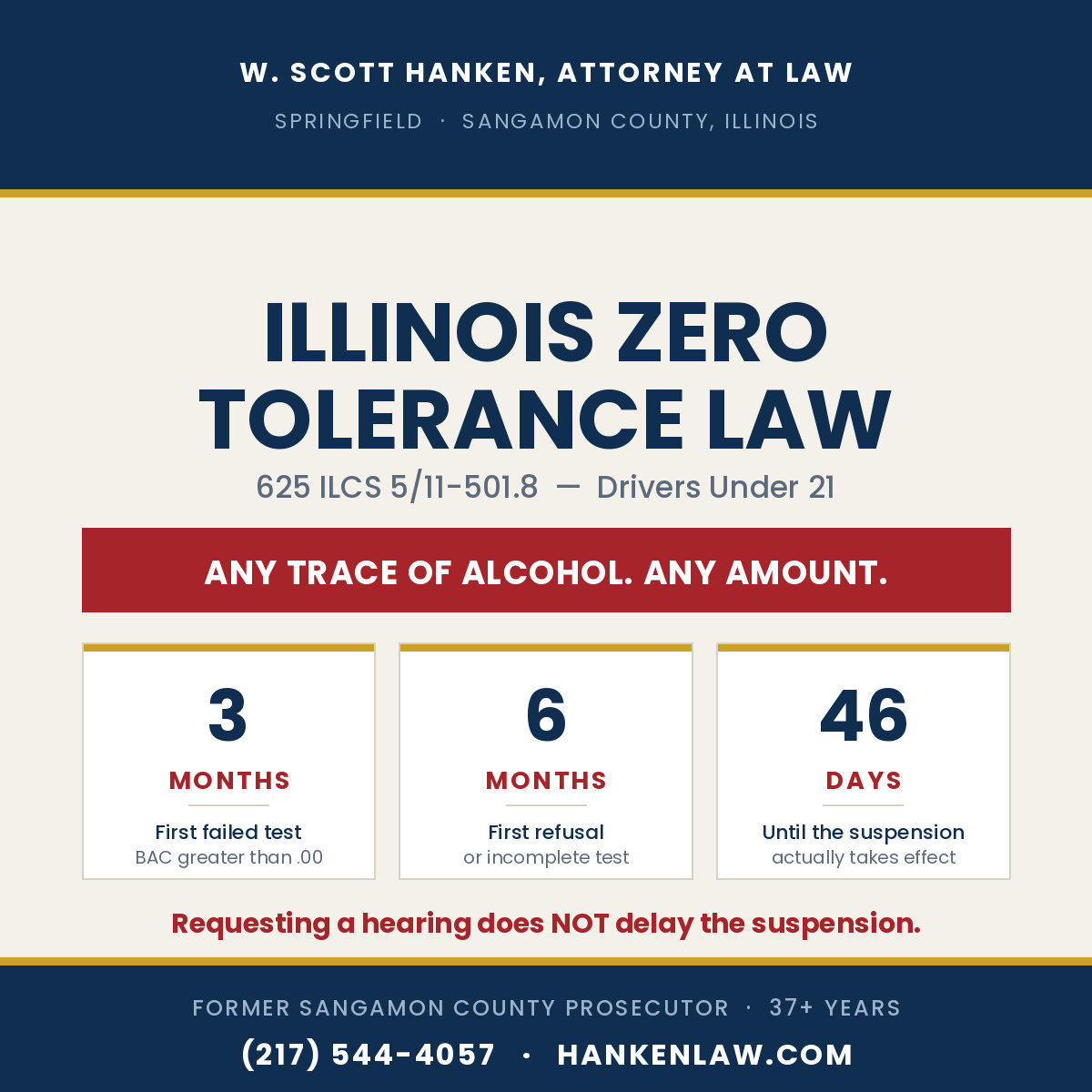
Under Illinois’ Zero Tolerance Law, 625 ILCS 5/11-501.8, a driver under 21 who registers any alcohol concentration greater than 0.00 faces an automatic license suspension — three months on a first failed test, six months on a first refusal. The Illinois Secretary of State enters that suspension administratively, entirely separate from any criminal DUI charge.
Two facts change everything about how fast you have to move:
- The suspension takes effect on the 46th day after notice is given.
- Filing a hearing request does not delay it. The statute is explicit: the petition “shall not stay or delay the effective date of the impending suspension.”
That means the clock does not stop while you prepare. Call (217) 544-4057 for a free consultation.
You Got a Zero Tolerance Ticket. Now What?
A Springfield officer pulls over a 19-year-old UIS student on South Sixth Street on a Friday night. One beer at a party. Breath test: 0.03%. No erratic driving. No criminal DUI charge. The officer files a sworn report with the Secretary of State, and forty-six days later that student’s license is suspended for three months — with collateral consequences that can follow for years.
That scenario plays out in Sangamon County regularly. Illinois’ Zero Tolerance Law is among the strictest in the country, and most young drivers — and most parents — do not understand how it actually works until the notice arrives in the mail.
I’m W. Scott Hanken. I served as a Sangamon County prosecutor before switching sides to defend the people the state prosecutes. For 37+ years I’ve handled DUI and related traffic cases in this courthouse. I know how these cases are built, and I know where they come apart.
What Is Illinois’ Zero Tolerance Law?
Illinois’ Zero Tolerance Law is codified at 625 ILCS 5/11-501.8 of the Illinois Vehicle Code. The Secretary of State calls it the “Use It & Lose It” law. The premise is simple and severe: a driver under 21 who operates a motor vehicle with any measurable alcohol in their system faces an automatic administrative suspension — whether or not they appeared impaired.
The adult DUI threshold under 625 ILCS 5/11-501(a) is 0.08%. Under Zero Tolerance, the threshold is greater than 0.00.
How the Law Is Triggered
Under 11-501.8(a), an officer may request a chemical test — breath, blood, other bodily substance, or urine — after issuing a Uniform Traffic Ticket for any Vehicle Code violation, provided the officer has probable cause to believe the driver consumed any amount of alcohol.
Statute Callout — That probable cause has a specific evidentiary source. The statute requires it to rest on “evidence of the driver’s physical condition or other first hand knowledge of the police officer.” Odor of alcohol, an admission, bloodshot eyes, or an open container the officer sees can supply it. A dispatch relay of an anonymous caller’s hunch, standing alone, is a weaker foundation — and that is litigable.
Once testing occurs (or the driver refuses), the officer files a sworn report with the Secretary of State, and the suspension is entered on the driving record.
Zero Tolerance vs. DUI: Two Separate Systems
This distinction confuses nearly every family I meet. A Zero Tolerance violation is administrative. No criminal conviction, no jury, no jail. It runs entirely through the Secretary of State and concerns only driving privileges.
A DUI charge under 11-501(a) is criminal. A first-offense DUI is a Class A misdemeanor punishable by up to one year in jail and fines up to $2,500.
Aggravated DUI — the felony version — requires specific statutory factors listed at 11-501(d), such as a third or subsequent offense, a crash causing great bodily harm or death, driving while revoked for a prior DUI, or driving without a license or insurance. A first offense is not made a felony by a 0.16% BAC or by carrying a passenger under 16. Those facts trigger mandatory minimum penalties inside the Class A misdemeanor — 100 hours of community service and a $500 minimum fine at 0.16% or above, and a $1,000 minimum fine plus 25 days of community service for transporting a child under 16 — but the charge stays a misdemeanor.
An underage driver can face both a Zero Tolerance suspension and a criminal DUI charge from the same stop. Which route the officer takes is a discretionary decision at the scene.
Illinois Zero Tolerance Suspension Penalties
The suspension periods are set by 625 ILCS 5/6-208.2, not by the Zero Tolerance statute itself. The Secretary of State publishes the companion penalty schedule on its Zero Tolerance page.
| Situation | Offense # | Sanction |
|---|---|---|
| Failed test (BAC greater than .00) | 1st | 3-month suspension |
| Failed test (BAC greater than .00) | 2nd | 1-year suspension |
| Refused or failed to complete test | 1st | 6-month suspension |
| Refused or failed to complete test | 2nd | 2-year suspension |
| DUI conviction, driver under 21 | 1st | Min. 2-year revocation |
| DUI conviction, driver under 21 | 2nd (within 20 years) | Min. 5-year revocation |
| Illegal transport of alcohol, under 21 | 1st conviction | 12-month suspension |
| Possession/consumption of alcohol as a vehicle occupant, under 21 | 1st conviction | 6-month suspension |
Bottom Line: A suspension has a fixed end date. A revocation — which follows a DUI conviction — has none. Reinstatement after a revocation requires a successful Secretary of State hearing, and the Secretary has broad discretion. Full privileges are not restored under either until all reinstatement fees are paid.
Statute Callout — Under 6-208.2(d), time already served on a Zero Tolerance suspension is credited toward the minimum revocation period if the driver is later convicted of DUI arising from the same incident.
Refusal Is Not the Safe Choice
Many young drivers believe refusing the test avoids consequences. Under Illinois’ implied consent framework at 625 ILCS 5/11-501.1 and the consent provision inside 11-501.8(a) itself, every Illinois driver is deemed to have consented to chemical testing. Refusing during a Zero Tolerance stop triggers a six-month suspension on a first violation — double the penalty for failing the test. A second refusal brings two years. In nearly every Zero Tolerance situation, refusal makes the outcome worse, not better.
Who Is Affected
Zero Tolerance reaches every driver under 21 — high school seniors with new licenses, students at UIS and Lincoln Land, young adults commuting to jobs across Sangamon County, and CDL holders and permit-holders in training. The consequences extend well past the loss of a license.
Driving Privileges
The immediate effect is loss of the license or permit. In Springfield, where transit options are limited, that alone is a genuine hardship for work, school, and medical appointments.
Employment
Any job requiring a license or a clean driving record is exposed — delivery work, healthcare roles involving travel between sites, construction, and more. An administrative suspension appears on motor vehicle record checks employers run.
College and Scholarships
Many colleges require applicants and enrolled students to disclose alcohol-related offenses or proceedings. A Zero Tolerance suspension — even with no criminal conviction — can trigger a disclosure obligation, affect scholarship eligibility, and prompt campus discipline.
Auto Insurance
Expect a rate increase or non-renewal once your insurer runs a record check. Certain suspensions also require an SR-22 certificate of financial responsibility, adding cost.
Military and Security Clearances
ROTC students, enlistment applicants, and candidates for federal employment or clearances must disclose alcohol-related actions. A non-criminal administrative suspension still generates questions in a background investigation.
CDL Holders
This is where the draft-stage myth does real damage. A Zero Tolerance suspension is not CDL-neutral. Section 11-501.8(c) requires the officer to warn a CDL holder that a refusal or a result above 0.00 “may result in the disqualification of the person’s privilege to operate a commercial motor vehicle, as provided in Section 6-514,” and subsection (d) directs the Secretary to enter “the suspension and disqualification” on the driving record. If you hold a CDL or a CLP, treat a Zero Tolerance stop as a threat to your livelihood and call immediately.
Religious and Medical Exceptions
Illinois recognizes two narrow exceptions under 11-501.8(e): alcohol consumed in the performance of a religious service or ceremony, and alcohol resulting solely from ingestion of a prescribed or recommended dosage of medicine. These are fact-specific and must be proven. Under 92 Ill. Adm. Code 1001.650, a BAC of 0.02 or more creates a presumption against the exception, rebuttable only by clear and convincing evidence — which, per the rule, generally requires written verification or testimony from a medical or pharmacological expert.
From Traffic Stop to Suspension: The Mechanics
Every step below creates a potential challenge point.
- The traffic stop. The officer stops the vehicle for an observed violation — a broken taillight on Dirksen Parkway, a rolled stop sign on White Oak Drive, weaving on I-55. The stop itself must be lawful. If there was no reasonable articulable suspicion, everything downstream is vulnerable. See our guide on what to do during a traffic stop in Illinois.
- A Uniform Traffic Ticket is issued. Section 11-501.8(a) conditions the test request on issuance of a citation for a Vehicle Code violation or local ordinance equivalent. No ticket, no statutory basis for the request.
- Probable cause of alcohol consumption. The officer must have probable cause — grounded in the driver’s physical condition or the officer’s own first-hand knowledge — to believe the driver consumed any alcohol.
- The test request and warning. The officer must warn the driver that refusing, or testing above 0.00, may cost driving privileges, and must obtain written acknowledgment of that warning. Testing must follow Illinois State Police standards, administered by a permit holder on certified equipment.
- The sworn report. If the driver refuses or tests above 0.00, the officer immediately submits a sworn report to the Secretary of State on a prescribed form. This — not a court order — starts the administrative process.
- Notice, then the 46th day. The officer serves immediate notice, and the Secretary mails confirmation of the effective date. The suspension and any CDL disqualification take effect on the 46th day following notice. If a defective sworn report reaches the Secretary, the suspension is not entered and the report goes back to the issuing agency.
Defense Strategies: Challenging the Suspension
A Zero Tolerance suspension can be contested at an administrative hearing before the Secretary of State under 625 ILCS 5/2-118 and 11-501.8(e). Having spent years on the prosecution side, I can tell you these cases have real vulnerabilities.
1. Challenge the Stop and the Citation
The hearing scope expressly includes whether the officer had probable cause to believe the person was driving and had reason to believe the person violated the Vehicle Code, and whether a Uniform Traffic Ticket was actually issued. A pretextual stop, a stop resting on a mistake of law, or a missing citation is a live issue.
2. Challenge the Probable Cause to Request the Test
Even after a lawful stop, the officer needed independent probable cause — drawn from the driver’s physical condition or the officer’s first-hand knowledge — to believe the driver consumed alcohol. If the sworn report notes no odor, no admission, no containers, and no observations, the request itself is questionable.
3. Challenge the Warning and the Acknowledgment
Two of the seven statutory hearing issues turn on whether the driver was properly advised that privileges would be suspended for refusing or for testing above 0.00. The statute also requires written acknowledgment of the warning. Gaps here matter.
4. Challenge the Testing Itself
Breath instruments must be certified and operated by a permit holder under Illinois State Police standards, and the 20-minute observation period exists to prevent mouth alcohol from inflating a reading. A tobacco pouch, a breath mint, or reflux can affect results. Note the procedural posture: test administration is not one of the seven enumerated hearing issues, so this line of attack usually runs through the reliability of the “more than 0.00” finding rather than as a freestanding claim.
5. Assert the Religious or Medical Exception
Both exceptions appear in the hearing scope. Documented evidence is essential, and at 0.02 or above the 1001.650 presumption must be overcome with clear and convincing evidence.
6. Mitigate the Collateral Damage
Even where rescission is unlikely, counsel can limit real-world harm — early completion of the required education program, a timely restricted driving permit petition, and coordination with any parallel criminal case so the two tracks don’t compound each other. See The Ultimate Guide to DUI Defense in Sangamon County for the full strategic picture.
The Secretary of State Process: Your Action Plan
Step 1 — Request a Hearing Immediately
You may contest the suspension by requesting an administrative hearing under 2-118. There is no waiting period, and there is no benefit to delay. Under 2-118(a), once you submit a written request the Secretary must set a date within 20 days and commence the hearing within 90 calendar days — that 90-day figure is the Secretary’s obligation, not your filing deadline.
The critical point: your petition does not stop the suspension from taking effect on the 46th day. Every week you wait is a week of the suspension running.
The formal hearing request form is the Secretary of State’s Formal Hearing Request (DAH H-12). It carries a $50 non-refundable filing fee, payable by check or money order — cash is not accepted, and a request submitted without the fee is returned unscheduled. Mail the form and fee to the hearing location you are requesting.
Step 2 — Formal vs. Informal Hearing
Under 2-118, hearings are held in Sangamon, Jefferson, or Cook County as the petitioner specifies, unless both parties agree otherwise.
Informal hearing: conducted at a Secretary of State Driver Services facility on a walk-in or scheduled basis. No court reporter, no filing fee. Best for straightforward first-time situations where you are seeking a restricted driving permit and have no conflicting history.
Formal hearing: conducted by a hearing officer with a court reporter present, on a $50 filing fee. The record is preserved for judicial review. Formal is generally required if you want to contest the suspension itself on legal or procedural grounds, or if you have prior DUI dispositions.
Statute Callout — Section 2-118(d-5) allows an implied-consent hearing to proceed on a review of the official police reports. Either party may subpoena the arresting officer, and the arresting officer’s failure to appear is not by itself grounds for rescission — the hearing proceeds on the rest of the evidence.
Step 3 — The Issues the Hearing Officer Decides
Section 11-501.8(e) limits the hearing to seven issues:
- Whether the officer had probable cause to believe the person was driving or in actual physical control on a public highway, and reason to believe the person violated the Vehicle Code or a similar local ordinance;
- Whether the person was issued a Uniform Traffic Ticket for that violation;
- Whether the officer had probable cause to believe the driver had consumed any amount of alcohol, based on the driver’s physical actions or the officer’s first-hand knowledge;
- Whether the person, after being advised that privileges would be suspended for refusal, refused or failed to complete the test;
- Whether the person, after being advised of the consequences, submitted to and completed a test showing more than 0.00;
- Whether the result above 0.00 came from alcohol consumed in a religious service or ceremony; and
- Whether the result above 0.00 came from a prescribed or recommended dosage of medicine.
At the conclusion, the Secretary may rescind, continue, or modify the suspension and disqualification.
Step 4 — If the Suspension Stands: Restricted Driving Permit
If the suspension is not rescinded, the Secretary may issue a restricted driving permit “upon application being made and good cause shown,” to relieve undue hardship for employment, education, and medical driving.
The timing rules are strict. Under 6-208.2(e) and (f), a first-time Zero Tolerance suspension carries no RDP eligibility until at least 30 days from the effective date. A second or subsequent suspension carries no RDP until at least 12 months.
What the process requires:
- Alcohol and drug education and awareness program. Section 11-501.8(e) directs the Secretary to require participation in an education and awareness program as a condition of RDP issuance; the program is governed by 92 Ill. Adm. Code 1001.660.
- Evaluation, if triggered. Under 92 Ill. Adm. Code 1001.670, an investigative alcohol/drug evaluation is required where the petitioner registered between 0.04 and 0.08, may be an unsafe user of alcohol or drugs, has multiple Zero Tolerance suspensions, or has a prior DUI disposition. A fuller alcohol/drug evaluation uniform report is required where the petitioner registered 0.08 or more, failed a drug test, has a DUI disposition on record, or has multiple Zero Tolerance suspensions.
- Any recommended rehabilitative activity. Section 1001.670(c) requires completion of whatever the evaluation recommends — or a written waiver — before any permit issues.
- A hearing, and proof of hardship. Appear and document employment, enrollment, or medical necessity.
- Reinstatement fees. Under 6-208.2(c), full privileges are not restored until all applicable fees are paid.
Step 5 — Appealing an Adverse Decision
Under 11-501.8(h), the Secretary’s action is subject to judicial review under the Administrative Review Law in the Circuit Court of Sangamon County or the Circuit Court of Cook County. For Springfield families, Sangamon County is the natural venue. The court reviews the administrative record — which is exactly why a formal hearing with a court reporter matters if there is any prospect of appeal.
What If a DUI Charge Was Also Filed?
If the officer also charged criminal DUI under 11-501(a), you are running two tracks at once.
The criminal case proceeds in the Sangamon County Circuit Court. A conviction produces a mandatory revocation — minimum two years for a driver under 21 — not a suspension. Revocation has no automatic end date; reinstatement requires petitioning the Secretary of State once eligible.
Court supervision is the common favorable outcome on a first DUI, and it is not a conviction — but it is not free of consequence either. Under 730 ILCS 5/5-6-1, DUI supervision is available only once in a lifetime. Receiving it makes you permanently ineligible for supervision on any future DUI charge, it remains on the Secretary of State driving record, and it counts as a prior DUI disposition for later purposes. It also does not protect a CDL, and it does not prevent an administrative suspension. See DUI Court Supervision Won’t Protect Your Illinois CDL.
Bottom Line: The two tracks are independent. A dismissal in criminal court does not automatically void a Zero Tolerance suspension, and a suspension entered by the Secretary is not evidence of guilt in the criminal case. Managing both at once is where local experience pays.
Statute and Administrative Code Reference Index
Verified against primary sources on September 1, 2026.
| Citation | Subject |
|---|---|
| 625 ILCS 5/11-501.8 | Zero Tolerance — suspension, hearing scope, exceptions, judicial review |
| 625 ILCS 5/6-208.2 | Restoration of privileges under 21 — suspension lengths, RDP timing |
| 625 ILCS 5/11-501 | Driving under the influence; aggravated DUI |
| 625 ILCS 5/11-501.1 | Implied consent; statutory summary suspension |
| 625 ILCS 5/2-118 | Secretary of State hearings; venue; fees; judicial review |
| 92 Ill. Adm. Code, Part 1001, Subpart F | Zero Tolerance hearing procedures (1001.600–1001.690) |
| 92 Ill. Adm. Code 1001.650 | Rebuttable presumption at 0.02 BAC |
| 92 Ill. Adm. Code 1001.670 | Petitions for restricted driving permits |
| 625 ILCS 5/6-514 | CDL disqualification |
| 625 ILCS 5/6-205 | Mandatory revocation |
| 730 ILCS 5/5-6-1 | Court supervision |
| 735 ILCS 5/3-101 et seq. | Administrative Review Law |
Secretary of State resources: Zero Tolerance / Underage Drinking · Losing Your Driving Privileges · Formal Hearing Request (DAH H-12)
Frequently Asked Questions (FAQs)
It is 625 ILCS 5/11-501.8, which subjects any driver under 21 who registers an alcohol concentration above 0.00 to an automatic administrative suspension of driving privileges — regardless of whether the driver appeared impaired.
No. Zero Tolerance is an administrative action by the Secretary of State affecting only your license. A DUI under 11-501(a) is a criminal charge. Both can arise from the same traffic stop.
A first refusal or failure to complete the test carries a six-month suspension — twice the three months for a failed test. A second refusal carries two years.
Yes. You may request an administrative hearing before the Secretary of State under 625 ILCS 5/2-118. The hearing is limited to the seven issues listed in 11-501.8(e).
No. Section 11-501.8(e) states that the petition “shall not stay or delay the effective date of the impending suspension.” The suspension takes effect on the 46th day after notice whether or not a hearing is pending.
Submit the Secretary of State’s Formal Hearing Request form (DAH H-12) with a $50 filing fee by check or money order, mailed to the hearing location you are requesting. Requests without the fee are returned and no hearing is scheduled.
Possibly. On a first Zero Tolerance suspension the Secretary may issue an RDP only after at least 30 days from the effective date; on a second or subsequent suspension, only after at least 12 months. You must complete the required alcohol and drug education and awareness program, any evaluation triggered under 92 Ill. Adm. Code 1001.670, and any recommended treatment, and demonstrate hardship at a hearing.
It carries a commercial disqualification. Section 11-501.8 requires CDL holders to be warned of disqualification under 625 ILCS 5/6-514, and directs the Secretary to enter both the suspension and the disqualification on the driving record.
It can. Many institutions require disclosure of alcohol-related offenses, arrests, or proceedings, and a suspension can trigger that obligation, affect scholarship terms, and prompt campus disciplinary review — even with no criminal conviction. Check your school’s specific disclosure policy.
Further Reading
Practice Area
Related Articles
- The Ultimate Guide to DUI Defense in Sangamon County — the full local playbook once a criminal DUI charge is on the table alongside the suspension.
- DUI Court Supervision Won’t Protect Your Illinois CDL — why the disposition that saves most drivers still ends a commercial driving career.
- What to Do During a Traffic Stop in Illinois: A Step-by-Step Guide — the stop is the first thing a hearing officer examines; know what should have happened.
- Flashing Lights in Your Rear-view: Illinois DUI Checkpoints, Stops & What to Do in 2026 — checkpoints operate on different rules than an ordinary stop.
- DUI Dismissal in Illinois: What Actually Gets Cases Dropped — what a winnable case actually looks like from the defense side.
Browse by Topic
- DUI Defense
- License Suspension / Revocation
- Breathalyzer / Breath Test
- CDL / Commercial Driver’s License
Ready to Fight Your DUI Charge in Springfield?
Call W. Scott Hanken at (217) 544-4057 or contact us online for a free consultation. We serve clients throughout Springfield, Sangamon County, and Central Illinois.
About the Author: W. Scott Hanken, Attorney at Law
Scott Hanken is a Springfield, Illinois criminal defense attorney with over 37 years of experience, including service as a former Sangamon County prosecutor. He has been voted Best Attorney by the Illinois Times and State Journal-Register, holds an Avvo 10.0 “Superb” rating, and has earned over 270 five-star Google reviews. He serves clients throughout Sangamon County and Central Illinois.
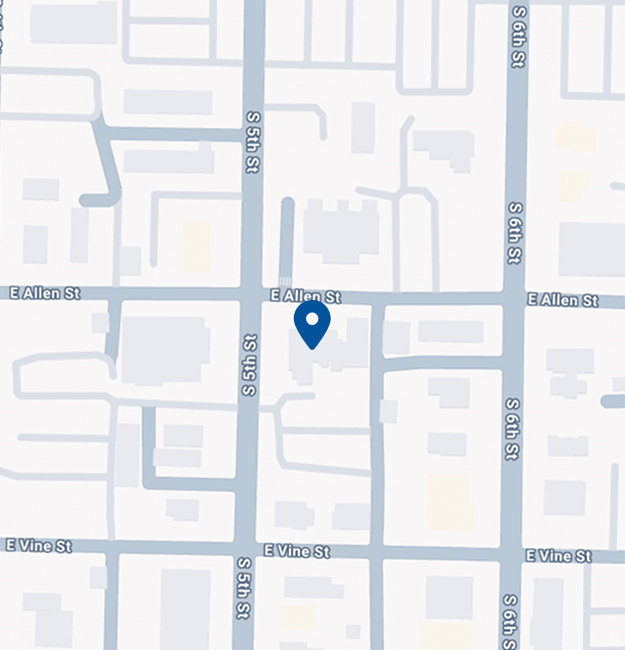
📍 1100 S 5th St, Springfield, IL 62703 | ☎ (217) 544-4057 | 🌐 hankenlaw.com
This article is for general educational purposes only and does not constitute legal advice. Every case is unique — contact an experienced Springfield criminal defense attorney for guidance on your specific situation.
Address
Our offices are located at the corner of South Fifth Street and Vine, in the historic Mary Bryant Home for the Blind.