- Free Consultation: (217) 544-4057 Tap Here To Call Us















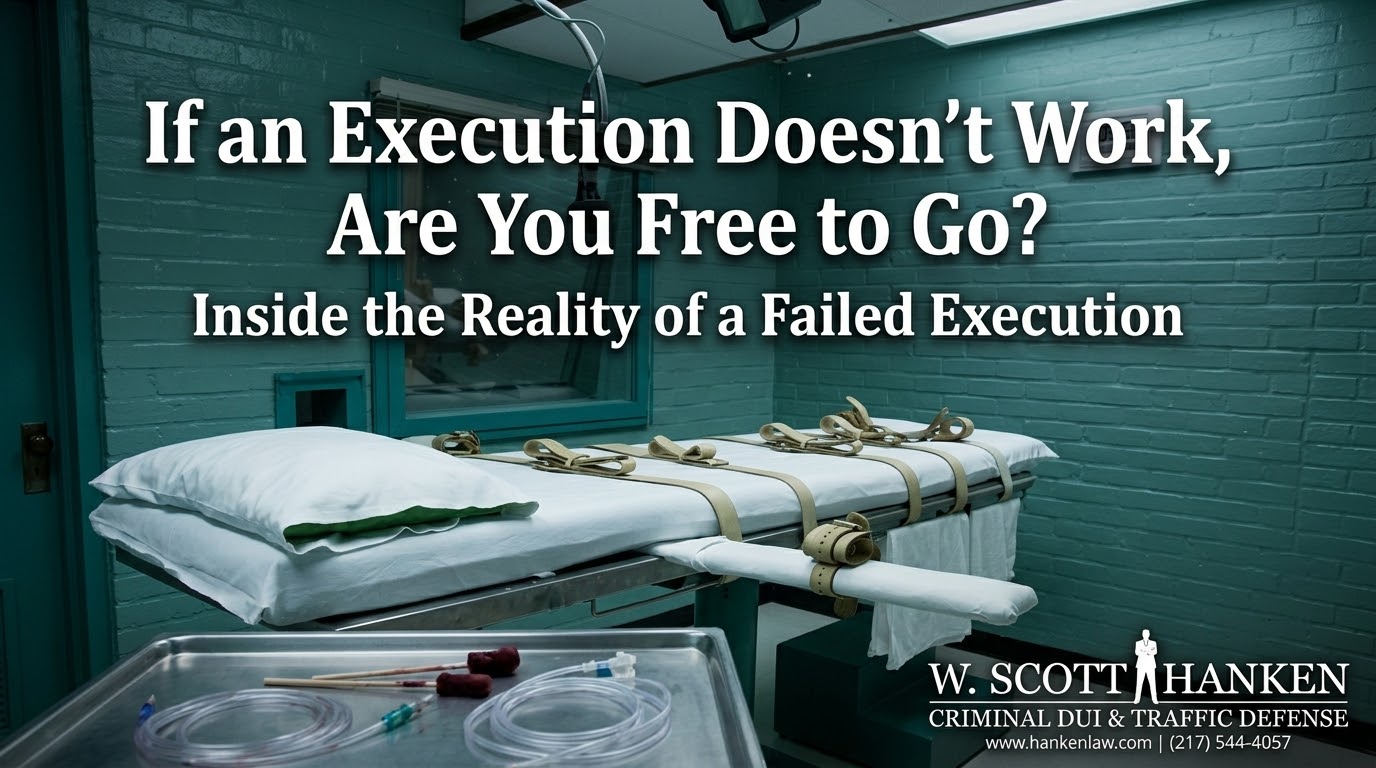
If an Execution Doesn’t Work, Are You Free to Go? Inside the Reality of a Failed Execution


Last Reviewed & Updated: October 5, 2026
By: W. Scott Hanken | Former Sangamon County Prosecutor | Springfield Criminal Defense & Violent Crimes Defense Attorney | Voted “Best Attorney” — Illinois Times Best of Springfield & State Journal-Register Reader’s Choice | Springfield, IL | Sangamon County | (217) 544-4057 | hankenlaw.com
Illinois Readers: Illinois has no death penalty. The state abolished capital punishment effective July 1, 2011, and no Illinois state court can impose a death sentence today. The executions discussed below took place in other states. The only route to a death sentence for a crime committed in Illinois is a federal prosecution, covered at the end of this article.
No. An inmate who survives a failed execution is not set free. The death sentence stays in force, and the U.S. Supreme Court has allowed states to make a second attempt since 1947.
Bottom Line: A failed execution changes the inmate’s medical condition and litigation posture. It does not change the judgment. The sentence survives until a court vacates it or a governor commutes it.
This is a developing story. Facts about the Pike case are current as of October 4, 2026.
Charged with a serious felony in Springfield or Sangamon County? Call W. Scott Hanken, Attorney at Law at (217) 544-4057.
What Happens if a Lethal Injection Fails?
The execution stops, the inmate receives medical care, and the death sentence stays in force until a court or a governor says otherwise.
That is what happened in Tennessee on September 30, 2026. Christa Gail Pike received two sets of pentobarbital syringes at Riverbend Maximum Security Institution in Nashville. Media witnesses reported she was still alive and audibly snoring when they were escorted out.
In a court filing on October 2, her attorneys said she was unconscious and on a ventilator. On October 4, one of her lawyers said she had not regained consciousness and that her prognosis might not be known for days.
Pike, 50, was convicted in 1996 of the January 1995 murder of Colleen Slemmer, 19, in Knoxville. Pike was 18 at the time. A federal appeals court stayed the execution about an hour before it was to begin, and the U.S. Supreme Court lifted that stay hours later.
The cause is disputed. The Tennessee Department of Correction says it followed its protocol. That protocol calls for a backup set of syringes if the inmate is still alive after the first. It does not say what happens if she survives both. Pike’s attorneys believe the IV lines were misplaced or her veins burst, so that some or all of the drug went into the tissue of her arms and not her bloodstream.
Governor Bill Lee ordered a third-party review, led by former U.S. Attorney Ed Stanton. He also said Tennessee would carry out no more executions this year. Pike’s lawyers have asked him to commute her sentence to life. On October 3, he announced that Correction Commissioner Frank Strada will resign this month.
It was the state’s second failure this year. In May, the execution of Tony Carruthers was called off after staff spent more than an hour without establishing the IV access the protocol requires. The governor then ordered a one-year delay before any new attempt.
Does a Failed Execution Count as Carrying Out the Sentence?
No. A failed attempt does not satisfy a death sentence, and the judgment remains enforceable.
The belief that a survivor has “paid the debt” is folklore. It traces to stories like that of John Lee, the English prisoner whose gallows trapdoor failed three times in 1885. Lee lived because the Home Secretary commuted his sentence. That was executive mercy, and no rule of law required it.
The governing case is Louisiana ex rel. Francis v. Resweber, 329 U.S. 459 (1947). Willie Francis, 17, survived Louisiana’s electric chair on May 3, 1946, when the equipment malfunctioned. A divided Court ruled 5 to 4 that a second attempt would not violate the Constitution.
The four-justice plurality found no double jeopardy or cruel-and-unusual-punishment problem, because the failure was an unforeseen accident and not a deliberate infliction of pain. Justice Frankfurter concurred on narrower due process grounds. Louisiana executed Francis on May 9, 1947.
Can a State Try to Execute Someone Twice?
Yes. The Supreme Court allowed a second attempt in 1947, and the Ohio Supreme Court did the same in 2016.
Double jeopardy bars a second prosecution and a second punishment for the same offense. A second attempt to carry out one lawful sentence is neither. That was the Francis plurality’s reasoning, and courts have followed it since.
The modern application is State v. Broom, 146 Ohio St.3d 60, 2016-Ohio-1028. In September 2009, Ohio’s execution team spent about two hours trying to place IV lines in Romell Broom before stopping. The court held, 4 to 3, that a second attempt was permissible.
Relying on Ohio’s lethal injection statute, the court ruled that an execution “commences when the lethal drug enters the IV line.” Because no drug was ever injected into Broom’s lines, jeopardy never attached. Broom died of COVID-19 in 2020, still on death row.
Has Anyone Been Freed After Surviving an Execution?
No. No American court has released a prisoner because an execution attempt failed.
A botched execution is also not the same thing as a survived one. Professor Austin Sarat’s study, summarized by the Death Penalty Information Center, counted 276 of 8,776 American executions from 1890 to 2010 as botched, or 3.15 percent.
That figure measures departures from protocol, most of which still ended in the prisoner’s death. It is not a survival rate. Oklahoma’s Clayton Lockett, for example, died of a heart attack 43 minutes after his 2014 lethal injection began.
True survivors are far rarer. The Death Penalty Information Center’s executive director has said seven other prisoners survived failed attempts to find a usable vein. Before Pike, no one had survived receiving the lethal drugs themselves.
Outcomes for American execution survivors:
| Inmate | State and Date | What Failed | Outcome |
|---|---|---|---|
| Willie Francis | Louisiana, May 1946 | Electric chair malfunction | Executed May 1947 |
| Romell Broom | Ohio, Sept. 2009 | No usable vein | Died of COVID-19, Dec. 2020 |
| Alva Campbell | Ohio, Nov. 2017 | No usable vein | Died of illness, March 2018 |
| Doyle Hamm | Alabama, Feb. 2018 | No usable vein | Settlement barred a retry; died 2021 |
| Alan Miller | Alabama, Sept. 2022 | No usable vein | Executed by nitrogen, Sept. 2024 |
| Kenneth Smith | Alabama, Nov. 2022 | No usable vein | Executed by nitrogen, Jan. 2024 |
| Thomas Creech | Idaho, Feb. 2024 | No usable vein | Not released; second date stayed by a federal court, Nov. 2024 |
| Tony Carruthers | Tennessee, May 2026 | IV access not established | One-year delay ordered by the governor |
| Christa Pike | Tennessee, Sept. 2026 | Survived two full syringe sets | Hospitalized; Tennessee executions halted for the rest of 2026 |
This list is illustrative, not complete.
Three of these survivors were later executed. The only one permanently protected from a second attempt, Doyle Hamm, got that protection through a negotiated settlement and not a ruling.
Can Tennessee Try to Execute Christa Pike Again?
Probably, under Francis. But no court has decided the case of a prisoner who survived the lethal drug itself, and several open questions stand in the way.
Statute & Case Callout — the Eighth Amendment standard: Three cases set the test:
- Baze v. Rees, 553 U.S. 35 (2008)
- Glossip v. Gross, 576 U.S. 863 (2015)
- Bucklew v. Precythe, 587 U.S. 119 (2019)
Under these cases, a prisoner challenging a method of execution must show a substantial risk of severe pain. The prisoner must also identify a feasible, readily implemented alternative that the state has refused without a legitimate penological reason. Bucklew adds that the Constitution does not guarantee a painless death.
Does it matter whether the drug reached her bloodstream?
Less for double jeopardy than it first appears. Broom drew its line at the moment the lethal drug enters the IV line, and both of Pike’s syringe sets were pushed into her lines. Under Broom’s reasoning, her execution had begun. Broom also binds only Ohio courts.
Tennessee’s stronger precedent is therefore Francis, where the punishment reached the prisoner and failed by accident. Whether the pentobarbital circulated, or went into the tissue of her arms as her lawyers allege, has not been established. That fact may matter more to an Eighth Amendment challenge, and to the review of what went wrong, than to whether a second attempt is legally possible.
What if the inmate asked for a different method before the failure?
Pike did. She reportedly asked to be executed by an all-female firing squad. Her lawyers had raised concerns about her small veins, a blood disorder, and her trauma history. In August, they also proposed hanging. A state judge rejected the hanging alternative, and Tennessee said it had neither the legal authority nor the equipment to carry it out.
Preserving the request helps her, but it does not decide the question. Tennessee is not among the five states that authorize the firing squad. Bucklew does not confine a prisoner to methods her own state authorizes. A state can still defend a refusal by pointing to a legitimate reason, and Tennessee has already cited its lack of authority and equipment.
What if the inmate is left permanently impaired?
A separate rule then applies. Three cases bar executing a prisoner who cannot rationally understand why the state is putting them to death:
- Ford v. Wainwright, 477 U.S. 399 (1986)
- Panetti v. Quarterman, 551 U.S. 930 (2007)
- Madison v. Alabama, 586 U.S. 265 (2019)
Pike’s prognosis is unknown, and nothing here predicts it. One of her lawyers has said publicly that her competence may become an issue if she recovers. If any survivor suffered lasting cognitive injury, competency would become a threshold issue before a new date could be set.
Facing a murder or violent felony charge in Sangamon County? Speak with a former Sangamon County prosecutor. Call (217) 544-4057.
Does Illinois Have the Death Penalty in 2026?
No. Illinois abolished the death penalty effective July 1, 2011, after exonerations outnumbered executions.
Statute Callout — 725 ILCS 5/119-1: Beginning July 1, 2011, “the death penalty is abolished and a sentence to death may not be imposed.” Source: Public Act 96-1543, effective July 1, 2011.
The Death Penalty Information Center summarizes the history. Illinois executed 12 prisoners by lethal injection from 1990 to 1999. Governor George Ryan declared a moratorium in 2000. In 2003, he commuted 167 death sentences and pardoned four inmates. Governor Pat Quinn signed the abolition bill on March 9, 2011, making Illinois the 16th state to end capital punishment.
By the time of the moratorium, 13 condemned Illinois prisoners had been exonerated, one more than the state had executed. Quinn also commuted the 15 death sentences that remained.
Bills to restore the death penalty are introduced regularly. The latest, Senate Bill 3892, was filed on February 6, 2026, and would remove the abolition provision. Its last recorded action was referral to the Senate Assignments Committee. It is a proposal, not law. The firm’s violent crimes defense page covers how murder and other violent felony charges are defended today.
What Is the Sentence for First-Degree Murder in Sangamon County?
First-degree murder carries 20 to 60 years in prison, generally served at 100 percent, with firearm add-ons and natural life in some cases.
The base range comes from 730 ILCS 5/5-4.5-20: 20 to 60 years, 60 to 100 years on an extended term, or natural life in specified cases.
The base range understates the real exposure in a shooting case. Under 730 ILCS 5/5-8-1(a)(1)(d), the court must add:
- 15 years if the defendant was armed with a firearm
- 20 years if the defendant personally discharged the firearm
- 25 years to natural life if that discharge caused great bodily harm, permanent disability, permanent disfigurement, or death
These terms are added to the base sentence. A defendant convicted of personally firing the fatal shot therefore faces a minimum of 45 years, not 20.
Under 730 ILCS 5/3-6-3, a first-degree murder sentence is served in full, with no day-for-day credit. There is one exception. A person who was under 21 at the time of the offense and was sentenced on or after June 1, 2019, may seek parole review after serving 20 years (40 years in some cases) under 730 ILCS 5/5-4.5-115. Eligibility for review is not a promise of release.
How Did a Death Penalty Trial Work in Illinois?
An Illinois capital case ran in three stages, and a death sentence required the State to win all three.
I have handled death penalty cases as part of my practice. In my experience, a death penalty case is really three trials in one. The first stage is guilt or innocence. If the defendant is convicted, it is followed by a proceeding to determine whether the crime is death penalty eligible. The final stage is the presentation of aggravating and mitigating evidence, after which the jury decides between a prison sentence and the death penalty.
The statute matched that structure. Under former 720 ILCS 5/9-1(g), as it read before abolition, the jury first had to find unanimously that a statutory eligibility factor existed. It then had to agree unanimously that death was the appropriate sentence. If even one juror concluded that death was not appropriate, the court imposed a prison sentence instead.
Can You Still Get the Death Penalty for a Crime Committed in Illinois?
Yes, but only in federal court. Abolition binds Illinois prosecutors, not the United States.
What if the murder happens in Springfield but is charged federally?
Federal law authorizes death for certain offenses under 18 U.S.C. § 3591. Such a case would be prosecuted in the U.S. District Court for the Central District of Illinois.
In 2019, federal prosecutors sought death in that district against Brendt Christensen for the kidnapping and killing of a visiting scholar at the University of Illinois at Urbana-Champaign. The jury could not agree unanimously, and he received life without release.
Under 18 U.S.C. § 3596(a), when the sentencing state has no death penalty, the court designates another state. The sentence is then implemented in the manner that state’s law prescribes. Practice has been narrower than the text suggests.
The Bureau of Prisons has carried out federal executions at its own facility in Terre Haute, Indiana, under a federal protocol. How closely § 3596(a) binds the government to state procedures has been litigated. Federal prisoners have not simply been sent to another state’s death chamber.
Key Takeaways:
- If an execution fails, the inmate is not freed and the sentence is not discharged.
- Francis v. Resweber (1947) permits a second attempt after an accidental failure.
- No American court has released an execution survivor.
- Pike appears to be the first prisoner to survive the lethal drugs themselves, so no court has addressed a case like hers.
- Illinois abolished capital punishment effective July 1, 2011, under 725 ILCS 5/119-1.
- First-degree murder in Illinois carries 20 to 60 years plus firearm add-ons, generally served at 100 percent.
- Federal death sentences remain possible for crimes committed in Illinois.
Sources and Primary Authorities
This article relies on Illinois statutes published by the Illinois General Assembly, published court opinions, and contemporaneous reporting on the Pike case. That reporting came from the Associated Press, PBS NewsHour, NBC News, the Tennessee Lookout, and Al Jazeera. W. Scott Hanken reviewed the legal analysis before publication.
- 725 ILCS 5/119-1 (P.A. 96-1543, eff. July 1, 2011)
- 720 ILCS 5/9-1(g) (former capital sentencing procedure, pre-abolition text)
- 730 ILCS 5/5-4.5-20; 730 ILCS 5/5-8-1(a)(1)(d); 730 ILCS 5/3-6-3; 730 ILCS 5/5-4.5-115
- 18 U.S.C. §§ 3591, 3596(a)
- Louisiana ex rel. Francis v. Resweber, 329 U.S. 459 (1947)
- State v. Broom, 146 Ohio St.3d 60, 2016-Ohio-1028
- Baze v. Rees, 553 U.S. 35 (2008); Glossip v. Gross, 576 U.S. 863 (2015); Bucklew v. Precythe, 587 U.S. 119 (2019)
- Ford v. Wainwright, 477 U.S. 399 (1986); Panetti v. Quarterman, 551 U.S. 930 (2007); Madison v. Alabama, 586 U.S. 265 (2019)
Frequently Asked Questions (FAQs)
No. The death sentence remains valid. Only a court order vacating it or clemency from the governor can end it.
Yes. A state may make a second attempt. Alabama executed Kenneth Smith and Alan Miller in 2024 after failed lethal injection attempts in 2022.
Yes, as of October 4, 2026. One of her lawyers said she remained unconscious and on a ventilator, and that her prognosis might not be known for days. Governor Lee has halted her execution pending an independent review.
Only by passing a new law. The General Assembly would have to approve it, and the governor would have to sign it or the legislature would have to override a veto. No restoration bill has passed.
Generally all of it. A first-degree murder sentence is served at 100 percent, with no day-for-day credit. People who were under 21 at the time of the offense and sentenced on or after June 1, 2019, can seek parole review after 20 years (40 in some cases). Review does not guarantee release.
Yes. Federal prosecutors can seek death for certain federal crimes committed in Illinois, even though state prosecutors cannot.
Further Reading
Practice Area
Related Articles
- Murder vs. Manslaughter in Illinois: What the Charges Really Mean — covers second-degree murder and manslaughter, which this post’s sentencing section skips.
- If Lindsay Clancy Were Tried in Illinois: No Soft Landing — shows what Illinois does when mental illness, not the method of punishment, is the central question in a homicide case.
- The Lindsay Clancy Deadlocked Jury: What the Tuey-Rodriquez Charge Is, and Why a Mistrial Is Not Automatic — explains what happens when a jury can’t agree, as Christensen’s sentencing jury couldn’t.
- Can You Use a Weapon in Self-Defense? — explains when firing a gun is legally justified, before the 25-year add-on ever comes into play.
Browse by Topic
Ready to Fight Your Violent Crime Charge in Springfield?
Call W. Scott Hanken at (217) 544-4057 or contact us online for a free consultation. We serve clients throughout Springfield, Sangamon County, and Central Illinois.
About the Author: W. Scott Hanken, Attorney at Law
Scott Hanken is a Springfield, Illinois criminal defense attorney with over 37 years of experience, including service as a former Sangamon County prosecutor. He has been voted Best Attorney by the Illinois Times and State Journal-Register, holds an Avvo 10.0 “Superb” rating, and has earned over 270 five-star Google reviews. He serves clients throughout Sangamon County and Central Illinois.
📍 1100 S 5th St, Springfield, IL 62703 | ☎ (217) 544-4057 | 🌐 hankenlaw.com
This article is for general educational purposes only and does not constitute legal advice. Every case is unique — contact an experienced Springfield criminal defense attorney for guidance on your specific situation.

Address
Our offices are located at the corner of South Fifth Street and Vine, in the historic Mary Bryant Home for the Blind.