- Free Consultation: (217) 544-4057 Tap Here To Call Us












The Lindsay Clancy Deadlocked Jury: What the Tuey-Rodriquez Charge Is, and Why a Mistrial Is Not Automatic


Last Reviewed & Updated: September 2, 2026
By: W. Scott Hanken | Former Sangamon County Prosecutor | Springfield Criminal Defense Attorney | Voted “Best Attorney” — Illinois Times Best of Springfield & State Journal-Register Reader’s Choice | Springfield, IL | Sangamon County | (217) 544-4057 | hankenlaw.com
Bottom Line: A Massachusetts jury reporting deadlock does not trigger a mistrial, and it does not trigger the Tuey-Rodriquez charge either. The statute limits how many times a judge can send a jury back out. It says nothing about when the charge must be given. That decision is the judge’s alone.
Jurisdiction note — This article explains Massachusetts criminal procedure in connection with public reporting on an active trial. Massachusetts procedure differs from Illinois procedure. For a matter arising in Illinois, consult counsel licensed in this state.
What a Tuey-Rodriquez Charge Actually Is
The Tuey-Rodriquez charge is a Massachusetts supplemental jury instruction, typically given after a jury reports it cannot reach a unanimous verdict. It comes from Commonwealth v. Tuey, 8 Cush. 1, 2-3 (1851), as rewritten in Commonwealth v. Rodriquez, 364 Mass. 87, 101-102 (1973) (Appendix A).
The instruction tells jurors that another jury is unlikely to be better equipped to decide the case, that a verdict is desirable, and that they should re-examine one another’s views with candor and proper regard for each other’s opinions — without surrendering an honest conviction. It is sometimes called a dynamite charge.
A deadlock report is not a prerequisite. Whether to give the charge is committed to the trial judge’s sound discretion. Commonwealth v. Chalue, 486 Mass. 847, 860 (2021), quoting Ray v. Commonwealth, 463 Mass. 1, 6 (2012). The Supreme Judicial Court has cautioned that the charge carries a “sting” and can risk coercing a verdict jurors are not comfortable with, so it should not be given prematurely. Rodriquez, 364 Mass. at 100; Ray, 463 Mass. at 6.
(Note on spelling: the official case name is Rodriquez*, with a q, and the SJC consistently calls it the Tuey-Rodriquez charge. Much of the press coverage spells it “Tuey-Rodriguez.”)*
The Lindsay Clancy Deadlocked Jury: What Happened on September 1, 2026
On day four of deliberations in Lindsay Clancy’s Plymouth Superior Court murder trial, the jury sent a note at roughly 10 a.m. stating it was unable to come to a unanimous decision.
Judge William Sullivan did not read the Tuey-Rodriquez charge. Citing the length of the trial — more than eighty witnesses and more than three hundred exhibits — he sent the jury back to continue deliberating. The jury later asked to stop for the day and was excused until nine o’clock the next morning.
What the Statute Requires
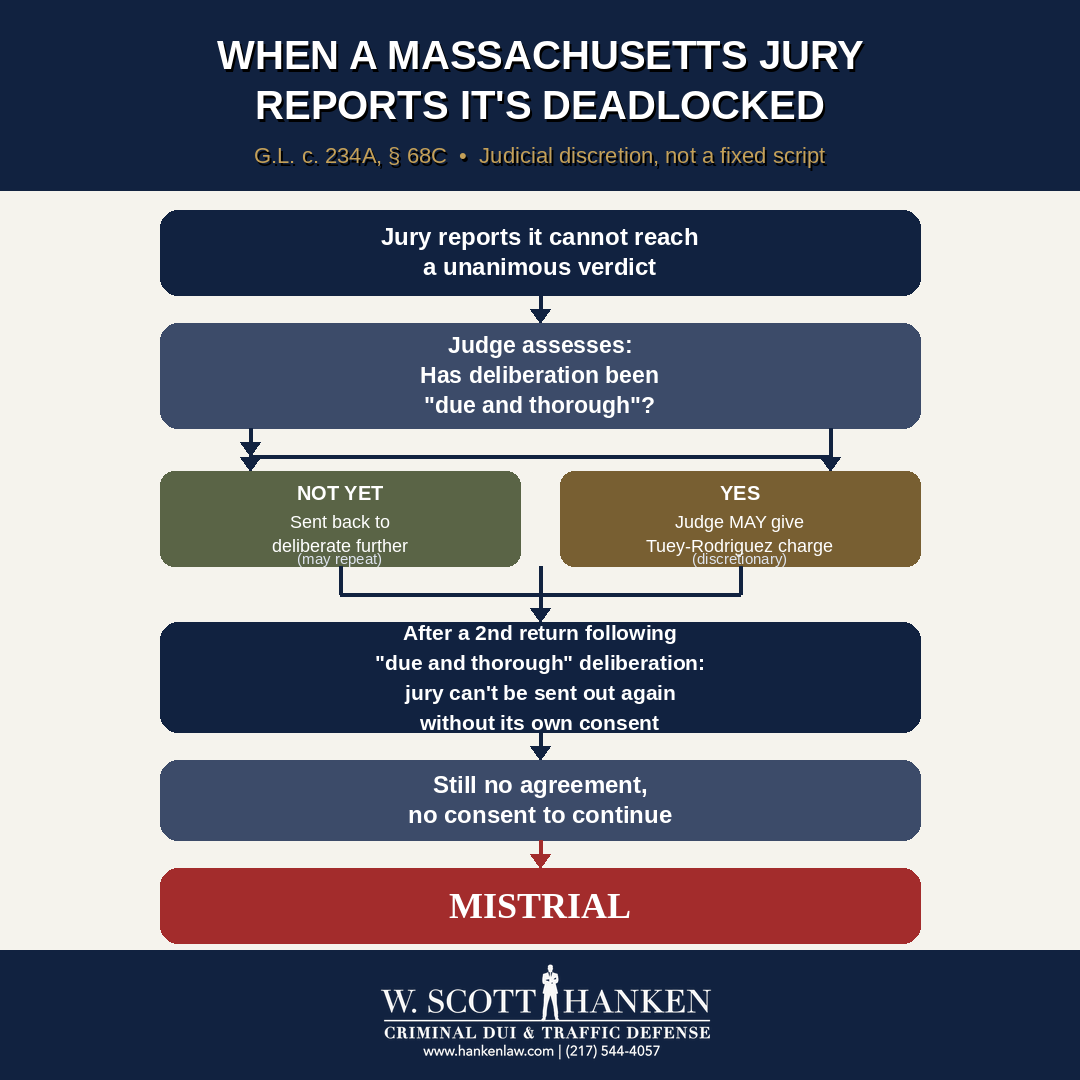
The controlling law is General Laws chapter 234A, section 68C, successor to former chapter 234, section 34, which was repealed by St. 2016, c. 36.
The statute works in two steps:
- First return. If a jury returns without a verdict after due and thorough deliberation, the court may restate the evidence, explain the law again, and send the jury out for further deliberation.
- Second return. If the jury returns a second time without a verdict, it cannot be sent out again without its own consent — unless the jurors themselves ask for further explanation of the law.
Two points get lost in most coverage.
First, giving the Tuey-Rodriquez charge is discretionary and not tied to a fixed step in that sequence. A judge may give it on a first report if satisfied that deliberations have been due and thorough, or may withhold it through several reports if not.
Second, the two-return limit counts only returns that follow “due and thorough” deliberation. If a judge concludes the jury is not yet there, that return arguably does not count against the limit — which is why the notes to Massachusetts Model Jury Instruction 2.460 advise judges to state clearly on the record whenever they find a potential impasse did not occur after due and thorough deliberation.
A note on Instruction 2.460 — Model Jury Instruction 2.460, “When Jurors Cannot Agree,” is often described in press coverage as an alternative to the Tuey-Rodriquez charge. It is not. Instruction 2.460 is the District Court’s version of the Tuey-Rodriquez charge, adapted from Rodriquez Appendix A. Printed alongside it is a separate Alternate Instruction, drawn from Rodriquez Appendix B (the ABA model charge), whose plainer language urges jurors to consult with one another without surrendering honest conviction. The Appeals Court has recommended the first two paragraphs of that alternate as a “pre-Tuey-Rodriquez” instruction when a jury signals impasse prematurely. Commonwealth v. O’Brien, 65 Mass. App. Ct. 291, 296 (2005). One further caveat: 2.460 is a District Court instruction, written for six-person juries. The Clancy trial is a twelve-person Superior Court case.
How This Compares to the Karen Read Case
In the 2024 Read trial, the sequence unfolded along a path consistent with the statute, and the First Circuit later walked through it in detail in Read v. Norfolk County Superior Court, No. 25-1257 (1st Cir. Mar. 27, 2025):
| Event | Judge Cannone’s response |
|---|---|
| First note (June 28, 2024) — unable to reach a unanimous verdict | Declined the charge; found deliberations not yet due and thorough; sent the jury back |
| Second note (July 1, 2024) — consensus unattainable | Found deliberations due and thorough; gave the Tuey-Rodriquez charge |
| Third note (same afternoon) — further deliberation would be futile | Declared a mistrial |
The charge did not produce a verdict at that trial. The 2025 retrial did: on June 18, 2025, Read was acquitted of second-degree murder, manslaughter while operating under the influence, and leaving the scene of a collision causing death, and convicted only of misdemeanor OUI, for which she received one year of probation.
The Read case illustrates one way the statute can play out. It is not a fixed script that every deadlocked Massachusetts jury follows.
What Happens Next in the Clancy Trial
The jury resumed deliberations on the morning of September 2. Whether Judge Sullivan eventually reads the Tuey-Rodriquez charge depends on what any further notes say and on his own assessment of whether deliberations have been due and thorough.
A hung jury is not an acquittal. If the jury cannot reach a verdict and a mistrial is declared, the Commonwealth retains the option to retry the case.
Frequently Asked Questions (FAQs)
No. There is no rule that a third note ends a case. A mistrial typically follows when the jury has reached the statutory limit on being sent back, still cannot agree, and will not consent to continue deliberating. The outcome depends on the jury’s consent and the judge’s assessment of whether further deliberation would serve a purpose.
No. Nothing in Massachusetts law makes the charge mandatory — not even when both sides request it. Ray v. Commonwealth, 463 Mass. 1, 6-7 (2012). The Supreme Judicial Court has described giving it as the ordinary and preferable course when a jury is genuinely deadlocked, but the decision belongs to the trial judge.
No. A mistrial from a hung jury is not a verdict. Double jeopardy does not bar a second trial, and the prosecution may retry the case, negotiate a resolution, or drop the charges.
Further Reading
Related Articles
- If Lindsay Clancy Were Tried in Illinois: No Soft Landing — this post covers what happens when a jury can’t agree; that one covers what happens in Illinois when it can.
- Can an Illinois Prosecutor Argue That Asking for a Lawyer Shows Guilt? — another instance of what a jury is and isn’t permitted to be told.
- Entrapment Defense in Illinois: What Actually Works — how an affirmative defense actually gets presented to an Illinois jury.
- The Tony Romo DUI Video: What It Really Teaches Springfield Drivers About Their Rights — a national case used the same way: to explain what the law does locally.
Browse by Topic
Ready to Fight Your Criminal Charge in Springfield?
Call W. Scott Hanken at (217) 544-4057 or contact us online for a free consultation. We serve clients throughout Springfield, Sangamon County, and Central Illinois.
About the Author: W. Scott Hanken, Attorney at Law
Scott Hanken is a Springfield, Illinois criminal defense attorney with over 37 years of experience, including service as a former Sangamon County prosecutor. He has been voted Best Attorney by the Illinois Times and State Journal-Register, holds an Avvo 10.0 “Superb” rating, and has earned over 270 five-star Google reviews. He serves clients throughout Sangamon County and Central Illinois.
📍 1100 S 5th St, Springfield, IL 62703 | ☎ (217) 544-4057 | 🌐 hankenlaw.com
This article is for general educational purposes only and does not constitute legal advice. Every case is unique — contact an experienced Springfield criminal defense attorney for guidance on your specific situation.

Address
Our offices are located at the corner of South Fifth Street and Vine, in the historic Mary Bryant Home for the Blind.