- Free Consultation: (217) 544-4057 Tap Here To Call Us















Murder vs. Manslaughter in Illinois: What the Charges Really Mean


Last Reviewed & Updated: August 28, 2026
By: W. Scott Hanken | Former Sangamon County Prosecutor | Springfield Criminal Defense & Violent Crimes Defense Attorney | Voted “Best Attorney” — Illinois Times Best of Springfield & State Journal-Register Reader’s Choice | Springfield, IL | Sangamon County | (217) 544-4057 | hankenlaw.com
Most of what people think they know about murder and manslaughter comes from television, and almost none of it matches Illinois law. If you or someone in your family is facing a homicide charge in Sangamon County, the labels used on TV will not tell you what you are up against. Illinois uses its own set of offense names, its own definitions, and its own sentencing structure — and one of the most commonly used terms in the country does not exist here at all.
Here is what the charges actually are, how prosecutors decide which one to file, and what each one carries.
Illinois Does Not Have “Voluntary Manslaughter”
This is the single biggest source of confusion, and it comes up in almost every consultation.
In most states, a killing committed in the heat of passion is charged as voluntary manslaughter. Illinois eliminated that offense in 1987 and folded it into a charge called second degree murder. So in Illinois, a heat-of-passion killing is not “manslaughter” at all — it is a murder charge with a mitigating factor attached.
That matters for a practical reason. Second degree murder is not a separate crime the State charges from the outset in most cases. It is what a first degree murder charge becomes when the defense proves a mitigating factor. Understanding that relationship is the whole ballgame in a contested homicide case.
The word “manslaughter” still exists in Illinois, but only in one form: involuntary manslaughter, which covers reckless killings.
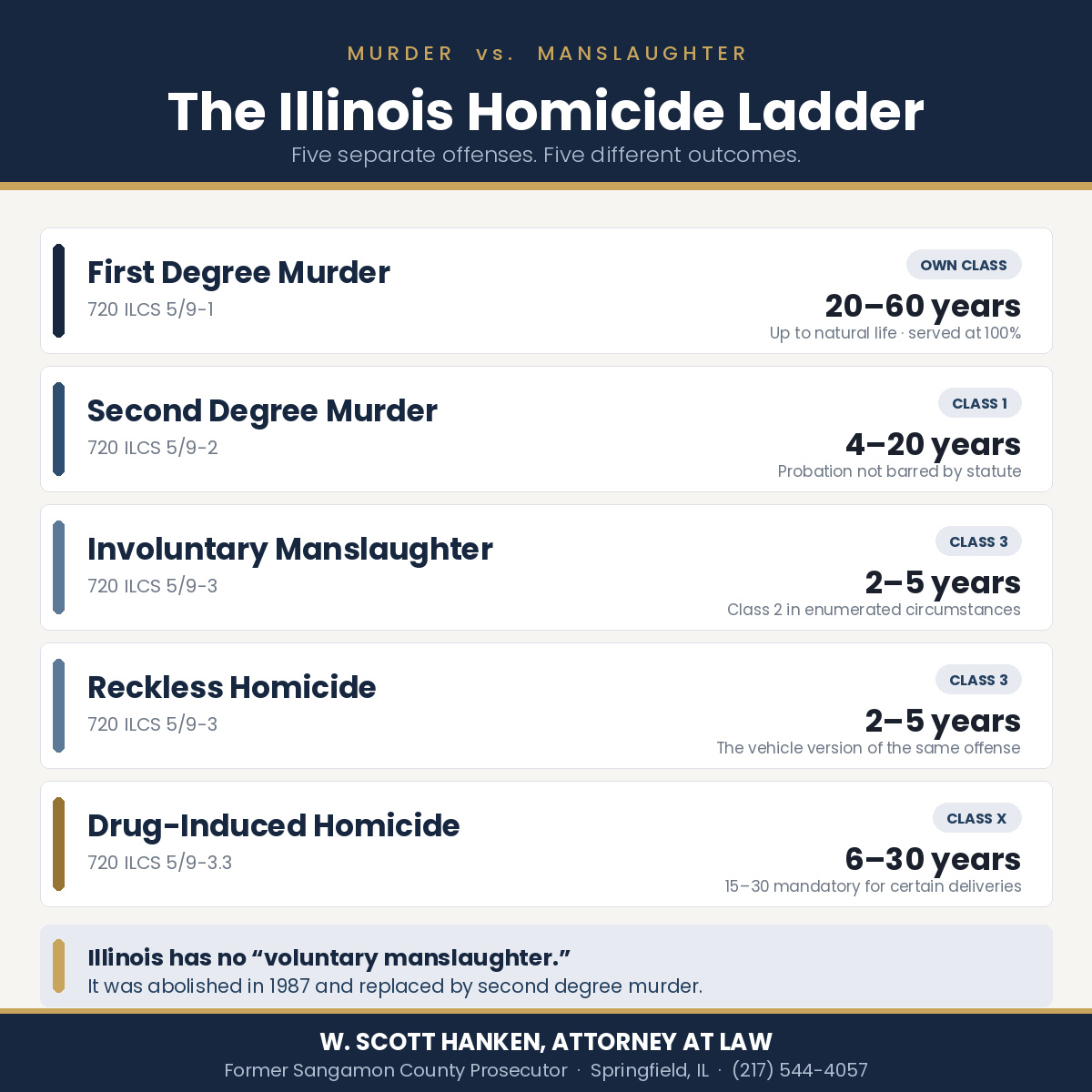
The Illinois Homicide Ladder
| Offense | What the State must show | Statute |
|---|---|---|
| First degree murder | Intent to kill or cause great bodily harm; or knowledge that the acts would cause death; or knowledge that the acts create a strong probability of death or great bodily harm; or a death caused during a forcible felony | 720 ILCS 5/9-1 |
| Second degree murder | Every element of first degree murder, plus a proven mitigating factor — serious provocation, or an unreasonable belief in self-defense | 720 ILCS 5/9-2 |
| Involuntary manslaughter | A reckless act likely to cause death or great bodily harm, not involving a vehicle | 720 ILCS 5/9-3(a) |
| Reckless homicide | The same recklessness, where the cause of death is driving a vehicle, snowmobile, ATV, or watercraft | 720 ILCS 5/9-3(a) |
| Drug-induced homicide | Unlawful delivery of a controlled substance, and a death caused by ingesting it | 720 ILCS 5/9-3.3 |
First Degree Murder Under 720 ILCS 5/9-1
Section 9-1 gives prosecutors three distinct routes to a first degree murder conviction. They are not interchangeable, and which one the State picks shapes the entire defense.
The Three Theories
- Intentional or knowing murder — 9-1(a)(1). The defendant intended to kill or cause great bodily harm, or knew the acts would cause death. This is closest to what most people picture when they hear “murder.”
- Strong probability murder — 9-1(a)(2). The defendant knew the acts created a strong probability of death or great bodily harm. No intent to kill is required. Firing into an occupied car is the classic example.
- Felony murder — 9-1(a)(3). A death occurs during, in furtherance of, or in flight from a forcible felony other than second degree murder. The State does not have to prove any intent to kill at all.
Notice that nothing in the Illinois statute requires premeditation or “malice aforethought.” Those are borrowed terms from other states and from television, and they will not appear in a Sangamon County charging instrument.
The Felony Murder Rule Narrowed in 2021
For decades Illinois followed one of the broadest felony murder rules in the country. Under the old proximate-cause approach, a person could be convicted of murder for a death caused by someone else entirely — including a co-defendant shot by police or by an intended victim.
That changed with the SAFE-T Act, Public Act 101-652, effective July 1, 2021. The statute now reads that the defendant “or another participant” must cause the death. In plain terms, Illinois moved to an agency theory: the death has to be caused by someone acting on the crime’s side, not by a third party responding to it.
Bottom Line: If your case involves a death during a robbery, burglary, or other forcible felony, who actually caused the death is now a live legal issue that it was not before 2021.
Second Degree Murder Under 720 ILCS 5/9-2
Section 9-2 is what people elsewhere would call voluntary manslaughter. It applies when the State can prove first degree murder under theory (a)(1) or (a)(2) — not felony murder — and one of two mitigating factors is present.
The Two Mitigating Factors
Serious provocation. The defendant acted under a sudden and intense passion resulting from serious provocation by the person killed, or by someone the defendant was trying to kill. Section 9-2(b) defines serious provocation as conduct sufficient to excite an intense passion in a reasonable person. It also contains an important limit added in 2018: conduct that would not otherwise be serious provocation cannot become serious provocation because of the discovery, knowledge, or disclosure of the victim’s sexual orientation.
Imperfect self-defense. The defendant believed the circumstances would have justified the killing under Illinois’ justification statutes, but that belief was unreasonable. This is the most common path to second degree murder in a contested case — the defendant genuinely thought they were defending themselves, but a jury concludes the belief did not hold up.
Who Has to Prove What
This is where second degree murder is unusual, and where a lot of bad information circulates.
Under 9-2(c), once evidence of a mitigating factor is in front of the jury, the defendant carries the burden of proving that factor by a preponderance of the evidence. The State’s burden does not shift: it still must prove every element of first degree murder beyond a reasonable doubt, and where the issue is properly raised, it must also disprove justification beyond a reasonable doubt.
So a defense in a homicide case often runs on two tracks at once — arguing the killing was fully justified under 720 ILCS 5/7-1, and arguing in the alternative that if the belief was unreasonable, the verdict should be second degree murder rather than first.
Involuntary Manslaughter and Reckless Homicide
Both offenses live in 720 ILCS 5/9-3, and the dividing line between them is simply what caused the death.
A person commits involuntary manslaughter by unintentionally killing someone through acts that are likely to cause death or great bodily harm, performed recklessly. If the same recklessness involves the driving of a motor vehicle — or the operation of a snowmobile, all-terrain vehicle, or watercraft — the offense is called reckless homicide instead.
Both are Class 3 felonies at baseline. But Section 9-3 contains a long list of circumstances that elevate the offense to a Class 2 felony with a 3-to-14-year range, including:
- Reckless homicide committed where children cross to and from school while a crossing guard is on duty
- Reckless homicide committed in a construction or maintenance zone
- Reckless homicide committed while failing to comply with the move-over requirements of Section 11-907(c) of the Illinois Vehicle Code
- Involuntary manslaughter or reckless homicide resulting in the death of a peace officer in the performance of duty
- Involuntary manslaughter where the victim was a family or household member
Where the defendant causes two or more deaths as part of a single course of conduct, several of these provisions extend the range to 6 to 28 years.
Section 9-3 also permits the trier of fact to infer recklessness in certain settings — for example, where the driver was more than 20 miles per hour over the limit in a posted school zone with children present, or in a construction zone with workers present.
Fatal crashes involving alcohol or drugs may also be charged as aggravated DUI under the Illinois Vehicle Code, which is a separate offense from reckless homicide.
Drug-Induced Homicide
Illinois treats a fatal overdose as a homicide offense in its own right. Under 720 ILCS 5/9-3.3, a person commits drug-induced homicide by unlawfully delivering a controlled substance where any person’s death is caused by injecting, inhaling, absorbing, or ingesting it.
It is a Class X felony. Where the underlying delivery falls under Section 401(a) or 401(c) of the Illinois Controlled Substances Act, the statute imposes a mandatory 15-to-30-year term, with an extended range of 30 to 60 years.
What the Penalties Actually Look Like
| Offense | Class | Prison range | Probation available | Time actually served |
|---|---|---|---|---|
| First degree murder | Its own class | 20–60 years; 60–100 extended; natural life in specified circumstances | No | 100% — no sentence credit |
| Second degree murder | Class 1 | 4–20 years | Not barred by statute | Day-for-day credit generally available |
| Involuntary manslaughter | Class 3 (Class 2 in enumerated circumstances) | 2–5 years; 3–14 for the Class 2 versions | Yes, up to 30 months | Day-for-day credit generally available |
| Reckless homicide | Class 3 (Class 2 in enumerated circumstances) | 2–5 years; 3–14 for the Class 2 versions | Yes, up to 30 months | Day-for-day credit generally available |
| Drug-induced homicide | Class X | 6–30 years; 15–30 mandatory for certain deliveries | No | 7.5 days credit per month maximum |
Two points that surprise people:
Second degree murder is probation-eligible on paper. It does not appear on the list of offenses for which probation is prohibited under 730 ILCS 5/5-5-3(c)(2). That does not mean probation is likely — it depends entirely on the facts, the record, and the judge — but the door is not closed by statute the way it is for first degree murder. There are exceptions: probation is unavailable if the defendant has a Class 1 or greater felony conviction within the prior ten years, or committed the offense while on probation for a felony.
A first degree murder sentence is served in full. Under 730 ILCS 5/3-6-3(a)(2)(i), a person serving time for first degree murder receives no sentence credit at all. A 30-year sentence means 30 years.
Firearm Enhancements
If a firearm is involved, the numbers above are only the starting point. Under 730 ILCS 5/5-8-1(a)(1)(d), the court must add:
- 15 years if the person committed the offense while armed with a firearm
- 20 years if the person personally discharged a firearm during the offense
- 25 years to natural life if the person personally discharged a firearm that proximately caused great bodily harm, permanent disability, permanent disfigurement, or death
These are add-ons stacked on top of the underlying sentence, not alternatives to it.
The Death Penalty
Illinois abolished capital punishment through Public Act 96-1543, effective July 1, 2011. Some vestigial language referencing a death sentence still appears in 730 ILCS 5/5-4.5-20, but it has no effect. The maximum penalty for first degree murder in Illinois is natural life imprisonment.
Natural life is available where the trier of fact finds beyond a reasonable doubt that the murder was accompanied by exceptionally brutal or heinous behavior indicative of wanton cruelty, or where certain statutory aggravating factors are present.
Where Homicide Cases Are Actually Won
Homicide prosecutions are document-heavy and expert-heavy, and they are lost far more often on the small things than on the big ones. The issues that tend to matter:
- Cause of death. Medical examiner findings are opinions, and opinions are cross-examinable. The chain from the defendant’s conduct to the death is an element the State must prove.
- Mental state. The gap between 9-1(a)(2) knowledge and 9-3 recklessness is the difference between decades and years. It is proven almost entirely through circumstantial evidence.
- Justification. Section 7-1 permits force intended or likely to cause death only where the person reasonably believes it necessary to prevent imminent death or great bodily harm, or the commission of a forcible felony. Whether that belief was reasonable — or merely honest — is often the entire case.
- Identification and eyewitness reliability. Homicide cases frequently turn on a single witness under extreme stress in poor conditions.
- Statements. What a client said to police in the first six hours shapes everything that follows.
- Who caused the death, in a felony murder case charged after July 1, 2021.
There Is No Filing Deadline
Under 720 ILCS 5/3-5(a), a prosecution for first degree murder, second degree murder, involuntary manslaughter, or reckless homicide may be commenced at any time. There is no statute of limitations.
That cuts both ways. Old cases can be reopened decades later when new forensic evidence surfaces. It also means an unresolved investigation never formally closes.
What This Looks Like in Sangamon County
Homicide cases in Springfield are prosecuted by the Sangamon County State’s Attorney’s Office and heard in the Seventh Judicial Circuit. Practically, that means a grand jury presentation, a detention hearing, a long pretrial period, and extensive forensic discovery.
Having spent years on the prosecution side in this county before spending decades defending against it, I can tell you the charging decision is made early and is heavily influenced by what the investigating agency hands over in the first week. That is precisely the window in which most people talk to police without counsel.
If you are being asked to come in for an interview about a death — even as a witness, even if no one has said the word “suspect” — that is the moment to call a lawyer.
Frequently Asked Questions (FAQs)
No. Illinois eliminated voluntary manslaughter effective July 1, 1987 and replaced it with second degree murder under 720 ILCS 5/9-2. Heat-of-passion killings are charged as murder in Illinois, with the mitigating factor operating to reduce the offense.
Yes, and that is the ordinary path to a second degree murder verdict. Second degree murder is what first degree murder becomes when a mitigating factor is proven. The defense carries the burden of proving that factor by a preponderance of the evidence, while the State’s burden on the elements of first degree murder stays at beyond a reasonable doubt. One limitation: a second degree murder conviction cannot rest on a felony murder charge under 9-1(a)(3).
It is not statutorily prohibited. Second degree murder does not appear on the list of non-probationable offenses in 730 ILCS 5/5-5-3(c)(2), and Class 1 probation can run up to four years. Whether a court would actually impose it is a different question and depends on the facts, the criminal history, and the judge. Probation is unavailable if the defendant has a Class 1 or greater felony conviction within the prior ten years or committed the offense while on felony probation.
The mental state is identical — recklessness. The difference is the instrumentality. If the cause of death is the driving of a motor vehicle, or the operation of a snowmobile, ATV, or watercraft, the offense is reckless homicide. Everything else is involuntary manslaughter. Both are Class 3 felonies at baseline.
Under the felony murder rule, yes — but the rule is narrower than it used to be. Since July 1, 2021, the death must be caused by the defendant or another participant in the underlying forcible felony. Before that change, Illinois used a proximate-cause theory that reached deaths caused by third parties responding to the crime.
All of it. A person serving a sentence for first degree murder receives no sentence credit and serves the entire term imposed by the court. Second degree murder, involuntary manslaughter, and reckless homicide are generally eligible for day-for-day credit.
No. First degree murder, second degree murder, involuntary manslaughter, and reckless homicide can all be charged at any time under 720 ILCS 5/3-5(a).
No. Illinois abolished capital punishment effective July 1, 2011 through Public Act 96-1543. The maximum sentence for first degree murder is natural life imprisonment.
Further Reading
Practice Area
Related Articles
- The Difference Between Assault and Battery in Illinois — the same intent-versus-conduct distinction that separates murder from manslaughter, applied to non-fatal charges.
- 4 Ways to Boost a Defense Against Aggravated Battery Charges — the evidentiary attacks that work in violent crime cases, laid out step by step.
- What Counts as Violating an IL Protective Order? — relevant if a domestic relationship is in the background of your case.
Browse by Topic
Ready to Fight Your Violent Crime Charge in Springfield?
Call W. Scott Hanken at (217) 544-4057 or contact us online for a free consultation. We serve clients throughout Springfield, Sangamon County, and Central Illinois.
About the Author: W. Scott Hanken, Attorney at Law
Scott Hanken is a Springfield, Illinois criminal defense attorney with over 37 years of experience, including service as a former Sangamon County prosecutor. He has been voted Best Attorney by the Illinois Times and State Journal-Register, holds an Avvo 10.0 “Superb” rating, and has earned over 270 five-star Google reviews. He serves clients throughout Sangamon County and Central Illinois.
📍 1100 S 5th St, Springfield, IL 62703 | ☎ (217) 544-4057 | 🌐 hankenlaw.com
This article is for general educational purposes only and does not constitute legal advice. Every case is unique — contact an experienced Springfield criminal defense attorney for guidance on your specific situation.

Address
Our offices are located at the corner of South Fifth Street and Vine, in the historic Mary Bryant Home for the Blind.