- Free Consultation: (217) 544-4057 Tap Here To Call Us









Your Phone at a Red Light: Illinois’s Cell Phone Driving Law Explained


Last Reviewed & Updated: August 18, 2026
By: W. Scott Hanken | Former Sangamon County Prosecutor | Springfield Criminal Defense & Traffic Ticket Defense Attorney | Voted “Best Attorney” — Illinois Times Best of Springfield & State Journal-Register Reader’s Choice | Springfield, IL | Sangamon County | (217) 544-4057 | hankenlaw.com
It happens dozens of times every week right here in Springfield. Someone is sitting at a red light on Veterans Parkway or South 6th Street, glances down at their phone for two seconds, and suddenly there’s a squad car behind them with lights on. Or they get pulled over after a Sangamon County deputy saw them scrolling on I-72. The ticket says 625 ILCS 5/12-610.2 — Electronic Communication Device. They figure they’ll just pay the fine and move on.
Here’s what most people don’t know. That ticket is a moving violation. It goes on your driving record. It can raise your insurance rates. If you’re a CDL holder — a truck driver, a bus driver, a commercial vehicle operator — a conviction counts as a serious traffic violation that can threaten your commercial license, and the usual fix that protects ordinary drivers will not protect you. And if your phone use played any role in a crash that seriously injured someone, you’re not looking at a traffic fine at all. You’re looking at a misdemeanor or a felony.
After 37+ years handling criminal and traffic cases in Sangamon County, I’ve seen this statute trip up people who genuinely had no idea they were breaking the law. So let me break it all down — what the law actually says, what constitutes a violation, why the red light assumption is flat wrong, and what your options are if you’ve already been ticketed.
The Statute: 625 ILCS 5/12-610.2
The Illinois law governing cell phone and electronic device use while driving is found in the Illinois Vehicle Code at 625 ILCS 5/12-610.2. The prohibition is broad, and since 2024 it names specific activities outright:
Statute Callout — 625 ILCS 5/12-610.2(b), the core rule:
“A person may not operate a motor vehicle on a roadway while using an electronic communication device, including using an electronic communication device to watch or stream video, participate in any video conferencing application, including, but not limited to, Zoom, Microsoft Teams, or WebEx, or access any social media site, including, but not limited to, Facebook, Snapchat, Instagram, or Twitter. The exemptions in paragraphs (3) and (9) of subsection (d) do not apply when a person is using the electronic communication device to watch or stream video, participate in any video conferencing application, or access any social media site.”
Source: Illinois General Assembly, 625 ILCS 5/12-610.2. Source line: P.A. 102-558, eff. 8-20-21; 102-982, eff. 7-1-23; 103-310, eff. 1-1-24.
Read that second sentence carefully, because almost nobody knows it’s there. Hands-free mode and the single-button-press rule are exemptions for ordinary phone calls. They are not exemptions for video or social media. Running a Zoom call through your car’s speakers is still a violation. The statute says so in as many words.
What Is an “Electronic Communication Device”?
The statute defines the term broadly. Under 625 ILCS 5/12-610.2(a):
Statute Callout — 625 ILCS 5/12-610.2(a), definition:
“‘Electronic communication device’ means an electronic device, including, but not limited to, a hand-held wireless telephone, hand-held personal digital assistant, tablet, or a portable or mobile computer, but does not include a global positioning system or navigation system or a device that is physically or electronically integrated into the motor vehicle.”
In plain terms: your cell phone, your tablet, your laptop — covered. The built-in navigation system in your dashboard — not covered. A standalone GPS unit mounted on the dash — not covered. The gray area is running Google Maps or Waze on your phone. The navigation function itself falls near the statute’s exclusion, but manually handling the phone to reroute is a different act, and an officer watching you touch the screen has no way to tell the two apart.
What Counts as “Using” Your Phone? More Than You Think.
The statute does not define “using,” which leaves the term broad enough to reach a wide range of conduct. Based on the statutory text, here is what clearly falls inside and outside the prohibition:
| Activity | Prohibited? | Notes |
|---|---|---|
| Texting while driving | Yes | Always prohibited, no exceptions |
| Hand-held phone call (ear to phone) | Yes | Use hands-free mode instead |
| Scrolling social media (Facebook, Instagram, TikTok) | Yes | Named in subsection (b); hands-free and single-button exemptions expressly do not apply |
| Streaming video (YouTube, Netflix) | Yes | Named in subsection (b); hands-free and single-button exemptions expressly do not apply |
| Video calling (FaceTime, Zoom, Teams) | Yes | Named in subsection (b); hands-free and single-button exemptions expressly do not apply |
| Reading or typing an email | Yes | Covered under the portable/mobile computer definition |
| Checking a text notification | Yes | Any screen interaction beyond a single button press |
| Hands-free Bluetooth call | No | Permitted under (d)(3) — voice communication only |
| Voice-activated command (Siri, Google Assistant) | No | Permitted — voice-operated mode |
| Single button press to answer or end a call | No | Permitted under (d)(9) — voice communication only |
| Apple CarPlay / Android Auto | No | Integrated into the vehicle, or hands-free mode |
| Reporting an emergency | No | Permitted under (d)(2) |
The 2024 Amendment: What Changed?
Public Act 103-0310, effective January 1, 2024, tightened the law in two ways.
First, it named streaming video, video conferencing, and social media access directly in subsection (b), closing an argument that those activities weren’t squarely covered by the older language.
Second — and this is the part that gets overlooked — it stripped the hands-free and single-button exemptions for those three activities specifically. Before the amendment, a driver could at least argue that a hands-free setup put him inside subsection (d)(3). For video and social media, that argument is now foreclosed by the statute’s own text.
Note what the amendment did not do: it did not change the penalty structure. A social media violation with no crash is still an ordinary traffic violation under subsection (c), not a criminal charge. The criminal exposure comes from the aggravated-use provision discussed below, which requires a crash causing serious injury or death.
The Full List of Legal Exceptions
Under 625 ILCS 5/12-610.2(d), the following are expressly permitted:
(d)(1) — Law enforcement officers and emergency vehicle operators performing official duties.
(d)(1.5) — First responders, including volunteer first responders, operating their own personal vehicle and using a device solely to receive information about an emergency while en route to official duties.
(d)(2) — Reporting an emergency, and continued communication with emergency personnel during the emergency.
(d)(3) — Using the device in hands-free or voice-operated mode, which may include the use of a headset.
(d)(4) — Commercial motor vehicle drivers reading a message on a permanently installed communication device with a screen not exceeding 10 inches tall by 10 inches wide.
(d)(5) — Using the device while parked on the shoulder of a roadway.
(d)(6) — Using the device when the vehicle is stopped due to normal traffic being obstructed and the transmission is in neutral or park.
(d)(7) — Using two-way or citizens band radio services.
(d)(8) — FCC-licensed amateur radio operators.
(d)(9) — Pressing a single button to initiate or terminate a voice communication.
(d)(10) — Multi-function devices such as fleet management systems, dispatching devices, or music players, when used for a purpose not otherwise prohibited.
Two of these carry the limitation built into subsection (b): the (d)(3) and (d)(9) exemptions do not apply to watching or streaming video, video conferencing, or accessing social media.
The Red Light Myth: “I Was Stopped, So It Was OK”
This is the single most common misconception I hear. The logic makes intuitive sense: if I’m not moving, I’m not driving, so the law shouldn’t apply. That is not how 625 ILCS 5/12-610.2 is written.
The statute does include an exception for a vehicle stopped at a traffic obstruction. Under subsection (d)(6):
Statute Callout — 625 ILCS 5/12-610.2(d)(6), the obstruction exception:
“This Section does not apply to: a driver using an electronic communication device when the vehicle is stopped due to normal traffic being obstructed and the driver has the motor vehicle transmission in neutral or park.”
Source: Illinois General Assembly, 625 ILCS 5/12-610.2(d)(6).
Read it carefully. Two conditions must both be satisfied:
- The vehicle must be stopped due to normal traffic being obstructed. The statute doesn’t define what qualifies, but a red light, stop-and-go congestion, and a railroad crossing all fit the ordinary meaning of traffic being obstructed.
- The transmission must be in neutral or park. This is where nearly everyone falls out of the exception.
If your foot is on the brake at a red light and the car is sitting in Drive, you do not qualify. You are still operating a motor vehicle on a roadway while using an electronic communication device. The statute requires an affirmative shift into neutral or park — not merely coming to a stop.
How many Springfield drivers actually shift into park at every red light? Very few. Which means most people who believe they are lawfully using their phones at stoplights are not.
Is this technicality always enforced? No. But it can be, and the fact that you were stopped is not the defense most drivers assume it is.
Is Simply Holding Your Phone a Violation?
Another question I field regularly. The honest answer: the statute prohibits using a device, not holding one. Simply having a phone in your hand while driving is not, on the face of the text, expressly prohibited.
The practical reality is different. If an officer watches you holding your phone while driving, the reasonable inference he will draw — and write in his report — is that you were using it. Officers are trained to look for the tells: eyes down, the glow of a screen, hand movement consistent with scrolling or typing. “I was just holding it” is a defense you can raise, but it needs supporting facts to carry weight.
So expect that if a Sangamon County deputy or a Springfield police officer sees a phone in your hand at the wheel, you will be stopped, you will likely be cited, and the report will describe conduct consistent with use. You can fight it. You will need more than your word against his.
My advice after 37+ years: don’t hold your phone while driving. Use a mount. Use Bluetooth. Use voice commands. The fine is the least of your worries if the stop opens the door to something else — a DUI investigation, a warrant check, or anything that escalates the encounter.
Penalties: From a Traffic Fine to a Felony
The penalties under 625 ILCS 5/12-610.2 operate on two very different levels, and most people only know about the first.
Standard Violations — Fine Scale
Statute Callout — 625 ILCS 5/12-610.2(c), fine schedule:
Subsection (c) sets maximum fines, not fixed amounts:
- First offense: maximum $75
- Second offense: maximum $100
- Third offense: maximum $125
- Fourth or subsequent offense: maximum $150
The same subsection imposes a minimum $1,000 fine on anyone who violates subsection (b-5), the aggravated offense described below.
Source: 625 ILCS 5/12-610.2(c), Illinois Vehicle Code.
Those are low ceilings. But subsection (c) also classifies the violation as an offense against traffic regulations governing the movement of vehicles — a moving violation. It goes on your driving record. Three such convictions within any 12-month period give the Secretary of State authority to suspend or revoke your driving privileges under 625 ILCS 5/6-206(a)(2). Insurance carriers pull that record. So do courts, if you ever face another charge.
The Insurance Hit: What a Conviction Actually Costs You
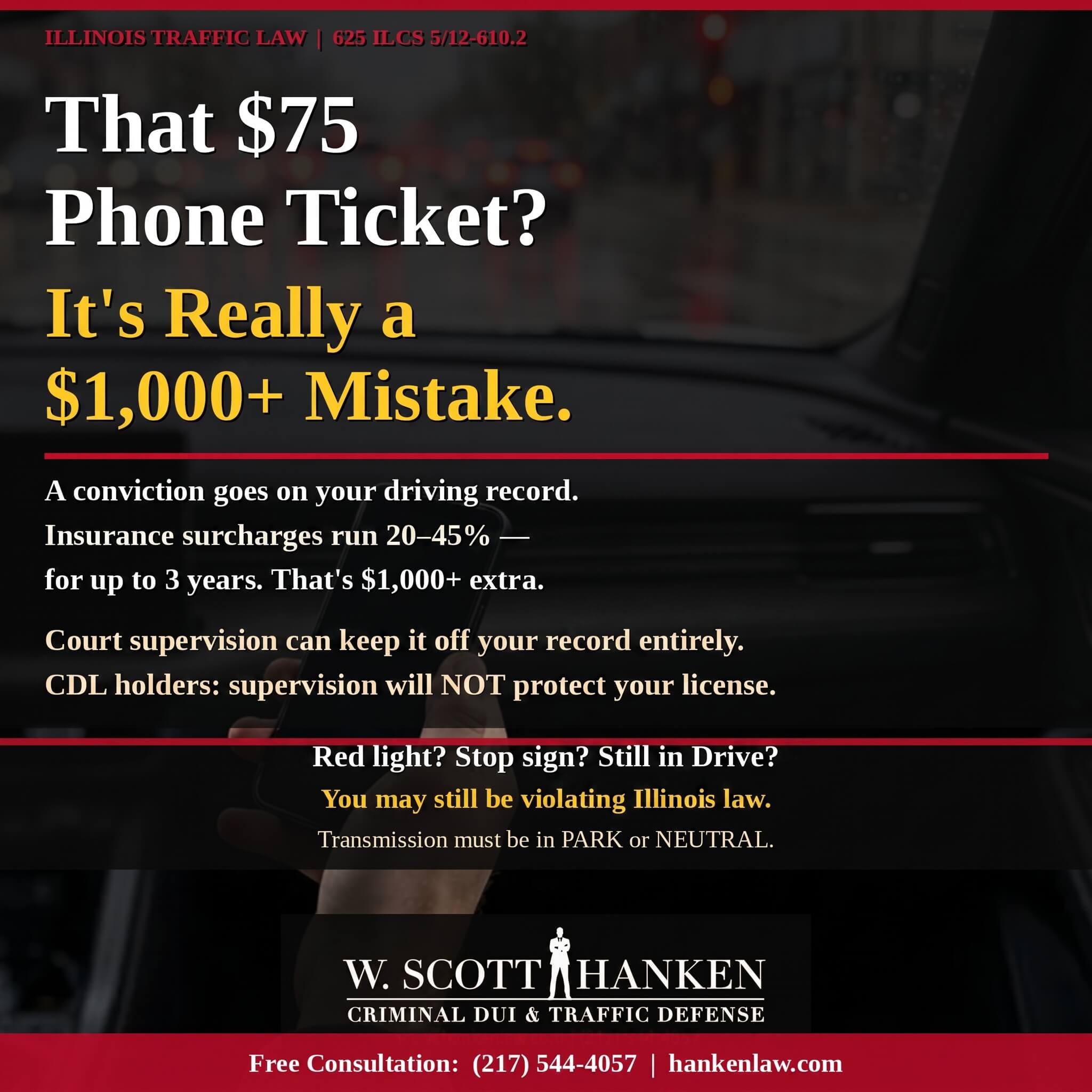
Most people see a $75 ceiling and assume they’re getting off cheap. The fine is rarely the largest number involved.
Carriers treat an electronic device conviction as a distracted driving offense, a category insurers increasingly price as a serious risk indicator. How much it costs is harder to pin down than most articles admit, because the published estimates diverge sharply. The Zebra’s rate analysis puts the average increase for a distracted driving violation at roughly 23%. CarInsurance.com’s analyses of texting violations have reported figures in the 33% to 43% range. None of these studies is Illinois-specific, and the spread between carriers is wider than the spread between studies — in CarInsurance.com’s carrier comparison, the increase ran about 15% at State Farm and roughly 49% at Travelers.
What that means in dollars depends entirely on your baseline premium and your carrier. To illustrate the scale rather than predict your bill: on a $1,500 annual premium, a 25% surcharge is about $375 a year. Violations typically affect your rating for about three years. Even at the low end of the published estimates, that is several times the fine.
There is one more layer people rarely account for. If your insurer has been giving you a good-driver discount — and most do after a few clean years — that discount generally disappears with a moving violation conviction. The real-world effect is the new surcharge plus the lost discount, which is why the actual renewal bill often lands higher than a raw percentage suggests.
The bottom line: the fine is a one-time hit. Elevated premiums are a multi-year tax on a single bad moment. That is the math that changes the calculus on whether a ticket is worth fighting.
Court Supervision: The Tool That Keeps a Ticket Off Your Record
Here is what most people who simply mail in the fine never learn. Illinois law provides a disposition designed to keep a traffic case from becoming a conviction on your public driving record. It’s called court supervision.
Court supervision is authorized under 730 ILCS 5/5-6-1(c), with its conditions set out in 730 ILCS 5/5-6-3.1. Rather than entering a conviction, the court defers further proceedings and places you on supervision for a set period — commonly a few months in a traffic case. For a cell phone ticket in Sangamon County, the condition is usually that you pick up no new violations during that period. Complete it successfully and, under 5-6-3.1(e), the court discharges you and enters a judgment dismissing the charge. Subsection (f) makes explicit that the discharge is without adjudication of guilt and is not a conviction for purposes of disqualifications imposed by law.
For insurance purposes, that distinction is the whole ballgame. No conviction on the public abstract generally means no surcharge for the offense.
What it costs in Sangamon County is the fine plus court costs and a supervision fee. The exact total depends on which assessments apply to your case, and those figures change — the circuit clerk can quote you the current amount, and so can we. In practical terms it runs modestly more than simply paying the ticket, and it avoids the conviction entirely. That is not a close call for most drivers.
Two important limits.
First, 730 ILCS 5/5-6-1(k) restricts supervision for offenses against traffic regulations governing the movement of vehicles to twice within any 12-month period. Supervision is also unavailable for certain offenses outright, DUI among them. Judges retain discretion to deny it even when you are technically eligible.
Second, and this one is critical: if you hold a commercial driver’s license, supervision will not protect you. See the next section before you make any decision.
For everyone else, the advice is simple: do not just pay it. Find out whether you qualify for supervision before you decide anything. The cost difference is small. The difference in consequences is not.
CDL Holders Face a Different Standard — and Supervision Won’t Save You
If you hold a Commercial Driver’s License, a phone violation is a serious traffic violation, and the rules that protect ordinary drivers do not apply to you.
Disqualification is governed by 625 ILCS 5/6-514 and the federal standards at 49 C.F.R. § 383.51. Two serious traffic violations arising from separate incidents within a three-year period trigger a disqualification of not less than two months. Three within three years triggers not less than four months. The violations count whether they occurred in a commercial vehicle or your personal car — with one qualifier: where the violations were committed in a non-commercial vehicle, the disqualification enters only if those convictions would also suspend or revoke your non-commercial driving privileges.
Now the part that costs commercial drivers their careers.
Court supervision does not prevent a CDL disqualification. Illinois defines “conviction,” for commercial licensing purposes, at 625 ILCS 5/6-500 to include the payment of a fine or court costs regardless of whether the imposition of sentence is deferred and a judgment dismissing the charge is ultimately entered. Federal law reinforces this: 49 C.F.R. § 384.226 bars states from masking, deferring, or otherwise concealing a CDL holder’s conviction. Supervision that would keep a ticket off an ordinary driver’s public record still lands on a commercial driver’s record and still counts toward disqualification.
I have seen drivers accept supervision believing the problem was solved, then receive a disqualification notice months later. It is one of the most damaging misunderstandings in traffic court, and it is entirely avoidable.
For a CDL holder, the realistic paths are narrower: get the citation dismissed, win it at trial, or negotiate an amendment to a non-moving violation that is not reportable as a serious traffic violation. Each of those requires the case to be handled as a contested matter from the start, not resolved at the counter. If you drive for a living, treat a phone ticket as a threat to your livelihood, because that is what it is. The same trap applies in the DUI context — see DUI Court Supervision Won’t Protect Your Illinois CDL.
Aggravated Use — Misdemeanor and Felony Charges
This is where the statute stops being a traffic law. Under 625 ILCS 5/12-610.2(b-5):
Statute Callout — 625 ILCS 5/12-610.2(b-5) and (e), the aggravated offense:
A person commits aggravated use of an electronic communication device when he or she violates subsection (b) and, in committing the violation, is involved in a motor vehicle crash that results in great bodily harm, permanent disability, disfigurement, or death to another — and the violation is a proximate cause of the injury or death.
- Class A misdemeanor if the violation resulted in great bodily harm, permanent disability, or disfigurement to another.
- Class 4 felony if the violation resulted in the death of another person.
Source: 625 ILCS 5/12-610.2(b-5) and (e), Illinois Vehicle Code.
Note the two elements that limit the charge: the injury threshold is high — great bodily harm, permanent disability, disfigurement, or death, not any injury — and the State must prove the phone use was a proximate cause. Neither element is automatic, and both are contestable.
The exposure, however, is real. A Class A misdemeanor carries up to 364 days in jail and fines up to $2,500. A Class 4 felony carries one to three years in the Illinois Department of Corrections. Subsection (c) adds a minimum $1,000 fine on top of either. These are criminal charges with consequences for your employment, your freedom, and your record.
If you have been in a crash and the other driver or the police are suggesting your phone played a role, stop talking and call an attorney before you give a statement.
School Zones, Construction Zones, and Emergency Scenes
A separate statute — 625 ILCS 5/12-610.1(e) — imposes a stricter rule in three high-risk areas. No driver, regardless of age, may use a wireless telephone while operating a motor vehicle on a roadway in a school speed zone established under Section 11-605, on a highway in a construction or maintenance speed zone established under Section 11-605.1, or within 500 feet of an emergency scene. An emergency scene is a location where an authorized emergency vehicle is present and has activated its oscillating, rotating, or flashing lights.
Here is the trap. The exceptions under 12-610.1(e) are narrower than the exceptions under 12-610.2(d). The 12-610.1(e) list covers only: construction or maintenance workers engaged in the project for which the zone was established; use for emergency purposes; law enforcement officers and emergency vehicle operators performing official duties; voice-operated mode, which may include a headset; a single button press to initiate or terminate a voice communication; and using a device solely to report an emergency and communicate with emergency personnel during it.
What is not on that list matters. There is no shoulder-parking exception. There is no traffic-obstruction exception. Sitting at a red light in a school speed zone with your transmission in park does not exempt you under 12-610.1(e), even though the same conduct would fall inside 12-610.2(d)(6) elsewhere.
Officers pay heightened attention in these areas and prosecutors treat school zone violations more seriously. In a Springfield school zone, the safe rule is simple: hands off the phone entirely.
Defense Options: Every Case Has Facts Worth Examining
As a former Sangamon County prosecutor who has spent 37+ years on both sides of the courtroom, I’ll tell you plainly: these cases are rarely as open-and-shut as the ticket makes them look. Here is what I evaluate in every electronic device case:
The officer’s observation angle and distance. Was he positioned to actually see what your hands and your screen were doing? Was it dark? Were there obstructions between you? The observation window is often a fraction of a second, and the State’s whole case may rest on it.
Integrated device or hands-free mode. Apple CarPlay, Android Auto, a dash-mounted GPS, a vehicle-integrated system — these fall outside the definition or inside the (d)(3) exemption. For voice communication, that is a complete answer.
Single-button press. Subsection (d)(9) permits pressing one button to initiate or terminate a voice call. If that is all you did, it is a complete defense — with the caveat that subsection (b) removes this exemption when the device is being used for video, video conferencing, or social media.
Parked on the shoulder. Were you actually stopped on the shoulder rather than in a travel lane? That is (d)(5), and it is a full exemption outside the zones covered by 12-610.1(e).
The obstruction exception, properly established. If you can show the transmission was in neutral or park while traffic was obstructed, (d)(6) applies — red light included.
Emergency reporting. Were you calling 911, reporting a crash, or reporting a crime in progress? That is (d)(2).
Charging and notice defects. A citation that misidentifies the subsection or fails to state the offense is a problem for the State, not for you.
None of these works in every case. But every case deserves a real look before you decide how to resolve it.
Frequently Asked Questions (FAQs)
Only if your transmission is in neutral or park. Subsection (d)(6) requires two things at once: that the vehicle be stopped due to normal traffic being obstructed, and that the transmission be in neutral or park. Stopping with the car in Drive satisfies only the first. Most drivers who believe they are covered at a stoplight are not.
The statute prohibits using an electronic communication device, not holding one, so holding alone is not expressly prohibited by the text. Practically, an officer who sees a phone in your hand will infer use and write a report describing conduct consistent with use. It is a defense you can raise, but it needs corroborating facts.
Yes. Subsection (c) classifies the violation as an offense against traffic regulations governing the movement of vehicles — a moving violation. Three such convictions within any 12-month period give the Secretary of State authority to suspend or revoke your license under 625 ILCS 5/6-206(a)(2).
For a standard violation with no aggravating circumstances, supervision is generally available to drivers who request it properly. Illinois limits supervision for moving violations to twice within any 12-month period under 730 ILCS 5/5-6-1(k), and judges retain discretion to deny it. If you hold a CDL, supervision will not protect your commercial license — see the CDL section above.
Under subsection (b-5), when the violation occurs in a motor vehicle crash causing great bodily harm, permanent disability, disfigurement, or death to another, and the phone use was a proximate cause. That is a Class A misdemeanor for serious injury and a Class 4 felony where someone dies, plus a minimum $1,000 fine under subsection (c).
Further Reading
Practice Area
Related Articles
- DUI Court Supervision Won’t Protect Your Illinois CDL — If you drive commercially, the same trap described above applies in the DUI context, with steeper penalties.
- Illinois Improper Lane Usage: What the Law Actually Says, What It Costs, and Why You Should Fight It — Another everyday citation that quietly counts as a serious traffic violation for CDL holders.
- What to Do During a Traffic Stop in Illinois: A Step-by-Step Guide — What you say in the first sixty seconds shapes what the officer’s report says you were doing with your phone.
- How a Traffic Ticket Outside Illinois Impacts Your Driving Record — Ticketed on I-72 heading out of state, or somewhere else entirely? It still follows you home.
- 2026 Guide to Sangamon County DUI & Traffic Court: Navigating the Shift Toward Remote Justice — Find out how your court date will actually be held before deciding whether to appear in person.
Browse by Topic
Ready to Fight Your Traffic Case in Springfield?
Call W. Scott Hanken at (217) 544-4057 or contact us online for a free consultation. We serve clients throughout Springfield, Sangamon County, and Central Illinois.
About the Author: W. Scott Hanken, Attorney at Law
Scott Hanken is a Springfield, Illinois criminal defense attorney with over 37 years of experience, including service as a former Sangamon County prosecutor. He has been voted Best Attorney by the Illinois Times and State Journal-Register, holds an Avvo 10.0 “Superb” rating, and has earned over 270 five-star Google reviews. He serves clients throughout Sangamon County and Central Illinois.
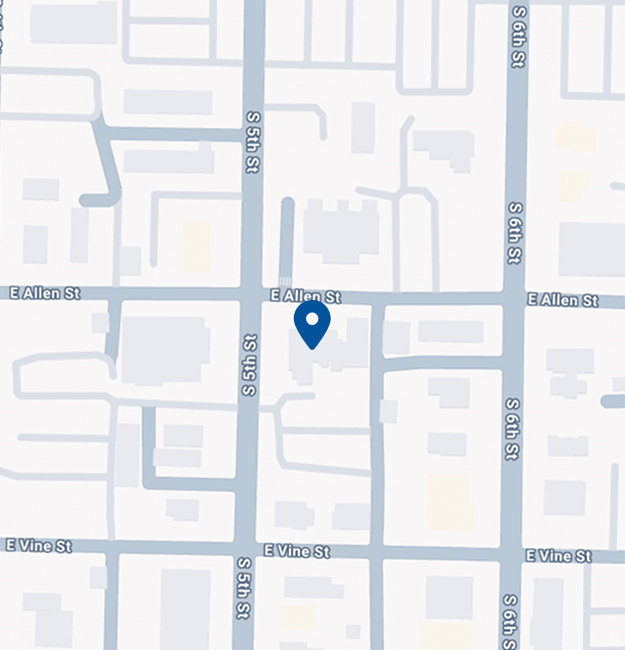
📍 1100 S 5th St, Springfield, IL 62703 | ☎ (217) 544-4057 | 🌐 hankenlaw.com
This article is for general educational purposes only and does not constitute legal advice. Every case is unique — contact an experienced Springfield criminal defense attorney for guidance on your specific situation.
Address
Our offices are located at the corner of South Fifth Street and Vine, in the historic Mary Bryant Home for the Blind.