- Free Consultation: (217) 544-4057 Tap Here To Call Us















Illinois Improper Lane Usage: What the Law Actually Says, What It Costs, and Why You Should Fight It


By: W. Scott Hanken | Former Sangamon County Prosecutor | Springfield Criminal Defense & DUI Attorney |
Voted “Best Attorney” — Illinois Times Best of Springfield & State Journal-Register Reader’s Choice | Springfield, IL • Sangamon County • (217) 544-4057 • hankenlaw.com
The short answer:
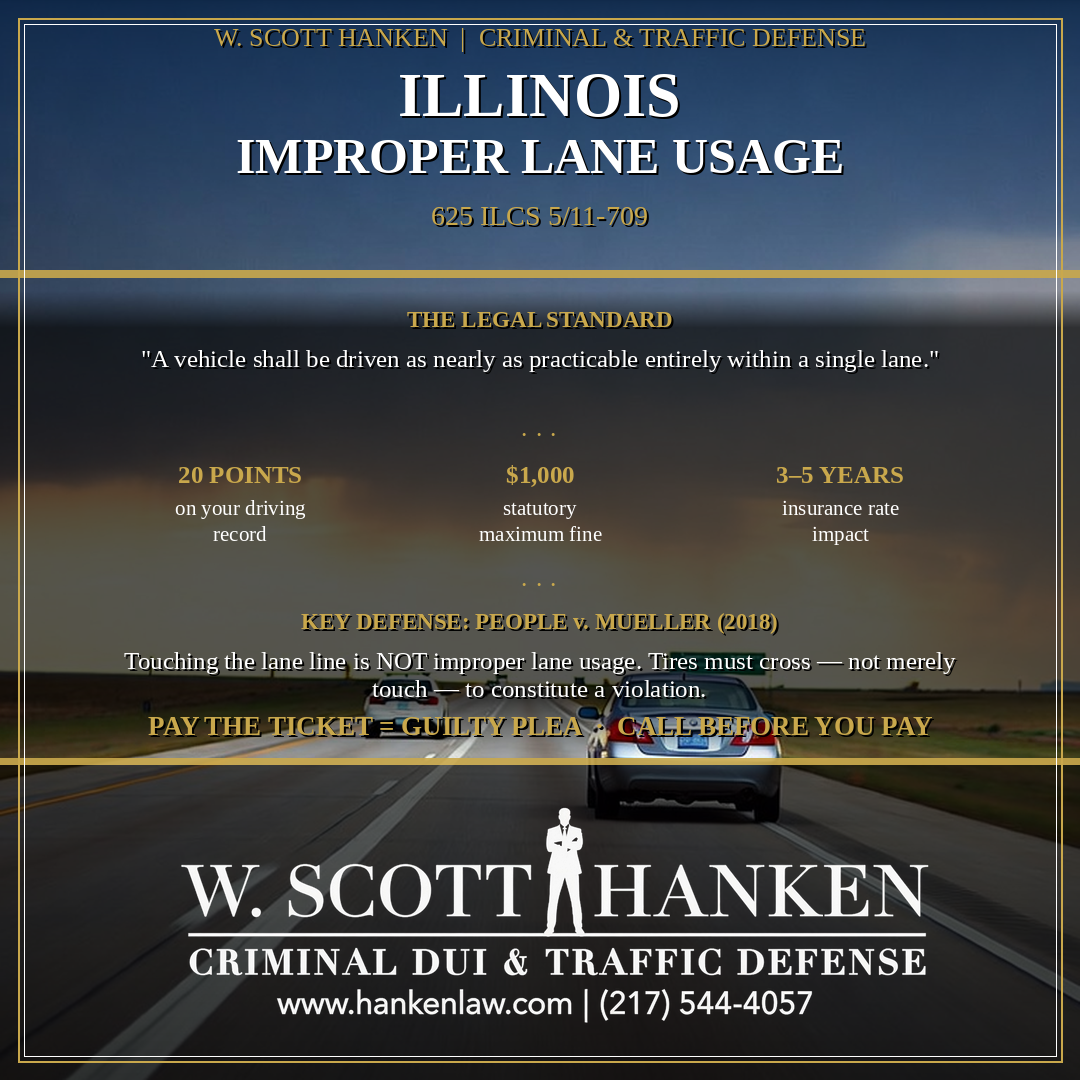
An improper lane usage citation under 625 ILCS 5/11-709 is a petty offense — but it is also a moving violation. Pay the ticket online and you have just entered a guilty plea. That conviction adds 20 points to your driving record, triggers an insurance premium increase that typically runs 20-30% and lasts three to five years, and counts toward the three-conviction threshold that suspends your license. It is also the most common pretextual basis officers use to initiate a DUI stop in Sangamon County and across Illinois. This ticket deserves a fight.
You were driving down South MacArthur, heading north on I-55 past the Wabash Avenue exchange, or maybe making your way home on Veterans Parkway. You drifted slightly, changed lanes without perfect precision, or found yourself in the center lane longer than an officer thought was appropriate. Now you are holding a ticket.
The box marked 11-709 seems minor. It is not. After 37 years of handling Illinois criminal and traffic cases — including years as a Sangamon County Assistant State’s Attorney — I can tell you that “petty offense” is one of the most misleading labels in the Illinois Vehicle Code. Here is exactly what this statute says, what it does not say, and what a conviction will actually cost you.
The Statute: What 625 ILCS 5/11-709 Actually Requires
The controlling statute is 625 ILCS 5/11-709, titled “Driving on roadways laned for traffic,” as amended by P.A. 101-173 (eff. 1-1-20). It applies only when a roadway has been divided into two or more clearly marked lanes. Here is what each subsection actually says:
Section (a) — The core rule:
A vehicle shall be driven as nearly as practicable entirely within a single lane and shall not be moved from that lane until the driver has first ascertained that such movement can be made with safety.
Section (b) — Three-lane two-way roads:
On a roadway divided into three lanes that allows two-way traffic, a vehicle shall not be driven in the center lane except (1) when overtaking and passing another vehicle traveling the same direction and the center lane is clear within a safe distance, (2) in preparation for making a left turn, or (3) where the center lane is at that time allocated exclusively to traffic moving in the same direction and that allocation is designated by official traffic control devices.
Section (c) — Official lane designations:
When traffic control devices designate specific lanes for specific types of traffic or specific directions, drivers must obey those designations — except when a different lane is necessary to complete a turning maneuver.
Section (d) — No-lane-change zones:
Where official traffic control devices prohibit changing lanes, drivers must obey those devices.
Section (e) — Emergency vehicle exception:
A person is not in violation of this section if complying with Sections 11-907 (approaching an emergency vehicle), 11-907.5, or 11-908 (funeral processions).
The phrase that drives most of the litigation around this statute is “as nearly as practicable.” The legislature did not write “perfectly” or “at all times.” Practicable means feasible under the actual conditions present. That language creates real room for defense.
What Counts as Improper Lane Usage — and What Does Not
The statute requires that an officer observe a driver failing to maintain lane position when doing so was actually practicable. That distinction matters enormously in court.
Conduct That Can Support a Valid Citation
| Conduct | How It Triggers 11-709 |
|---|---|
| Weaving or drifting across the lane dividing line repeatedly | Failure to stay “as nearly as practicable” in a single lane |
| Abrupt, unsignaled lane change without checking safety | Moving from a lane without first ascertaining it can be done safely |
| Occupying the center lane on a three-lane two-way road without overtaking, turning left, or official designation | Direct violation of Section (b) |
| Changing lanes in a marked no-lane-change zone | Violation of Section (d) and traffic control device |
| Straddling the lane line without changing lanes | Failure to stay within a single lane — though see People v. Mueller below |
| Driving on the shoulder of a multi-lane road as a travel lane | Using an area not designated as a traffic lane |
Conduct That May NOT Support a Valid Citation
| Conduct | Why It May Be Defensible |
|---|---|
| A single, brief touch of the lane line | People v. Mueller, 2018 IL App (2d) 170863: a vehicle’s tires touching, but not crossing, the lane line does not by itself establish improper lane usage |
| Lane position adjustment to avoid road debris, pothole, or obstacle | Impracticable to maintain lane under the actual conditions — “as nearly as practicable” language |
| Slight lane drift in a construction zone with narrow or faded markings | If lane markings were unclear, the statutory trigger (“clearly marked lanes”) may not be met |
| Lane adjustment to yield to a merging emergency vehicle | Expressly exempted by Section (e) / 625 ILCS 5/11-907 |
| Lane change in response to sudden evasive action by another driver | Safety practicability defense; driver lacked opportunity to first ascertain safety |
| Wide turn into the nearest available lane on a two-lane road | May not involve a “clearly marked” lane violation depending on intersection geometry |
The practical takeaway: the statute requires both a clearly marked lane and a failure to maintain it when maintenance was practicable. An officer’s observation that a vehicle crossed a line once, briefly, under imperfect road conditions is not a guarantee of conviction. People v. Mueller is particularly important — the Second District’s holding that a driver’s tires merely touching the line between lanes, without crossing it, does not establish improper lane usage is a usable defense argument in Sangamon County courts today. (Mueller verified good law as of June 2026; no reversal found. The Third District discussed Mueller in People v. Rice, 2021 IL App (3d) 180549, but expressly declined to either adopt or reject its holding, finding Rice’s facts — a lane change within an intersection — distinguishable.)
Penalties for a Conviction Under 625 ILCS 5/11-709
Classification and Fine
Improper lane usage is a petty offense under the Illinois Vehicle Code. It is not a misdemeanor and carries no potential jail time. The statutory maximum fine is $1,000, plus mandatory court fees and assessments. In practice, fines imposed in Sangamon County courts are typically well below that ceiling — but court costs and assessments can add substantially to your out-of-pocket total regardless of the base fine amount.
Points on Your Illinois Driving Record
This is where the real exposure begins. The Illinois Secretary of State assigns 20 points to a driver’s record for a conviction under 625 ILCS 5/11-709. To put that in context: a speeding conviction for 11 to 14 mph over the limit generates only 10 points. Improper lane usage generates double that.
Under the Illinois Secretary of State point and conviction system, the consequences build quickly:
| Situation | Consequence |
|---|---|
| 3 moving violation convictions within any 12-month period (drivers 21+) | Mandatory license suspension; length determined by accumulated point total |
| 15-44 points (first suspension for drivers 21+) | 2-month suspension |
| 45-74 points | 3-month suspension |
| 75-89 points | 6-month suspension |
| 90-99 points | 9-month suspension |
| 100+ points | 12-month suspension |
| 2 moving violation convictions within any 24-month period (drivers under 21) | Mandatory suspension; stricter thresholds apply |
A single ILU conviction at 20 points, combined with one prior speeding conviction at 20 points, puts a driver within reach of the minimum suspension threshold before a third violation even occurs. In the Sangamon County court system, clients have lost their licenses over what they thought were a series of minor tickets — because they paid each one online without understanding the cumulative effect.
CDL Drivers Face Stricter Consequences
If you hold a Commercial Driver’s License, improper lane usage carries a separate layer of exposure. Erratic or improper lane changes are listed as a “serious traffic violation” for CDL holders under federal and Illinois commercial licensing rules. Two serious traffic violations within three years can result in a 60-day CDL disqualification. Three within three years means a 120-day disqualification. For a CDL holder who drives for a living, a single ILU ticket is not a minor annoyance — it can be the beginning of the end of a commercial driving career.
The Insurance Impact of an Improper Lane Usage Conviction
This is the consequence most people underestimate. The fine is a one-time cost. The insurance impact is not.
When you pay an improper lane usage ticket without fighting it, you have entered a guilty plea. That conviction is reported to the Illinois Secretary of State. Your insurance carrier pulls your driving abstract at renewal. They see the conviction. They reclassify your risk tier. Your rate goes up — and stays up for three to five years.
Illinois drivers typically see premium increases in the range of 20-30% following a single moving violation conviction, though the exact increase varies by carrier and driving history. On a policy that costs $1,500 per year, that range translates to roughly $300 to $450 annually — potentially $900 to $1,350 or more over a three-year period. If you already have a prior moving violation, the recalculation can be steeper, and some standard-market insurers may decline to renew your policy entirely, pushing you into the non-standard or assigned-risk market where rates are significantly higher.
The real financial picture for a typical Springfield-area driver:
| Cost Category | Estimated Amount |
|---|---|
| Base fine (typical Sangamon County range) | $150 – $300 |
| Court fees and mandatory assessments | $100 – $226+ |
| Insurance premium increase (20-30% for 3 years at $1,500/yr baseline) | $900 – $1,350+ |
| TOTAL REAL COST OF JUST PAYING THE TICKET | $1,150 – $1,900+ |
Court supervision is the other path. In Illinois, court supervision is a disposition — available for eligible petty offenses in Sangamon County courts — under which the ticket is dismissed upon successful completion of the supervision period. A supervised dismissal is not a conviction. It is not reported to the Secretary of State as a conviction. Your insurance company sees nothing. Your record stays clean. Not every driver is eligible, and not every court grants it, but it is a real option that should be explored before you pay any moving violation ticket online.
Improper Lane Usage and DUI: The Stop That Starts Everything
Officers are trained to observe specific driving patterns as indicators of impairment. Lane weaving, drifting, and failing to maintain lane position are at the top of that list. In most DUI investigations, the officer’s written report will document some form of observed lane behavior as the stated reason for the initial traffic stop. That ILU ticket attached to a DUI arrest is not incidental — it is strategic. It is the legal foundation on which the entire stop is built.
Here is why that matters for the defense: if the observed driving did not actually rise to the level of a violation of 625 ILCS 5/11-709, the traffic stop may not have been legally justified. An unjustified stop is a Fourth Amendment problem. Evidence gathered during an unconstitutional stop — field sobriety test results, breath test readings, observations of the driver — can be subject to a motion to suppress. If that motion succeeds, the State’s case can collapse entirely.
Whether a single crossing of the lane line on a wet road on Dirksen Parkway at 11 PM constitutes improper lane usage — or whether it was, in fact, as nearly as practicable what any driver would do under those conditions — is exactly the kind of factual and legal argument that needs to be made at the suppression stage.
Defense Strategies for Improper Lane Usage in Illinois
“As nearly as practicable” challenge.
If road conditions, traffic, weather, construction, or a road hazard made staying perfectly within the lane impracticable, that directly addresses the statutory standard. The offense is not failing to stay in the lane — it is failing to stay in the lane when doing so was practicable.
Driving on the line is not leaving the lane.
The Second District Appellate Court held in People v. Mueller, 2018 IL App (2d) 170863, that a driver whose vehicle’s tires touched, but did not cross, the line separating two lanes did not, by that fact alone, commit improper lane usage. This holding remains good law and is a persuasive argument in courts throughout the state, including Sangamon County, though it has not yet been squarely adopted outside the Second District.
No clearly marked lanes.
The statute only applies when lanes are “clearly marked.” Faded lines, construction zones, unmarked areas near intersections, or nighttime conditions that rendered markings unclear are all potential challenges to whether the statutory trigger was even met.
The emergency vehicle exception.
If you moved out of your lane to yield to an approaching or overtaking authorized emergency vehicle — ambulance, police cruiser, fire apparatus — Section (e) of the statute expressly exempts that conduct from any violation.
No independent corroboration of the officer’s observation.
Patrol vehicle dash camera footage, intersection camera footage, or the absence of any recorded footage may be crucial. If the officer’s written account of lane behavior is contradicted by video evidence — or if no video exists — that goes to the weight of the prosecution’s evidence.
The stop itself was pretextual.
In a DUI context, challenging whether the observed lane behavior actually constituted a violation, and therefore whether the stop was supported by reasonable articulable suspicion, is a foundational motion. A Sangamon County judge considering a suppression motion will examine the totality of circumstances, including the specificity of the officer’s observations, the road conditions, and any available video.
Frequently Asked Questions (FAQs)
625 ILCS 5/11-709 requires that a vehicle be driven “as nearly as practicable” within a single lane when lanes are clearly marked, and that the driver not move from that lane until they have ascertained the movement can be made safely. The statute does not require perfection — it requires reasonable lane discipline under prevailing conditions.
Yes. In Illinois, paying a traffic ticket — whether online, by mail, or at the clerk’s window — is legally equivalent to entering a guilty plea. That guilty plea is processed as a conviction, reported to the Secretary of State, posted to your driving record, and made visible to your insurance carrier at renewal. Court supervision or dismissal at trial are the paths to avoiding a conviction.
A conviction for improper lane usage carries 20 demerit points under the Illinois Secretary of State system. That is twice the point value of a speeding ticket for 11 to 14 mph over the limit. Points from a moving violation conviction remain on your driving record for four to five years.
Not from a single ticket alone, typically. But it counts toward the three-conviction-in-12-months threshold that triggers mandatory suspension for drivers 21 and older. For drivers under 21, only two convictions within any 24-month period are needed to trigger suspension. At 20 points per conviction, an ILU ticket is a meaningful step toward that threshold.
Potentially. Court supervision is available for many petty traffic offenses, and Sangamon County courts do grant it when a defendant has a favorable driving history and the facts support the request. Supervision, if successfully completed, results in a dismissal — not a conviction — and does not affect your insurance rates. Not everyone qualifies and it is not automatic; an attorney can assess your eligibility and appear on your behalf.
Erratic or improper lane changes can qualify as a “serious traffic violation” for CDL holders under applicable commercial licensing rules. Two serious violations within three years triggers a 60-day CDL disqualification; three within three years triggers 120 days. CDL holders should never pay an ILU ticket without consulting an attorney first.
Improper lane usage is frequently the stated basis for a traffic stop that then escalates into a DUI investigation. The lane violation itself does not produce a DUI charge. But if the officer uses observed lane behavior as the justification for pulling you over, the validity of that observation — and whether it actually constituted a statutory violation — becomes the central issue in any subsequent Fourth Amendment suppression motion.
Why Experience With the Sangamon County Court System Matters
Not every traffic ticket attorney is the same. Most traffic cases in Illinois are resolved through negotiation before trial — through a dismissal, a supervision order, or an amendment to a non-moving violation. Those outcomes depend in part on the strength of the legal arguments, and in part on a defense attorney’s familiarity with how individual courts and prosecutors approach these cases.
W. Scott Hanken has been practicing in Sangamon County courts for 37 years, including as a former Sangamon County Assistant State’s Attorney. Avvo 10.0 Superb rating. Recognized annually as Best Attorney by both the Illinois Times and the State Journal-Register. These are not just credentials — they are the record of a practice built on outcomes.
If you are holding an improper lane usage ticket in Springfield, Sangamon County, or the surrounding central Illinois area, call before you pay. The cost of a consultation is a fraction of what a conviction will cost you in insurance alone.
Related Reading
Traffic Ticket from a Fender Bender in Springfield? Here’s What Actually Happens Next — Another look at how a routine moving violation ticket can snowball into points, license consequences, and insurance costs.
Reasonable Suspicion Is a Key Element in Drunk Driving Stops — A closer look at the reasonable suspicion standard officers must meet before pulling you over — the same standard at the heart of an improper lane usage stop.
Charged With Resisting or Obstructing a Peace Officer in Illinois? Here’s What the Law Actually Says — and What Just Changed — What can happen when a routine traffic stop escalates, and how Fourth Amendment challenges to the initial stop factor into the defense.
What You Should Know About DUI Checkpoints in Illinois — More on how Illinois officers build the case for a DUI stop, and what rights you have when you’re pulled over.
Ready to Fight Your Traffic Case in Springfield?
Call W. Scott Hanken at (217) 544-4057 or contact us online for a free consultation. We serve clients throughout Springfield, Sangamon County, and Central Illinois.
About the Author: W. Scott Hanken, Attorney at Law
Scott Hanken is a Springfield, Illinois criminal defense attorney with over 37 years of experience, including service as a former Sangamon County prosecutor. He has been voted Best Attorney by the Illinois Times and State Journal-Register, holds an Avvo 10.0 “Superb” rating, and has earned over 270 five-star Google reviews. His firm handles DUI defense, drug crimes, traffic violations, violent crimes, and weapons offenses throughout Sangamon County and Central Illinois.
📍 1100 S 5th St, Springfield, IL 62703 | ☎ (217) 544-4057 | 🌐 hankenlaw.com
This document is provided for general informational purposes only and does not constitute legal advice. Reading this document does not create an attorney-client relationship. Every case is different, and the law may have changed since this document was prepared. Statute citations verified against ilga.gov. People v. Mueller, 2018 IL App (2d) 170863 verified as good law as of June 2026; discussed but neither adopted nor rejected by People v. Rice, 2021 IL App (3d) 180549, on distinguishable facts; no reversal or negative subsequent history identified for Mueller. If you have been cited for improper lane usage or any other traffic or criminal offense in Illinois, consult a licensed Illinois attorney about the specific facts of your case. W. Scott Hanken, Attorney at Law is licensed to practice law in Illinois. Office: 1100 S. 5th St., Springfield, IL 62703. Phone: (217) 544-4057.

Address
Our offices are located at the corner of South Fifth Street and Vine, in the historic Mary Bryant Home for the Blind.