- Free Consultation: (217) 544-4057 Tap Here To Call Us




Illinois CCL Bar Carry: Felony UUW Conviction Blocked (2026)


Last Reviewed & Updated: October 16, 2026
By: W. Scott Hanken | Former Sangamon County Prosecutor | Springfield Criminal Defense & Weapons Offenses Defense Attorney | Voted “Best Attorney” — Illinois Times Best of Springfield & State Journal-Register Reader’s Choice | Springfield, IL | Sangamon County | (217) 544-4057 | hankenlaw.com
Opinion filed: September 16, 2026 (published opinion, Illinois Appellate Court, First District, Third Division).
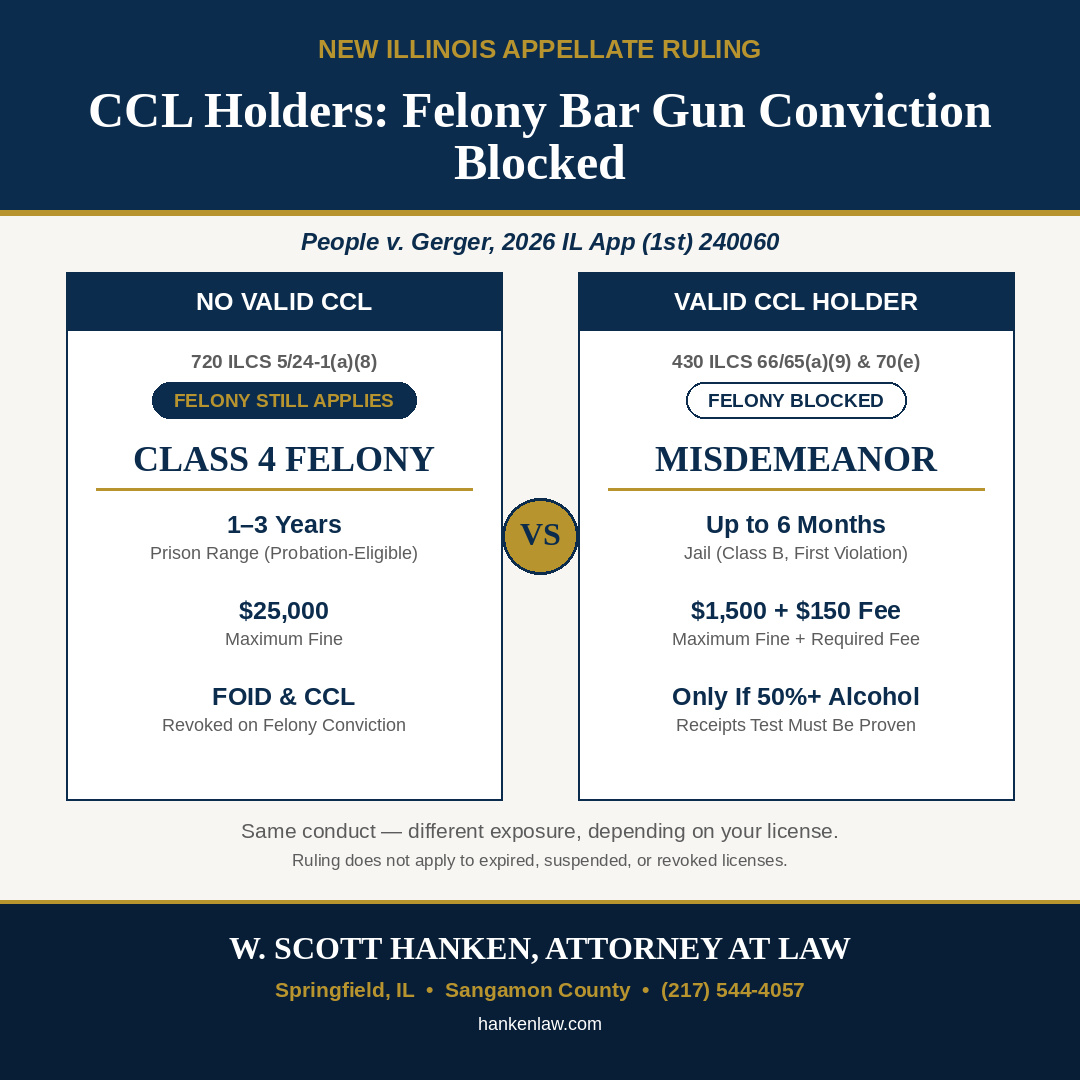
A valid Illinois concealed carry license (CCL) exempts the licensee from prosecution for the felony of carrying a firearm into a bar, restaurant, or other place licensed to sell alcohol under 720 ILCS 5/24-1(a)(8). The First District Appellate Court so held in People v. Gerger, 2026 IL App (1st) 240060, a published opinion filed September 16, 2026. A CCL holder can still face a lesser misdemeanor under the Firearm Concealed Carry Act itself if the establishment meets that Act’s 50%-alcohol-receipts test.
A note on names: Effective January 1, 2025, the legislature renamed the offense in 720 ILCS 5/24-1. It went from “unlawful use of weapons” to “unlawful possession of weapons.” Gerger arose from a 2022 incident and uses the older “unlawful use of a weapon (UUW)” label, so this article does too.
Bottom Line: Suppose you held a valid Illinois CCL, were otherwise eligible to carry, and are charged under 24-1(a)(8) for carrying into a bar or restaurant. Gerger holds that 430 ILCS 66/70(f) exempts you from that felony prosecution. This doesn’t make carrying into a qualifying alcohol establishment legal, because a Carry Act violation is still possible. But it changes your maximum exposure from a Class 4 felony to a misdemeanor.
Key Takeaways:
- Under Gerger, a valid CCL exempts the licensee from prosecution under 720 ILCS 5/24-1(a)(8). A charge filed anyway should be subject to dismissal.
- The (a)(8) felony has no 50%-alcohol-receipts test. The Carry Act’s own prohibition does.
- CCL holders can still face a Class B misdemeanor for a first violation (Class A for a second or subsequent one) under 430 ILCS 66/65(a)(9) and 70(e).
- Gerger is a First District decision. Even so, Illinois appellate decisions bind trial courts statewide, including in Sangamon County, unless the trial court’s home district has ruled the other way. For Sangamon County that is the Fourth District, which has not addressed subsection (a)(8). Neither has the Illinois Supreme Court.
- Under Ill. S. Ct. R. 315(b)(1), a petition for leave to appeal Gerger is due 35 days after judgment, which is October 21, 2026. A timely petition for rehearing in the appellate court would extend that deadline.
- The same opinion held that bringing a gun into a bar does not, by itself, prove that a later discharge during a struggle was reckless.
Facing a weapons charge in Sangamon County right now? Call (217) 544-4057 for a free consultation with a former Sangamon County prosecutor who brings 37+ years of experience to your defense.
What Happened in People v. Gerger?
In January 2022, Daniel Gerger and a companion were seated at the bar of The Stadium Sports Club and Pizza (The Stadium Club) in Rolling Meadows. Another patron, Sean Kelly, objected to the companion’s noise. He picked up a pitcher of water and advanced on them. Gerger raised his hands defensively, and Kelly knocked him to the floor and kicked him. From the floor, Gerger drew a handgun and shot Kelly once in the abdomen.
The trial court found that Kelly was the initial aggressor and that Gerger reasonably believed deadly force was necessary. It acquitted Gerger of attempted murder and of aggravated battery as to Kelly. Gerger, ¶¶ 4, 7, 12.
What followed was chaos. The bar’s general manager and several patrons piled onto Gerger, punching and choking him while he tried to keep hold of the gun. The struggle lasted about a minute. During it, a second shot fired and struck another patron, Giovanni Resendez, in the leg; Resendez was trying to wrest the gun away at the time. Gerger, ¶¶ 5, 7, 9.
The trial court acquitted Gerger of aggravated battery with a firearm as to Resendez. It convicted him of two offenses:
- reckless discharge of a firearm, for the second shot; and
- the (a)(8) offense, for bringing a gun into a place licensed to sell alcohol, even though he held a valid FOID card and CCL.
He received two years of probation on each count, to run concurrently. Gerger, ¶¶ 11, 13–16. The appellate court reversed both convictions. Gerger, ¶¶ 24, 35, 37–38.
Can a Concealed Carry License Holder Be Convicted of Felony UUW for Carrying a Gun Into a Bar?
Not under current Illinois appellate law. Section 24-1(a)(8) makes it a Class 4 felony to carry or possess a firearm “in any place which is licensed to sell intoxicating beverages.” A second or subsequent violation is a Class 3 felony. 720 ILCS 5/24-1(a)(8), (b).
Read on its own, that subsection contains no exception for CCL holders. That is exactly what the trial court in Gerger relied on to convict. Gerger, ¶ 15.
The appellate court found that reading incomplete. Gerger holds that 430 ILCS 66/70(f) exempts a valid CCL holder from prosecution under subsection (a)(8). Gerger, ¶ 24.
That is a statutory holding, not a constitutional one. Gerger raised Second Amendment, proportionate-penalties, due process, and equal protection arguments. The court declined to reach any of them because it resolved the case on statutory grounds. Gerger, ¶ 26.
Illinois has a single appellate court. A published decision from any district therefore binds trial courts statewide, unless it conflicts with a decision from the district where the trial court sits. Sangamon County sits in the Fourth District, which has not ruled on this question.
What Does Section 70(f) of the Firearm Concealed Carry Act Actually Say?
Statute Callout — 430 ILCS 66/70(f): “A licensee convicted or found guilty of a violation of this Act who has a valid license and is otherwise eligible to carry a concealed firearm shall only be subject to the penalties under this Section and shall not be subject to the penalties under Section 21-6, paragraph (4), (8), or (10) of subsection (a) of Section 24-1, or subparagraph (A-5) or (B-5) of paragraph (3) of subsection (a) of Section 24-1.6 of the Criminal Code of 2012.”
Source: 430 ILCS 66/70(f), current text as published by the Illinois General Assembly.
The Illinois Supreme Court addressed this language in People v. Harvey, 2024 IL 129357. Harvey was about what the State must prove in a misdemeanor UUW prosecution under subsection (a)(10). In deciding it, the Court read section 70(f) as exempting anyone with a valid CCL from prosecution under (a)(10). Harvey, ¶ 16.
According to the Gerger court, Harvey was the first decision by an Illinois reviewing court to interpret section 70(f). Harvey addressed only subsection (a)(10). Gerger applied the same reasoning to (a)(8) because both appear in the same list in section 70(f). Gerger, ¶ 21.
Why Does 720 ILCS 5/24-1(a)(8) Cover More Bars Than the Concealed Carry Act Does?
This distinction is what makes the exemption matter. The felony statute and the Carry Act’s own prohibition do not cover the same ground.
Statute Callout — 430 ILCS 66/65(a)(9): The Carry Act bars a CCL holder from carrying into “[a]ny building, real property, and parking area under the control of an establishment that serves alcohol on its premises, if more than 50% of the establishment’s gross receipts within the prior 3 months is from the sale of alcohol.”
Section 24-1(a)(8) has no such threshold. It applies to “any place which is licensed to sell intoxicating beverages,” whether that place’s revenue is 5% alcohol or 95%.
Source: 430 ILCS 66/65.
A sports bar with a full kitchen might fail the Carry Act’s 50% test, so carrying there would not violate 430 ILCS 66/65(a)(9) at all. It would still be an “(a)(8) premises” under the broader felony statute. Before Gerger, the State could charge a valid licensee with that felony precisely because subsection (a)(8) has no revenue threshold to prove. After Gerger, that charge should not survive against a valid licensee.
What Is the State’s Strongest Argument Against Gerger?
Section 70(f) applies to a licensee “convicted or found guilty of a violation of this Act.” Read literally, that could mean the exemption applies only after a Carry Act conviction. On that reading, a prosecutor could sidestep it entirely by charging only the (a)(8) felony. The trial court effectively accepted that reasoning. Gerger, ¶ 15.
The appellate court rejected the literal reading as “overly literal” and contrary to the legislature’s intent. It invoked the rule that a literal reading must yield when it produces absurd results, and it held that a Carry Act conviction is not a precondition to the exemption. Gerger, ¶ 22. It also rejected the State’s separate argument that the Carry Act stopped protecting Gerger once he drew the gun from concealment. Gerger, ¶ 25.
Arguments remain available if the case goes further:
- Harvey’s context. Harvey’s statement about section 70(f) came in a case about the State’s burden of proof and the corpus delicti rule on an (a)(10) charge. Harvey never discussed the “convicted or found guilty” language. Gerger, ¶ 22.
- Section 24-2(a-5). That section of the Criminal Code expressly exempts CCL holders from subsections (a)(4) and (a)(10), but not (a)(8). Gerger acknowledged this argument and rejected it, reading the two statutes together. Gerger, ¶ 23.
- The Harvey special concurrence. Justice Neville, joined by Justice Rochford, specially concurred in Harvey and disagreed with the majority’s statutory reading. Harvey, ¶¶ 34–47.
The Illinois Supreme Court has not ruled on subsection (a)(8), and Gerger should not be read as a Supreme Court holding on that point.
Felony UUW vs. Concealed Carry Act Violation: How Do the Penalties Compare?
| Felony — 720 ILCS 5/24-1(a)(8) | Carry Act Violation — 430 ILCS 66/65(a)(9), 70(e) | |
|---|---|---|
| Who can be charged | Anyone carrying a firearm into a place licensed to sell alcohol. After Gerger, this does not include a valid CCL holder. | A CCL holder who carries into an establishment where more than 50% of gross receipts in the prior 3 months came from alcohol |
| Offense class | Class 4 felony; Class 3 felony for a second or subsequent violation (720 ILCS 5/24-1(b)) | Class B misdemeanor for a first violation; Class A for a second or subsequent violation (430 ILCS 66/70(e)) |
| Sentencing range | 1 to 3 years in prison (730 ILCS 5/5-4.5-45(a)); probation or conditional discharge of up to 30 months (730 ILCS 5/5-4.5-45(d)) | Up to 6 months in jail for Class B (730 ILCS 5/5-4.5-60); less than 1 year for Class A (730 ILCS 5/5-4.5-55(a)) |
| Maximum fine | $25,000 (730 ILCS 5/5-4.5-50(b)) | $1,500 for Class B or $2,500 for Class A (730 ILCS 5/5-4.5-55(e)), plus a $150 Mental Health Reporting Fund fee (430 ILCS 66/70(e)) |
| License consequence | A felony conviction is grounds to revoke your FOID card (430 ILCS 65/8(c)), and losing the FOID card requires revocation of your CCL (430 ILCS 66/70(h)) | Illinois State Police may suspend the CCL for up to 6 months after a second violation and must permanently revoke it after 3 or more Section 65 violations (430 ILCS 66/70(e)) |
The gap between those two columns is the reason Gerger matters. Take the same physical conduct: a CCL holder walking into a bar with a concealed firearm. It could be charged as a felony that costs you your FOID card and your CCL. Or it could be charged as a misdemeanor with a possible license suspension. The difference depended entirely on which statute the prosecutor chose. Gerger says that choice isn’t the prosecutor’s to make once someone holds a valid license.
Why Did the Appellate Court Also Throw Out the Reckless Discharge Conviction?
This part of the ruling matters for anyone whose gun discharges during a physical struggle, licensed or not. The trial judge convicted Gerger of reckless discharge on the theory that bringing a firearm into a bar created the reckless risk in the first place.
The appellate court held that reasoning was legally wrong. The reckless discharge statute requires that the discharge itself be done recklessly, not the earlier decision to carry. The State had to prove that Gerger consciously disregarded a substantial and unjustifiable risk at the moment the second shot fired. Gerger, ¶ 32.
The court applied the standard deferential to the State. It viewed the evidence in the light most favorable to the prosecution and asked whether “any rational trier of fact could have found the essential elements of the crime beyond a reasonable doubt.” People v. Jackson, 2020 IL 124112, ¶ 64 (quoted in Gerger, ¶ 29). Even under that standard, the court found the evidence so unsatisfactory that reasonable doubt remained, given the chaotic, multi-person struggle over the weapon. As the court put it, “An accident is not to be equated with recklessness.” Gerger, ¶ 34 (quoting People v. Olivieri, 2016 IL App (1st) 152137, ¶ 28). The conviction was reversed outright. Gerger, ¶ 35.
Gerger does not hold that a second shot fired during a struggle is never reckless. It holds that, on these specific facts, the State failed to prove recklessness beyond a reasonable doubt.
What This Ruling Does Not Decide
- It is not a Second Amendment ruling. The court declined to reach Gerger’s constitutional arguments. Gerger, ¶ 26.
- It does not legalize carrying into a bar with a CCL. A Carry Act violation under 430 ILCS 66/65(a)(9) remains possible if the establishment meets the 50%-alcohol-receipts test.
- It does not protect anyone without a valid license. By its terms, section 70(f) applies only to a licensee who has a valid license and is otherwise eligible to carry a concealed firearm.
- It does not create a categorical rule about discharges during struggles. A discharge during a struggle over a firearm can still be reckless on other facts.
- It is not the last word. The Fourth District has not ruled on this question, and the Illinois Supreme Court has not ruled on subsection (a)(8).
What This Ruling Means for CCL Holders in Springfield and Sangamon County
Many Springfield restaurants and bars hold liquor licenses. Whether a given establishment crosses the Carry Act’s 50% line depends on its own sales figures, and a carrier usually can’t know that from the door.
Unless the Fourth District rules otherwise, Gerger binds the Sangamon County Circuit Court. A prosecutor who charges a licensed carrier under (a)(8), rather than under the Carry Act, should expect that count to face a section 70(f) challenge. That is a real change in leverage at charging and in plea negotiations, not just an academic point.
What If I Have a CCL But Police Charge Me With Felony UUW Instead of a Concealed Carry Act Violation?
Under 430 ILCS 66/70(f) as applied in Gerger, a CCL that was valid at the time of the offense exempts you from prosecution under 24-1(a)(8). That is true regardless of which statute the State puts on the charging document. Gerger, ¶¶ 24–25. If you are facing that felony charge with a valid license, it is the first issue your attorney should raise: through a motion to dismiss, or on appeal if it wasn’t raised below.
What If the Place I Was In Is Mostly a Restaurant?
The Carry Act’s alcohol-establishment prohibition applies only where more than 50% of the establishment’s gross receipts in the prior three months came from alcohol sales. 430 ILCS 66/65(a)(9).
In Gerger, the State never introduced evidence of The Stadium Club’s alcohol-to-food revenue ratio. The appellate court noted that gap directly and declined to reduce the conviction to a Carry Act violation for that reason. Gerger, ¶ 20 n.2, ¶ 24.
A Springfield establishment that serves substantial food alongside alcohol may not reach the 50% threshold at all. That matters for the Carry Act charge, even though it never mattered for the (a)(8) felony.
Can the State Charge Me With Both Felony UUW and a Carry Act Violation?
The State may file both. However, Gerger holds that a valid CCL holder is exempt from prosecution under the (a)(8) count. 430 ILCS 66/70(f); Gerger, ¶¶ 19–25. In practice, the felony count should be dismissed when the issue is properly raised. That leaves only the Carry Act violation, which requires the State to prove the 50%-alcohol-receipts element that subsection (a)(8) never required.
What If My Gun Discharged a Second Time During a Struggle to Keep Someone From Grabbing It?
That is not automatically reckless discharge. The State has to prove that the discharge itself, at that specific moment, involved a conscious disregard of a substantial and unjustifiable risk amounting to a gross deviation from reasonable care. 720 ILCS 5/4-6; Gerger, ¶¶ 30, 32.
A discharge that happens while multiple people have their hands on the weapon can point toward an accident, which Illinois law treats as legally distinct from recklessness. That is a fact-specific determination, not a blanket defense.
Charged with a weapons offense after a bar altercation in Springfield or Sangamon County? Don’t wait for a court date to find out what these statutes actually allow. Call (217) 544-4057 now.
Primary Authorities
- People v. Gerger, 2026 IL App (1st) 240060 (1st Dist. Sept. 16, 2026)
- People v. Harvey, 2024 IL 129357
- 720 ILCS 5/24-1(a)(8)
- 720 ILCS 5/24-1.5 (reckless discharge)
- 430 ILCS 66/70(e)–(f)
- 430 ILCS 66/65(a)(9)
- Ill. S. Ct. R. 315(b)(1) (petition for leave to appeal deadline)
What’s Next: Watch for a petition for leave to appeal to the Illinois Supreme Court. If one is filed, we will update this article.
Frequently Asked Questions (FAQs)
It depends on the establishment. Gerger changes the charge, not the Carry Act’s prohibition.
If more than half the establishment’s gross receipts in the prior three months came from alcohol, carrying inside is still a Carry Act violation. In that bar’s parking area, the Carry Act lets you keep the firearm in your vehicle only if it is stored concealed in a case within a locked vehicle or locked container, out of plain view. 430 ILCS 66/65(b).
Yes. It carries up to 6 months in jail and a fine of up to $1,500, plus a $150 Mental Health Reporting Fund fee.
A second or subsequent violation is a Class A misdemeanor, carrying less than a year in jail and a fine of up to $2,500. The Illinois State Police may also suspend your CCL for up to 6 months after a second violation.
No. Subsection (a)(8) applies to any place licensed to sell intoxicating beverages, with no revenue threshold. The 50% test exists only in the Carry Act’s own prohibition at 430 ILCS 66/65(a)(9).
Yes, for now. Illinois has one appellate court, so a published decision from any district binds trial courts statewide. The exception is a conflicting decision from the trial court’s own district. Sangamon County is in the Fourth District, which has not ruled on subsection (a)(8), so Gerger currently binds the Sangamon County Circuit Court.
No. Section 70(f)’s exemption applies only to a licensee who has a valid license and is “otherwise eligible to carry a concealed firearm.” If your CCL was suspended or revoked at the time, you remain exposed to the full (a)(8) felony charge. The same is true if your CCL had expired, unless you had a timely renewal application pending and were otherwise eligible. 430 ILCS 66/70(c).
Yes. The trial court found Gerger’s first shot was justified self-defense. His second shot led to a separate reckless discharge conviction, which the appellate court reversed for insufficient evidence. Each shot gets its own legal analysis under Illinois law.
It can file both. Under Gerger, however, a valid CCL holder is exempt from prosecution on the felony count. The Carry Act violation remains available if the State can prove the establishment meets the 50%-alcohol-receipts test.
No. The court declined to reach Gerger’s constitutional arguments because it resolved the case on statutory grounds. Those questions remain open for a future case.
Further Reading
Practice Area
Related Articles
- Can You Carry a Firearm in Your Vehicle in Illinois? — Read this if the bar is off-limits and you need to know how to leave your gun in the car legally.
- Can I Carry a Firearm While Drinking in Illinois? — Carrying while under the influence is a separate offense that Gerger doesn’t touch.
- Can You Use a Weapon in Self-Defense? — Gerger’s first shot turned on Illinois self-defense law; this explains the test.
- Can a Convicted Felon Ever Legally Own a Firearm Again? — Shows what’s at stake if a felony weapons conviction sticks.
- State Senate Oks Bill to Change Names of Weapons Charges — Explains why “unlawful use” became “unlawful possession.”
Browse by Topic
Ready to Fight Your Weapons Charge in Springfield?
Call W. Scott Hanken at (217) 544-4057 or contact us online for a free consultation. We serve clients throughout Springfield, Sangamon County, and Central Illinois.
About the Author: W. Scott Hanken, Attorney at Law
Scott Hanken is a Springfield, Illinois criminal defense attorney with over 37 years of experience, including service as a former Sangamon County prosecutor. He has been voted Best Attorney by the Illinois Times and State Journal-Register, holds an Avvo 10.0 “Superb” rating, and has earned over 270 five-star Google reviews. He serves clients throughout Sangamon County and Central Illinois.
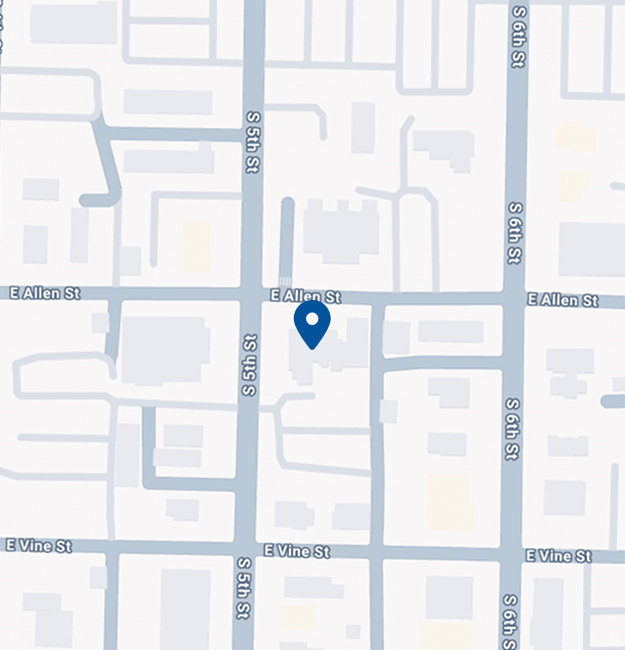
📍 1100 S 5th St, Springfield, IL 62703 | ☎ (217) 544-4057 | 🌐 hankenlaw.com
This article is for general educational purposes only and does not constitute legal advice. Every case is unique — contact an experienced Springfield criminal defense attorney for guidance on your specific situation.
Address
Our offices are located at the corner of South Fifth Street and Vine, in the historic Mary Bryant Home for the Blind.