- Free Consultation: (217) 544-4057 Tap Here To Call Us














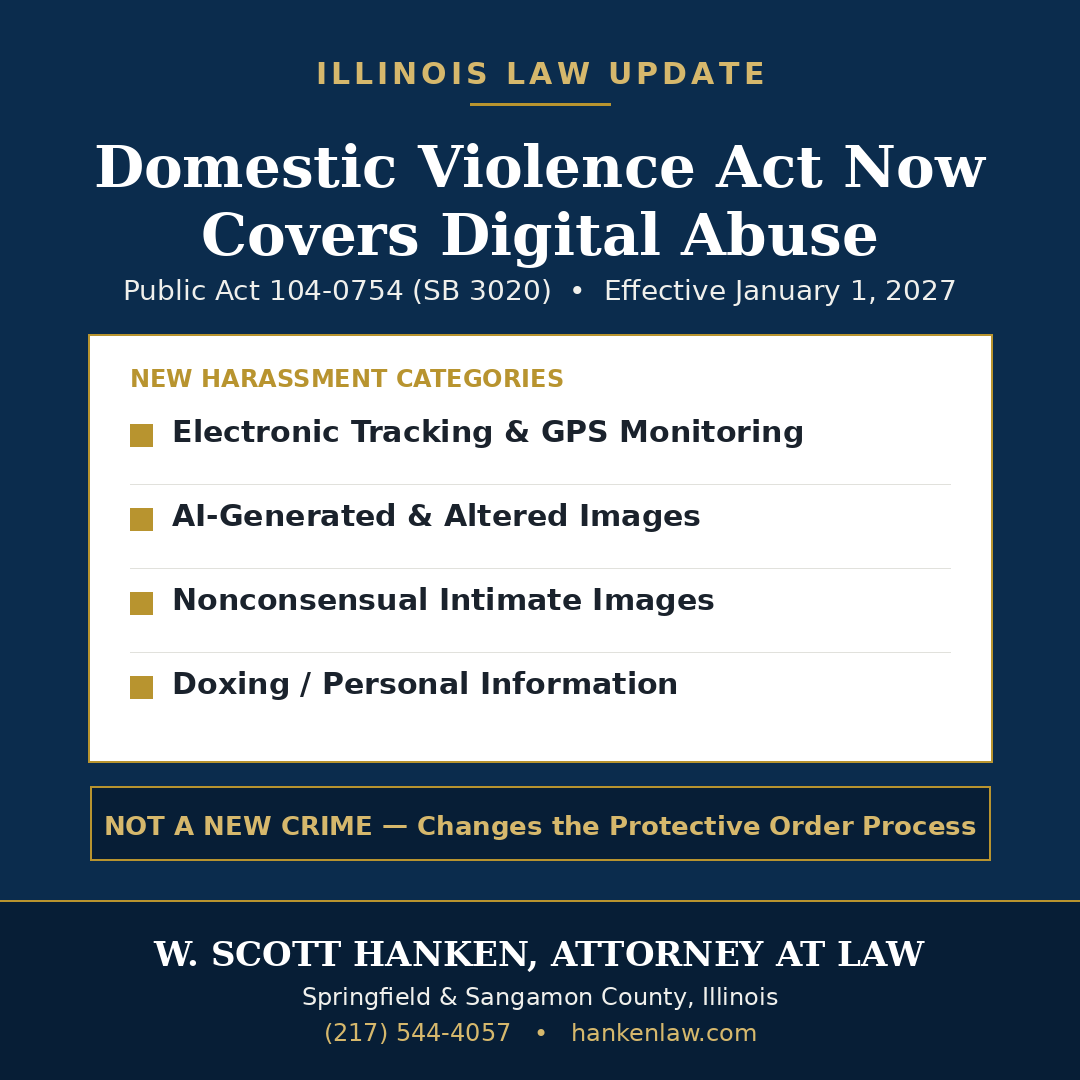
Illinois Domestic Violence Act Update Covers Digital Abuse


Last Reviewed & Updated: September 14, 2026
By: W. Scott Hanken | Former Sangamon County Prosecutor | Springfield Criminal Defense & Violent Crimes Defense Attorney | Voted “Best Attorney” — Illinois Times Best of Springfield & State Journal-Register Reader’s Choice | Springfield, IL | Sangamon County | (217) 544-4057 | hankenlaw.com
Direct Answer: On August 7, 2026, Governor JB Pritzker signed Senate Bill 3020 into law as Public Act 104-0754, amending the Illinois Domestic Violence Act of 1986 (750 ILCS 60) and the protective order provisions of the Code of Criminal Procedure of 1963 (725 ILCS 5, Article 112A). Effective January 1, 2027, the law adds electronic tracking, AI-generated impersonation, nonconsensual intimate images, and the publishing of someone’s personal information to the list of conduct a court can treat as harassment, lets judges order a respondent to delete tracking data as a condition of a protective order, and makes it explicit that an order of protection can be extended without a new violation or incident. It does not create new stand-alone crimes. It changes what a court can rely on to issue, extend, or enforce an order of protection, and once that order exists, violating it is what exposes a person to criminal charges under 720 ILCS 5/12-3.4.
Bottom Line: If you are the one seeking protection, this law gives Sangamon County courts more tools to reach GPS trackers, AI-manipulated photos, and doxing, and it writes an existing judicial rule about extensions into the statute itself. If you are the one accused, more categories of conduct now carry a legal presumption against you, and the argument that an order should lapse because “nothing new happened” is now foreclosed by statute rather than merely by case law. Either way, what happens in that civil hearing shapes any criminal exposure that follows.
What Changed in Illinois’s Domestic Violence Law Under Public Act 104-0754?
Senate Bill 3020, sponsored by State Senator Adriane Johnson and State Representative Maurice West II, passed the General Assembly with bipartisan support and became Public Act 104-0754 when the Governor signed it. It amends four sections of the Code of Criminal Procedure’s protective order article (725 ILCS 5/112A-3, 112A-5.5, 112A-11.5, and 112A-14) and five sections of the Illinois Domestic Violence Act of 1986 (750 ILCS 60/103, 60/201, 60/212, 60/214, and 60/220). Because the harassment definitions in both statutes were amended together, the same updated language applies whether a protective order comes out of a civil petition or is attached to a criminal domestic violence case.
The law does four main things. It broadens the legal definition of “harassment” to name specific forms of technology-facilitated abuse. It gives judges a new remedy, on both the civil and the criminal-case track, requiring a respondent to delete tracking data and harassing content and prove they did it. It removes an existing barrier tied to incarceration. And it rewrites the extension standard for orders of protection so that a new violation or incident is not required to keep one in force. None of it takes effect until January 1, 2027.
What New Conduct Counts as “Harassment” Under Illinois Law?
Illinois has always defined harassment as knowing conduct that is not necessary for any reasonable purpose, that would cause a reasonable person emotional distress, and that actually causes the petitioner emotional distress. That baseline definition, in 750 ILCS 60/103(7) and its criminal-case mirror at 725 ILCS 5/112A-3(b)(4), has not changed. What changed is the list of conduct that is presumed to satisfy it.
Before PA 104-0754, six categories carried that presumption: disturbances at work or school, repeated calls or contact, following someone in public, physical surveillance (parking outside a home, peering in windows), threats to conceal a child, and threats of physical force. The amendment broadens the contact category to expressly cover electronic and third-party contact, and it adds four new categories:
- Using electronic means to repeatedly track, monitor, surveil, record, or otherwise acquire information about a petitioner’s location, movement, or travel patterns, including through third parties.
- Nonconsensually disseminating, or threatening to disseminate, electronically generated or altered content using the petitioner’s image, voice, or other characteristic to falsely and deceptively impersonate the petitioner or the petitioner’s representative.
- Nonconsensually disseminating, or threatening to disseminate, private sexual images or electronically altered sexual images of the petitioner.
- Publishing the petitioner’s personally identifiable information (the conduct commonly called doxing).
Statute Callout — “Harassment” means knowing conduct which is not necessary to accomplish a purpose that is reasonable under the circumstances; would cause a reasonable person emotional distress; and does cause emotional distress to the petitioner. Ten categories of conduct now carry a rebuttable presumption of causing that distress: six carried over from prior law, plus four new. See 750 ILCS 60/103, as amended by P.A. 104-0754, eff. Jan. 1, 2027, and the parallel criminal-case definition at 725 ILCS 5/112A-3, eff. Jan. 1, 2027.
The word to focus on is presumed, not automatic. The statute says these categories are presumed to cause emotional distress unless the presumption is rebutted by a preponderance of the evidence. A judge still has to find the conduct was knowing, unnecessary, and actually distressing to this petitioner. What the amendment does is shift the starting point: instead of the petitioner having to build that case from scratch on tracking or AI-image conduct, the respondent now has to rebut it once the conduct is shown.
Comparison: Harassment Presumption Categories Before and After P.A. 104-0754
Harassment presumption categories under 750 ILCS 60/103 before and after P.A. 104-0754 (eff. Jan. 1, 2027). These are the categories that carry a rebuttable presumption, not the entire definition of harassment. Electronic contact outside these categories could already support a finding under the general three-part test before this amendment, and still can.
| Presumed Category | Before Jan. 1, 2027 | After Jan. 1, 2027 |
|---|---|---|
| Repeated contact | Repeated phone calls to petitioner’s workplace, home, or residence | Any means, including electronic and through a third party |
| Physical surveillance | Present at home, school, work, vehicle; peering in windows | Substantively unchanged |
| Digital tracking | Not addressed | New, separate category (iv-5): GPS, apps, or third-party tracking of movement |
| AI/altered images (non-sexual) | Not addressed | New: nonconsensual impersonation content |
| Intimate images | Not addressed | New: private or electronically altered sexual images |
| Personal information | Not addressed | New: publishing identifying information |
Can a Judge Now Order Me to Delete an App or Take Down a Post?
Yes, and on both tracks. The amendment adds a new remedy, numbered (19) in the list of things an order of protection can require, and it appears in both statutes: 725 ILCS 5/112A-14(b)(19) for a protective order tied to a criminal case, and 750 ILCS 60/214(b)(19) for a civil petition under the Domestic Violence Act. Either way, a court can order a respondent to remove or delete harassing statements or materials, delete tracking and monitoring information the respondent collected, and produce sufficient evidence that this was done.
Statute Callout — Order the respondent to remove or delete and take reasonable steps to remove or delete the harassing statements or materials or delete the tracking and monitoring information collected by the respondent and produce sufficient evidence that such compliance has occurred. 725 ILCS 5/112A-14(b)(19), with parallel language at 750 ILCS 60/214(b)(19), both as added by P.A. 104-0754, eff. Jan. 1, 2027.
That last phrase is where respondents get caught. It is not enough to simply stop, and it is not enough to quietly comply. The statute puts an affirmative production burden on the respondent, which in a contested case means screenshots, account deletion confirmations, or a sworn statement describing exactly what was removed. Failing to produce that evidence is itself a basis for the court to find the order was violated, even if the underlying conduct actually stopped.
Is Sharing an AI-Generated Image of My Ex a Crime in Illinois?
Not automatically, and not under this Act specifically. P.A. 104-0754 adds nonconsensual AI-generated or electronically altered impersonation content to the list of conduct that can support a domestic violence order of protection, 750 ILCS 60/103(7)(vii). That is a civil, protective-order consequence, not a criminal charge by itself. It becomes criminal exposure in one of two ways: if it violates the terms of an order of protection already in place, chargeable under 720 ILCS 5/12-3.4, or if the specific content and conduct independently meet the elements of an existing criminal statute. For a sexually explicit AI or digitally altered depiction, the closer analog is 720 ILCS 5/11-23.7, non-consensual dissemination of a sexually explicit digitized depiction (Class 4 felony), rather than the older private-image statute at 720 ILCS 5/11-23.5, which is built around an image obtained under circumstances meant to stay private. A pattern of AI-image threats can also independently support a cyberstalking charge under 720 ILCS 5/12-7.5 (Class 4 felony, Class 3 on a repeat offense). Which of those applies depends on what was shared, who it depicts, and whether an order was already in place.
Does It Matter If the Respondent or Petitioner Is Already Incarcerated?
It matters less than it used to. The amendment adds explicit language to both 725 ILCS 5/112A-11.5(b) and 750 ILCS 60/201(b), eff. Jan. 1, 2027. Under the criminal-case provision, a petitioner cannot be denied a protective order solely because the respondent or petitioner is incarcerated in a penal institution at the time the order is issued. Under the Domestic Violence Act provision, a petition cannot be denied solely because the respondent or petitioner is incarcerated at the time the petition is filed.
This works both directions. A survivor whose abuser is currently in the Sangamon County Jail, or an Illinois Department of Corrections facility, can still get and keep an order of protection against that person. And a person who is themselves incarcerated is not barred from filing one.
The same amendment also tightens two filer categories in 750 ILCS 60/201(b). Paragraphs (iv) and (v), which previously allowed a petition by a crime victim abused by “an offender,” or by any person previously abused by “a person” convicted of certain domestic violence or violent offenses, now require that the abuser be a family or household member.
Does This Law Make It Easier to Extend an Existing Order of Protection?
Yes, and this is a real change to the standard, not just a clarification of practice. Amended 750 ILCS 60/220(e) now splits extensions into two tracks. For emergency and interim orders, a new sentence provides that a violation of the original order or a subsequent incident of abuse is not required to grant an extension. For plenary orders, the court must grant the petitioner’s extension motion once the underlying requirements are satisfied and there has been no material change in circumstances, and the statute says directly that the court cannot deny the motion solely because there was no violation and no new incident.
The amendment adds two more practical pieces: an extension can now run for any fixed period the court sets, not just in capped increments, and if a plenary order is about to expire before the next available court date, the hearing must be expedited or the court can extend the order on an emergency basis pending one.
Statute Callout — “The court shall not deny a motion to extend solely because there is no violation of the original order nor a subsequent incident of abuse.” 750 ILCS 60/220(e)(2)(A), as amended by P.A. 104-0754, eff. Jan. 1, 2027.
This section was not previously silent, and the pre-amendment law was already more favorable to petitioners than most summaries suggest. Two published decisions matter here, and they do different work. Stapp v. Jansen, 2013 IL App (4th) 120513, is the controlling Fourth District case in Sangamon County; it holds that 220(e)’s “no material change in relevant circumstances” affidavit shortcut applies only to an uncontested extension and has no application once the respondent contests. The separate rule that no new incident is required, and that the same conduct supporting the original order can carry a contested fixed-term extension of two years or less, is the published holding of Graham v. Van Rengen, 2024 IL App (2d) 230611, which also declined to follow an unpublished 2023 order going the other way. See also Dale v. Bennett, 2021 IL App (4th) 200188, Fourth District authority on good cause for an indefinite extension.
What the amendment does, then, is less a reversal than a codification and a hardening. It converts a district-by-district judicial reading into express statutory text, and it converts permission into obligation: the court “shall grant” a qualifying extension motion, and “shall not deny” one solely for lack of a violation or a new incident. It also codifies the very line Graham drew. Under new 750 ILCS 60/220(e)(2)(B), an extension may run for any fixed period, and “good cause” is expressly required only where the petitioner seeks an extension longer than two years. That is the Graham distinction, now written into the statute.
That distinction matters locally. Graham is a Second District decision, so in Sangamon County it is persuasive rather than binding; Stapp and Dale are the Fourth District authority. No Fourth District case squarely holds that the conduct behind the original order, standing alone, carries a contested fixed-term extension. That is precisely why the new statutory language matters here: after January 1, 2027, a Sangamon County respondent resisting an extension is arguing against the text of the statute rather than against an out-of-district opinion. 725 ILCS 5/112A-20, the criminal-case parallel, was not itself amended by this bill, but its subsection (e) sends extension motions in criminal-linked cases back to the 750 ILCS 60/220(e) standard, so the new rule reaches those cases too.
Will Sangamon County Courts Have to Offer Remote Hearings?
Yes — and this is the part of the law most coverage gets wrong in the other direction.
Before this amendment, 725 ILCS 5/112A-5.5(f-5) and 750 ILCS 60/212(d) required only courts in counties with a population above 250,000 to offer a petitioner the option of a remote hearing, and even in those counties the court had discretion to grant or deny the request. Sangamon County sits below that threshold, so remote appearance here was a matter of local practice under Illinois Supreme Court Rule 45 rather than a statutory entitlement.
P.A. 104-0754 changes both halves of that. Effective January 1, 2027, the population limitation comes out and the discretionary standard is replaced: the court shall grant a request for a remote hearing unless good cause is shown for denial. The amendment also ties remote-hearing procedure expressly to Illinois Supreme Court Rule 45 and extends the remote-appearance option to applicable witnesses, not just the petitioner and the respondent.
For a Sangamon County petitioner, that converts a courtesy into a right with a narrow exception. Until January 1, 2027, remote appearance here remains discretionary, so plan your next hearing around current local practice rather than the new language.
What Happens If You’re Accused of Violating One of These New Provisions?
None of these civil-order provisions create a new crime by themselves. What they change is how easily a protective order can be obtained, extended, and defined broadly enough to reach digital conduct. Once an order of protection exists, whether it was issued under the old harassment definition or the new one, violating any of its terms is charged under 720 ILCS 5/12-3.4, Violation of an Order of Protection, a separate statute this amendment does not touch.
Some of this conduct is already independently criminal outside the order-of-protection context. Nonconsensual dissemination of private sexual images is chargeable under 720 ILCS 5/11-23.5, and a sexually explicit AI or digitally altered depiction under 720 ILCS 5/11-23.7, both Class 4 felonies. A pattern of electronic tracking or contact can independently support a cyberstalking charge under 720 ILCS 5/12-7.5 (Class 4 felony, Class 3 on a repeat offense). This Act changes the civil protective-order pathway. It does not replace, and someone accused under it may also face exposure under, those existing criminal statutes.
Comparison: Violating an Order of Protection in Illinois
| Class A Misdemeanor (first violation) | Class 4 Felony (prior qualifying conviction) | |
|---|---|---|
| Jail/prison exposure | Up to 364 days county jail | 1 to 3 years, Illinois Department of Corrections |
| Fine | Up to $2,500 | Up to $25,000 |
| Mandatory minimum | None | 24 hours imprisonment on 2nd or subsequent violation |
| Court supervision available | Eligible, not automatic — 730 ILCS 5/5-6-1(c) | No |
Sentencing ranges: 730 ILCS 5/5-4.5-55 (misdemeanor term, fine, and probation); 730 ILCS 5/5-4.5-45 (felony term and probation) and 730 ILCS 5/5-4.5-50(b) (felony fine cap, cross-referenced through 5-4.5-45(e)); 730 ILCS 5/5-6-1(c) (supervision eligibility).
Statute Callout — “Violation of an order of protection is a Class A misdemeanor. Violation of an order of protection is a Class 4 felony if the defendant has any prior conviction under this Code for domestic battery… or violation of an order of protection.” 720 ILCS 5/12-3.4(d).
This is the practical stakes of both the new harassment categories and the harder-to-fight extensions. If a Sangamon County judge finds that repeatedly checking a shared vehicle’s GPS location, or sharing an AI-altered photo, falls within the presumption and issues an order restricting that conduct, and that order is later extended without any new incident because the amended standard no longer requires one, the next violation of that order, however small, is what triggers a misdemeanor or felony charge. The civil hearing, at issuance and at every extension, is where the real fight happens.
What If Your Situation Doesn’t Fit the Basic Rule?
What if the tracking or “AI image” conduct happened before January 1, 2027?
Illinois law does not require statutes to apply retroactively unless the legislature says so, and P.A. 104-0754 does not. If the alleged conduct occurred entirely before the effective date, the new presumption categories should not apply to that conduct. In practice, though, a petition filed after January 1, 2027 will often describe a pattern of conduct spanning months or years. A Sangamon County judge weighing that pattern is likely to look at the whole history, and pre-2027 conduct can still support a finding of harassment under the general definition even without the new presumption. The effective date matters for which legal standard applies, not for whether older conduct disappears from the case.
What if I’m already incarcerated when the petition is filed?
Under amended 750 ILCS 60/201(b), incarceration alone is no longer grounds to deny the petition, whether you are the respondent or the petitioner. If you are the respondent and currently held in the Sangamon County Jail or an IDOC facility, expect that a petition can proceed and an order can issue even though you cannot be personally present in the way the process previously assumed. Service still has to happen, and which statute governs depends on the track. On a protective order tied to a criminal or delinquency case, service runs through 725 ILCS 5/112A-5.5: a 7-day answer window, service by the sheriff or another law enforcement officer, and publication as a fallback if personal service fails within 30 days. On a standalone civil petition under the Domestic Violence Act, the parallel rules are in 750 ILCS 60/210, a separate summons, the same 7-day answer window, and its own publication fallback. Getting the summons into the jail and confirming it was actually received, not just sent, is often the first thing worth reviewing with an attorney.
What if the order against me is coming up for extension and nothing new has happened?
It was a weaker argument than most people assume even before this amendment, and after January 1, 2027 it is weaker still. Published Illinois authority already held that a petitioner seeking a contested two-year extension does not have to prove a new incident, and may rely on the same conduct that supported the original order. The amendment now says so in the statute: a court cannot deny an extension solely because there was no violation and no new incident, for plenary orders and for emergency and interim orders alike. The practical fight shifts to whether there has been “no material change in the relevant circumstances,” and, if the petitioner is asking for more than two years, to whether good cause supports that longer term.
Information Gain: Two Corrections to the Statewide Headline
Most coverage of this law describes it as two clean wins: broader digital-abuse protections and easier remote hearings. Both are real, but both get described imprecisely.
The remote-hearing change is bigger than “easier.” It is two separate amendments working together. The population threshold that had limited the remote-hearing offer requirement to counties above 250,000 people since 2023 comes out, and the standard inside the requirement changes from discretionary to mandatory-unless-good-cause. For a county like Sangamon, which was outside the old threshold entirely, that is the difference between a local courtesy and a statutory entitlement. Anyone filing, or defending against, an order of protection here should know that the change lands on January 1, 2027, not before.
The second correction is about the extension rule, and it cuts against the way that change is usually described. Coverage frames the no-new-incident rule as new protection created by this Act. It is more accurately a codification. Graham v. Van Rengen had already held that a contested two-year extension requires no new incident and may rest on the conduct behind the original order, and Stapp v. Jansen had already closed off the uncontested-affidavit shortcut in a contested Fourth District hearing. What P.A. 104-0754 adds is mandatory language, statewide reach, and a statutory home for the two-year line Graham drew. For a respondent, that means the argument was already difficult before 2027, and anyone told otherwise is working from an outdated picture of Illinois law.
What to Do This Week
If you are seeking or already hold an order of protection:
- Save dated evidence of tracking, unwanted contact, or shared images before you delete anything from your own accounts.
- If your order is nearing its two-year mark, calendar the extension deadline now; the new “no material change” standard still requires a timely motion.
- If the respondent is currently incarcerated, tell your attorney or advocate immediately; the incarceration-denial barrier is gone as of Jan. 1, 2027, but service still has to happen.
- Ask the court directly whether the new removal-of-tracking-data remedy applies to your case; it is not automatic.
If you have been served with a petition, or think you might be:
- Do not contact the petitioner to “explain” or negotiate; that contact itself can be a violation once an order is in place.
- If a removal-of-tracking-data remedy is ordered, document every step you take to comply; the statute requires you to produce evidence, not just to comply.
- Do not assume an extension will be denied just because nothing new happened since the last hearing; plan your response around “material change,” not around a new incident.
- Call an attorney before your first court date, not after; the civil hearing is where this case gets decided, and it shapes any criminal exposure that follows.
Frequently Asked Questions (FAQs)
The presumption categories for electronic tracking, AI-altered images, and doxing apply going forward from the January 1, 2027 effective date. Conduct before that date can still be considered under the existing general harassment definition, just without the new presumption attached.
Yes. As of January 1, 2027, incarceration alone is no longer a basis to deny a petition for an order of protection under 750 ILCS 60/201(b) or 725 ILCS 5/112A-11.5(b).
The statute requires the respondent to produce sufficient evidence that harassing material or tracking data was removed, not just to have removed it. Keep documentation (deletion confirmations, account closure records) before a hearing where this remedy is requested.
Starting January 1, 2027, yes, unless the court finds good cause to deny the request. P.A. 104-0754 removes the 250,000-population threshold that had limited the remote-hearing requirement to larger counties and replaces the court’s discretion with a mandatory-grant standard in 725 ILCS 5/112A-5.5(f-5) and 750 ILCS 60/212(d). Before that date, remote appearance here remains a matter of court discretion under Illinois Supreme Court Rule 45
No, not under this Act specifically. The amendment adds that conduct to the list of harassment a court can rely on to issue or extend an order of protection, a civil consequence. Criminal exposure comes from violating an order already in place under 720 ILCS 5/12-3.4, or independently from an existing statute such as 720 ILCS 5/11-23.7 for a sexually explicit AI depiction or 720 ILCS 5/12-7.5 for cyberstalking.
The same as violating any other term of a protective order: a Class A misdemeanor for a first violation, up to 364 days in jail and a $2,500 fine, escalating to a Class 4 felony with 1 to 3 years in prison if you have a prior qualifying conviction.
It confirms in statute what published Illinois case law already held. Amended 750 ILCS 60/220(e) says a court cannot deny an extension solely because there was no violation of the original order and no new incident of abuse, for plenary, emergency, and interim orders. Extensions can run for any fixed period the court sets, “good cause” is expressly required only for an extension longer than two years, and a plenary order about to expire gets an expedited hearing rather than lapsing.
Primary Authorities
- Public Act 104-0754 (SB 3020), signed Aug. 7, 2026, eff. Jan. 1, 2027
- 750 ILCS 60/103, 60/201, 60/212, 60/214, 60/220 — Illinois Domestic Violence Act of 1986, sections amended by P.A. 104-0754 (60/214(b)(19) is the new removal-of-tracking-data remedy)
- 750 ILCS 60/210 — Illinois Domestic Violence Act, process and service on a civil petition (not amended by P.A. 104-0754)
- 725 ILCS 5/112A-3, 112A-5.5, 112A-11.5, 112A-14 — Code of Criminal Procedure of 1963, Article 112A, sections amended by P.A. 104-0754
- 725 ILCS 5/112A-20 — duration and extension of final protective orders (not amended by P.A. 104-0754)
- 720 ILCS 5/12-3.4 — Violation of an Order of Protection
- 720 ILCS 5/11-23.5 — Non-consensual Dissemination of Private Sexual Images (Class 4 felony)
- 720 ILCS 5/11-23.7 — Non-consensual Dissemination of a Sexually Explicit Digitized Depiction (Class 4 felony)
- 720 ILCS 5/12-7.5 — Cyberstalking (Class 4 felony, Class 3 on repeat)
- 730 ILCS 5/5-4.5-55, 5-4.5-45, 5-4.5-50(b) — misdemeanor and felony sentencing ranges
- 730 ILCS 5/5-6-1(c) — court supervision eligibility
- Stapp v. Jansen, 2013 IL App (4th) 120513 — the “no material change” affidavit shortcut applies only to an uncontested extension (Fourth District, controlling in Sangamon County)
- Graham v. Van Rengen, 2024 IL App (2d) 230611 — contested fixed-term extension of 2 years or less does not trigger “good cause”; original conduct may support the extension
- Dale v. Bennett, 2021 IL App (4th) 200188 — good cause and indefinite extension of a plenary order (Fourth District)
Further Reading
Practice Area
Related Articles
- What Counts as Violating an IL Protective Order? — This post explains what triggers the charge; that one walks through the specific acts, including a single text message, that count as a violation.
- New 2026 Remote Court Rules for Springfield Criminal & DUI Cases: What You Need to Know — Covers the Supreme Court Rule 45 changes that govern remote appearance in Sangamon County until the new statutory standard takes effect.
- Illinois Order of Protection & No Contact Orders — Answers the question this post raises but does not cover: how civil no-contact orders differ from criminal-case protective orders, and how long each can run.
- Illinois SAFE-T Act: What Happens at a Detention Hearing in Springfield — and How to Fight Back — Explains why a protective-order violation is one of the few charges that can lead to pretrial detention.
Browse by Topic
Ready to Fight Your Violent Crime Charge in Springfield?
Call W. Scott Hanken at (217) 544-4057 or contact us online for a free consultation. We serve clients throughout Springfield, Sangamon County, and Central Illinois.
About the Author: W. Scott Hanken, Attorney at Law
Scott Hanken is a Springfield, Illinois criminal defense attorney with over 37 years of experience, including service as a former Sangamon County prosecutor. He has been voted Best Attorney by the Illinois Times and State Journal-Register, holds an Avvo 10.0 “Superb” rating, and has earned over 270 five-star Google reviews. He serves clients throughout Sangamon County and Central Illinois.
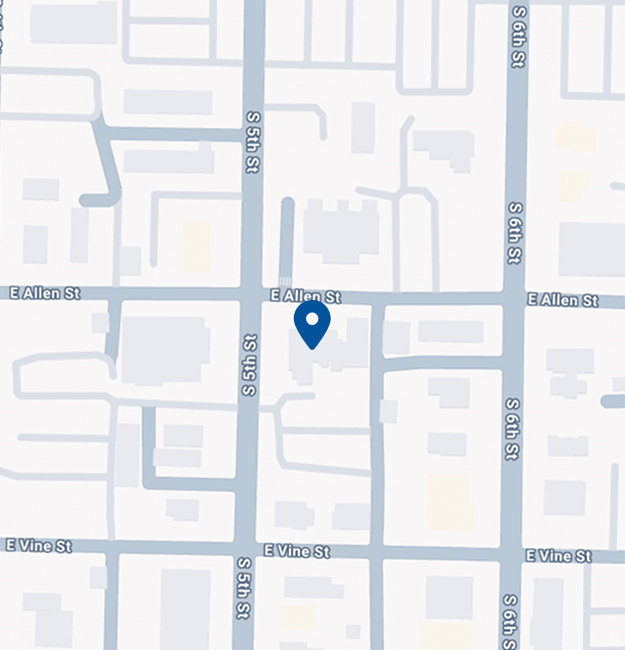
📍 1100 S 5th St, Springfield, IL 62703 | ☎ (217) 544-4057 | 🌐 hankenlaw.com
This article is for general educational purposes only and does not constitute legal advice. Every case is unique — contact an experienced Springfield criminal defense attorney for guidance on your specific situation.
Address
Our offices are located at the corner of South Fifth Street and Vine, in the historic Mary Bryant Home for the Blind.