- Free Consultation: (217) 544-4057 Tap Here To Call Us















Falling Asleep at the Wheel: Illinois Criminal Charges


Last Reviewed & Updated: October 12, 2026
By: W. Scott Hanken | Former Sangamon County Prosecutor | Springfield Criminal Defense & Violent Crimes Defense Attorney | Voted “Best Attorney” — Illinois Times Best of Springfield & State Journal-Register Reader’s Choice | Springfield, IL | Sangamon County | (217) 544-4057 | hankenlaw.com
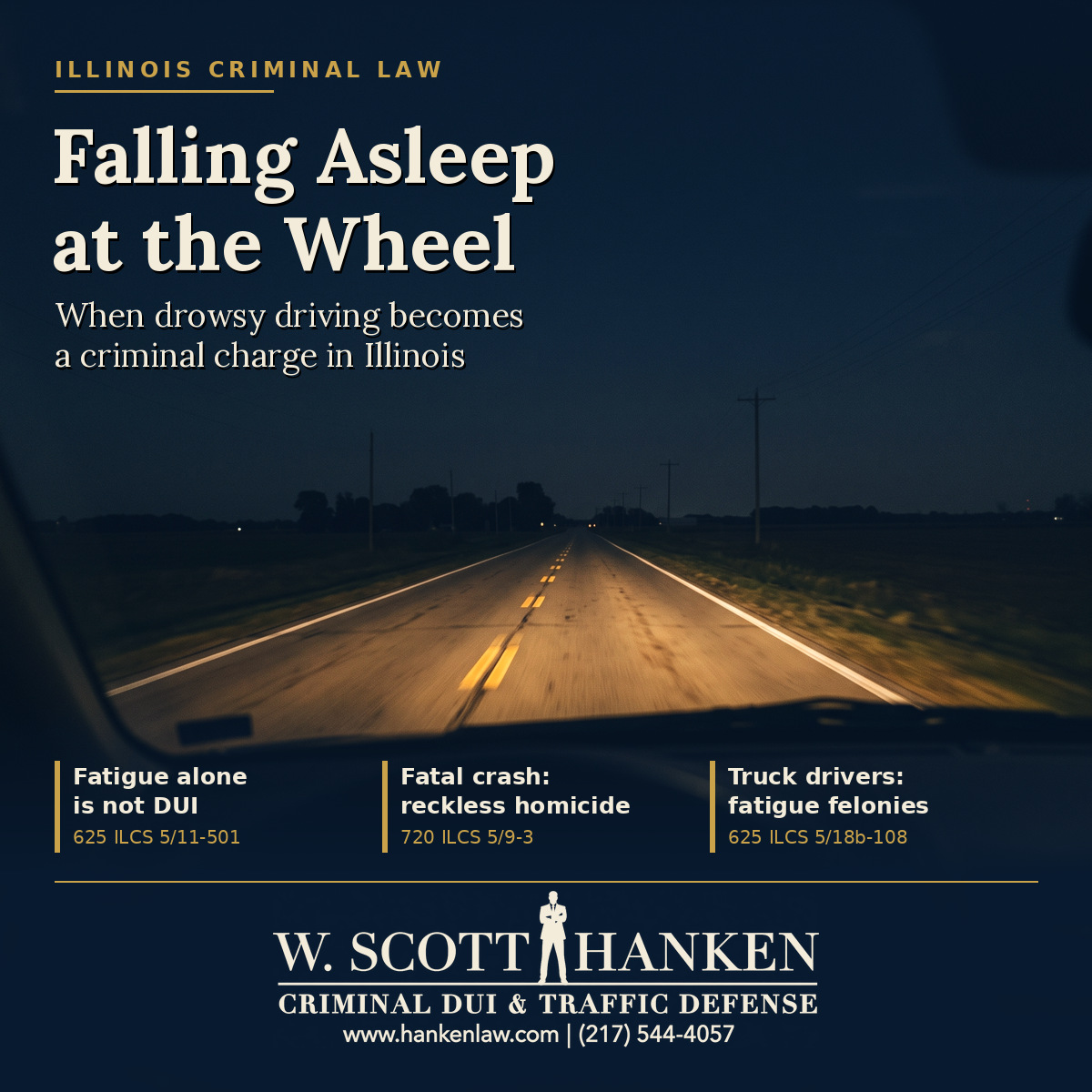
In Illinois, sleep deprivation by itself is not a basis for a DUI charge. 625 ILCS 5/11-501 punishes two things: driving with a measurable blood alcohol or drug concentration, and driving while actually impaired by alcohol, a drug, or an intoxicating compound. Fatigue satisfies neither.
But if you fall asleep at the wheel and cause a fatal crash, prosecutors in Sangamon County can and do charge reckless homicide under 720 ILCS 5/9-3. That is a Class 3 felony that can rise to a Class 2 felony under several enhancements. Commercial drivers face separate exposure under Illinois’s Motor Carrier Safety Law for violating federal fatigue regulations.
Bottom Line: Being tired is not, on its own, a crime. What turns exhaustion into a criminal case is what you knew about your own condition before you got behind the wheel, and whether you kept driving anyway. That single fact question decides whether you face a misdemeanor, a felony, or nothing at all.
Facing questions from police or the Sangamon County State’s Attorney’s Office about a fatigue-related crash? Call W. Scott Hanken, Attorney at Law, at (217) 544-4057 before you say anything further.
Is Drowsy Driving Itself Illegal in Illinois?
No single Illinois statute makes “driving while tired” a stand-alone offense the way 625 ILCS 5/11-501 makes driving with a 0.08% blood alcohol concentration illegal. There is no per se fatigue limit, no roadside “tiredness test,” and no ticket for simply yawning behind the wheel.
Fatigue becomes a legal problem only when it produces conduct the law already punishes: crossing the center line, failing to stop at a sign, or causing a crash. The exception is commercial drivers, discussed below. For them, a willful violation of the federal fatigue and hours-of-service rules can be charged as a Class 4 felony under 625 ILCS 5/18b-108(b) even when no crash occurs.
Can You Get a DUI in Illinois for Being Too Tired to Drive?
Not from fatigue alone. Section 11-501(a) makes driving illegal in two different ways.
Three provisions are per se violations that require no proof of actual impairment:
- a blood alcohol concentration of 0.08% or more;
- any amount of certain controlled substances in your system; or
- a THC concentration above set thresholds.
The rest are impairment-based. They include driving under the influence of alcohol, an intoxicating compound, or “any other drug or combination of drugs to a degree that renders the person incapable of safely driving.”
Fatigue satisfies none of these. It isn’t alcohol, it isn’t a scheduled drug concentration, and exhaustion by itself isn’t a “drug.” A prosecutor cannot charge DUI on fatigue evidence alone.
The analysis changes the moment a substance enters the picture. Suppose you took a sedating antihistamine, a prescription sleep aid like zolpidem, or any other drug that impaired your ability to drive safely. Then the impairment-based prong applies, whether or not the drug was legally prescribed. Illinois law is explicit that having a valid prescription is not a defense to a charge under this section.
So the honest answer to “can fatigue become a DUI” is this: only when something you took to fight the fatigue, or something that caused it, independently satisfies one of these provisions.
What Charges Apply If You Fall Asleep and Cause a Fatal Crash in Sangamon County?
This is where sleep deprivation becomes serious criminal exposure. Illinois prosecutes an unintentional death caused by driving a vehicle recklessly as reckless homicide.
Statute Callout — 720 ILCS 5/9-3, Involuntary Manslaughter and Reckless Homicide: “A person who unintentionally kills an individual without lawful justification commits involuntary manslaughter if his acts whether lawful or unlawful which cause the death are such as are likely to cause death or great bodily harm to some individual, and he performs them recklessly, except in cases in which the cause of the death consists of the driving of a motor vehicle… in which case the person commits reckless homicide.” Reckless homicide is a Class 3 felony. Source: Public Act 101-173, effective January 1, 2020. Read 720 ILCS 5/9-3 on the Illinois General Assembly website
Reckless homicide from falling asleep is charged as a base Class 3 felony in most cases. It rises to a Class 2 felony under several separate enhancements:
- a crash on a thoroughfare where children walk to school while a school crossing guard is on duty;
- a crash in a construction or maintenance zone;
- a crash tied to a Scott’s Law violation; or
- a crash that kills a peace officer performing official duties.
When two or more people die, several of these enhancements carry a 6-to-28-year range if the court imposes prison. A driver who dozes off on Interstate 55 near a squad car with its lights activated on the shoulder can face any combination of these, depending on the facts.
How Do Prosecutors Prove You Were Reckless for Falling Asleep?
Recklessness has a specific legal meaning in Illinois, and it matters enormously in a sleep-deprivation case.
Statute Callout — 720 ILCS 5/4-6, Recklessness: “A person is reckless or acts recklessly when that person consciously disregards a substantial and unjustifiable risk that circumstances exist or that a result will follow… and that disregard constitutes a gross deviation from the standard of care that a reasonable person would exercise.” Source: Public Act 96-710, effective January 1, 2010. Read 720 ILCS 5/4-6 on the Illinois General Assembly website
The word “consciously” is doing the legal work. Recklessness requires proof that you were aware of the risk and disregarded it anyway, not merely that a reasonable person should have known better. This is not a theoretical distinction.
People v. Lee, 2023 IL App (4th) 220779 shows how this plays out. It was decided by the Fourth District Appellate Court, which is headquartered in Springfield and binding on Sangamon County Circuit Court.
- The crash. In this Boone County case, a driver fell asleep at the wheel of a Ford F-550, ran a stop sign, and killed two people.
- The charges. He was charged with reckless homicide, willfully operating a commercial motor vehicle while fatigued, and aggravated DUI based on a THC blood-concentration threshold.
- The verdict. The trial court found him guilty only on the aggravated DUI counts.
- On the fatigue counts, it found “insufficient evidence that the defendant knew he was so tired” before the crash that he should have pulled over rather than kept driving.
- On the reckless homicide counts, which alleged he disobeyed the stop sign, it found the state hadn’t proven he was impaired by, or even tired from, cannabis at the time of the crash.
- The sentence. He was sentenced to six years on the THC-based aggravated DUI. The appellate opinion describes that as the minimum available prison sentence under the 6-to-28-year range for a violation causing two or more deaths (625 ILCS 5/11-501(d)(1)(F), (d)(2)(G)(ii)). The Fourth District affirmed.
In 37+ years of practice, including service as a Sangamon County prosecutor, I’ve found that one narrow fact often decides whether a fatigue-related crash becomes a reckless homicide case: what the driver told the first officer on scene.
Prosecutors treat a statement like “I was so tired” or “I dozed off for a second” as direct evidence of the subjective awareness the recklessness element demands. A driver who says only what he actually remembers, without volunteering a theory about why the crash happened, leaves the state with a much harder case to prove.
What About Commercial Truck Drivers Who Fall Asleep on I-55?
Commercial drivers face a layer of exposure that does not apply to ordinary motorists. It is where Illinois law and federal trucking regulation overlap directly.
Statute Callout — 625 ILCS 5/18b-108(d), Illinois Motor Carrier Safety Law: A driver who willfully violates Parts 392 or 395 of Title 49 of the Code of Federal Regulations, or specified sections of Part 391, in a way that would place the driver or vehicle out of service, and the violation results in a crash causing great bodily harm, permanent disability, disfigurement, or death, is guilty of a Class 3 felony. A person other than the driver, such as a motor carrier, who commits the same willful violation is guilty of a Class 2 felony when it results in a crash causing great bodily harm, permanent disability or disfigurement, or death. Read 625 ILCS 5/18b-108 on the Illinois General Assembly website
The federal regulation incorporated here is direct. 49 C.F.R. § 392.3 provides that “no driver shall operate a commercial motor vehicle… while the driver’s ability or alertness is so impaired, or so likely to become impaired, through fatigue… as to make it unsafe for him/her to begin or continue to operate the commercial motor vehicle.” Illinois adopts Part 392 and the hours-of-service rules in Part 395 by reference through 625 ILCS 5/18b-105.
Even without a crash, a driver’s willful violation of these rules is a Class 4 felony under 625 ILCS 5/18b-108(b). A carrier or dispatcher who willfully causes a violation faces a Class 3 felony under 18b-108(c).
This is not a hypothetical charge.
- The crash. On March 28, 2019, a semi driver struck and killed Illinois State Trooper Brooke Jones-Story while she was inspecting a commercial vehicle on U.S. Route 20 in Stephenson County.
- The charges. The Illinois State Police announced that the Stephenson County State’s Attorney’s Office approved:
- two counts of reckless homicide, charged as Class 2 felonies; and
- one count of operating a commercial motor vehicle while fatigued causing death, a Class 3 felony.
- The plea. He later pleaded guilty to one count of reckless homicide and one count of a safety-regulation violation resulting in death.
- The sentence. He was sentenced to six months in jail, four years of probation, and a $3,000 fine.
- The admission. Investigators said he told them he had fallen asleep multiple times before the crash. That is the kind of admission that maps directly onto the federal standard in 49 C.F.R. § 392.3.
For I-55 corridor drivers hauling through Sangamon County, two kinds of records can become the state’s central exhibit in exactly this kind of case: an electronic logging device showing hours-of-service violations, or dispatcher messages pushing a driver past a mandated rest break.
Talk through your exposure before you talk to an investigator. Call (217) 544-4057.
What If I Had No Warning I Was About to Fall Asleep — Can an Undiagnosed Sleep Disorder Be a Defense?
Illinois’s recklessness standard requires conscious disregard of a known risk, not just the existence of a risk. Consider a driver with undiagnosed sleep apnea, narcolepsy, or another condition that produces sudden, unforeseeable microsleep episodes. That driver has a real argument that he lacked the subjective awareness the statute requires. It is precisely the gap the state failed to close on the fatigue counts in People v. Lee.
The defense is strongest when there is no prior diagnosis, no doctor’s warning against driving, and no history of falling asleep at the wheel before. It weakens fast if medical records show a prior warning that was ignored, because that history supplies the very awareness the state needs to prove.
What If I Took a Sleep Aid or Antihistamine Before Driving?
This shifts the case from reckless homicide analysis to DUI analysis. Under 625 ILCS 5/11-501(a)(4), the statute is satisfied if you drive while impaired by any drug, prescribed or over-the-counter, to a degree that renders you incapable of safely driving. That is true whether or not the drug was legally prescribed.
If the crash resulted in death and the violation was a proximate cause of that death, subsection (d)(1)(F) treats it as aggravated DUI causing death. Subsection (d)(2)(G) makes that a Class 2 felony:
- 3 to 14 years for one death;
- 6 to 28 years if more than one person died; and
- probation available only in extraordinary circumstances.
The defense here turns on dosage, timing, and whether the medication’s package warnings and your own prior experience with the drug put you on notice of impairing effects.
What If My Logbook Shows I Was Within Legal Hours of Service But I Still Fell Asleep?
Compliance with the federal hours-of-service rules in Part 395 is strong evidence against a willful violation under 625 ILCS 5/18b-108. That statute requires willfulness, not just an unfortunate outcome. A driver who followed the mandated rest breaks, kept an accurate electronic log, and still experienced an unforeseeable fatigue episode has a materially stronger position than one whose log shows he drove through a required break.
That said, hours-of-service compliance does not eliminate exposure to a straight reckless homicide charge under 720 ILCS 5/9-3. That charge asks what the driver subjectively knew about his own condition that day, log entries aside.
Comparison Table — Fatigue-Related Driving Charges in Illinois
| Charge | Statute | Classification | Sentence Range |
|---|---|---|---|
| Reckless driving (no injury) | 625 ILCS 5/11-503(b) | Class A misdemeanor | Up to 364 days jail, $2,500 fine |
| Aggravated reckless driving (great bodily harm) | 625 ILCS 5/11-503(c) | Class 4 felony | 1 to 3 years |
| Reckless homicide (base) | 720 ILCS 5/9-3(d)(2) | Class 3 felony | 2 to 5 years, probation eligible |
| Reckless homicide (school crossing guard zone) | 720 ILCS 5/9-3(e-2), (e-3) | Class 2 felony | 3–14 yrs (1 death); 6–28 yrs (2+ deaths), if imprisonment is imposed |
| Reckless homicide (construction/maintenance zone, or disobeying a police or traffic-control officer’s order) | 720 ILCS 5/9-3(e-7), (e-8) | Class 2 felony | 3–14 yrs (1 death); 6–28 yrs (2+ deaths), if imprisonment is imposed |
| Reckless homicide (Scott’s Law violation) | 720 ILCS 5/9-3(e-12), (e-13) | Class 2 felony | 3–14 yrs (1 death); 6–28 yrs (2+ deaths), if imprisonment is imposed |
| Reckless homicide (peace officer killed on duty) | 720 ILCS 5/9-3(e-10) | Class 2 felony | Standard Class 2 range; subsection states no separate term |
| CMV driver, willful fatigue/hours-of-service violation (no crash required) | 625 ILCS 5/18b-108(b) | Class 4 felony | 1 to 3 years; fine up to $10,000 |
| CMV driver, willful fatigue violation causing great bodily harm or death | 625 ILCS 5/18b-108(d) | Class 3 felony | 2 to 5 years |
| Motor carrier or other non-driver, willful violation causing great bodily harm or death | 625 ILCS 5/18b-108(d) | Class 2 felony | 3 to 7 years |
| Aggravated DUI causing death (drug-impaired) | 625 ILCS 5/11-501(d)(1)(F), (d)(2)(G) | Class 2 felony | 3–14 yrs (1 death); 6–28 yrs (multiple deaths); probation only in extraordinary circumstances |
What Defenses Are Available If You’re Charged After Falling Asleep While Driving?
- Lack of subjective knowledge. The state must prove you consciously disregarded a known risk, not that you should have pulled over. No prior warning signs, no history of drowsy driving, and no admission at the scene all work in your favor.
- Causation. Even a genuinely fatigued driver is not guilty if something else actually caused the crash, such as a mechanical failure, another driver’s sudden lane change, or a road hazard.
- Challenging the “willful” element in CMV cases. For commercial drivers, hours-of-service logs, dispatch records, and rest-stop receipts can show compliance that undercuts the willfulness the state must prove under 18b-108.
- Medical documentation. Records from a sleep study, a treating physician, or an emergency room visit can establish that a medical event, not ordinary tiredness, caused the loss of control.
- Statement suppression. Statements obtained through custodial interrogation without Miranda warnings may be subject to a motion to suppress. Routine questioning at a crash scene usually isn’t custodial, but questioning that continues in a squad car, at a hospital, or at the station can be. Even a statement that comes in can be challenged for reliability if you were injured or disoriented when you made it.
Every one of these defenses depends on facts developed early, often within days of the crash, before logs are lost or memories fade. Call (217) 544-4057 as soon as you’re contacted by police or a state’s attorney’s investigator.
Frequently Asked Questions (FAQs)
No. Without a crash or an underlying traffic violation, there is no independent Illinois offense for driving while tired in a personal vehicle. An admission of fatigue only becomes relevant once you are already being investigated for a crash, a moving violation, or a commercial hours-of-service issue.
No. DUI under 625 ILCS 5/11-501 requires either a measurable blood alcohol or drug concentration or actual impairment by alcohol, a drug, or an intoxicating compound. Fatigue alone satisfies neither. That is why fatal fatigue crashes are typically charged as reckless homicide under 720 ILCS 5/9-3 rather than DUI, unless a sedating substance was also involved.
A witness account of swerving is circumstantial evidence, not proof of your state of mind. If the state’s theory is that you fell asleep, it still has to prove you consciously disregarded a known risk, such as knowing you were too tired to keep driving. Swerving alone doesn’t prove that. Prosecutors may still try to build recklessness from other conduct, such as speeding or running a stop sign.
Yes. For the base Class 3 felony under 720 ILCS 5/9-3(d)(2), probation is available and often argued for a first-time offender with no aggravating factors.
Enhancements like a school crossing guard zone, a construction zone, or a Scott’s Law violation set an explicit 3-to-14-year range if the court imposes a prison term, or 6 to 28 years when two or more people die. The peace-officer enhancement is different: it names a Class 2 felony but doesn’t itself state a specific range, so the standard Class 2 sentencing range would apply. None of these carry the same express statutory bar on probation that applies to DUI-related fatalities.
A pending felony charge alone doesn’t disqualify a CDL. A conviction is different. Under 625 ILCS 5/6-514(a)(3), a minimum 12-month disqualification follows a first conviction for either of these:
– causing a death through negligent operation of a commercial motor vehicle, which the statute expressly says includes reckless homicide and aggravated DUI causing death; or
-any felony committed while driving.
The disqualification rises to at least three years if you were hauling placarded hazardous materials. A second such conviction from a separate incident means lifetime disqualification.
No. Explaining your theory of the crash, including any reference to being tired, hands the state the subjective-knowledge evidence it otherwise has to work to obtain. Speak with an attorney before giving a recorded or written statement.
Further Reading
Practice Area
Related Articles
- Murder vs. Manslaughter in Illinois: What the Charges Really Mean — See where reckless homicide sits on the ladder between involuntary manslaughter and murder.
- DUI Court Supervision Won’t Protect Your Illinois CDL — If you drive for a living, find out why even a lenient outcome can still cost you your CDL.
- Pleading the Fifth in Illinois: What You Need to Know — Before an investigator asks why the crash happened, know exactly what you can decline to answer.
- Can an Illinois Prosecutor Argue That Asking for a Lawyer Shows Guilt? — Worried that asking for an attorney after a crash will look bad? This answers that fear directly.
- Aggravated Speeding in an Illinois Work Zone: Penalties and Why Court Supervision Is Off the Table — Work zones raise the stakes on every driving charge, including the construction-zone reckless homicide enhancement.
Browse by Topic
Ready to Fight Your Violent Crime Charge in Springfield?
Call W. Scott Hanken at (217) 544-4057 or contact us online for a free consultation. We serve clients throughout Springfield, Sangamon County, and Central Illinois.
About the Author: W. Scott Hanken, Attorney at Law
Scott Hanken is a Springfield, Illinois criminal defense attorney with over 37 years of experience, including service as a former Sangamon County prosecutor. He has been voted Best Attorney by the Illinois Times and State Journal-Register, holds an Avvo 10.0 “Superb” rating, and has earned over 270 five-star Google reviews. He serves clients throughout Sangamon County and Central Illinois.
📍 1100 S 5th St, Springfield, IL 62703 | ☎ (217) 544-4057 | 🌐 hankenlaw.com
This article is for general educational purposes only and does not constitute legal advice. Every case is unique — contact an experienced Springfield criminal defense attorney for guidance on your specific situation.

Address
Our offices are located at the corner of South Fifth Street and Vine, in the historic Mary Bryant Home for the Blind.