- Free Consultation: (217) 544-4057 Tap Here To Call Us




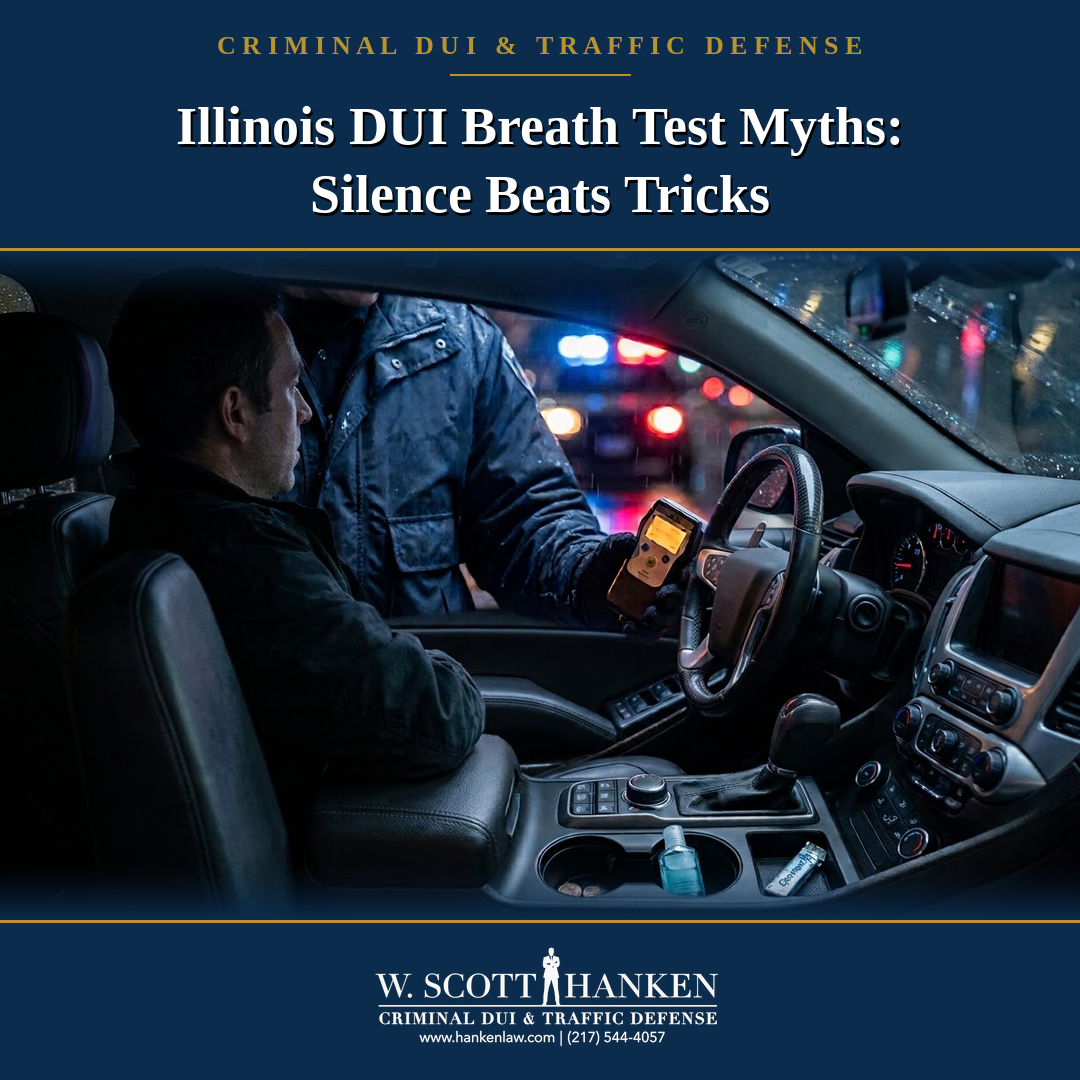
Illinois DUI Breath Test Myths: Silence Beats Tricks


Last Reviewed & Updated: September 20, 2026
By: W. Scott Hanken | Former Sangamon County Prosecutor | Springfield Criminal Defense & DUI Attorney | Voted “Best Attorney” — Illinois Times Best of Springfield & State Journal-Register Reader’s Choice | Springfield, IL | Sangamon County | (217) 544-4057 | hankenlaw.com
None of the internet’s breathalyzer tricks work on an Illinois breath test, and some make your reading worse. You’re not required to perform field sobriety tests, and you can refuse the evidentiary breath test too. Refusing doesn’t stop your arrest or the criminal case; it triggers a statutory summary suspension under 625 ILCS 5/11-501.1, with the length set by 625 ILCS 5/6-208.1 — twelve months for a first offender — and it can be used against you at trial as evidence of consciousness of guilt.
Bottom Line: Skip the penny, the mints, and the mouthwash. They don’t work, and Sangamon County officers have heard every version of these tricks. What actually matters is how little you say and do at the scene, and that’s a real legal strategy with real trade-offs, not a home remedy. Refusing a test doesn’t make the case disappear and it isn’t free of consequences, so talk to a lawyer before you decide anything else.
Key Takeaways:
- No home remedy changes a breath test reading. Mouthwash and holding your breath can push it higher.
- Field sobriety tests are voluntary in Illinois. No automatic license penalty for declining, but the refusal itself is admissible under People v. Roberts.
- Refusing the evidentiary breath test triggers a 12-month suspension for a first offender, or 3 years if you’re not a first offender, under 625 ILCS 5/6-208.1. “First offender” is defined at 625 ILCS 5/11-500.
- A first-offender refusal usually still qualifies for a Monitoring Device Driving Permit, not just a failed test.
- The suspension takes effect on the 46th day after written notice (625 ILCS 5/11-501.1(g)), not at the moment of arrest.
- Chemical-test refusal is admissible under 625 ILCS 5/11-501.2(c)(1), and People v. Rolfingsmeyer, 101 Ill. 2d 137 (1984), is what allows a prosecutor to argue it shows consciousness of guilt — but People v. Johnson, 218 Ill. 2d 125 (2005), limits how far that argument can go.
- Field sobriety test refusal is separately admissible under People v. Roberts, 115 Ill. App. 3d 384 (1983). Invoking silence or asking for a lawyer is neither kind of refusal.
- Saying little and calling a lawyer immediately is the strongest move at a stop.
Already arrested or facing a DUI stop in Sangamon County? Call (217) 544-4057 now.
Do Any of the Breathalyzer Tricks People Talk About Actually Work?
No. Every version has been tested and debunked, and a few backfire.
- Sucking on a penny or holding change under your tongue does not neutralize alcohol. There’s no chemical reaction between coin metal and ethanol, and modern pennies aren’t even copper anymore.
- Mouthwash and breath spray can mask odor, but many brands run over 25% alcohol, well above the average beer. Swishing it right before a test can push your reading up.
- Holding your breath doesn’t trap alcohol away from the machine. It gives alcohol more time to diffuse from your blood into your lungs, which can raise the result.
- Burping or “bringing up” stomach air doesn’t reroute your breath sample and doesn’t work anatomically. It can still matter procedurally: current Illinois regulations require the officer to restart the 20-minute observation period if you vomit during it, after you rinse your mouth with water. That’s a foundation issue for your attorney to raise, not a trick to beat the machine.
- Eating a big meal or chewing gum doesn’t lower your blood alcohol content. Once alcohol is in your bloodstream, food in your stomach doesn’t pull it back out.
What Happens If You Refuse a Breath Test in Illinois?
Refusing an evidentiary breath test doesn’t stop the DUI arrest or the criminal case. It triggers a separate civil penalty, a statutory summary suspension, governed by 625 ILCS 5/11-501.1 and 625 ILCS 5/6-208.1, and the length depends on whether you’re a first offender.
Statute Callout — 625 ILCS 5/11-501.1, Implied Consent. Under 625 ILCS 5/11-501.1 (Source: P.A. 104-260, eff. 8-15-25), any driver arrested for DUI in Illinois is deemed to have consented to a chemical test. Refusing doesn’t stop the arrest. It triggers a suspension under Section 6-208.1, the officer must warn you before requesting the test, and under subsection (g) the suspension takes effect on the 46th day after written notice, not the day of the stop.
| Result | First Offender | Not a First Offender |
|---|---|---|
| Refuse chemical testing | 12-month suspension, MDDP available | 3-year suspension, no MDDP |
| Submit and fail (BAC 0.08+) | 6-month suspension, MDDP available | 1-year suspension, no MDDP |
625 ILCS 5/6-208.1 (Source: P.A. 102-982, eff. 7-1-23). Under 625 ILCS 5/11-500, “first offender” means no prior DUI conviction or court supervision at all, with no time limit, and no statutory summary suspension or revocation under 625 ILCS 5/11-501.1 within the 5 years before this arrest, subject to a narrow not-guilty exception.
A first-offender refusal is not automatically barred from an MDDP. What actually blocks it under 625 ILCS 5/6-206.1 is a license that’s otherwise invalid, an arrest involving death or great bodily harm, a prior reckless homicide or aggravated DUI-death conviction, or being under 18. That’s narrower than most people assume. One more limit worth knowing: an MDDP never authorizes commercial driving, so a CDL holder facing a DUI is in a different position entirely.
Refusing is also not evidence-free. Under 625 ILCS 5/11-501.2(c)(1), evidence that you refused a chemical test is admissible at trial, and People v. Rolfingsmeyer, 101 Ill. 2d 137 (1984), holds that admitting it doesn’t violate your privilege against self-incrimination — which is what lets a prosecutor argue the refusal shows “consciousness of guilt.” There is a ceiling on that argument. In People v. Johnson, 218 Ill. 2d 125, 842 N.E.2d 714 (2005), the Illinois Supreme Court reversed a DUI conviction because the prosecutor crossed it, implying the defendant could have proven his innocence by blowing. Either way, instead of a printout reading .14, the state has to build its case out of an officer’s word about your driving, speech, and balance, which is harder to win.
Do You Have to Perform Field Sobriety Tests Before You’re Arrested?
No. Field sobriety tests are voluntary in Illinois, with no automatic license penalty for declining.
Case Callout — People v. Roberts. People v. Roberts, 115 Ill. App. 3d 384, 450 N.E.2d 451 (2d Dist. 1983), held it was not error to admit testimony that a driver refused to perform sobriety tests. An officer can testify that you declined, and a prosecutor can argue the same consciousness-of-guilt theory that applies to a chemical test refusal.
What Should You Actually Say and Do During a Sangamon County DUI Stop?
Provide your license, registration, and insurance. Beyond that, the fewer facts you hand an officer, the less the state has to work with later. Politely stating that you’re exercising your right to remain silent and want a lawyer is not obstruction. Keep the distinction sharp: refusing the chemical test after arrest is a specific, statutorily defined event with its own suspension and its own admissibility rule. Saying “I’m not answering questions and I want a lawyer” before that point is not a test refusal, and Illinois law doesn’t treat the two the same way.
What if I already tried a breath mint or mouthwash before the officer reached my window?
Officers must continuously observe you for at least 20 minutes before an evidentiary breath test. Under 20 Ill. Adm. Code 1286.310(a)(1), you must be deprived of alcohol and foreign substances during that period and must not have vomited; under subsection (a)(2), if you do vomit, the observation starts over after you rinse your mouth with water. That regulation, not the 1988 Orth opinion word for word, is what the officer has to satisfy today, though Orth remains the leading Illinois case on the foundation fight. Tell your attorney exactly what was in your mouth and when. More depth here: The Skoal, Zyn, or Breath Mint Defense.
What if I refuse the breath test but already stumbled through the field sobriety tests?
The state leans on the field sobriety performance instead. Those tests are sensitive to weather, footwear, and administration errors, common issues on Springfield’s older side streets and gravel shoulders around Sangamon County. More on declining them in what the Tony Romo DUI video teaches Springfield drivers about their rights.
What if refusing just makes the officer more suspicious and I get arrested anyway?
You may get arrested either way. The question isn’t whether refusing prevents an arrest, it’s what evidence exists afterward for a prosecutor to prove the case beyond a reasonable doubt.
How Silence Interacts With the State’s Burden to Prove a Breath Test Was Done Right
A breath number doesn’t walk into evidence on its own. Under 625 ILCS 5/11-501.2(a), a chemical analysis is valid only if it was performed according to standards set by the Illinois State Police. In current practice that means substantial compliance with 20 Ill. Adm. Code Part 1286: a licensed breath analysis operator, an approved and regularly tested instrument, a 20-minute observation period during which you were deprived of alcohol and foreign substances and did not vomit, and a printout tied to you specifically.
People v. Orth, 124 Ill. 2d 326, 530 N.E.2d 210 (1988), governs how that plays out at a statutory summary suspension hearing, and the order matters. The hearing is civil, and the burden starts with you: you have to make a prima facie showing that the breath result was inaccurate or didn’t reflect your actual alcohol concentration. Only if the judge credits that showing does the burden shift to the State to move the test into evidence and lay its foundation. Orth is still good law; the regulation is what the officer had to follow last night in Sangamon County.
Every fact you volunteer can end up corroborating that foundation or filling a gap in an officer’s report. The less you say, the more the state has to prove using only its own equipment and paperwork, which is why the first call after a stop should be to a lawyer, not a search engine.
Considering how a Sangamon County DUI stop might unfold? Call (217) 544-4057.
Frequently Asked Questions (FAQs)
No. They can request it and warn you of the consequences, but they cannot physically force a breath sample. Blood draws require a warrant absent specific exceptions.
No. Refusal only affects your license through the statutory summary suspension. The criminal charge under 625 ILCS 5/11-501 proceeds separately.
No, in the ordinary case. A first-offender refusal still qualifies for an MDDP under 625 ILCS 5/6-206.1, just with a 12-month window instead of 6 — which means twice as many months of MDDP administration fees and BAIID costs.
The roadside preliminary test helps an officer decide whether to arrest you. Under 625 ILCS 5/11-501.5, the state can’t use that number to prove your BAC — though you can use it if it helps you. The evidentiary test given later has to satisfy 625 ILCS 5/11-501.2(a) and 20 Ill. Adm. Code Part 1286, and that’s the number the state uses in court.
It can mask odor, but many mouthwashes contain enough alcohol themselves to raise a reading rather than lower it.
Twelve months if you’re a first offender, three years if not, under 625 ILCS 5/6-208.1. Either way, it starts on the 46th day after notice, not the day of the stop.
Yes. You or your attorney can file a petition to rescind in circuit court within 90 days of notice, under 625 ILCS 5/2-118.1. Filing doesn’t pause the suspension while you wait for the hearing.
Yes. Calibration records, operator certification, and the 20-minute observation period are all still open to challenge.
Further Reading
Practice Area
Related Articles
- The Skoal, Zyn, or Breath Mint Defense: How Smokeless Tobacco, Nicotine Pouches, or Mints Can Invalidate an Illinois DUI Breath Test in Springfield — if something was in your mouth during the 20 minutes, this is the argument your lawyer will build.
- The Tony Romo DUI Video: What It Really Teaches Springfield Drivers About Their Rights — watch the decisions in this post get made in real time on real dashcam footage.
- Can an Illinois Prosecutor Argue That Asking for a Lawyer Shows Guilt? — the precise line between a refusal and invoking your rights, which this post only sketches.
- DUI Dismissal in Illinois: What Actually Gets Cases Dropped — what a foundation challenge looks like when it works.
- Common Mistakes Police Make in Field Sobriety Tests and How We Use Them — the specific administration errors that make a stumble meaningless.
- The Ultimate Guide to DUI Defense in Sangamon County — start here if you were arrested and don’t yet know what happens next.
Browse by Topic
Ready to Fight Your DUI Charge in Springfield?
Call W. Scott Hanken at (217) 544-4057 or contact us online for a free consultation. We serve clients throughout Springfield, Sangamon County, and Central Illinois.
About the Author: W. Scott Hanken, Attorney at Law
Scott Hanken is a Springfield, Illinois criminal defense attorney with over 37 years of experience, including service as a former Sangamon County prosecutor. He has been voted Best Attorney by the Illinois Times and State Journal-Register, holds an Avvo 10.0 “Superb” rating, and has earned over 270 five-star Google reviews. He serves clients throughout Sangamon County and Central Illinois.
📍 1100 S 5th St, Springfield, IL 62703 | ☎ (217) 544-4057 | 🌐 hankenlaw.com
This article is for general educational purposes only and does not constitute legal advice. Every case is unique — contact an experienced Springfield criminal defense attorney for guidance on your specific situation.

Address
Our offices are located at the corner of South Fifth Street and Vine, in the historic Mary Bryant Home for the Blind.