- Free Consultation: (217) 544-4057 Tap Here To Call Us











Illinois Medicaid Vendor Fraud Charges: What to Know


Last Reviewed & Updated: September 12, 2026
By: W. Scott Hanken | Former Sangamon County Prosecutor | Springfield Criminal Defense & Theft Crimes Defense Attorney | Voted “Best Attorney” — Illinois Times Best of Springfield & State Journal-Register Reader’s Choice | Springfield, IL | Sangamon County | (217) 544-4057 | hankenlaw.com
Direct Answer: In Illinois, vendor fraud against Medicaid is prosecuted under 305 ILCS 5/8A-3 of the Public Aid Code, with penalties ranging from a Class A misdemeanor to a Class 1 felony depending on the dollar amount involved. Since October 1, 2023, the Illinois Attorney General’s Medicaid Fraud Control Unit, not the Illinois State Police, investigates these cases, and its June 2026 enforcement wave charged 17 defendants statewide, several tied directly to personal assistant billing under the Home Services Program.
Bottom Line: If you provide services billed to Illinois Medicaid, whether as a physician, a pharmacist, a home health agency, or a personal assistant under the Division of Rehabilitation Services (DORS) Home Services Program, you are now operating in an environment where electronic timekeeping data, wage records, and financial analytics flag irregularities automatically. An investigation does not mean a conviction, and the intent element, “willfully” under the vendor fraud statute, “knowingly or willfully” under managed health care fraud, is where real defenses live.
Facing a vendor fraud inquiry or charge tied to Illinois Medicaid or the DORS Home Services Program? Call W. Scott Hanken, Attorney at Law, at (217) 544-4057 for a direct conversation about your case.
What Counts as Vendor Fraud Under Illinois Medicaid Law?
Vendor fraud is defined in 305 ILCS 5/8A-3, the vendor fraud and kickbacks provision of the Illinois Public Aid Code. The statute reaches any person, firm, corporation, agency, or other entity that willfully, by false statement, concealment of a material fact, or other fraudulent scheme, obtains or attempts to obtain Medicaid benefits or payments it is not entitled to, or in a greater amount than it is entitled to. The same section separately criminalizes soliciting or paying kickbacks, bribes, or rebates in exchange for patient referrals or for purchasing, leasing, or ordering goods and services billed to Medicaid.
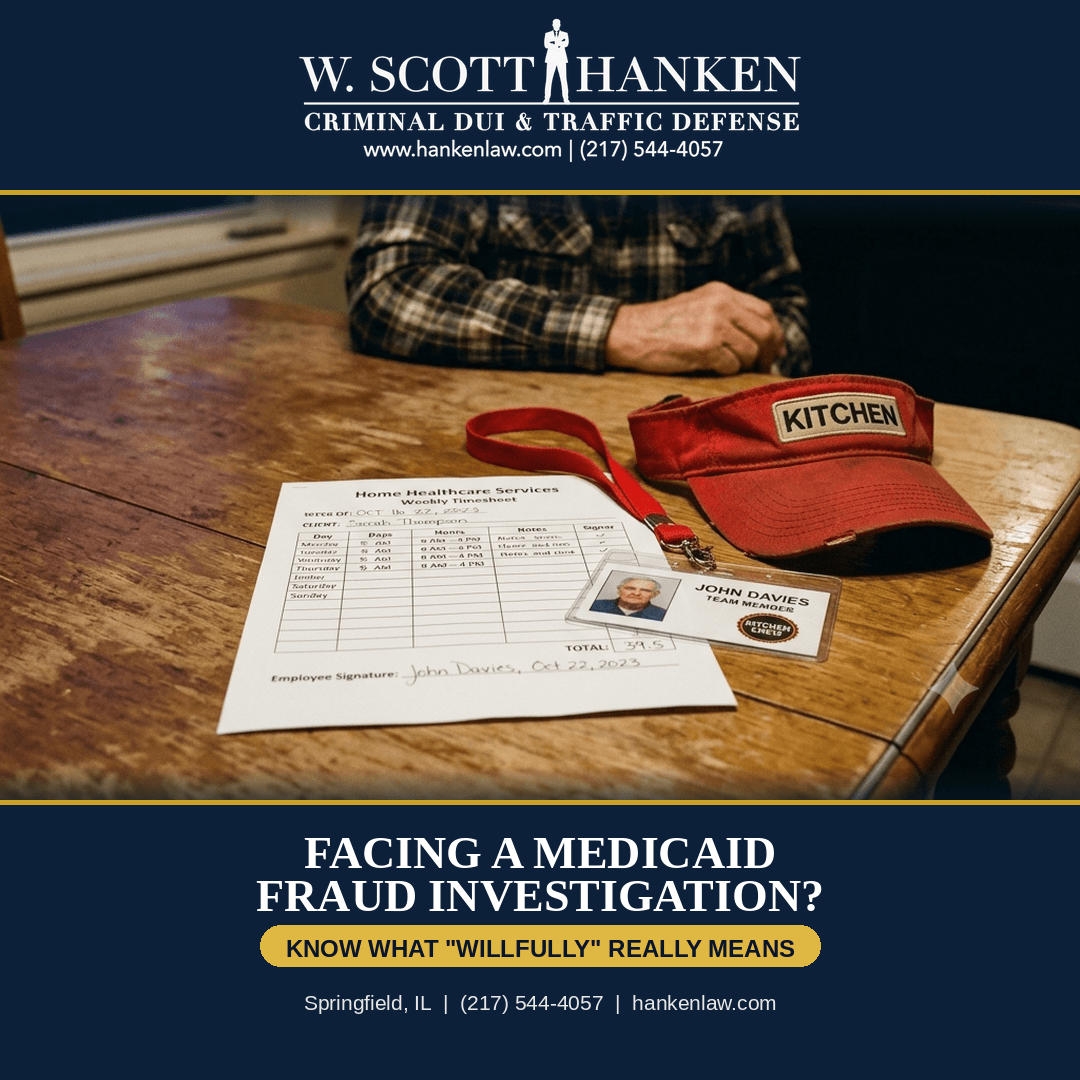
Notice the word “willfully.” Billing errors, documentation mistakes, and administrative sloppiness are not automatically crimes. The statute requires proof of intent, and that distinction matters enormously once you’re sitting across from an investigator.
Vendor fraud is punished according to 305 ILCS 5/8A-6, which sets penalties on a sliding scale tied to the dollar amount involved:
- Under $150: Class A misdemeanor
- $150 to $999: Class 4 felony
- $1,000 to $4,999: Class 3 felony
- $5,000 to $9,999: Class 2 felony
- $10,000 or more: Class 1 felony
That top tier matters because it does not climb any higher. No matter how large the alleged scheme, a standalone vendor fraud count under 8A-3 caps out at a Class 1 felony. That is not true of the companion charges prosecutors typically stack alongside it, which is where the real exposure in a large-dollar case comes from.
How Does Managed Care Fraud Differ From Vendor Fraud?
A separate provision, 305 ILCS 5/8A-13, covers “managed health care fraud.” It applies specifically to fraud connected to a “health plan,” a term the statute defines broadly enough to include Medicaid managed care organizations (MCOs) like Molina, Meridian, or Aetna Better Health, and any vendor or entity that contracts to provide goods or services reimbursed through one of those plans. Illinois moved most of its Medicaid population into managed care years ago, so a large share of current fraud charges now run through this section rather than the older fee-for-service vendor fraud language.
Like vendor fraud, managed health care fraud is punished on the amount-based scale set out in 305 ILCS 5/8A-6 rather than a fixed classification, though in each of the recent cases discussed here the dollar amounts involved have put the charge at a Class 1 felony. In June 2026, for example, Raoul’s office charged individuals in the Home Services Program with “managed healthcare fraud” alongside theft and forgery counts specifically because the personal assistant services in question were billed through Medicaid MCOs rather than directly through the state.
Why Prosecutors Stack Theft and Forgery Charges
Because the vendor fraud statute caps at a Class 1 felony regardless of dollar amount, prosecutors reach for 720 ILCS 5/16-1, the general theft statute, when the alleged loss is large. Theft of governmental property, which includes Medicaid funds, is a Class X felony once the amount exceeds $100,000, and any theft exceeding $1,000,000 is a Class X felony regardless of the property’s classification. Forgery under 720 ILCS 5/17-3, typically charged when a defendant is accused of falsifying timesheets, prescriptions, or billing documents, is a Class 3 felony.
This is why the case against a Cook County physician accused of over $1 million in fraudulent Medicaid and Medicare billing was charged in November 2025 with six counts of theft — each a Class X felony — plus one count of money laundering, one count of managed health care fraud, one count of vendor fraud, and two counts of forgery, rather than a single vendor fraud count. Prosecutors added a conspiracy count in June 2026 and separately charged a pharmacist in the same scheme; the Attorney General’s Medicaid Fraud Control Unit was recognized by the DEA for the investigation in July 2026. Stacking charges this way lets the state reach Class X exposure that the vendor fraud statute alone cannot deliver. Both defendants in that case have been charged, not convicted, and remain presumed innocent.
| Statute | Offense | Penalty (by amount) |
|---|---|---|
| 305 ILCS 5/8A-3 via 8A-6 | Vendor fraud | Class A misdemeanor to Class 1 felony (top tier begins at $10,000) |
| 305 ILCS 5/8A-13 via 8A-6 | Managed health care fraud | Class A misdemeanor to Class 1 felony (same amount-based scale) |
| 305 ILCS 5/8A-15 | False statements re: health care delivery | Class 4 felony |
| 720 ILCS 5/16-1 | Theft (governmental property) | Class 4 to Class X, depending on amount |
| 720 ILCS 5/17-3 | Forgery | Class 3 felony |
What Changed in How Illinois Investigates These Cases?
Two structural shifts matter more than any single case.
First, jurisdiction moved. As of October 1, 2023, the Illinois Attorney General’s office, not the Illinois State Police, investigates Medicaid provider fraud statewide. If you receive a letter or a visit connected to a Medicaid billing inquiry today, it is coming from Raoul’s Medicaid Fraud Control Unit (MFCU), which operates out of five offices across the state and receives roughly 75 percent of its funding through a federal HHS grant.
Second, the scale and speed of federal-state coordination increased sharply. On June 23, 2026, the Department of Justice announced its 2026 National Health Care Fraud Takedown, charging 455 defendants nationwide, including 90 doctors and other licensed professionals, in connection with more than $6.5 billion in alleged false claims. The Department describes it as its largest such action by several measures, spanning 56 federal districts with 50 state Medicaid Fraud Control Units participating, the most ever in a single takedown. Illinois’s share of that action was 17 defendants, several of them tied directly to the DORS Home Services Program: providers charged with submitting false timesheets for personal assistant services, and at least one case built around a falsified gas mileage reimbursement scheme connected to medical transportation billing.
Separately, in August 2025, the U.S. Attorney’s Office for the Northern District of Illinois created its first-ever standalone Healthcare Fraud Section, staffing it with six federal prosecutors led at launch by Section Chief Heidi Manschreck. That section works alongside, not in place of, the existing Healthcare Fraud Strike Force, meaning Chicago-based federal prosecutors now have two dedicated teams pursuing these cases instead of one.
How Are Investigators Catching Personal Assistant and Home Services Fraud?
The Home Services Program lets DORS customers with disabilities hire personal assistants to help with daily activities in their own homes rather than entering a nursing facility. Illinois began using Electronic Visit Verification for personal assistants in that program in 2014, and the federal 21st Century Cures Act has since pushed EVV across Illinois’s Medicaid-funded personal care and home health services generally, with the home health deadline landing on January 1, 2023. Individual providers call in and call out through the Sandata system, which the Illinois Department of Human Services, Division of Rehabilitation Services (DHS/DRS) contracts with as its EVV vendor for personal assistants specifically. Statewide, the Department of Healthcare and Family Services contracts with HHAeXchange to aggregate EVV data for Medicaid-funded providers, with DRS the one waiver program running its own aggregation system. That system time-stamps each shift and ties the call to the customer’s telephone line.
This is not a new detection tool. It is a well-established one that now gets cross-referenced automatically against billing submissions, and mismatches between an EVV call record and the claimed service are exactly the kind of anomaly that triggers a referral. A Home Services Program EVV investigation typically starts here: an automated exception report, not a tip from a disgruntled customer. The June 2026 case against a Glendale Heights personal assistant charged with submitting false time sheets for services she did not render illustrates the pattern directly.
Illinois DHS also conducts routine wage-matching against the Illinois Department of Employment Security’s New Hire Registry and the federal National Directory of New Hires, a practice DHS documents in its own policy manual for verifying benefit eligibility. The same underlying data, an individual drawing a paycheck from an unrelated employer during hours billed to Medicaid, is the kind of overlap that turns a routine audit into a fraud referral once EVV and payroll data are compared side by side.
What if My EVV Timestamps Look Wrong But I Didn’t Falsify Anything?
Illinois law requires proof that a defendant “willfully” made a false statement or engaged in a fraudulent scheme before a vendor fraud conviction can stand. 305 ILCS 5/8A-3(a). A dropped call, a dead cell phone battery, or a customer’s landline losing service does not establish intent by itself. In Sangamon County cases I’ve handled involving electronic timekeeping disputes, whether in the DORS context or in employment-adjacent matters, the recurring issue is that the program has never treated the electronic record as the only record: HSP requires individual providers to both call in and call out through EVV and record all visits on a paper timesheet signed by the provider and the customer. A single missed call-in is evidence of a technical failure, not evidence of fraud, and the contemporaneous paper record that program rules already require is often the strongest defense exhibit in the case.
What if I Have a Second Job That Overlaps My Medicaid Billing Hours?
A wage-match flag showing income from another employer during hours billed to Medicaid looks damning on a spreadsheet, but it is not proof of “concurrent employment” fraud by itself. Illinois’s New Hire Registry captures the employer, the employee, and the Social Security number; it carries no wage information at all, and the date of hire is requested but not required. Quarterly wage reports aggregate income across a three-month period with no hour-by-hour breakdown. A personal assistant who works a part-time retail shift in the evening and provides Home Services Program care during the day can generate a wage-match flag that has nothing to do with actual billing fraud. Sorting out whether an overlap reflects a scheduling conflict or fabricated hours requires pulling the underlying pay stubs and shift schedules before any charging decision, and that reconstruction work is where a defense attorney earns their fee early in an investigation rather than after an indictment.
What if I’m a Provider Who Relied on Staff I Believed Were Qualified?
Vendor fraud and managed health care fraud both require the defendant’s own knowledge and willfulness, not just the conduct of an employee acting without the owner’s knowledge. Where prosecutors allege a physician personally directed the use of an unlicensed or uncertified person to render services, or was out of the country while claiming to have provided the care himself, as in the pending Cook County case discussed above, the state has to prove the individual defendant knew about and directed the scheme, not merely that irregular billing occurred somewhere in the practice. A practice owner facing this kind of allegation needs to separate what they personally knew and authorized from what employees or contractors did without their knowledge, and that separation often becomes the central fight in the case.
How MFCU Cases Move Through Sangamon County Differently Than a Typical Theft Case
The MFCU vs. State’s Attorney distinction in Sangamon County is one of the first things I walk new clients through, because it changes who you’re actually negotiating with. Here is something that surprises most clients: when the Attorney General’s Medicaid Fraud Control Unit brings a vendor fraud or managed health care fraud charge, the Sangamon County State’s Attorney is not the prosecuting authority. MFCU attorneys, not the local State’s Attorney’s office, handle these cases directly, even though they are filed and heard in Sangamon County Circuit Court when the defendant resides here or the underlying conduct occurred here.
In 37+ years of criminal defense work in Sangamon County, including time as an Assistant State’s Attorney, I’ve seen clients assume they’re dealing with the same prosecutor’s office that handles a shoplifting case down the street. They are not, and that changes everything from the pace of discovery to who has authority to negotiate a resolution. Understanding which office actually controls the case, and confirming that early, shapes the entire defense strategy from the first meeting.
If you’ve received a letter, a subpoena, or a visit connected to a Medicaid billing investigation, don’t wait for formal charges to get legal advice. Call W. Scott Hanken, Attorney at Law, at (217) 544-4057 to talk through what’s actually being alleged.
Frequently Asked Questions (FAQs)
No. Under 305 ILCS 5/8A-6, a violation involving less than $150 is a Class A misdemeanor. Felony exposure begins at $150 and increases in tiers up to a Class 1 felony for $10,000 or more.
The statute requires a willful false statement or fraudulent scheme, not a clerical error. Genuine billing mistakes, corrected once discovered, are a fundamentally different legal question than an intentional false claim, though prosecutors and defendants often disagree about which one occurred in a given case.
The Illinois Attorney General’s Medicaid Fraud Control Unit prosecutes these cases statewide, including in Sangamon County Circuit Court, rather than the local State’s Attorney’s office.
Vendor fraud under 305 ILCS 5/8A-3 covers false claims made directly against the Medicaid program. Managed health care fraud under 305 ILCS 5/8A-13 covers fraud connected to a Medicaid managed care health plan, such as an MCO. Both are frequently charged together when a scheme runs through managed care billing.
Do not answer substantive questions about your timesheets or billing history without legal representation present. Anything you say, including an attempt to explain a discrepancy, can be used to build the case against you.
Depending on the amount involved, the defendant’s history, and the strength of the intent evidence, resolutions short of a felony conviction, including negotiated pleas to lesser charges or diversion in appropriate cases, are sometimes available. This depends heavily on the specific facts and is not something a general answer can promise.
Further Reading
Practice Area
Related Articles
- New Illinois Telecommunications Wire Theft Law Explained — see how Illinois grades a theft offense when the legislature writes a dedicated statute instead of relying on the general theft ladder.
- Illinois Retail Theft Charges: Why the $300 Line Matters — the clearest illustration of how a single dollar figure decides whether you face a misdemeanor or a felony.
- Can an Illinois Prosecutor Argue That Asking for a Lawyer Shows Guilt? — if you’re deciding whether to call an attorney before answering an investigator’s questions, this answers the fear that doing so looks bad.
- New Illinois Law on Gambling Disorder: What It Means for Criminal Charges — what happens when an underlying condition, rather than intent to steal, drives the conduct behind a theft allegation.
Browse by Topic
Ready to Fight Your Theft Charge in Springfield?
Call W. Scott Hanken at (217) 544-4057 or contact us online for a free consultation. We serve clients throughout Springfield, Sangamon County, and Central Illinois.
About the Author: W. Scott Hanken, Attorney at Law
Scott Hanken is a Springfield, Illinois criminal defense attorney with over 37 years of experience, including service as a former Sangamon County prosecutor. He has been voted Best Attorney by the Illinois Times and State Journal-Register, holds an Avvo 10.0 “Superb” rating, and has earned over 270 five-star Google reviews. He serves clients throughout Sangamon County and Central Illinois.
📍 1100 S 5th St, Springfield, IL 62703 | ☎ (217) 544-4057 | 🌐 hankenlaw.com
This article is for general educational purposes only and does not constitute legal advice. Every case is unique — contact an experienced Springfield criminal defense attorney for guidance on your specific situation.
Address
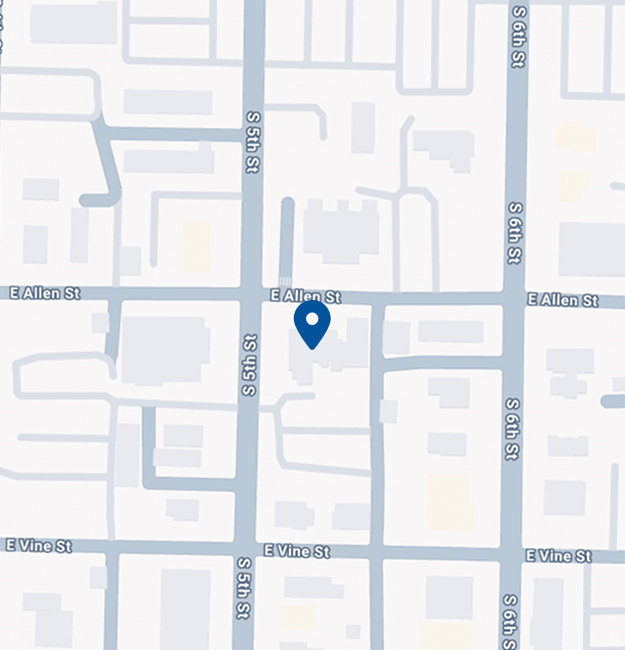
Our offices are located at the corner of South Fifth Street and Vine, in the historic Mary Bryant Home for the Blind.