- Free Consultation: (217) 544-4057 Tap Here To Call Us















Illinois Pretrial Sentence Credit: What Public Act 104-0722 Changes on January 1, 2027


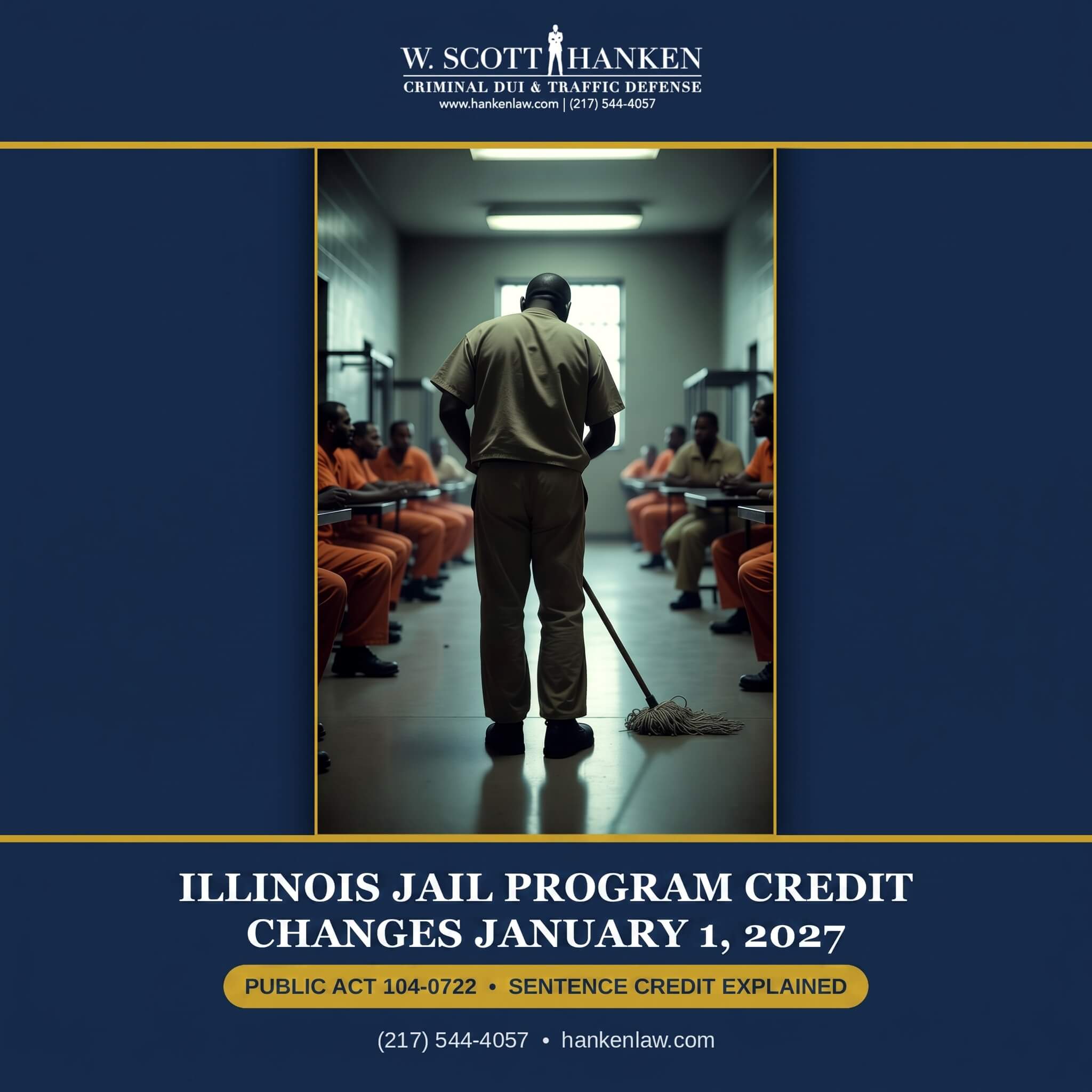
Last Reviewed & Updated: August 23, 2026
By: W. Scott Hanken | Former Sangamon County Prosecutor | Springfield Criminal Defense Attorney | Voted “Best Attorney” — Illinois Times Best of Springfield & State Journal-Register Reader’s Choice | Springfield, IL | Sangamon County | (217) 544-4057 | hankenlaw.com
Senate Bill 3333 was signed into law on July 31, 2026 as Public Act 104-0722, and it takes effect January 1, 2027. It expands the sentence credit available to people held in pretrial detention in Illinois by dropping the requirement that a jail substance abuse program be full-time and last 60 days, and by adding county jail work assignments and parenting programs to the list of credit-eligible activities under 730 ILCS 5/3-6-3.
Bottom Line: If you or a family member is sitting in the Sangamon County Jail awaiting trial, the programming and work assignments completed there could shorten a future IDOC sentence — but only if it gets documented and put into the sentencing order. That last part is where cases fall through the cracks.
Questions about how this affects a pending case? Call (217) 544-4057.
What Does Public Act 104-0722 Change About Illinois Sentence Credit?
The new law amends 730 ILCS 5/3-6-3(a)(4)(A), the section of the Unified Code of Corrections governing “county program credit.” Three changes matter for pretrial detainees:
- The old law required a substance abuse program completed in county jail to be full-time and at least 60 days long before it counted for credit. Public Act 104-0722 removes that threshold entirely.
- It adds county jail or detention facility work assignments and parenting programs as expressly credit-eligible, alongside the existing categories of educational programs, behavior modification programs, and life skills courses.
- It changes the standard from programs “provided by” the county department of corrections or jail to programs “facilitated by” them — a broader standard for who can run a qualifying program.
One thing worth flagging: the bill as introduced would have also created credit for pretrial “supervised community work or activities.” Senate Floor Amendment No. 2 stripped that provision before final passage, so it is not part of the law.
Is the New Sentence Credit Law in Effect Yet?
Not yet. The Senate passed SB3333 35-18 on April 15, 2026, and the House passed it 70-37 on May 29, 2026. It was sent to the Governor on June 26, 2026, and Governor Pritzker signed it on July 31, 2026. It became Public Act 104-0722.
The effective date is January 1, 2027. That gap matters. A sentencing hearing held between now and December 31, 2026 is governed by the current version of the statute — which still contains the full-time, 60-day requirement for substance abuse credit and does not expressly list county jail work assignments or parenting programs.
What County Jail Programs Will Count Toward Sentence Credit?
Beginning January 1, 2027, the amended statute provides that sentence credit may be given to a person held in pretrial detention who successfully completed any of the following before being committed to IDOC:
- Substance abuse programming, regardless of whether it was full-time or 60 days
- County jail or detention facility work assignments, including trustee positions
- Educational programs, behavior modification programs, and life skills courses
- Parenting programs
- Re-entry planning facilitated by the county department of corrections, the jail, or another provider
When Is Pretrial Sentence Credit Actually Calculated and Awarded?
This is the part generic explainers miss, and it is the part that actually determines whether a client gets the credit. The statute requires that county program credit “be done at sentencing as provided in Section 5-4.5-100 of this Code and shall be included in the sentencing order.”
That means this credit is not something IDOC automatically tacks on later when a defendant arrives at intake. It has to be raised, documented, and entered into the record by the sentencing judge in Sangamon County Circuit Court or wherever the case is pending. If defense counsel does not bring it up, it often does not happen.
If you are still at the front end of a case — facing a detention hearing rather than a sentencing hearing — the earlier decisions matter too. See Illinois SAFE-T Act: What Happens at a Detention Hearing in Springfield — and How to Fight Back.
What Are the Most Common Ways Sangamon County Defendants Lose This Credit?
What if I served as a jail trustee but never got the extra credit?
In 37+ years of criminal defense in Sangamon County, I have represented pretrial clients who worked as trustees in the county jail while awaiting trial or disposition and never received additional sentence credit for that work. Under Public Act 104-0722, trustee duty is a county jail work assignment expressly listed in 730 ILCS 5/3-6-3(a)(4)(A). The gap almost always comes down to documentation: nobody put the trustee record in front of the sentencing judge, so it never made it into the order.
What if my jail substance abuse program wasn’t full-time?
Under the current statute, this is a real problem. A defendant who completed part-time counseling or a shorter program in the Sangamon County Jail can be denied credit outright because the statute demands full-time, 60-day-or-longer participation. Public Act 104-0722 removes that bar as of January 1, 2027, which means shorter or part-time programming should qualify going forward, provided it is documented and presented at sentencing.
What if I’m sentenced before January 1, 2027?
If sentencing happens before the new law takes effect, the current version of the statute controls — including the full-time and 60-day requirements for substance abuse credit, and the absence of county jail work assignments and parenting programs from the eligible list. Timing matters here, and it is a reason to raise the issue with the court and consider whether the sentencing date itself is worth discussing with your attorney.
Pretrial Jail Program Credit: Before and After Public Act 104-0722
| Activity | Under Current Law (through 12/31/2026) | Under PA 104-0722 (from 1/1/2027) |
|---|---|---|
| Substance abuse program | Full-time, 60+ days required | No minimum duration or full-time requirement |
| County jail work assignment (e.g., trustee) | Not expressly listed | Expressly credit-eligible |
| Parenting program | Not expressly listed | Expressly credit-eligible |
| Supervised community work/activities | Not credit-eligible | Considered, then removed by Senate Floor Amendment No. 2; not in the final law |
Not sure how this applies to your case? Call (217) 544-4057 to talk it through.
Frequently Asked Questions (FAQs)
No. Neither the current statute nor Public Act 104-0722 uses the word “trustee.” The credit-eligible category the new law adds is “county jail or detention facility work assignments” — a broader term a trustee position has to fit within, not a defined trustee credit.
This hasn’t been tested in court or by IDOC rule yet, since the law doesn’t take effect until January 1, 2027. But the statutory structure supports it. Public Act 104-0722 places “county jail or detention facility work assignments” in paragraph (4)(A) — the same paragraph covering substance abuse and educational programming — rather than in paragraph (4.2), which provides up to 0.5 days of credit per day for work “not otherwise eligible under paragraph (4).” A trustee position is a work assignment performed inside the detention facility, which reads naturally as the kind of assignment (4)(A) now covers.
Until IDOC issues rules and regulations implementing the amendment, or a case tests this in Sangamon County Circuit Court, this is our office’s reading of the statutory language, not a guaranteed outcome.
No. Under 730 ILCS 5/3-6-3(a)(4)(A), county program credit must be calculated at sentencing and included in the sentencing order. It is not something IDOC intake staff will search out on their own.
The statute directs IDOC to prescribe rules under which sentence credit “may be provided” for qualifying pretrial programming, and requires the amount to be calculated at sentencing and entered in the sentencing order. The rate that will apply to county program credit under the amended statute is a question your attorney should raise directly with the sentencing court.
Largely no. Paragraph (2) of the same statute already eliminates or caps sentence credit for a specific list of violent and sex offenses, and Public Act 104-0722 does not change those caps. The interaction between those caps and program credit is governed by paragraph (4.7), which is unchanged — so anyone in that category needs individualized advice rather than a general rule.
It was removed by Senate Floor Amendment No. 2 before the bill passed both chambers. It is not part of the final law.
The full text of the amendment is published as Public Act 104-0722 on the Illinois General Assembly’s website. The compiled version of 730 ILCS 5/3-6-3 will not reflect these changes until the effective date.
Contact your attorney before sentencing. Once a case is resolved and the sentencing order is entered, adding credit after the fact is far harder than getting it right the first time.
Further Reading
Related Articles
- Illinois SAFE-T Act: What Happens at a Detention Hearing in Springfield — and How to Fight Back — This post assumes you’re already in pretrial detention; that one explains how that decision gets made and how to fight it.
- Illinois FAIR Act: What the New State Public Defender Law Means for Criminal Defendants in Sangamon County — Sentence credit only gets awarded if counsel raises it, so who represents you directly affects whether you get it.
- What If I Miss My Court Date in Springfield, IL? A 2026 Guide Under Illinois’ No-Cash-Bail Law — A missed date is one of the fastest ways to end up in the pretrial detention this post is about.
- Top 5 Questions People Ask a DUI, Criminal Defense, and Traffic Attorney in Springfield, Illinois — Start here if this is your family’s first time dealing with the Sangamon County criminal system.
Browse by Topic
Ready to Fight Your Criminal Charge in Springfield?
Call W. Scott Hanken at (217) 544-4057 or contact us online for a free consultation. We serve clients throughout Springfield, Sangamon County, and Central Illinois.
About the Author: W. Scott Hanken, Attorney at Law
Scott Hanken is a Springfield, Illinois criminal defense attorney with over 37 years of experience, including service as a former Sangamon County prosecutor. He has been voted Best Attorney by the Illinois Times and State Journal-Register, holds an Avvo 10.0 “Superb” rating, and has earned over 270 five-star Google reviews. He serves clients throughout Sangamon County and Central Illinois.
📍 1100 S 5th St, Springfield, IL 62703 | ☎ (217) 544-4057 | 🌐 hankenlaw.com
This article is for general educational purposes only and does not constitute legal advice. Every case is unique — contact an experienced Springfield criminal defense attorney for guidance on your specific situation.

Address
Our offices are located at the corner of South Fifth Street and Vine, in the historic Mary Bryant Home for the Blind.