- Free Consultation: (217) 544-4057 Tap Here To Call Us














Illinois Speed Limiter Law: 2 Convictions, Device in 2028


Last Reviewed & Updated: October 2, 2026
By: W. Scott Hanken | Former Sangamon County Prosecutor | Springfield Criminal Defense & Traffic Ticket Defense Attorney | Voted “Best Attorney” — Illinois Times Best of Springfield & State Journal-Register Reader’s Choice | Springfield, IL | Sangamon County | (217) 544-4057 | hankenlaw.com
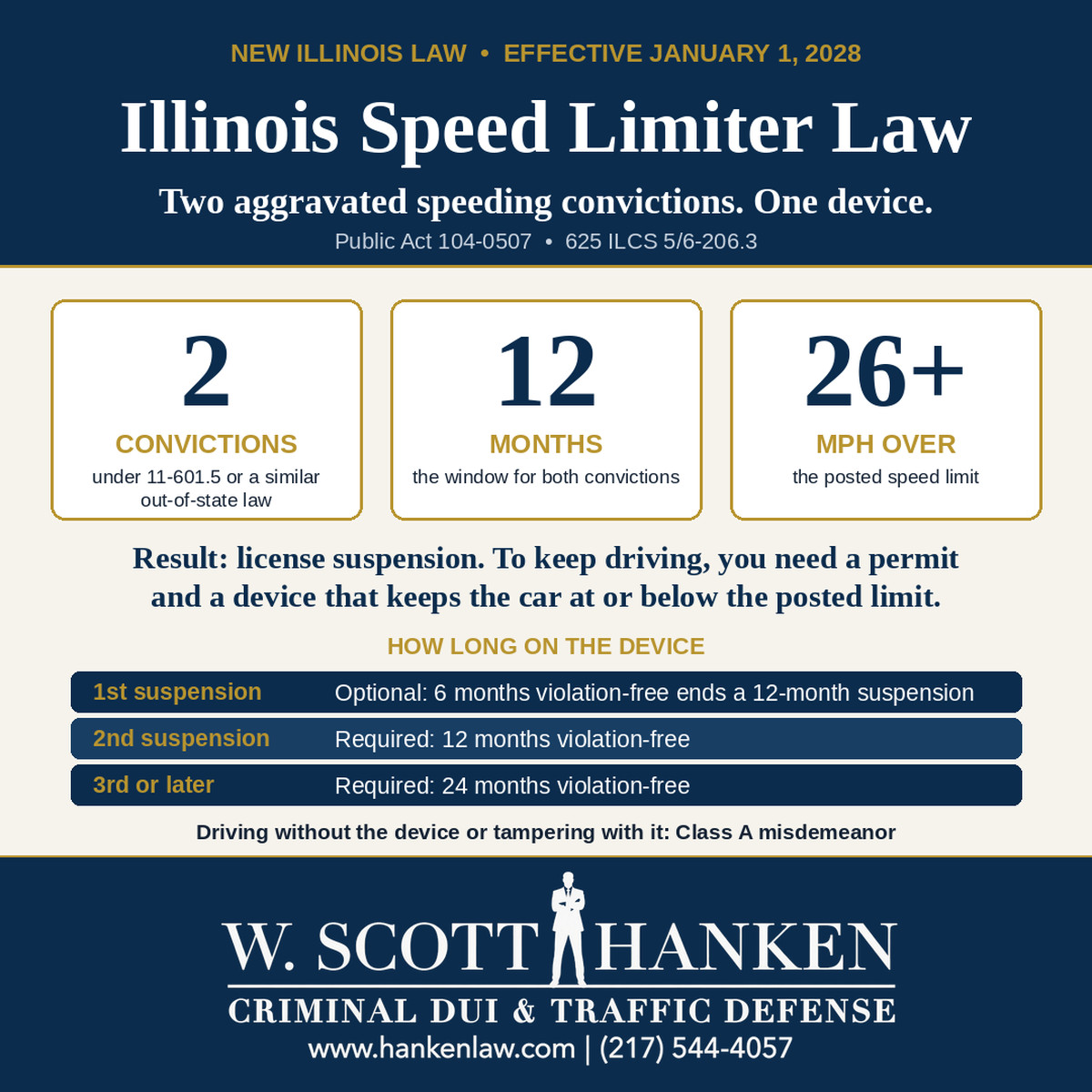
Starting January 1, 2028, two convictions within 12 months for driving 26 mph or more over the limit will trigger an Illinois license suspension. A conviction under 625 ILCS 5/11-601.5 counts, and so does a similar conviction in another state. To keep driving, you need a permit and a device that keeps the car from going over the posted limit and does not use the brakes.
Bottom Line: One aggravated speeding conviction is now a setup for the second. How your first case is resolved decides whether a later ticket costs you a fine or puts a speed limiter in your car. The time to protect your record is before the first plea.
Charged with aggravated speeding in Sangamon County? Call W. Scott Hanken, Attorney at Law at (217) 544-4057 before your first court date.
What Is the Illinois Intelligent Speed Assistance Program?
It is a new Secretary of State program that suspends repeat high-speed drivers and lets them drive only in vehicles fitted with a speed-limiting device.
Public Act 104-0507 (House Bill 4948) creates the program by adding Section 6-206.3 to the Illinois Vehicle Code. The Governor approved it June 26, 2026, and it takes effect January 1, 2028.
Statute Callout — 625 ILCS 5/6-206.3 (added by P.A. 104-0507, eff. 1-1-28): An intelligent speed assistance device is “an aftermarket device that actively prevents a motor vehicle from exceeding the applicable speed limit and does not interact with the braking system.”
The device can read the limit using technology such as GPS, digital maps, or sign-recognition cameras. Variable “dynamic speed zones” are excluded.
Which Offenses Trigger the Speed Limiter Requirement?
Only aggravated speeding convictions count: 26 mph or more over the limit under 625 ILCS 5/11-601.5 (P.A. 98-511, eff. 1-1-14), or a similar conviction in another state.
Two of them within a 12-month period require the Secretary of State to suspend your license. Reckless driving appeared in early drafts of the bill. It is not in the law that passed.
On the 70 mph stretches of I-55 and I-72 outside Springfield, 96 mph qualifies. On a 45 mph city street, 71 mph qualifies.
| Speed over limit | Charge | Maximum penalty |
|---|---|---|
| 26 to 34 mph | Class B misdemeanor (11-601.5(a)) | 6 months in jail, $1,500 fine (730 ILCS 5/5-4.5-60) |
| 35 mph or more | Class A misdemeanor (11-601.5(b)) | 364 days in jail, $2,500 fine (730 ILCS 5/5-4.5-55) |
Both levels count. The sentencing ranges come from 730 ILCS 5/5-4.5-60 and 730 ILCS 5/5-4.5-55 (P.A. 100-1161, eff. 7-1-19).
How Long Do You Have to Use the Device?
It depends on how many times you have been suspended under this law. The clock runs only while you drive violation-free on the Permit.
| Suspension under 6-206.3(e) | What the Secretary of State imposes | How it ends |
|---|---|---|
| First | 12-month suspension; the program is optional | 6 months on the Permit without a violation |
| Second | Suspension until program completed | 12 months on the Permit without a violation |
| Third or later | Suspension until program completed | 24 months on the Permit without a violation |
A first-time driver can decline the device and sit out the full 12 months. A second-time driver has no such choice.
What If the Aggravated Speeding Caused a Death?
A narrow group of fatal cases goes on a separate, longer track. It applies only if your license is revoked under 625 ILCS 5/6-205(a)(16) and the conviction was for aggravated speeding under Section 11-601.5.
Paragraph (16) requires revocation for any traffic offense that was the proximate cause of a death. For those drivers, amended 625 ILCS 5/6-208(b)(6) blocks any application for a new license until a device-restricted driving permit has been held for the period below.
| Prior enrollments in the program | Time on the device-restricted permit |
|---|---|
| None | Not less than 365 days |
| One | Not less than 730 days |
| Two or more | 1,095 days |
The time counts only while the restricted permit is not suspended, cancelled, or revoked for a violation of law or Secretary of State rules, including a violation involving the device. The standard Permit is unavailable, because Section 6-206.3 bars it when death resulted from a qualifying offense.
This rule does not reach every fatal crash. A death revocation based on a reckless driving conviction is still a paragraph (16) revocation, but because the conviction is not under Section 11-601.5, this reinstatement rule does not apply.
What Does the Permit Allow, and What Does It Cost?
The Permit lets you drive at any time and for any purpose, but only in a vehicle equipped with an approved device (625 ILCS 5/6-206.3(h)).
The cost falls on you:
- A Secretary of State fee of up to $30 per month
- Installation, monitoring, and removal charges set by the service provider
Indigency is not a full waiver. If the Secretary of State finds you indigent, the provider must install, monitor, and remove the device without charge and seek reimbursement from the Indigent Intelligent Speed Assistance Device Fund. The statute then adds: “Any other monetary charges shall be the responsibility of the participant.” (625 ILCS 5/6-206.3(k))
The deadlines are short. A required participant must return the application within 14 days of the suspension’s effective date, then has 14 days from Permit issuance to install the device. The service provider has 14 days to send proof of installation to the Secretary of State. If that proof does not arrive, the Permit is cancelled (625 ILCS 5/6-206.3(e)).
In my 37+ years of practice, clients are often caught off guard because they never updated their address with the Secretary of State, so notices went unreceived or unread. A 14-day window makes that mistake far more expensive.
Worried about a second aggravated speeding charge? Call (217) 544-4057 to talk with a former Sangamon County prosecutor about your options.
What Happens If You Violate the Program?
A program violation adds 90 days, and driving around the device is a new crime (625 ILCS 5/6-206.3(m), (t), (u), (v)).
- If your suspension is still running, your enrollment is extended 90 days
- If your suspension already ended, the Secretary of State may suspend you for 90 days
- Driving a vehicle without the device while restricted is a Class A misdemeanor
- Tampering with or circumventing the device is a Class A misdemeanor
Tampering includes disconnecting wiring, using a GPS blocker, or altering software. Loss of device power for 24 continuous hours or more is a “failure to maintain” under the statute. Whether that counts as a program violation is left to Secretary of State rules, which are not final. A new Class A charge from a Springfield stop would be filed in the Sangamon County Circuit Court.
Does Court Supervision on an Aggravated Speeding Ticket Count Toward the Illinois Speed Limiter Law?
A completed supervision is not listed as a qualifying offense. The catch is that supervision is often unavailable for this charge.
Section 6-206.3 defines a qualifying offense as “a conviction of a violation of Section 11-601.5.” Supervision is not mentioned. But 730 ILCS 5/5-6-1 takes supervision off the table in two situations that matter in Springfield:
- Subsection (q): no supervision if you were driving in an urban district at 26 mph or more over the limit
- Subsection (p): no supervision if you have a prior conviction or supervision for Section 11-601.5
So on a stop inside an urban district, which covers most built-up city streets, supervision on the aggravated speeding charge is barred by statute. And if you received supervision on a first case, it is barred on the second.
Subsection (b-1) goes further. If you were convicted of, or pleaded guilty to, a Vehicle Code misdemeanor within the past 12 months, the probation and conditional discharge provisions of subsections (a) and (b) do not apply to a new Vehicle Code misdemeanor charge. Combined with subsection (p), a second aggravated speeding charge inside the 12-month window leaves very few sentencing options.
Where supervision is legally available, here is how it plays out locally. In Sangamon County, the State’s typical initial offer on an aggravated speeding charge involves a conviction. Proving mitigating circumstances, including the impact a conviction would have on your livelihood, is often the primary factor separating a conviction from court supervision. When the State will not agree, seasoned local counsel can still maneuver by requesting an Illinois Supreme Court Rule 402 conference before the judge. Read more about court supervision and traffic ticket defense in Springfield.
Does a School-Zone or Construction-Zone Speeding Conviction Trigger the ISA Device?
On the face of the definition, no. The law counts only a conviction “of a violation of Section 11-601.5.”
Three kinds of cases fall outside that wording:
- A school-zone case charged under 625 ILCS 5/11-605
- A construction-zone case charged under 625 ILCS 5/11-605.1(d-5)
- A case charged only under a municipal ordinance
Falling outside the definition is not the same as an easy outcome. Under 730 ILCS 5/5-6-1(f), court supervision is not available for a school-zone charge under Section 11-605 or for a charge under paragraph (d-5) of Section 11-605.1. A conviction there would not count toward the speed limiter law, but it is still a conviction on your record. I cover that charge in detail in aggravated speeding in an Illinois work zone.
The section named on the charge matters. The same speed, charged under Section 11-601.5, would count. That makes the charging decision, and any amendment negotiated in court, a real defense point. The Secretary of State has not yet adopted rules, so treat this as a reading of the text and not a settled practice.
If My First Aggravated Speeding Conviction Was Before 2028, Does It Count?
The statute does not say. The Act has no lookback clause.
Section 6-206.3 takes effect January 1, 2028, and applies to a driver who “commits 2 qualifying offenses within a 12-month period.” Whether a 2027 conviction starts the 12-month clock for a 2028 case is unanswered. Do not assume a pre-2028 conviction is safe, and do not assume it counts.
A second gap sits in the same sentence. A qualifying offense is defined as a conviction, yet the trigger speaks of offenses a driver “commits.” Whether the 12 months runs between offense dates or conviction dates is also open.
What If I Drive a Company Vehicle or Hold a CDL?
You can ask the Secretary of State for permission to drive an employer-owned vehicle without the device (625 ILCS 5/6-206.3(j)). A commercial motor vehicle is never covered.
Your employer must complete a verification form, and you must carry the approved form while driving. The exemption does not apply to:
- Commercial motor vehicles, school buses, or vehicles built for more than 15 passengers
- A business owned in whole or part by you or a family member
- A company vehicle you also use personally
- Driving beyond 12 hours a day, 6 days a week
A CDL holder can still be issued a Permit for a non-commercial vehicle. Separately from this program, speeding 15 mph or more over the limit is already a “serious traffic violation” for CDL purposes under 625 ILCS 5/6-500(26), so 26 over qualifies. And 625 ILCS 5/6-500(8) treats payment of a fine or court cost as a conviction even if sentence is deferred and the charge is later dismissed. A supervision that keeps the ticket off your personal record can still be a serious traffic violation for your CDL. Two serious traffic violations within three years disqualify a CDL holder for at least two months, but violations committed in a personal vehicle count toward that disqualification only if they would result in suspension or revocation of your non-commercial driving privileges (625 ILCS 5/6-514(e)). See how a traffic offense affects your CDL.
Does the Device Track Where I Drive?
Yes. The provider records your speed, the posted limit, trip times, override events, and location coordinates (625 ILCS 5/6-206.3(q)).
The law limits location data to compliance verification and requires trip data to be deleted after 30 days unless rules say otherwise. It also authorizes the Secretary of State to adopt rules for providing device data to police when a Permit holder is involved in a crash.
I have written before about police drone surveillance in Springfield. Drones, Flock cameras, and ShotSpotter each increase the State’s surveillance capability, and together they create a slippery slope for constitutional guarantees.
Primary Authorities
- Public Act 104-0507 (HB 4948), approved June 26, 2026, eff. January 1, 2028
- 625 ILCS 5/6-206.3 (new; Intelligent Speed Assistance Program)
- 625 ILCS 5/6-208(b)(6) (as amended by P.A. 104-0507)
- 625 ILCS 5/6-205(a)(16) (mandatory revocation where a traffic offense was the proximate cause of a death)
- 625 ILCS 5/11-601.5 (P.A. 98-511, eff. 1-1-14)
- 625 ILCS 5/11-605 and 625 ILCS 5/11-605.1 (school and construction zone speed limits)
- 625 ILCS 5/6-500(26) and 6-500(8) (CDL serious traffic violation; CDL definition of conviction)
- 625 ILCS 5/6-514(e) (CDL disqualification for serious traffic violations)
- 730 ILCS 5/5-6-1, subsections (b-1), (f), (p), and (q) (limits on supervision, probation, and conditional discharge)
- 730 ILCS 5/5-4.5-55 (Class A misdemeanor sentence; P.A. 100-1161, eff. 7-1-19)
- 730 ILCS 5/5-4.5-60 (Class B misdemeanor sentence; P.A. 100-1161, eff. 7-1-19)
- Illinois Supreme Court Rule 402 (pleas of guilty; plea conferences)
Frequently Asked Questions (FAQs)
The Illinois Intelligent Speed Assistance Program starts January 1, 2028. Public Act 104-0507 was approved June 26, 2026, with a delayed effective date. The Act has no lookback clause, so whether a conviction entered before 2028 counts toward the two-conviction trigger is not answered in the statute.
No. The Illinois speed limiter suspension requires two qualifying convictions within a 12-month period. A single aggravated speeding conviction is still a Class B or Class A misdemeanor with possible jail time, and it becomes the first of the two convictions if you are convicted again within 12 months.
No. Reckless driving is not a qualifying offense under the Illinois Intelligent Speed Assistance Program. The enacted law counts only a conviction under 625 ILCS 5/11-601.5 for driving 26 mph or more over the limit, or a similar conviction in another state. Reckless driving appeared in earlier drafts of the bill only.
No. An Intelligent Speed Assistance Permit allows you to drive only vehicles equipped with an approved device. Driving any other vehicle while restricted, without an approved employer exemption, is a Class A misdemeanor in Illinois, punishable by up to 364 days in jail and a $2,500 fine (730 ILCS 5/5-4.5-55). Tampering carries the same charge.
Yes. A conviction in another state that is similar to Illinois aggravated speeding, meaning 26 mph or more over the limit, is a qualifying offense under the Illinois speed limiter law. States with substantially similar programs will also exchange enrollment and violation data with the Illinois Secretary of State.
Not the standard Permit. If the revocation is under 625 ILCS 5/6-205(a)(16) and the conviction was for 11-601.5, you must instead hold a device-restricted driving permit for not less than 365 days, not less than 730 days after one prior enrollment, or 1,095 days after two or more, before you can apply for a new license. The standard Permit cannot be issued if death resulted from a qualifying offense.
Further Reading
Practice Area
Related Articles
- Aggravated Speeding in an Illinois Work Zone: Penalties and Why Court Supervision Is Off the Table — If your ticket was written in a construction zone, start here before you assume the speed limiter law is your only worry.
- Can a Lawyer Handle a Traffic Ticket for Me in Sangamon County Court? — Your first aggravated speeding case is the one to protect, and you may not need to take a day off to do it.
- Missed a Traffic Court Date in Illinois? What Happens Next — If you’ve already missed a court date on your first speeding ticket, read this before anything else.
- LiDAR Speed Enforcement in Illinois: Patrol Guns vs. Work-Zone Vans — and Why the Law Treats Them Differently — Whether you crossed the 26 mph line comes down to a speed reading, and not all readings are treated alike.
Browse by Topic
- Traffic Ticket Defense
- Speeding Ticket
- License Suspension / Revocation
- CDL / Commercial Driver’s License
Ready to Fight Your Traffic Case in Springfield?
Call W. Scott Hanken at (217) 544-4057 or contact us online for a free consultation. We serve clients throughout Springfield, Sangamon County, and Central Illinois.
About the Author: W. Scott Hanken, Attorney at Law
Scott Hanken is a Springfield, Illinois criminal defense attorney with over 37 years of experience, including service as a former Sangamon County prosecutor. He has been voted Best Attorney by the Illinois Times and State Journal-Register, holds an Avvo 10.0 “Superb” rating, and has earned over 270 five-star Google reviews. He serves clients throughout Sangamon County and Central Illinois.
📍 1100 S 5th St, Springfield, IL 62703 | ☎ (217) 544-4057 | 🌐 hankenlaw.com
This article is for general educational purposes only and does not constitute legal advice. Every case is unique — contact an experienced Springfield criminal defense attorney for guidance on your specific situation.
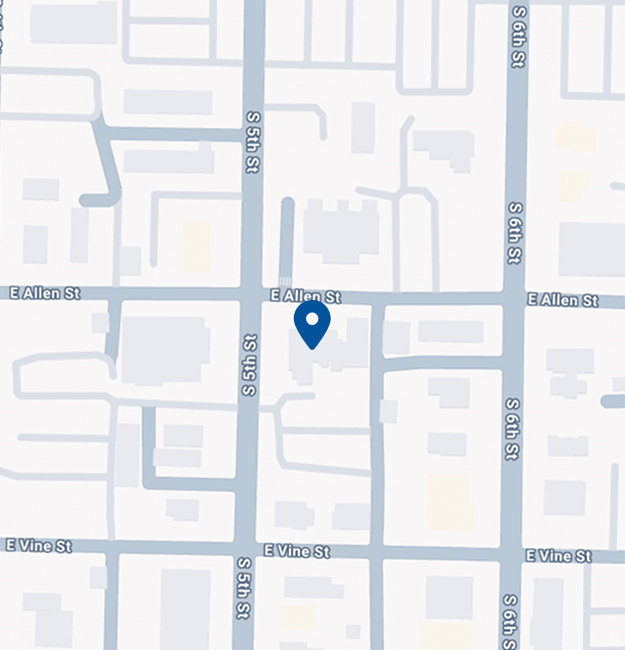
Address
Our offices are located at the corner of South Fifth Street and Vine, in the historic Mary Bryant Home for the Blind.