- Free Consultation: (217) 544-4057 Tap Here To Call Us








Labor Day DUI in Springfield, IL: Enforcement, Penalties and Your Rights


Last Reviewed & Updated: September 4, 2026
By: W. Scott Hanken | Former Sangamon County Prosecutor | Springfield Criminal Defense & DUI Attorney | Voted “Best Attorney” — Illinois Times Best of Springfield & State Journal-Register Reader’s Choice | Springfield, IL | Sangamon County | (217) 544-4057 | hankenlaw.com
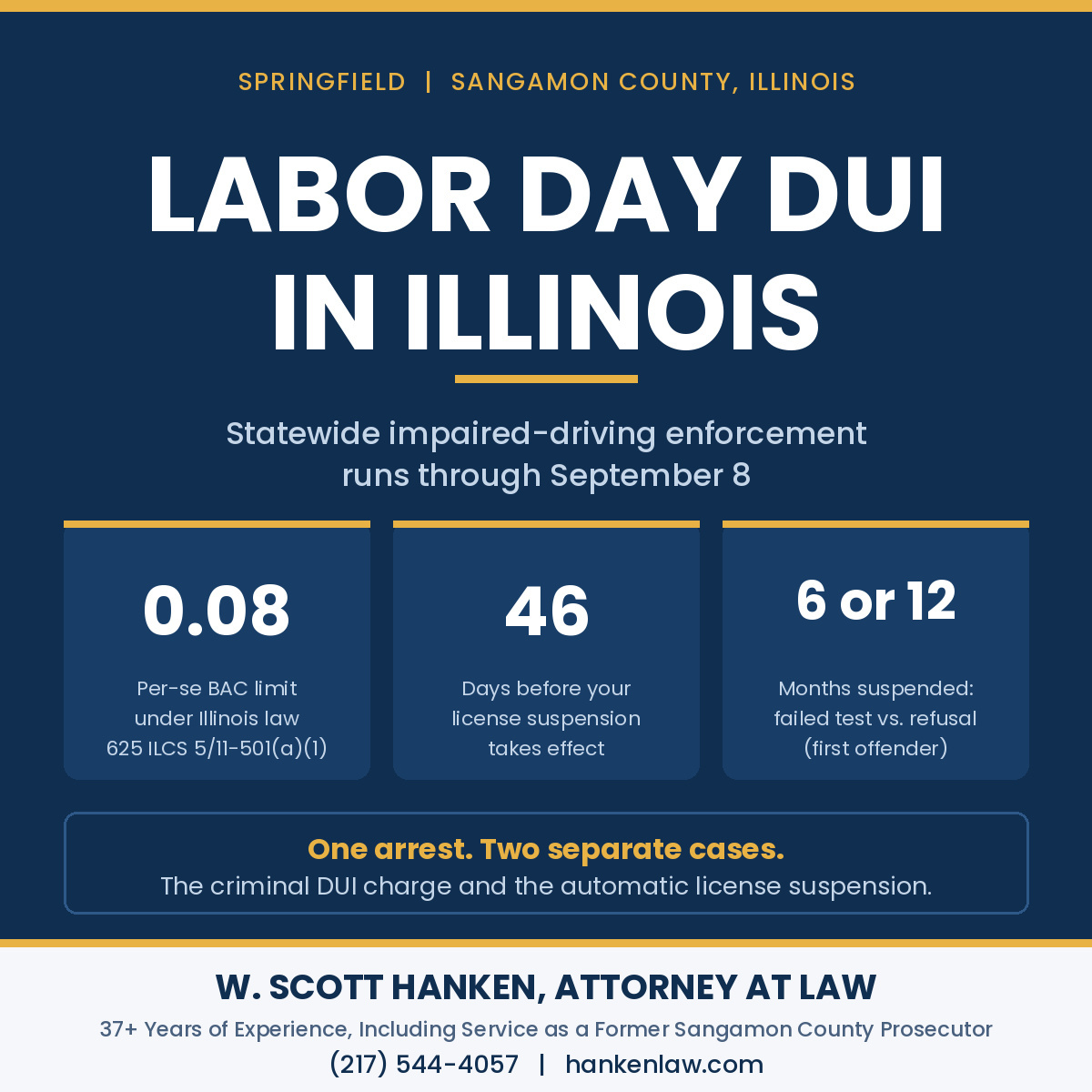
Bottom Line: Illinois is running a statewide impaired-driving enforcement campaign through September 8. A Labor Day DUI arrest in Sangamon County is not one case — it is two. The criminal charge moves through the Sangamon County Courthouse. The license suspension moves on its own schedule and lands on the 46th day whether or not anyone does anything about the criminal case. Most of the damage people suffer after a holiday DUI comes from ignoring the second one.
Illinois Is Running an Impaired-Driving Crackdown Through September 8
The Illinois Department of Transportation, the Illinois State Police, and local police and sheriff’s departments are in the middle of a coordinated statewide enforcement push. IDOT announced that the Labor Day safety campaign runs through September 8, with state troopers and local agencies focused on impaired driving. It runs under the national “Drive Sober or Get Pulled Over” banner alongside “Click It or Ticket.” prezly
The numbers behind it are small enough to be concrete. Over last year’s Labor Day weekend — measured from 6 p.m. Friday, August 29 through 11:59 p.m. Monday, September 1 — there were nine traffic fatalities on Illinois roads. Three of those nine fatal crashes were alcohol-related, and they accounted for three of the nine deaths. prezly
What that means for you practically: more patrol cars on Veterans Parkway, more attention at closing time, and a much lower tolerance for the borderline stop. An officer working a saturation patrol on Sunday night of Labor Day weekend is looking for a reason.
What Illinois Law Actually Prohibits
625 ILCS 5/11-501 does not have one definition of DUI. It has several, and they operate independently.
- 0.08 or more. Subsection (a)(1) makes it an offense to drive or be in actual physical control of a vehicle with an alcohol concentration of 0.08 or more in your blood, breath, or other bodily substance.
- Under the influence, at any number. Subsection (a)(2) is a separate offense. It requires no BAC at all.
- Drugs and intoxicating compounds. Subsections (a)(3) through (a)(6) cover intoxicating compounds, other drugs — including lawfully prescribed ones — combinations, and any detectable amount of a controlled substance.
- Cannabis. Subsection (a)(7) covers a THC concentration above the statutory threshold within two hours of driving.
The point most people miss: a breath result under 0.08 does not end the case. Prosecutors charge subsection (a)(2) on the officer’s observations — the odor, the field sobriety tests, the video. A 0.06 with a bad walk-and-turn is a chargeable case in Sangamon County. It is also, frequently, a winnable one.
One Arrest, Two Separate Cases
This is the structural thing to understand, and it is where holiday arrests do the most avoidable damage.
The criminal case
A first or second DUI is a Class A misdemeanor under 11-501(c)(1). Under 730 ILCS 5/5-4.5-55, that carries a determinate jail sentence of less than one year and a fine of up to $2,500, on top of court assessments. This case runs on the court’s calendar.
The statutory summary suspension
Separately and automatically, 625 ILCS 5/11-501.1 treats every Illinois driver as having consented to chemical testing. Fail the test or refuse it, and the officer files a sworn report with the Secretary of State and the circuit court. The suspension then takes effect on the 46th day following the date notice was given to you.
Nobody has to convict you of anything for that to happen. The criminal case can still be pending — or dismissed later — and the suspension will already be running.
Here is how long, under 625 ILCS 5/6-208.1:
| Situation | Suspension length |
|---|---|
| First offender — submitted to testing, 0.08 or more | 6 months |
| First offender — refused or failed to complete testing | 12 months |
| Not a first offender — submitted to testing, 0.08 or more | 1 year |
| Not a first offender — refused or failed to complete testing | 3 years |
Statute Callout — “First offender” is a defined term under 625 ILCS 5/11-500, and it is narrower than people assume. It excludes anyone with a prior 11-501 conviction or court-assigned supervision, a comparable out-of-state DUI conviction, or a suspension or revocation under 11-501.1 within the previous five years. A supervision you took years ago and thought was behind you can move you out of the first-offender column entirely — and out of the 6-month row into the 1-year row.
The Enhancements That Change the Math
| Circumstance | What the statute adds |
|---|---|
| First violation, BAC 0.16 or more | Mandatory minimum 100 hours community service plus a mandatory minimum $500 fine — 11-501(c)(4) |
| Transporting a passenger under 16 | Subject to 6 months imprisonment, a mandatory minimum $1,000 fine, and 25 days community service in a program benefiting children — 11-501(c)(3) |
| Second violation | Mandatory minimum of either 5 days imprisonment or 240 hours community service — 11-501(c)(2) |
| Third violation | Aggravated DUI, a Class 2 felony — 11-501(d)(1)(A) and (d)(2)(B) |
Two of those four are ordinary holiday-weekend facts, not exotic ones. A steady evening of drinking can land at 0.16. Driving family home from a cookout puts a child in the back seat.
The MDDP: How First Offenders Keep Driving
A suspension is not the same as being stranded. Under 625 ILCS 5/6-206.1, a first offender is issued a Monitoring Device Driving Permit allowing driving for any purpose and at any time, subject to the Secretary of State’s rules — provided you drive only vehicles fitted with a Breath Alcohol Ignition Interlock Device.
The mechanics matter:
- The interlock must be installed within 14 days of the date the MDDP is issued. Miss that and the Secretary cancels the permit.
- There is an administration fee not to exceed $30 per month, separate from what the device provider charges.
- If the Secretary determines you are indigent, the provider must install and monitor the device without charge and seek reimbursement from the Indigent BAIID Fund.
- You cannot drive a commercial motor vehicle on an MDDP. If you hold a CDL, this is a different and worse problem.
Checkpoints Are Legal in Illinois — But Not Automatically Valid
Roadside safety checks are constitutional in Illinois. In People v. Bartley, 109 Ill. 2d 273 (1985), the Illinois Supreme Court held that a planned DUI roadblock is not a per se Fourth Amendment violation simply because drivers are stopped without individualized suspicion. The U.S. Supreme Court reached the same conclusion five years later in Michigan Department of State Police v. Sitz, 496 U.S. 444 (1990).
But “not per se unconstitutional” is not “always valid.” Bartley made the question one of reasonableness, weighing the intrusion on the motorist against the public interest — and Illinois courts examine how the checkpoint was actually run. Supervisory-level planning, limits on individual officer discretion, and the degree of intrusion all matter. A checkpoint improvised by officers in the field, with no written plan and no neutral formula for which cars get stopped, is a different animal from the one approved in Bartley. That is a real line of attack, and it starts with getting the checkpoint’s operational plan into the record.
Under 21: There Is No Safe Number
For drivers under 21, 625 ILCS 5/11-501.8 sets the threshold at anything above 0.00 — not 0.08. One beer at a graduation party is enough.
Under 625 ILCS 5/6-208.2, a first zero-tolerance suspension runs three months for a test above 0.00 and six months for a refusal. Like the adult suspension, it takes effect on the 46th day. Two narrow exceptions exist: alcohol consumed in a religious service or ceremony, and alcohol from a prescribed or recommended dose of medicine.
The Cooler in the Back Seat
625 ILCS 5/11-502 prohibits transporting, carrying, or possessing alcoholic liquor in the passenger area of a vehicle except in the original container with the seal unbroken. It applies to the driver under subsection (a) and — separately — to every passenger under subsection (b).
The exceptions are narrow: limousines used as limousines, chartered buses used as chartered buses, and motor homes. Even then, the driver of those vehicles cannot consume or possess alcohol in the driver’s area, and evidence that the driver has been drinking is prima facie evidence of a violation.
Practical translation: the half-finished twelve-pack riding home from the lake is a separate citation from the DUI, and it hands the officer an independent reason to keep looking.
What to Do If You Are Stopped This Weekend
- Pull over promptly and keep your hands visible. Nothing that happens in the first thirty seconds helps you, but plenty can hurt.
- Provide your license, registration, and proof of insurance. You have to.
- You are not required to answer questions about where you have been or what you have had to drink. Declining politely is not evidence of guilt.
- Understand what you are being asked to do. Field sobriety tests are voluntary. The chemical test after arrest carries the implied-consent consequences described above. Those are different decisions with different consequences.
- Write down what happened while it is fresh — the time, the location, what was said, whether there was a checkpoint and how it was set up.
- Call a lawyer before the 46 days run. The suspension clock does not pause for the holiday, and it does not pause while you decide.
Frequently Asked Questions (FAQs)
No. The statute is the same on Labor Day as it is on a Tuesday in February. What changes is the enforcement volume — more patrols, more checkpoints, more officers specifically looking for impaired drivers. The odds of being stopped go up. The law being applied does not change.
On the 46th day following the date the officer gave you notice of the statutory summary suspension. That is a fixed statutory deadline under 11-501.1(g), and it runs independently of your criminal court dates. Because the suspension can be challenged in the circuit court, the practical answer is to get a lawyer involved well before that 46th day rather than waiting for your first court appearance.
You can physically refuse, but refusal has its own price. For a first offender, refusing produces a 12-month suspension instead of the 6 months that follows a failed test. For anyone who is not a first offender, refusal produces a three-year suspension instead of one year. Refusal also removes the test result from the State’s case, which matters differently in different cases. There is no universally right answer — which is exactly why it is a bad decision to make alone on the roadside.
You can still be charged. Subsection (a)(2) of 11-501 is a separate offense that requires no BAC number at all — it turns on whether you were under the influence. Prosecutors regularly file both counts. A sub-0.08 case is not automatically dismissed, but it is a case where the officer’s observations, the field sobriety test administration, and the squad video carry disproportionate weight.
No — checkpoints are lawful in Illinois under Bartley and Sitz. But how a specific checkpoint was planned and operated is fair game. Whether supervisors approved it in advance, whether officers followed a neutral formula for stopping vehicles, and how long drivers were detained are all facts that can be examined. Some checkpoints hold up. Some do not.
Substantially. Commercial license consequences run on a separate track from your regular driving privileges, an MDDP does not authorize you to drive a commercial vehicle, and outcomes that protect an ordinary driver may not protect a CDL holder at all. If you drive for a living, say so in the first conversation.
Further Reading
Practice Area
Related Articles
- Why the Fourth of July Is Sangamon County’s Most Dangerous Weekend for DUI, BUI, and Fireworks Charges — the other big holiday enforcement weekend, plus what happens when the drinking was on a boat instead of in a car.
- Flashing Lights in Your Rear-view: Illinois DUI Checkpoints, Stops & What to Do in 2026 — the minute-by-minute version of what to do at a checkpoint, which this post only summarizes.
- DUI Dismissal in Illinois: What Actually Gets Cases Dropped — if you want to know what a real defense looks like rather than what the charge looks like.
- The Ultimate Guide to DUI Defense in Sangamon County — the long-form walkthrough of how a DUI case actually moves through the local courthouse.
- Illinois Zero Tolerance Law: The Complete Guide for Drivers Under 21 — for parents whose reaction to the under-21 section above was a jolt.
- DUI Court Supervision Won’t Protect Your Illinois CDL — the answer to the CDL question above, in full.
Browse by Topic
Ready to Fight Your DUI Charge in Springfield?
Call W. Scott Hanken at (217) 544-4057 or contact us online for a free consultation. We serve clients throughout Springfield, Sangamon County, and Central Illinois.
About the Author: W. Scott Hanken, Attorney at Law
Scott Hanken is a Springfield, Illinois criminal defense attorney with over 37 years of experience, including service as a former Sangamon County prosecutor. He has been voted Best Attorney by the Illinois Times and State Journal-Register, holds an Avvo 10.0 “Superb” rating, and has earned over 270 five-star Google reviews. He serves clients throughout Sangamon County and Central Illinois.
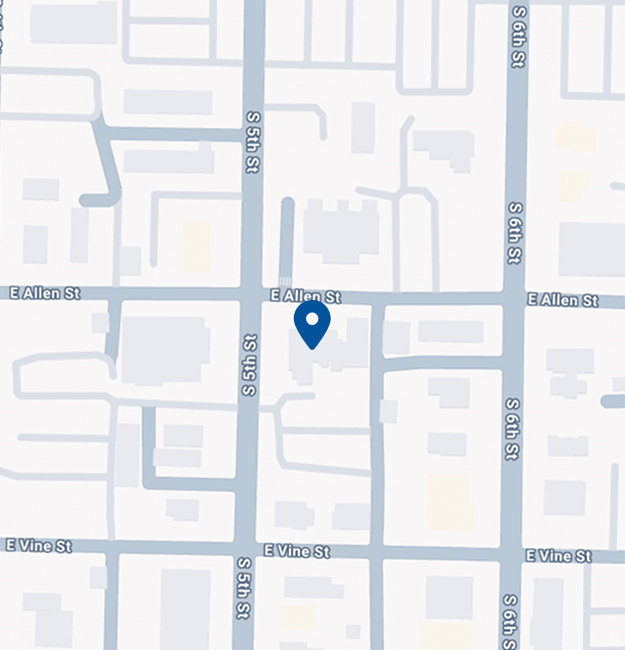
📍 1100 S 5th St, Springfield, IL 62703 | ☎ (217) 544-4057 | 🌐 hankenlaw.com
This article is for general educational purposes only and does not constitute legal advice. Every case is unique — contact an experienced Springfield criminal defense attorney for guidance on your specific situation.
Address
Our offices are located at the corner of South Fifth Street and Vine, in the historic Mary Bryant Home for the Blind.