- Free Consultation: (217) 544-4057 Tap Here To Call Us














Illinois RICO Law: What 720 ILCS 5/33G Means for You


Last Reviewed & Updated: September 22, 2026
By: W. Scott Hanken | Former Sangamon County Prosecutor | Springfield Criminal Defense & Violent Crimes Defense Attorney | Voted “Best Attorney” — Illinois Times Best of Springfield & State Journal-Register Reader’s Choice | Springfield, IL | Sangamon County | (217) 544-4057 | hankenlaw.com
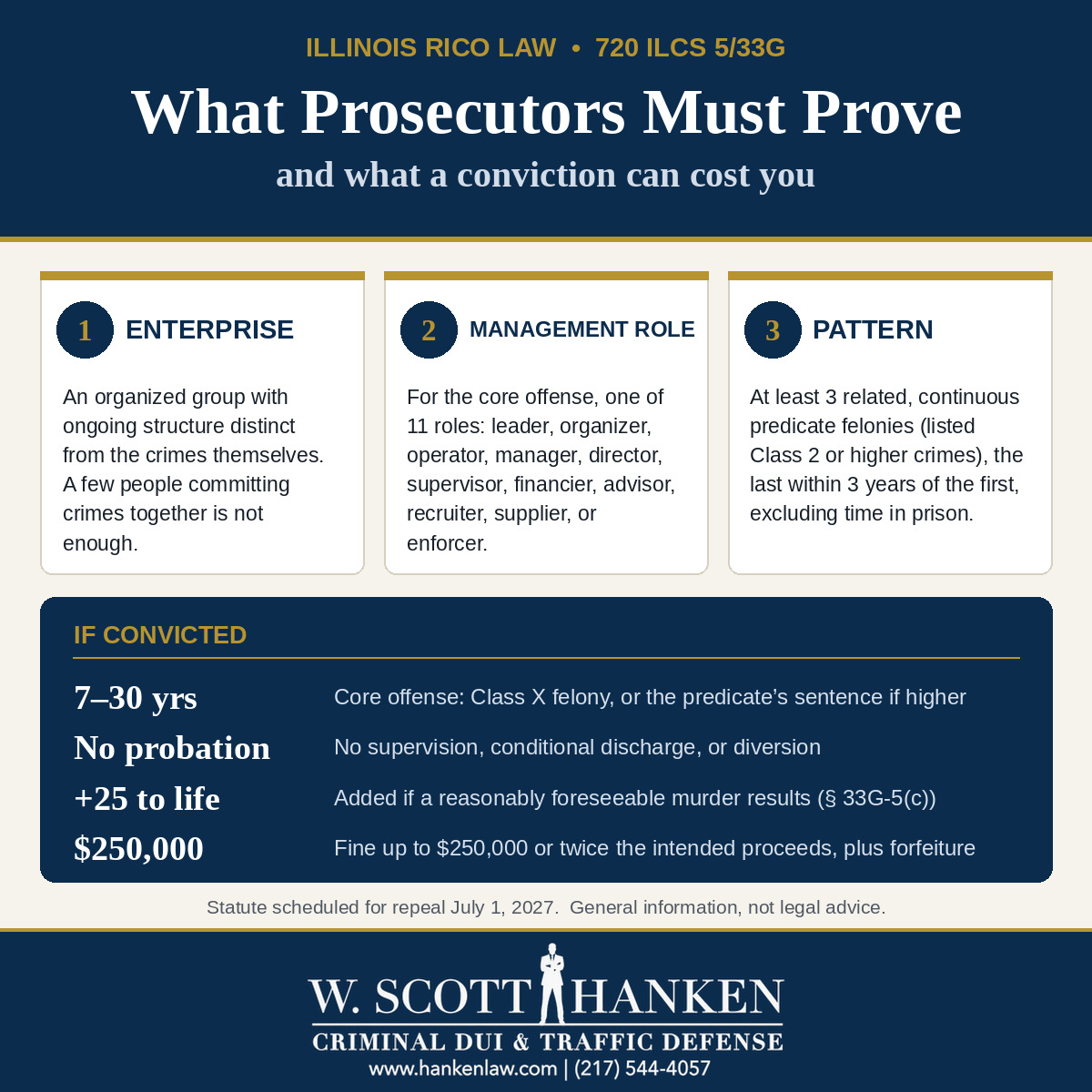
Under the Illinois RICO law, 720 ILCS 5/33G, a person who intentionally participates in the operation or management of an enterprise commits racketeering in one of three ways:
- by knowingly doing so through a pattern of at least three related Class 2 or higher predicate felonies, the last within three years of the first, excluding any period of imprisonment;
- by causing another person to violate the Article; or
- by agreeing that such predicate acts would be committed, followed by an overt act.
A conviction is a Class X felony carrying 7 to 30 years or the sentence for the underlying predicate, whichever is higher, with no probation. Section 33G-5(c) adds 25 years to natural life when an unlawful death:
- results as a necessary or natural consequence of the violation;
- was reasonably foreseeable to that defendant; and
- occurred while that defendant was otherwise engaged in the violation of this Article as a whole.
The statute is scheduled to be repealed on July 1, 2027.
Bottom Line: An Illinois RICO charge is not a single crime. It is a way of stacking several serious felonies together and punishing a person for a leadership role in a group. Because the sentence can match the underlying crime, a RICO count built on murder predicates can carry natural life by itself. The State has to prove the group, your role in it, and a qualifying pattern. Each of those three pieces is a place where a defense can break the case.
Charged or under investigation for racketeering in Springfield or Sangamon County? Call W. Scott Hanken, Attorney at Law, at (217) 544-4057 for a free, confidential consultation.
What Is the Illinois RICO Law?
Illinois has its own racketeering statute, separate from the federal RICO Act. It is formally named the Illinois Street Gang and Racketeer Influenced and Corrupt Organizations Law and sits in Article 33G of the Criminal Code of 2012. The General Assembly created it through Public Act 97-686, effective June 11, 2012. It was most recently re-enacted in full by Public Act 104-434, effective November 21, 2025.
The law was written with Chicago street gangs in mind, but its reach is broader. Under section 33G-3(b), an “enterprise” can be a corporation, partnership, charitable trust, or any group “associated in fact,” including groups with both legal and illegal purposes. A Springfield drug distribution network, a burglary crew, or a business run through violence or extortion can all be charged under Article 33G, not just a named gang. One exception is written into the statute: section 33G-4(g) exempts a labor organization, and its officers or agents acting in that capacity, from prosecution under the Article.
What Must Prosecutors Prove for an Illinois RICO Charge?
The State carries the burden on every element beyond a reasonable doubt. Section 33G-4(a) makes it unlawful for a person who intentionally participates in the operation or management of an enterprise to do any of three things:
- Participate through a pattern. Knowingly carry out that participation, directly or indirectly, through a pattern of predicate activity (section 33G-4(a)(1)).
- Cause a violation. Knowingly cause another person to violate the Article (section 33G-4(a)(2)).
- Conspire. Knowingly conspire to violate the Article (section 33G-4(a)(3)). Conspiracy requires agreement that predicate acts would be committed, not proof that you committed them yourself. It also requires an overt act by you or a co-conspirator, and the overt act need not itself be a predicate crime.
A separate offense, section 33G-4(b), reaches anyone who knowingly acquires or maintains an interest in an enterprise, or in real or personal property including money, through a pattern of predicate activity. Unlike section 33G-4(a), subsection (b) has no management-role requirement.
Statute Callout — 720 ILCS 5/33G-3(d), “Operation or management”
“‘Operation or management’ means directing or carrying out the enterprise’s affairs and is limited to any person who knowingly serves as a leader, organizer, operator, manager, director, supervisor, financier, advisor, recruiter, supplier, or enforcer of an enterprise in violation of this Article.” (Source: 720 ILCS 5/33G-3)
Statute Callout — 720 ILCS 5/33G-3(f), “Pattern of predicate activity”
At least 3 separate occurrences of predicate activity that are related and have continuity between them, which occur after the Article’s effective date, “and the last of which falls within 3 years (excluding any period of imprisonment) after the first occurrence of predicate activity.” (Source: 720 ILCS 5/33G-3)
Three limits are built into those definitions, and each one matters.
Only eleven roles qualify under section 33G-4(a). Illinois did not write its core RICO offense to reach everyone who ever sold for, or stood near, a group. Section 33G-4(a) applies only to people in eleven named roles. The acquisition offense in section 33G-4(b) is different. It reaches “any person” who knowingly acquires or maintains an interest in an enterprise or in property through a pattern of predicate activity, whatever that person’s role.
A group needs real structure to count as an enterprise. An association in fact must have an ongoing organization, members who function as a continuing unit, and “an ascertainable structure distinct from that inherent in the conduct of a pattern of predicate activity.” A few people committing crimes together is not enough.
Only serious, listed crimes count as predicates. Under section 33G-3(e), a predicate must be a Class 2 felony or higher and must appear on the statute’s list. The list includes:
- Violent offenses: first degree murder, drug-induced homicide, kidnapping, armed robbery, burglary, residential burglary, aggravated battery, stalking, and home invasion.
- Drug offenses: delivery of a controlled substance under section 401 of the Illinois Controlled Substances Act, calculated criminal drug conspiracy, and street gang criminal drug conspiracy. Cannabis offenses qualify only above 500 grams or 50 plants.
- Other listed offenses:
- solicitation of murder for hire and aggravated kidnapping;
- criminal sexual assault and related sex offenses, and specified promoting-prostitution offenses;
- criminal street gang recruitment and compelling organization membership;
- vehicular hijacking, arson, and aggravated arson;
- aggravated discharge of a firearm, unlawful possession of a firearm by a street gang member, gunrunning, and armed violence;
- terrorism offenses;
- methamphetamine manufacture or delivery.
Out-of-state conduct counts if it could be charged here as a Class 2 felony or higher. Theft does not appear on the list.
What Are the Penalties for an Illinois RICO Conviction?
The penalties in section 33G-5 escalate quickly, and most are mandatory.
| Consequence | What the statute provides |
|---|---|
| Base sentence, 33G-4(a) violation | Class X felony, 7 to 30 years, or the sentence for the underlying predicate, whichever is higher. In Polk, murder predicates produced natural life on the racketeering-conspiracy count itself |
| Fine and restitution | Restitution and/or a fine, jointly and severally, up to $250,000 or twice the gross intended proceeds, whichever is higher |
| Acquiring an interest, 33G-4(b) | Class X felony, with the same fine and restitution provisions. The 7-year floor in 33G-5(a) does not apply; the standard Class X range is 6 to 30 years |
| Unlawful death (33G-5(c)) | Additional 25 years to natural life when an unlawful death (first or second degree murder) results as a necessary or natural consequence of the violation, was reasonably foreseeable to you, and occurred while you were otherwise engaged in the violation of this Article as a whole |
| Probation and alternatives | None. Section 33G-5(d) bars probation, periodic imprisonment, conditional discharge, impact incarceration, court supervision, withheld adjudication, and any pretrial diversion or suspended sentence |
| Property | Disgorgement, divestiture, restrictions on future business, dissolution of the enterprise, and forfeiture under Article 29B (section 33G-6) |
| Underlying crimes | You can be convicted and sentenced for RICO and for the predicate offenses themselves (section 33G-4(e)) |
Note the minimum. A standard Class X felony carries 6 to 30 years under 730 ILCS 5/5-4.5-25(a). Section 33G-5(a) raises that floor to 7 years for the core RICO offenses in section 33G-4(a). The acquisition offense in section 33G-4(b) keeps the standard 6-year minimum.
Two separate provisions can produce a life sentence, and they work differently:
- Section 33G-5(a) itself. When the underlying predicate carries more than 30 years, that higher sentence governs the RICO count.
- The section 33G-5(c) enhancement. It applies only when an “unlawful death” (defined in section 33G-3(g) as first or second degree murder) “results as a necessary or natural consequence” of the violation. The death must also have been reasonably foreseeable to that defendant and must have occurred while that defendant was “otherwise engaged in the violation of this Article as a whole.”
You do not have to pull a trigger for either one to apply.
People v. Polk, 2024 IL App (1st) 181933, shows both at work. Because the jury found murders among the predicates, the trial court imposed natural life on the racketeering-conspiracy count. It then imposed two additional life terms under section 33G-5(c) for deaths the jury found reasonably foreseeable to the defendant. (Polk, ¶¶ 1, 87, 99–100.)
How Is Illinois RICO Different From Federal RICO?
Springfield sits inside two court systems. A state case goes to the Sangamon County Circuit Court in the Seventh Judicial Circuit. A federal case goes to the U.S. District Court for the Central District of Illinois, which also sits in Springfield.
| Feature | Illinois (720 ILCS 5/33G) | Federal (18 U.S.C. §§ 1961–1968) |
|---|---|---|
| Minimum predicates | 3 | 2 |
| Time window | Last act within 3 years of the first (excluding imprisonment) | Last act within 10 years of a prior act (excluding imprisonment) |
| Qualifying predicates | Listed Class 2 or higher felonies | Listed state and federal crimes |
| Who is covered | Section 33G-4(a): only the 11 listed management roles. Section 33G-4(b): any person who acquires or maintains an interest through a pattern | For the conduct offense (18 U.S.C. § 1962(c)), a person who participates in the operation or management of the enterprise under Reves v. Ernst & Young, 507 U.S. 170 (1993). Mere association is not enough; Illinois names eleven roles inside that same limit |
| Maximum prison | 30 years, or higher predicate penalty; murder enhancement to life | 20 years per count, or life if a predicate carries life |
| Probation | Barred by statute | Available in limited cases under federal sentencing law |
| Limitations period | Generally 5 years; no limit against any defendant if any part of the overall violation resulted in an unlawful death | 5 years under the general federal statute |
| Scheduled repeal | July 1, 2027 | None |
The practical point: facts that fail the Illinois three-predicate, three-year test may still satisfy the federal two-predicate, ten-year test. A defense strategy in Sangamon County has to account for whether the case could move across town to federal court.
Who Decides Whether to Bring an Illinois RICO Charge in Sangamon County?
The State’s Attorney, personally. Section 33G-4(f) provides that only the State’s Attorney, or a person designated by law to act during the State’s Attorney’s absence or disability, may authorize a prosecution under Article 33G. Before authorizing any RICO prosecution, the office must adopt written rules requiring an internal prosecution memorandum. That memo must conclude two things:
- A RICO charge is necessary to reflect the nature and extent of the conduct in a way that charging only the predicate crimes would not.
- A RICO charge would support an appropriate sentence that the predicate charges alone would not.
This safeguard has a limit. The statute makes the memo privileged and says it creates no enforceable right for a defendant and no judicial review of the charging decision. Its real value is strategic. In Springfield, a RICO count means the Sangamon County State’s Attorney personally signed off on it. The office has also already committed in writing to why the ordinary charges were not enough. Knowing that shapes how a defense approaches negotiation and trial.
This is no longer an abstract question in Springfield. On September 22, 2026, Sangamon County State’s Attorney John Milhiser announced racketeering-conspiracy indictments against at least 23 alleged members of two rival Springfield groups, SQAD and BP. According to WCIA’s report on the announcement, the indictments cover conduct from August 2024 through September 2026 and encompass four homicide investigations. The office described the potential sentence as up to 30 years, or up to life where death resulted, which tracks section 33G-5.
An indictment is an accusation, not proof, and every person charged is presumed innocent. For anyone who believes their name or conduct could surface as that investigation continues, the time to talk to a lawyer is before investigators call.
Is the Illinois RICO Law Still in Effect?
Yes. Article 33G has a built-in expiration date that the legislature keeps extending. The repeal date had been June 1, 2025, and the bill that would have extended it did not become law until June 16, 2025. In November 2025, the General Assembly responded with Public Act 104-434. That act added section 33G-10, which does four things:
- Continuous effect. It declares that Article 33G “shall be deemed to have been in continuous effect since its original effective date.”
- Validation. It validates actions taken in reliance on the Article.
- Re-enactment. It re-enacts the Article in full.
- Reach. It applies the fix to all proceedings pending on, before, or after its effective date.
The current repeal date is July 1, 2027. If the legislature does not act again before then, the statute expires.
How section 33G-10 applies to conduct that occurred between June 1 and June 16, 2025 is a case-specific question. Anyone charged with predicate conduct in that window should have the issue reviewed by counsel.
What Defenses Work Against an Illinois RICO Charge?
RICO cases are long, document-heavy, and built on inference. Each inference is an opening.
- No enterprise. The group must have structure distinct from the crimes themselves. Several people committing crimes near each other is not an enterprise.
- No management role. On a section 33G-4(a) charge, the State must place you in one of the eleven roles in section 33G-3(d). Presence, family ties, and association are not enough by themselves. (The acquisition offense in section 33G-4(b) has no role requirement.)
- No qualifying pattern. Count the predicates and check each against the statutory list and the Class 2 threshold. Then measure the time from the first to the last.
- Statute of limitations. Section 33G-8 generally requires prosecution within 5 years of the last predicate act or the last objective of a conspiracy. Later dates apply for minor or legally disabled victims. There is no deadline against any defendant if any part of the overall violation resulted in an unlawful death.
- Suppressible evidence. RICO cases often rest on wiretaps and informant recordings, and both have strict procedural rules.
- Jury integrity. Long, emotionally charged trials create juror problems. In Polk, the appellate court sent the case back for inquiry into juror racial-bias allegations. (Polk, ¶ 138.)
The underlying charges matter as much as the RICO label. See our pages on drug crimes defense and violent crimes defense.
A racketeering investigation moves long before charges are filed. Call W. Scott Hanken, Attorney at Law, at (217) 544-4057 for a free, confidential consultation before you talk to investigators.
What If the Facts of Your Case Are Not Straightforward?
What if I only sold on the street and never gave anyone orders?
The section 33G-4(a) offenses reach only people who knowingly serve in one of eleven management roles (720 ILCS 5/33G-3(d)). Street-level selling is not on that list, although “supplier” and “operator” are. The fight is over evidence of rank.
In People v. Spears, 2024 IL App (1st) 181491, one defendant argued he was connected to the group only through family. Other witnesses described him as a “manager type” who supervised two blocks, and the court held that was enough for a jury. (Spears, ¶¶ 198–200.) In a Springfield case, the State will try to prove rank through co-defendant and informant testimony, and that testimony is where cross-examination does its work. One caution: the role limit does not apply to the acquisition offense in section 33G-4(b), which reaches any person who acquires or maintains an interest through a pattern.
What if the acts they’re relying on happened long ago or years apart?
All three predicates must occur after the June 11, 2012 effective date, and the last must fall within three years of the first, excluding time in prison (720 ILCS 5/33G-3(f)). Older conduct can still matter at sentencing. In Spears, the jury found that a 2002 killing and a 2003 killing were reasonably foreseeable to the group’s leader and occurred while he was engaged in the racketeering conspiracy. The trial court then added life terms under section 33G-5(c) for those deaths. (Spears, ¶¶ 103, 117.) He challenged those enhancements on appeal (Spears, ¶ 204). The First District’s remand, however, was limited to the juror-bias inquiry and resentencing on a separate drug-conspiracy count. (Spears, ¶ 1.) The timeline question has two parts:
- Do the post-2012 predicates satisfy the three-year pattern on their own?
- Did your participation actually continue past the effective date?
What if the State’s case depends on wiretaps?
Illinois allows non-consensual eavesdropping orders only on an application authorized by the State’s Attorney. A designee may apply only if designated in writing, or by law, to act during the State’s Attorney’s absence or disability (725 ILCS 5/108B-3; see also 725 ILCS 5/108B-2). In Spears, the applications were signed by the First Assistant State’s Attorney with no written delegation, and the First District held that suppression was warranted. (Spears, ¶¶ 177–182.) The error was harmless there only because of the volume of other evidence. In a thinner case, that ruling can remove the core of the State’s proof.
Frequently Asked Questions (FAQs)
Yes. A racketeering conspiracy charge requires your agreement that predicate acts would be committed, not proof that you personally committed them. In Spears, the court held the State did not have to prove a defendant directly participated in the predicate murders. Citing Salinas v. United States, 522 U.S. 52 (1997), it held that his agreement could be proven through circumstantial evidence of a shared criminal objective. (Spears, ¶ 201.) The State must still prove your management role, your agreement, and an overt act. (A section 33G-4(b) acquisition charge is different: it has no management-role requirement.)
No. Section 33G-5(d) bars probation, periodic imprisonment, conditional discharge, impact incarceration, court supervision, withheld adjudication, and any pretrial diversion or suspended sentence.
Yes. Section 33G-4(e) allows a conviction and sentence for the RICO violation and for the predicate offenses, or for the RICO conspiracy and its objects.
Generally 5 years from the latest of three dates:
– the last predicate act in the pattern;
– for a conspiracy, the date its last objective was accomplished, defeated, or abandoned; or
– the date a minor victim turns 18 or a legally disabled victim gains capacity.
If the conduct of any defendant, or any part of the overall violation, resulted in an unlawful death, the State may file at any time against all defendants. (720 ILCS 5/33G-8.)
Not under the First District’s current reading. Polk held the jury must find agreement to at least three predicate acts but need not unanimously identify the same specific acts. (Polk, ¶¶ 169–174.) Section 33G-7 directs Illinois courts to construe the Article in light of the 1999 Seventh Circuit model jury instructions for the federal RICO statute, 18 U.S.C. §§ 1961–1968, except where they conflict with the plain language of Article 33G.
Yes. Section 33G-6 lets the circuit court order disgorgement of proceeds, divestiture of interests, restrictions on future business, and dissolution of an enterprise. It also applies the forfeiture procedures of Article 29B.
State and federal prosecutors are separate sovereigns, and the same conduct can be charged in either system. Federal RICO has a lower pattern threshold, so where a case lands has real consequences.
That depends on whether the legislature extends it again and on how Illinois courts treat pending prosecutions. Talk to your attorney about your specific timeline.
Further Reading
Practice Area
Related Articles
- Can an Illinois Prosecutor Argue That Asking for a Lawyer Shows Guilt? — If you’re weighing whether to call a lawyer before investigators reach you, this explains why doing so can’t be used against you.
- Entrapment Defense in Illinois: What Actually Works — RICO cases lean heavily on paid informants; this covers when informant-driven conduct becomes a defense.
- Understanding Murder Vs. Manslaughter — The 25-to-life enhancement turns on whether a death counts as first or second degree murder.
- What Does It Mean to Have Possession with Intent? — Drug delivery is one of the most common RICO predicates; this explains how the State proves intent to deliver.
Browse by Topic
Ready to Fight Your Violent Crime Charge in Springfield?
Call W. Scott Hanken at (217) 544-4057 or contact us online for a free consultation. We serve clients throughout Springfield, Sangamon County, and Central Illinois.
About the Author: W. Scott Hanken, Attorney at Law
Scott Hanken is a Springfield, Illinois criminal defense attorney with over 37 years of experience, including service as a former Sangamon County prosecutor. He has been voted Best Attorney by the Illinois Times and State Journal-Register, holds an Avvo 10.0 “Superb” rating, and has earned over 270 five-star Google reviews. He serves clients throughout Sangamon County and Central Illinois.
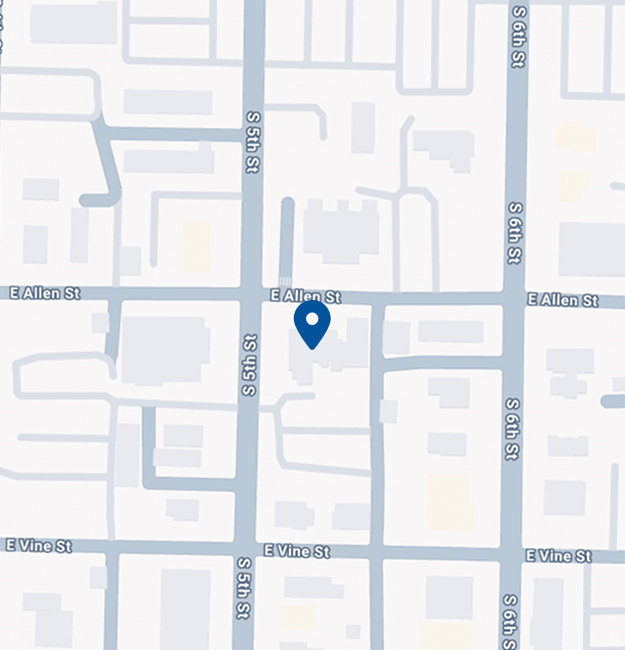
📍 1100 S 5th St, Springfield, IL 62703 | ☎ (217) 544-4057 | 🌐 hankenlaw.com
This article is for general educational purposes only and does not constitute legal advice. Every case is unique — contact an experienced Springfield criminal defense attorney for guidance on your specific situation.
Address
Our offices are located at the corner of South Fifth Street and Vine, in the historic Mary Bryant Home for the Blind.