

I Am a Former Prosecutor Who Will Fight for Your Rights













Illinois Criminal Sentencing Chart: Felony & Misdemeanor
Last reviewed and updated: November 2026
Illinois Sentencing at a Glance
Illinois sentences by offense class: misdemeanors run from up to 30 days (Class C) to 364 days (Class A), felonies run from 1 to 3 years (Class 4) to 6 to 30 years (Class X), and first degree murder carries 20 to 60 years or natural life.
If you’ve been charged with a crime in Springfield or anywhere in Sangamon County, the statute that defines the crime assigns its class. The Unified Code of Corrections then sets the range for that class: the prison or jail term, the extended term, the maximum fine, and whether probation is available. A judge sentences within that range after weighing statutory aggravating and mitigating factors.
The number announced in court is rarely the time actually served. Most Illinois prison sentences earn day-for-day credit, so a 4-year sentence is often about 2 years inside, followed by a period of mandatory supervised release (MSR). Certain violent, sex, and firearm offenses must be served at 75%, 85%, or 100%. MSR terms were shortened in 2021 and 2022, so older charts that list 3, 2, and 1 year of MSR for most felonies are out of date.
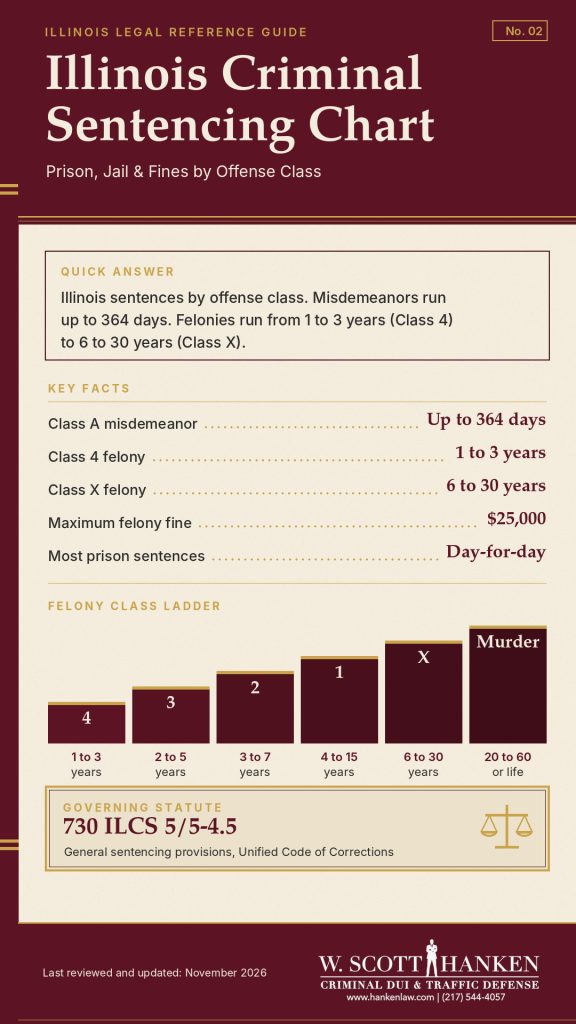
Key Facts: Illinois Sentencing at a Glance
| Question | Answer | Authority |
|---|---|---|
| Felony classes, most to least serious | First degree murder, Class X, 1, 2, 3, 4 | 730 ILCS 5/5-4.5-10 |
| Misdemeanor classes | Class A, B, C | 730 ILCS 5/5-4.5-10 |
| Highest misdemeanor jail term | 364 days (Class A) | 730 ILCS 5/5-4.5-55 |
| Lowest felony range | 1 to 3 years (Class 4) | 730 ILCS 5/5-4.5-45 |
| Class X range | 6 to 30 years, no probation | 730 ILCS 5/5-4.5-25 |
| First degree murder | 20 to 60 years; 60 to 100 extended; or natural life | 730 ILCS 5/5-4.5-20 |
| Maximum felony fine | $25,000 per offense, or the amount the offense specifies if greater | 730 ILCS 5/5-4.5-50(b) |
| Court supervision on a felony | Not available | 730 ILCS 5/5-6-1(c) |
| Default sentence credit | Day-for-day (about 50% served) | 730 ILCS 5/3-6-3(a)(2.1) |
| First degree murder credit | None (100% served) | 730 ILCS 5/3-6-3(a)(2)(i) |
| MSR after a Class 3 or 4 prison term | 6 months for most offenses | 730 ILCS 5/5-8-1(d)(3) |
| Three-strike natural life | Third Class X, criminal sexual assault, or murder conviction after two qualifying priors | 730 ILCS 5/5-4.5-95(a) |
A Former Prosecutor on Your Side
A sentencing chart tells you the range. It doesn’t tell you where your case will land.
W. Scott Hanken spent years as a Sangamon County prosecutor before turning to defense, and he has 37+ years of experience in Illinois courtrooms. He knows how the State builds a case, how charges get filed at a higher class than the facts support, and where the room to negotiate is. He has been voted “Best Attorney” by the Illinois Times and the State Journal-Register, holds an Avvo 10.0 “Superb” rating, and has earned 270+ five-star Google reviews. His office is at 1100 S. 5th St. in Springfield.
How Illinois Classifies a Criminal Offense
Every offense is a felony, a misdemeanor, or a petty or business offense under 730 ILCS 5/5-4.5-10.
The statute that creates the crime states its class. When a statute does not, 730 ILCS 5/5-4.5-85 fills the gap:
| If the offense statute provides | It is treated as |
|---|---|
| A felony, or imprisonment of one year or more | Class 4 felony |
| Imprisonment of less than one year but more than 6 months | Class A misdemeanor |
| Imprisonment of 6 months or less but more than 30 days | Class B misdemeanor |
| Imprisonment of 30 days or less | Class C misdemeanor |
Class can change with the facts. A prior conviction, the victim’s age or status, a weapon, or the location of the offense often moves the same conduct up one or more classes. Retail theft, domestic battery, and DUI are common Sangamon County examples where a prior turns a misdemeanor into a felony.
Sentencing Ranges for Each Class in Illinois
Each class has a standard range, an extended range, a probation limit, and a maximum fine.
| Class | Standard term | Extended term | Probation or conditional discharge | Maximum fine |
|---|---|---|---|---|
| First degree murder | 20 to 60 years, or natural life | 60 to 100 years | Not allowed | $25,000 |
| Class X felony | 6 to 30 years | 30 to 60 years | Not allowed | $25,000 |
| Class 1 felony | 4 to 15 years (4 to 20 for second degree murder) | 15 to 30 years | Up to 4 years | $25,000 |
| Class 2 felony | 3 to 7 years | 7 to 14 years | Up to 4 years | $25,000 |
| Class 3 felony | 2 to 5 years | 5 to 10 years | Up to 30 months | $25,000 |
| Class 4 felony | 1 to 3 years | 3 to 6 years | Up to 30 months | $25,000 |
| Class A misdemeanor | Up to 364 days | None | Up to 2 years | $2,500 |
| Class B misdemeanor | Up to 6 months | None | Up to 2 years | $1,500 |
| Class C misdemeanor | Up to 30 days | None | Up to 2 years | $1,500 |
| Petty offense | No jail | None | Up to 6 months | Up to $1,000 |
Felony fines are $25,000 or the amount the offense specifies, whichever is greater, and misdemeanor fines follow the same “whichever is greater” rule. Petty offenses work the other way: the fine is capped at $1,000, or a lower amount if the offense sets one. Felony and misdemeanor sentences may also include restitution.
730 ILCS 5/5-4.5-25(a) and (d): For a Class X felony, “The sentence of imprisonment shall be a determinate sentence, subject to Section 5-4.5-115 of this Code, of not less than 6 years and not more than 30 years.” The statute adds: “A period of probation or conditional discharge shall not be imposed.”
When can a judge impose an extended term? An extended term is available only when a statutory aggravating factor under 730 ILCS 5/5-5-3.2(b) is present and, where the factor is not a prior conviction, proven to the trier of fact beyond a reasonable doubt. The most common basis is a prior conviction for the same or a greater class of felony within the previous 10 years, not counting time spent in custody. The extended range replaces the standard range; it is not added to it.
Firearm Add-Ons
For first degree murder, 730 ILCS 5/5-8-1(a)(1)(d) adds time to the sentence when a firearm is involved. Many Class X offenses, such as armed robbery and home invasion, carry similar add-ons in their own statutes.
| Firearm finding | Added to the sentence |
|---|---|
| Armed with a firearm | 15 years |
| Personally discharged a firearm | 20 years |
| Personally discharged a firearm causing great bodily harm, permanent disability, disfigurement, or death | 25 years to natural life |
How a Prior Record Changes the Sentence
Certain combinations of prior convictions raise the sentence or take probation off the table.
| Situation | Result | Authority |
|---|---|---|
| Third Class X, criminal sexual assault, or first degree murder conviction after two qualifying priors (first offense committed at 21 or older, third within 20 years of the first judgment, excluding custody time) | Natural life (habitual criminal) | 730 ILCS 5/5-4.5-95(a) |
| Over 21, convicted of a Class 1 or 2 forcible felony after two prior Class 2 or greater forcible felonies, each committed after conviction on the one before, first committed at 21 or older | Sentenced as a Class X offender, 6 to 30 years | 730 ILCS 5/5-4.5-95(b) |
| Class 1 or greater felony with a prior Class 1 or greater felony within 10 years | No probation | 730 ILCS 5/5-5-3(c)(2)(F) |
| Class 2 or greater sex or firearm felony with a prior Class 2 or greater conviction within 10 years | No probation | 730 ILCS 5/5-5-3(c)(2)(F-3) |
How Much of a Prison Sentence Is Actually Served
Most Illinois sentences are served at about 50%, but murder, many violent and sex offenses, and some drug offenses carry higher floors under 730 ILCS 5/3-6-3.
| Share served | Offenses | Authority |
|---|---|---|
| 100% (no credit) | First degree murder, terrorism, natural life sentences | 730 ILCS 5/3-6-3(a)(2)(i), (2.2) |
| About 85% | Attempted first degree murder, solicitation of murder, criminal and predatory criminal sexual assault, aggravated kidnapping, aggravated domestic battery, aggravated discharge of a firearm, aggravated DUI causing death or great bodily harm, and home invasion or armed robbery with a great bodily harm finding | 730 ILCS 5/3-6-3(a)(2)(ii) through (vii), (2.3), (2.6) |
| About 75% | Drug trafficking and certain Class X drug offenses involving 100 grams or more, gunrunning, narcotics racketeering, drug-induced homicide | 730 ILCS 5/3-6-3(a)(2)(v) |
| About 50% (day-for-day) | Every offense not listed above | 730 ILCS 5/3-6-3(a)(2.1) |
These are representative offenses; see 730 ILCS 5/3-6-3 for the complete list. Additional program credit can shorten a day-for-day sentence further, but not below the floors set for 85% and 75% offenses.
Mandatory Supervised Release (MSR) in Illinois
MSR follows release from prison, and for most felonies it is now 6 to 18 months.
| Conviction | MSR term | Authority |
|---|---|---|
| First degree murder | 3 years | 730 ILCS 5/5-8-1(d)(1) |
| Class X felony | 18 months | 730 ILCS 5/5-8-1(d)(1.5) |
| Class 1 or 2 felony | 12 months | 730 ILCS 5/5-8-1(d)(2) |
| Class 3 or 4 felony | 6 months, with a Prisoner Review Board discharge review within 45 days | 730 ILCS 5/5-8-1(d)(3) |
| Any 85% offense | 3 years (Class X), 2 years (Class 1 or 2), 1 year (Class 3 or 4) | 730 ILCS 5/5-8-1(d)(7) |
| Felony domestic battery, aggravated domestic battery, stalking, aggravated stalking, felony order of protection violation | 4 years | 730 ILCS 5/5-8-1(d)(6) |
| Certain sex offenses | 3 years to natural life | 730 ILCS 5/5-8-1(d)(4) |
The shorter terms apply to people convicted on or after July 1, 2021 (Class X, 1, and 2) and July 1, 2022 (Class 3 and 4). The individual class sections, such as 5-4.5-30(l), still recite the older 3-year, 2-year, and 1-year terms, but each defers to 5-8-1, which controls. Many published charts miss this.
Does a Criminal Conviction Affect My Illinois Driver’s License?
Only for certain offenses. Sentencing class does not control license consequences; the Illinois Vehicle Code does.
DUI, leaving the scene, reckless homicide, fleeing and eluding, and many drug or vehicle-related convictions trigger suspension or revocation by the Secretary of State. See the Illinois DUI Penalty Chart and Fleeing and Eluding in Illinois.
Court Supervision in Illinois
Court supervision defers sentencing, and if you complete it, the charge is dismissed and there is no conviction.
Under 730 ILCS 5/5-6-1(c), the court must find that you are not likely to reoffend, that you and the public are best served without a criminal record, and that supervision serves the interests of justice.
| Situation | Supervision available? |
|---|---|
| Any felony | No |
| Most Class A, B, and C misdemeanors and petty offenses | Yes, at the court’s discretion |
| Domestic battery (12-3.2) | No |
| Resisting or obstructing a peace officer (31-1) | No |
| Criminal sexual abuse (11-1.50 or 12-15) | No |
| Sexual exploitation of a child (11-9.1) | No |
| Dog fighting (26-5 or 48-1) | No |
| Escape or aiding escape (31-6, 31-7) | No |
| Certain criminal damage to property offenses (21-1(a)(2), (a)(3)) | No |
| Misdemeanor unlawful use of weapons (24-1(a)(1) through (5), (8), (10), (11)) | No |
| Certain Humane Care for Animals Act violations | No |
| Retail theft with a conviction or supervision for retail theft in the last 5 years | No (5-6-1(e)) |
| DUI after any prior DUI conviction or supervision | No (5-6-1(d)) |
Misdemeanor and felony cases arising in Springfield are heard in the Sangamon County Circuit Court. Supervision is never available on a felony, so whether a charge is filed or amended as a misdemeanor often decides whether supervision is possible at all.
Probation in Illinois
Probation is presumed for most offenses. Under 730 ILCS 5/5-6-1(a), the court must impose probation or conditional discharge unless a statute bars it, imprisonment is necessary to protect the public, or probation would deprecate the seriousness of the offense.
| Class | Probation available? | Maximum term |
|---|---|---|
| First degree murder | No | — |
| Class X | No | — |
| Class 1 | Yes, unless barred | 4 years |
| Class 2 | Yes, unless barred | 4 years |
| Class 3 | Yes, unless barred | 30 months |
| Class 4 | Yes, unless barred | 30 months |
| Class A, B, or C misdemeanor | Yes | 2 years |
Common offenses barred from probation under 730 ILCS 5/5-5-3(c)(2):
| Offense or circumstance | Subsection |
|---|---|
| First degree murder or attempted first degree murder | (A), (B) |
| Any Class X felony | (C) |
| Class 1 or greater felony with a prior Class 1 or greater felony within 10 years | (F) |
| Class 2 or greater sex or firearm felony with a prior Class 2 or greater conviction within 10 years | (F-3) |
| Residential burglary | (G) |
| Criminal sexual assault | (H) |
| Aggravated battery of a senior citizen | (I) |
| Vehicular hijacking | (K) |
| Class 3 felony FOID Act violation under 430 ILCS 65/2(a)(1) | (N) |
| Class 1 felony committed while on felony probation or conditional discharge | (Z) |
| Aggravated assault with a firearm aimed at the victim under 12-2(c)(6) | (DD) |
The full list has more than 30 entries, including specific drug, weapon, and financial offenses. The current list reflects P.A. 104-245, effective January 1, 2026.
What if I am charged with a Class 4 felony but have no prior record? Probation is the presumptive sentence. A first-offense Class 4 felony is probationable for up to 30 months unless the offense itself appears on the 5-5-3(c)(2) list.
The contested questions are usually the conditions of probation, whether jail time is imposed as a condition, and whether the charge can be amended to a misdemeanor.
What if the offense is probationable but I have a prior felony? A prior felony does not automatically bar probation. For a Class 2, 3, or 4 felony, the court weighs the prior as an aggravating factor.
The automatic bar applies only to the combinations listed in 5-5-3(c)(2), most often a Class 1 or greater felony with a prior Class 1 or greater felony within 10 years. It also applies to Class X recidivist sentencing under 5-4.5-95(b), which requires two prior Class 2 or greater forcible felonies.
Mandatory Minimum Sentences in Illinois
Illinois has no single mandatory minimum statute. A mandatory minimum arises whenever probation is barred, because the court must then impose at least the bottom of the prison range.
| Situation | Practical mandatory minimum |
|---|---|
| First degree murder | 20 years, served at 100% |
| Any Class X felony | 6 years |
| Class X recidivist sentencing under 5-4.5-95(b) | 6 years |
| Non-probationable Class 1 felony | 4 years |
| Non-probationable Class 2 felony | 3 years |
| Non-probationable Class 3 felony | 2 years |
| Non-probationable Class 4 felony | 1 year |
| Firearm add-on findings | 15, 20, or 25 years added |
| Habitual criminal | Natural life |
Collateral Consequences of a Criminal Conviction in Illinois
The sentence ends, but many consequences of a conviction do not.
| Area | Consequence |
|---|---|
| Firearms | A felony conviction makes you ineligible for a FOID card |
| Employment and licensing | Background checks, professional and occupational licenses |
| Immigration | Certain convictions carry deportation or inadmissibility consequences for non-citizens |
| Sex offender registration | Required for listed sex offenses |
| Driver’s license | Suspension or revocation for listed Vehicle Code and drug offenses |
| Future sentencing | Priors raise offense classes, bar probation, and support extended terms |
| Records | A conviction stays on your record unless it qualifies for sealing, expungement, or a pardon |
Frequently Asked Questions (FAQs)
What is the difference between a Class 4 felony and a Class A misdemeanor in Illinois?
A Class 4 felony carries 1 to 3 years in prison and up to $25,000 in fines. A Class A misdemeanor carries up to 364 days in county jail and up to $2,500. Only the felony makes you a convicted felon.
Can I get probation for a Class X felony?
No. Class X felonies require 6 to 30 years in prison under 730 ILCS 5/5-4.5-25. Probation, conditional discharge, and periodic imprisonment are all barred.
What does day-for-day mean in Illinois?
Most prisoners receive one day of sentence credit for each day served under 730 ILCS 5/3-6-3(a)(2.1), so they serve about half the sentence. Murder, many violent and sex offenses, and some drug offenses are excluded.
Can I get court supervision on a felony in Illinois?
No. Supervision is available only for misdemeanors and petty offenses, and even then several misdemeanors, including domestic battery and resisting a peace officer, are excluded.
What is the difference between probation and conditional discharge?
Both release you without prison. Probation includes reporting to a probation officer. Conditional discharge has conditions but no reporting supervision. Either one is a conviction.
How long is parole in Illinois?
Illinois uses mandatory supervised release (MSR), not parole, for current sentences. MSR is 18 months for most Class X felonies, 12 months for Class 1 and 2, and 6 months for Class 3 and 4, with longer terms for 85% offenses and domestic violence felonies.
Can a judge give me more than the maximum?
Only through an extended term, which requires a statutory aggravating factor such as a qualifying prior conviction. The extended range replaces the standard range.
Schedule Your Free Consultation
The class you’re charged with isn’t always the class you’re sentenced on. How a charge is filed, amended, or negotiated can decide whether probation, supervision, or a lower range is on the table.
Call W. Scott Hanken at (217) 544-4057 or contact the office online for a free, confidential consultation. The office serves clients throughout Springfield, Sangamon County, and Central Illinois.
This page is for general informational purposes only and does not constitute legal advice. Every case is unique; contact W. Scott Hanken for guidance on your specific situation.
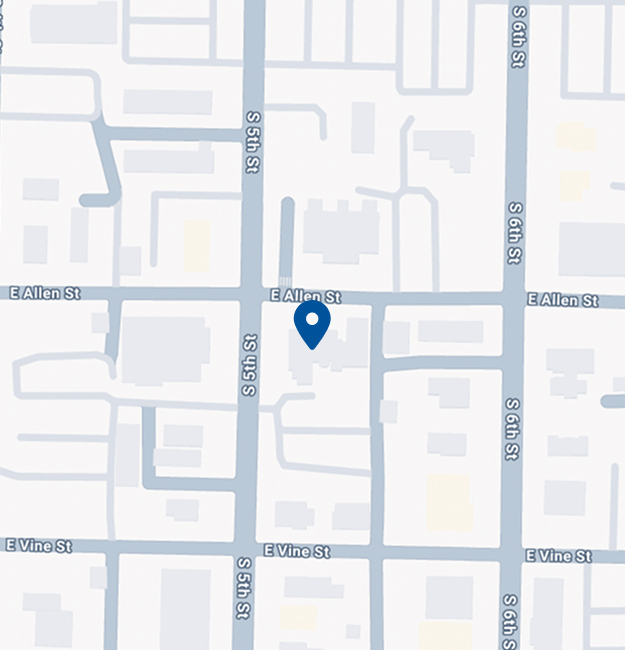
Address
Our offices are located at the corner of South Fifth Street and Vine, in the historic Mary Bryant Home for the Blind.