- Free Consultation: (217) 544-4057 Tap Here To Call Us












Fleeing and Eluding in Illinois: Penalties & Your License


Last Reviewed & Updated: November 6, 2026
By: W. Scott Hanken | Former Sangamon County Prosecutor | Springfield Criminal Defense & Traffic Ticket Defense Attorney | Voted “Best Attorney” — Illinois Times Best of Springfield & State Journal-Register Reader’s Choice | Springfield, IL | Sangamon County | (217) 544-4057 | hankenlaw.com
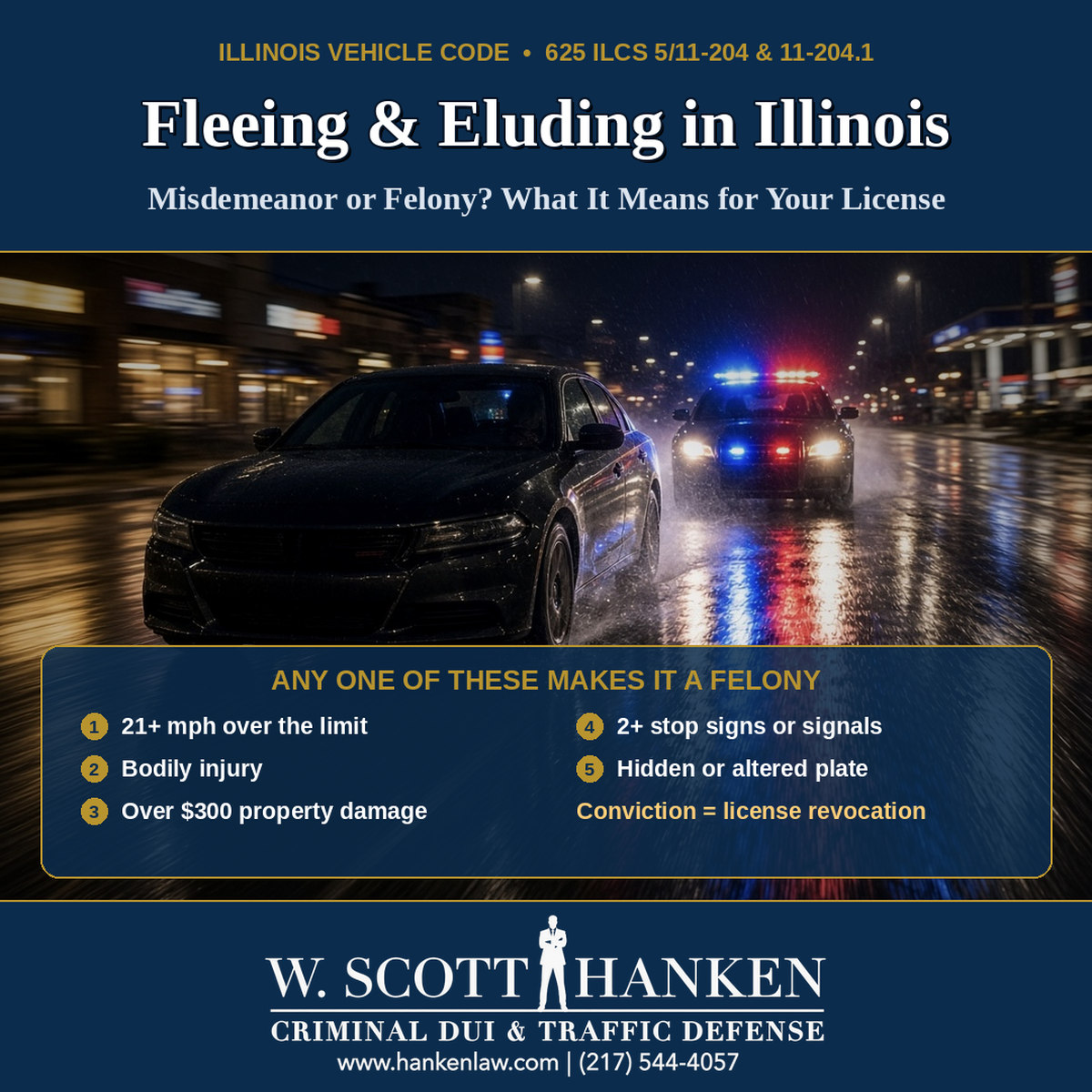
In Illinois, fleeing or attempting to elude a peace officer is a Class A misdemeanor, and a conviction can suspend your license for up to six months. Aggravated fleeing is a felony, and a conviction requires the Secretary of State to revoke your license. Fleeing becomes aggravated if you flee at 21 mph or more over the limit, cause injury or more than $300 in property damage, disobey two or more traffic control devices, or hide or alter your plate.
Bottom Line: The difference between a misdemeanor and a felony here often comes down to a single fact, such as a second stop sign, a speedometer reading, or a dented mailbox. That same fact decides whether you face a fixed suspension or an open-ended revocation that you can only undo through a Secretary of State hearing. The outcome of your case matters as much for your driving privileges as it does for your record.
Quick Penalties Comparison
| Charge | Class | License Impact |
|---|---|---|
| Fleeing, 1st or 2nd offense | Class A misdemeanor | Suspension up to 6 months (1st) or 12 months (2nd) |
| Fleeing, 3rd or later | Class 4 felony | Revocation |
| Aggravated fleeing, 1st | Class 4 felony | Mandatory revocation |
| Aggravated fleeing, 2nd or later | Class 3 felony | Mandatory revocation |
What Is Fleeing and Eluding a Police Officer in Illinois?
Fleeing and eluding is willfully refusing to stop your vehicle after a uniformed officer signals you to pull over. Speeding up, turning off your lights, or otherwise trying to get away also counts.
The offense is defined in 625 ILCS 5/11-204 of the Illinois Vehicle Code. The officer can signal you by hand, by voice, with a siren, or with a red or blue light.
The officer must be in police uniform. If the officer is in a vehicle, it must display illuminated oscillating, rotating, or flashing red or blue lights that, together with a horn or siren, mark it as an official police vehicle. The section was last amended by Public Act 93-120, effective January 1, 2004.
Statute Callout — 625 ILCS 5/11-204 (summary)
- (a) A driver commits a Class A misdemeanor if they willfully fail or refuse to obey a uniformed officer’s visual or audible signal to stop, increase speed, turn off their lights, or otherwise flee or try to elude the officer.
- (b) After a conviction, the Secretary of State suspends the driver’s license for up to 6 months for a first conviction and up to 12 months for a second.
- (c) A third or later violation is a Class 4 felony.
- Source: ILGA.gov, P.A. 93-120, eff. 1-1-04.
What Does the State Have to Prove for a Fleeing Charge in Illinois?
The State must prove every element beyond a reasonable doubt. If it fails to prove any one of them, the case should end.
Under 625 ILCS 5/11-204(a), the elements are:
- You were the driver or operator of a motor vehicle.
- A peace officer gave you a visual or audible signal to stop.
- The officer was in police uniform. If the officer was driving, the squad car displayed illuminated red or blue emergency lights.
- You willfully failed or refused to obey, or you increased speed, turned off your lights, or otherwise fled or tried to elude the officer.
The uniform requirement is the element most often overlooked. In People v. Murdock, 321 Ill. App. 3d 175 (2d Dist. 2001), the Second District reversed an aggravated fleeing conviction outright. The record had no evidence that the pursuing officer was in uniform, even though his emergency lights and siren were on.
In People v. Williams, 2015 IL App (1st) 133582, the First District reversed an aggravated fleeing conviction because the officer who tried to stop the defendant was wearing civilian clothes, even though he was driving a marked squad car. In Springfield, this element matters whenever a stop starts with a plainclothes or specialty unit officer rather than a uniformed patrol officer.
Is Fleeing a Felony in Illinois? When Does It Become Aggravated Fleeing?
Fleeing becomes aggravated fleeing, a felony, when the flight meets any one of five conditions. One is enough.
625 ILCS 5/11-204.1(a) makes the offense aggravated if the flight or attempt to elude:
- is at a rate of speed at least 21 miles per hour over the legal speed limit;
- causes bodily injury to any individual;
- causes damage in excess of $300 to property;
- involves disobedience of 2 or more official traffic control devices; or
- involves the concealing or altering of the vehicle’s registration plate or digital registration plate.
Statute Callout — 625 ILCS 5/11-204.1 (summary)
- (a) Fleeing as defined in 11-204(a), combined with any of the five aggravating factors above, is aggravated fleeing.
- (b) A first violation is a Class 4 felony. A second or later violation is a Class 3 felony. A conviction at either level requires the Secretary of State to revoke the driver’s license.
- (c) The vehicle used is subject to seizure and forfeiture under Sections 36-1 and 36-2 of the Criminal Code of 2012.
- Source: ILGA.gov, P.A. 101-395, eff. 8-16-19.
Here is something most people miss. The speed threshold for aggravated fleeing is lower than the threshold for aggravated speeding.
Under 625 ILCS 5/11-601.5, driving 26 to 34 mph over the limit is a Class B misdemeanor, and 35 mph or more over is a Class A misdemeanor. Driving 22 mph over on its own is just a speeding ticket. Driving 22 mph over while police try to pull you over is a felony.
“Official traffic control devices” includes stop signs and traffic signals. So rolling through two stop signs in a residential neighborhood off MacArthur Boulevard can carry the same felony charge as a high-speed chase on I-55. For more on how speed alone is charged, see our post on Illinois work zone speeding penalties.
What Are the Penalties for Fleeing and Aggravated Fleeing in Illinois?
The penalties range from up to 364 days in jail for a first misdemeanor to as much as five years in prison for a repeat aggravated offense, or up to 10 years if the court imposes an extended term. Every level carries license consequences.
The sentencing ranges come from the Unified Code of Corrections: Class A misdemeanors in 730 ILCS 5/5-4.5-55, Class 4 felonies in 5-4.5-45, and Class 3 felonies in 5-4.5-40. The license consequences come from the fleeing statutes themselves and from 625 ILCS 5/6-205.
| Offense | Class | Jail / Prison | Probation | Max Fine | License Consequence |
|---|---|---|---|---|---|
| Fleeing, 1st offense | Class A misdemeanor | Up to 364 days | Up to 2 years | $2,500 | Suspension up to 6 months (on conviction) |
| Fleeing, 2nd offense | Class A misdemeanor | Up to 364 days | Up to 2 years | $2,500 | Suspension up to 12 months (on conviction) |
| Fleeing, 3rd or later | Class 4 felony | 1 to 3 years (extended 3 to 6) | Up to 30 months | $25,000 | Revocation (felony involving a motor vehicle) |
| Aggravated fleeing, 1st | Class 4 felony | 1 to 3 years (extended 3 to 6) | Up to 30 months | $25,000 | Mandatory revocation; vehicle forfeiture |
| Aggravated fleeing, 2nd or later | Class 3 felony | 2 to 5 years (extended 5 to 10) | Up to 30 months | $25,000 | Mandatory revocation; vehicle forfeiture |
Probation is available for both felony levels. A felony conviction does not disappear when the sentence ends, though. Under 20 ILCS 2630/5.2, most felony convictions become eligible for a sealing petition three years after the sentence ends. Sealing your criminal record does not lift a license revocation. The revocation stays in place until the Secretary of State reinstates you.
How Does a Fleeing Case Affect My Driver’s License?
It depends on how the case ends. The disposition you accept in the Sangamon County Circuit Court decides whether you face no driving consequence, a fixed suspension, or a revocation.
The trigger is the word “conviction.” Section 11-204(b) suspends a license only “upon receiving notice of such conviction.” Section 11-204.1(b) and 6-205(a)(11) require revocation upon conviction for aggravated fleeing.
That makes the type of disposition the most important driving-privilege question in the case.
Disposition and License Impact at a Glance
| Disposition | Is It a Conviction? | Driving Consequence |
|---|---|---|
| Dismissal or not guilty | No | None from this charge |
| Court supervision on misdemeanor fleeing | No (if completed) | No 11-204(b) suspension |
| Conviction for misdemeanor fleeing, 1st | Yes | Suspension up to 6 months |
| Conviction for misdemeanor fleeing, 2nd | Yes | Suspension up to 12 months |
| Aggravated reduced to misdemeanor fleeing | Yes (misdemeanor) | Suspension, not revocation |
| Conviction for aggravated fleeing | Yes (felony) | Mandatory revocation |
| Conviction for 3rd fleeing (Class 4 felony) | Yes (felony) | Revocation under 6-205(a)(3) |
Can I Get Court Supervision for Fleeing in Illinois?
For the misdemeanor version, yes. For aggravated fleeing, no.
730 ILCS 5/5-6-1(c) bars supervision for any felony and for a short list of Class A misdemeanors, including resisting a peace officer under 720 ILCS 5/31-1. Section 11-204 is not on the list.
That means a first-offense misdemeanor fleeing charge is legally eligible for supervision. Successful supervision ends in dismissal rather than a conviction, so the six-month suspension in 11-204(b) never takes effect. Aggravated fleeing is a felony, so supervision is off the table unless the charge is first reduced.
Bills to bar supervision for fleeing have been introduced in past General Assemblies, for example HB 4235 in the 96th General Assembly. As of this review, 5-6-1 still does not exclude it.
What If My Fleeing Case Has Unusual Facts?
What if I didn’t pull over right away because I was looking for a safe place to stop?
If you were clearly cooperating, that is not fleeing. Slowing down and signaling while you look for a lit, safe spot is not the same as willfully refusing to stop.
The statute requires a willful failure or refusal to stop, or conduct such as increasing speed or turning off your lights. Picture a driver who turns on the hazard lights, slows down, and stops in a gas station lot a few hundred yards later. That driver has a strong argument that there was no willful refusal. Squad and body camera video is usually the best evidence, so it needs to be requested early in discovery.
What if the officer was in an unmarked car or plain clothes?
An officer in plain clothes can defeat the charge. An unmarked car, by itself, usually won’t. The statute requires the officer who signaled you to be in police uniform, and it requires a pursuing vehicle to display illuminated red or blue emergency lights. It does not require a marked squad car.
Murdock and Williams both turned on the uniform element. In Murdock, the record said nothing about what the officer was wearing, even though his lights and siren were on. In Williams, the officer was driving a marked police car but wore civilian clothes, and the conviction was still reversed. A street crimes or specialty unit officer in civilian clothes may not satisfy the statute even if you did drive away. The courts treat the uniform as something the State must prove with evidence, not something a judge can assume.
What if I wasn’t speeding much and nobody was hurt, but I ran two stop signs?
That is still aggravated fleeing. Under 11-204.1(a)(4), disobeying two or more official traffic control devices is enough by itself. There is no minimum speed and no injury requirement.
Defending these cases often comes down to the details: whether the signs were properly posted, whether the officer actually saw both, and whether the video matches the report.
What if I’m charged with aggravated fleeing but have a clean record?
A clean record does not change the felony classification, but it matters a great deal in negotiations.
Reducing the charge to misdemeanor fleeing turns a mandatory revocation into a suspension of no more than six months on a first conviction, and it may open the door to supervision. That is the difference between a hearing process measured in years and a suspension measured in months.
How Do I Get My License Back After a Fleeing Suspension?
Wait out the suspension period, clear any other holds, and pay the $70 reinstatement fee. No hearing is required for a suspension that runs out on its own.
The fee comes from 625 ILCS 5/6-118(b), which sets the reinstatement fee for an “other suspension” at $70. Before you drive again, confirm your status with the Secretary of State. Your driving privileges are not valid again until the fee is paid and the Secretary of State’s record shows you as eligible.
Keep your address current with the Secretary of State. In my 37+ years of practice, most of the driving while suspended or revoked cases I see involve people who were caught off guard at a traffic stop. They never updated their address with the Secretary of State, so the suspension notice never reached them or went unread. A fleeing suspension you don’t know about can quickly turn into a new charge under 625 ILCS 5/6-303.
How Do I Get My License Back After an Aggravated Fleeing Revocation?
A revocation does not simply expire. You must wait at least one year, win a Secretary of State administrative hearing, pay a $500 reinstatement fee, and file proof of insurance.
Here are the steps, in order.
Step 1: Wait out the minimum eligibility period. Under 625 ILCS 5/6-208(b), a person whose license was revoked may apply for a license after one year from the effective date of the revocation. Count from the effective date on the revocation notice, not from your plea date.
Step 2: Consider a restricted driving permit while you wait. Under 625 ILCS 5/6-205(c), the Secretary of State may issue a restricted driving permit (RDP) for work, medical care, school, treatment, or taking dependents to daycare. You must show undue hardship, no reasonable alternative transportation, and that you will not endanger public safety. A judge may recommend a permit, but the Secretary of State decides. A permit lasts no more than two years from issuance.
Step 3: Clear everything else on your record. Unpaid tickets, insurance suspensions, child support holds, or unresolved out-of-state matters will block reinstatement even if your hearing goes well. Pull your driving abstract first.
Step 4: Request the right type of hearing. The Secretary of State’s Department of Administrative Hearings holds two kinds. Informal hearings are walk-in hearings at certain Driver Services facilities, where a hearing officer sends a recommendation to Springfield.
Formal hearings must be requested in writing and are held only in Springfield, Chicago, Joliet, and Mount Vernon. At a formal hearing, an attorney for the Secretary of State presents the State’s side and can cross-examine you. For Sangamon County residents, the Springfield formal hearing office in the Howlett Building is close to home. Which type you qualify for depends on why your license was revoked and on your full driving history.
Step 5: Build your evidence. Section 6-208(b) bars the Secretary of State from issuing a license until you have had a hearing and the Secretary is satisfied that granting you driving privileges “will not endanger the public safety or welfare.” In practice, that means proof you completed your sentence, letters about your employment and character, a clean record since the offense, and an honest account of what happened. If alcohol or drugs were involved, expect questions about them and plan to address them.
Step 6: Wait for the written decision. Decisions are issued in writing from Springfield. The result can be full reinstatement, an RDP, or a denial. A denial is not the end. You can reapply, but you need to fix whatever the decision found lacking.
Step 7: Pay the fee, file the SR-22, and reapply. Once you’re approved, you pay the $500 revocation reinstatement fee under 625 ILCS 5/6-118(b). Under 625 ILCS 5/7-304, a revocation under 6-205 also requires you to file and keep proof of financial responsibility, commonly called an SR-22, for three years. If you don’t, the Secretary of State will suspend the registration of vehicles in your name. Because a revocation cancels your license entirely, you then apply for a new license under 625 ILCS 5/6-106, which may include testing.
Will Illinois Change the Fleeing Penalties?
Possibly. Several bills in the current 104th General Assembly would increase the penalties, but none has become law, and both statutes still carry the classifications described above.
SB 2377 would make misdemeanor fleeing a Class 4 felony and first-offense aggravated fleeing a Class 3 felony. It has sat in the Senate Assignments Committee since February 2025. SB 3090 would add higher felony classes when the flight injures a pursuing officer or a bystander. It was sent back to Assignments in March 2026. As of this review, the ILGA source notes still show P.A. 93-120 for 11-204 and P.A. 101-395 for 11-204.1. The penalty that applies to you is the one in effect on the date of the alleged offense.
Is Running From Police on Foot the Same as Fleeing and Eluding?
No. The fleeing statutes apply only to drivers and operators of motor vehicles. Running from an officer on foot is usually charged under 720 ILCS 5/31-1, resisting or obstructing a peace officer. That is a separate Class A misdemeanor, and it is not eligible for court supervision.
On May 27, 2026, the Illinois Supreme Court agreed to hear an appeal in People v. Carswell, 2026 IL App (1st) 231884 (No. 132938). The question is whether 31-1(d) adds an element the State must prove in resisting cases. Watch for that ruling. See our post on resisting or obstructing a peace officer in Illinois. Many fleeing cases also start with a stop that may not have been legal. See Can Police Stop You for Being in a High Crime Area?
Key Takeaways:
- Misdemeanor fleeing (625 ILCS 5/11-204) is a Class A misdemeanor. A first conviction carries up to 364 days in jail and a license suspension of up to 6 months.
- Aggravated fleeing (625 ILCS 5/11-204.1) is a Class 4 felony on a first offense and a Class 3 felony after that, with mandatory license revocation and possible vehicle forfeiture.
- The State must prove the officer who signaled you was in police uniform.
- Court supervision is legally available for misdemeanor fleeing, and it avoids the suspension that a conviction triggers.
- Getting your license back after a revocation means waiting at least one year, winning a Secretary of State hearing, paying a $500 fee, and filing an SR-22 for three years.
Frequently Asked Questions (FAQs)
Not always. A first or second fleeing offense is a Class A misdemeanor. A third or later fleeing offense is a Class 4 felony. Aggravated fleeing is a Class 4 felony on a first offense and a Class 3 felony after that.
A first misdemeanor fleeing conviction carries a suspension of up to six months, and a second carries up to 12 months. An aggravated fleeing conviction carries a revocation with no fixed end date. You can apply to get your license back only after one year, and you need a Secretary of State hearing.
Yes. The suspension in 11-204(b) is triggered by a conviction. Successfully completed supervision ends in a dismissal, not a conviction, so the suspension never applies.
Yes. Disobeying two or more official traffic control devices during the flight makes it aggravated fleeing under 11-204.1(a)(4). That is a Class 4 felony on a first offense, even with no high speed and no injury.
An unmarked car alone is not a defense if it displayed illuminated red or blue emergency lights. The bigger question is the officer’s clothing. The State must prove the officer who signaled you was in police uniform, and Illinois appellate courts have reversed fleeing convictions when that proof was missing.
They can try. Section 11-204.1(c) makes the vehicle subject to seizure and forfeiture under the Criminal Code’s forfeiture provisions. Owners who were not involved may have defenses, and forfeiture proceedings have deadlines that need attention right away.
You can apply for one. The Secretary of State may issue a restricted driving permit for work, medical, school, or childcare driving if you show undue hardship, no reasonable alternative transportation, and that you are not a danger to public safety.
One year from the effective date of the revocation, under 625 ILCS 5/6-208(b). Reinstatement still requires a Secretary of State hearing, a $500 fee, and an SR-22 filing.
The statute requires a willful refusal to stop after a visual or audible signal from a uniformed officer, and police vehicles must display illuminated red or blue lights. If the signal was unclear or the car could not be identified as a police vehicle, those facts go directly to the elements the State must prove.
No. Fleeing and eluding applies to drivers. Running on foot is usually charged as resisting or obstructing a peace officer under 720 ILCS 5/31-1, a Class A misdemeanor that is not eligible for court supervision.
The reinstatement fee is $70 after a suspension and $500 after a revocation, under 625 ILCS 5/6-118(b). A revocation also requires an SR-22 filing kept for three years.
It isn’t required, but a formal hearing is adversarial. An attorney for the Secretary of State can cross-examine you, and a denial costs you time. Preparation and documentation decide most of these hearings.
Further Reading
Practice Area
Related Articles
- Charged With Resisting or Obstructing a Peace Officer in Illinois? Here’s What the Law Actually Says — and What Just Changed — If you ran on foot instead of driving away, this is the charge you’re more likely facing.
- What to Do During a Traffic Stop in Illinois: A Step-by-Step Guide — How to pull over in a way that shows cooperation, so a delayed stop isn’t read as flight.
- Aggravated Speeding in an Illinois Work Zone: Penalties and Why Court Supervision Is Off the Table — How speed alone is charged when there’s no pursuit.
- Can Police Stop You for Being in a High Crime Area? — Many fleeing cases start with a stop that can be challenged.
- Can You Demand a Police Supervisor at an Illinois Traffic Stop? — Lawful options when a stop feels wrong, other than driving away.
Browse by Topic
Ready to Fight Your Traffic Case in Springfield?
Call W. Scott Hanken at (217) 544-4057 or contact us online for a free consultation. We serve clients throughout Springfield, Sangamon County, and Central Illinois.
About the Author: W. Scott Hanken, Attorney at Law
Scott Hanken is a Springfield, Illinois criminal defense attorney with over 37 years of experience, including service as a former Sangamon County prosecutor. He has been voted Best Attorney by the Illinois Times and State Journal-Register, holds an Avvo 10.0 “Superb” rating, and has earned over 270 five-star Google reviews. He serves clients throughout Sangamon County and Central Illinois.
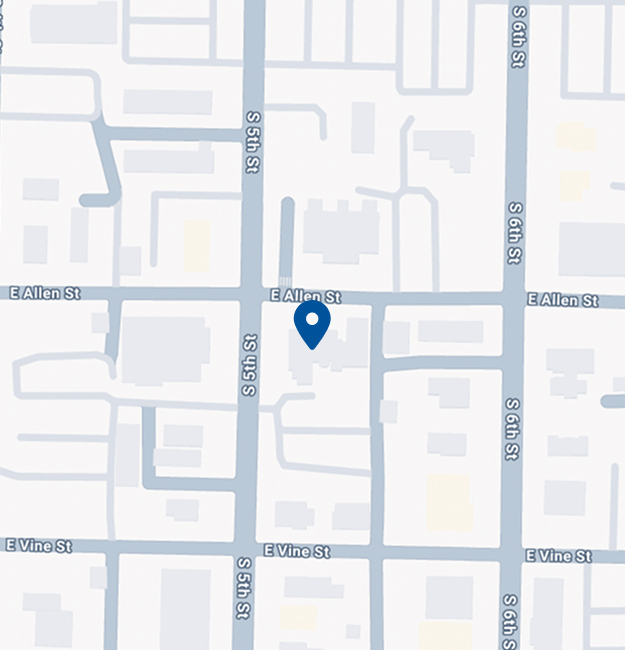
📍 1100 S 5th St, Springfield, IL 62703 | ☎ (217) 544-4057 | 🌐 hankenlaw.com
This article is for general educational purposes only and does not constitute legal advice. Every case is unique — contact an experienced Springfield criminal defense attorney for guidance on your specific situation.
Address
Our offices are located at the corner of South Fifth Street and Vine, in the historic Mary Bryant Home for the Blind.